The Amazon Is Growing a Climate It Has Never Seen Before
Researchers have identified a precise soil-moisture threshold below which Amazon trees don't just wilt — they suffer fatal internal embolisms, and climate models suggest those conditions could persist for five months a year by 2100.
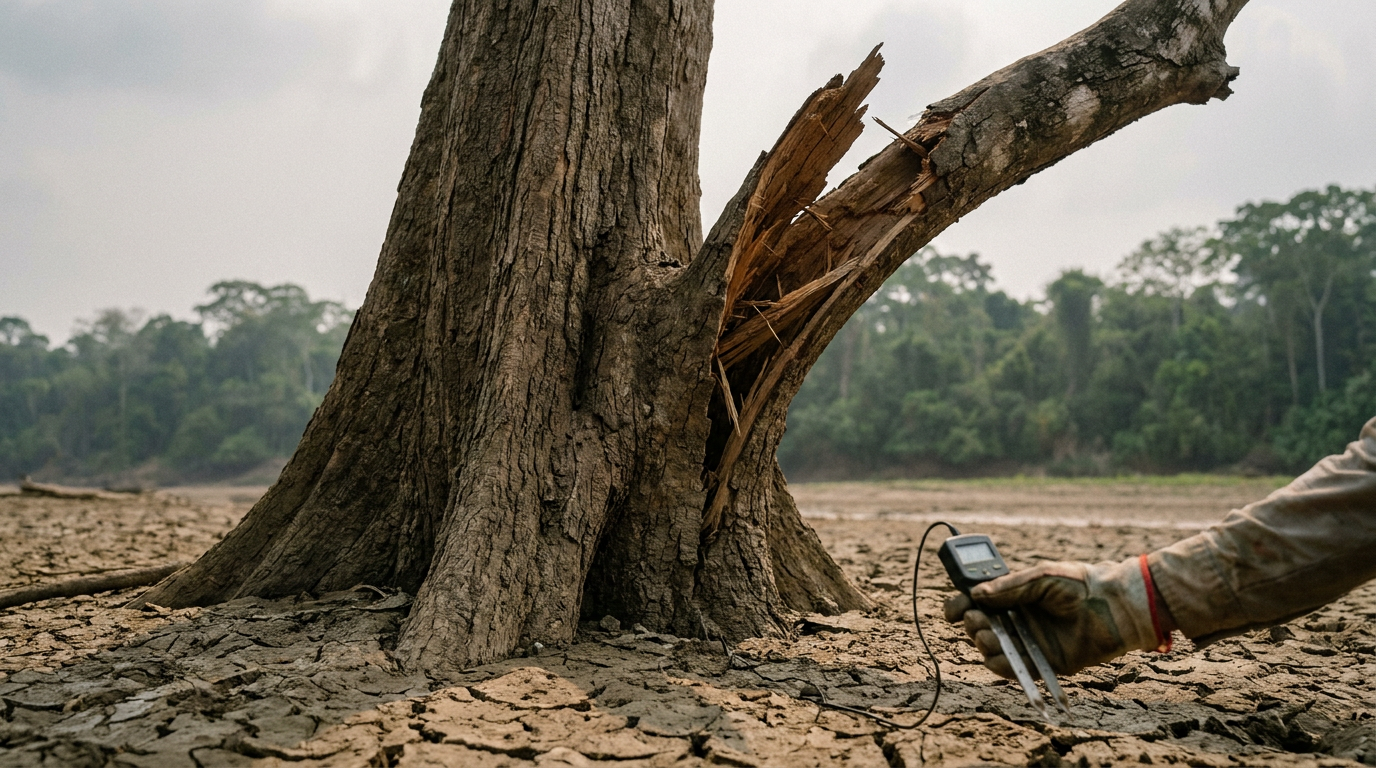
Stand in the Amazon basin on a normal wet-season morning and the air feels engineered by the forest itself. The canopy exhales moisture so reliably that researchers sometimes call it a biotic pump[4] — trees pulling groundwater upward through their root systems, releasing it through their leaves, seeding clouds that return rain to the same basin that made them. The forest is not simply living inside a climate. In a measurable, physical sense, it is making one. That feedback loop has sustained the Amazon through ice ages, through millions of years of continental drift and atmospheric shift, through every kind of slow geological pressure the Earth has applied. It has not sustained the Amazon through what is coming.
A study published in Nature[2] has used paleoclimate records, atmospheric modeling, and forest hydraulics to describe what that coming climate actually looks like — and the description is strange enough to stop you. The researchers found that the Amazon is tracking toward a thermal and moisture regime with no analog in the last 65 million years. Not warmer-than-usual. Not drier-than-normal. Something outside the range of conditions this particular biome has ever metabolized. The paper uses the term "hypertropical" to describe it, a word that functions less as technical jargon than as a flag planted at the edge of known territory.
The mechanism the study identifies is not gradual deterioration. It is a threshold — a specific point at which soil moisture drops far enough that the trees' internal water-transport systems begin to fail in a way that is not recovery-compatible. Below that threshold, trees do not simply slow their growth or shed leaves to conserve resources. They develop hydraulic embolisms: air bubbles forming in the xylem, the vascular tissue that pulls water from root to canopy. The system that keeps a tree alive is also, when it runs dry and then cavitates, the system that kills it. Death is not slow dehydration. It is structural failure, moving upward from root to crown.
What the climate projections add to that biological picture is a timeline and a duration. Under high-emissions scenarios, conditions capable of triggering widespread embolism events could persist across significant portions of the Amazon for roughly 150 days per year by 2100. That is not a drought. That is nearly half the year spent on the wrong side of a biological threshold that the trees of this forest have, in any evolutionary sense, never encountered before.
How a Forest Loses Its Weather
The Amazon's relationship with its own rainfall is not incidental. The basin generates a substantial portion of its own precipitation through evapotranspiration — the combined process of water evaporating from soil and transpiring through leaf surfaces into the atmosphere. Some estimates suggest that more than half the rainfall in certain parts of the Amazon is water the forest has already cycled through itself at least once. The canopy is not a passive recipient of climate conditions. It is an active participant in producing them. This is why forest cover loss matters climatically in ways that go beyond carbon accounting: when you remove trees, you reduce the moisture flux, which reduces rainfall, which stresses the remaining trees, which reduces their transpiration, which reduces rainfall further. The feedback runs in both directions, and right now it is running toward dryness.
The eastern and southern Amazon have already been showing signs of this shift for years. Dry season length has extended measurably across parts of the basin. Rainfall deficits during drought years — 2005, 2010, 2015-16 — have exceeded anything in the instrumental record, and each event has left behind evidence of canopy stress, increased tree mortality, and slowed carbon uptake. The forest has recovered from each of those events, partly. But recovery is not the same as resilience. A system can bounce back from stress while still accumulating damage — structural, biological, hydrological — that makes the next stress event harder to absorb. What the Nature study does is identify the point at which recovery stops being an option.
“The forest is not simply living inside a climate — in a measurable, physical sense, it is making one.”
The Hydraulics of a Dying Tree
Tree hydraulics is a field that does not get enough general attention given how much it determines about forest survival under climate stress. Water moves through a tree under negative pressure — the canopy's transpiration creates a tension that pulls water upward from the roots against gravity, through microscopic tubes in the xylem, sometimes dozens of meters. The system works because water under tension remains cohesive; it behaves almost like a continuous column. But that cohesion has limits. When soil moisture drops severely and the tree cannot replace the water it is losing to the air, the tension in the xylem increases until it exceeds the water's ability to stay liquid under those conditions. Cavitation happens: a bubble of water vapor or air forms in the tube, breaking the column. The tube fails. If enough tubes fail, the pathway from root to leaf is severed, and no amount of subsequent rain can reopen those pathways quickly enough to save the tissue they served.
Different tree species have different hydraulic safety margins[1] — the distance between their normal operating tension and the point at which cavitation becomes lethal. Researchers working on tropical forest hydraulics have found that many Amazonian species operate surprisingly close to their thresholds even under normal dry-season conditions. The trees are already running lean. They have evolved to exploit the moisture that the forest's own rainfall recycling provides, which means they have not been under selection pressure to maintain wide hydraulic safety margins against conditions the forest itself has historically prevented. The hypertropical scenario described in the Nature study would place those species, not occasionally and temporarily, but persistently, on the wrong side of a margin they were never built to survive.
A Climate With No Living Memory
The paleoclimate component of the research matters because it establishes what "unprecedented" actually means in a geological context. The researchers examined proxy records — isotopic signatures in ancient sediments, pollen records, fossil plant assemblages — to reconstruct the climate conditions the Amazon basin has experienced across tens of millions of years. Even during periods of elevated global temperatures, such as the Paleocene-Eocene Thermal Maximum around 56 million years ago, the Amazon's temperature-moisture balance remained within a range that the basin's vegetation could track through adaptation and species turnover. The forest changed during those periods, sometimes substantially. But it maintained function. It kept making rain.
The hypertropical regime the study projects does not have a match in that record. The combination of high temperatures — which increase atmospheric demand for moisture and accelerate evapotranspiration from both soil and leaf — with the soil moisture deficits driven by erratic rainfall and longer dry seasons produces a climate state that the proxy record simply does not show the Amazon having survived, or even occupied. This is not a claim that the Amazon will definitely collapse by a certain date. It is a claim about what kind of problem this is: not a stress event the system can be expected to absorb, but a transition into conditions it has no biological or ecological memory of navigating.
“The trees have evolved to exploit the moisture the forest's own rainfall recycling provides — which means they were never under selection pressure to survive conditions the forest itself has historically prevented.”
What 150 Days Means on the Ground
One hundred and fifty days is an abstraction until you think about what it means for the organisms that run on the Amazon's seasonal timing. The basin's biodiversity — among the most concentrated on Earth, with tens of thousands of plant species and extraordinary densities of invertebrates, amphibians, birds, and mammals — is organized around phenological cues that are themselves organized around the wet and dry season cycle. Fruit production, flowering, breeding, migration, larval emergence: all of it is timed. When the dry season extends, it does not simply delay those events. It creates mismatches between resources and the species that depend on them.
Fruiting trees in the Amazon have co-evolved with their dispersers over millions of years. A fig tree that drops fruit at a predictable point in the dry season has seed-dispersers — primates, large birds, tapirs — whose movement and behavior are synchronized to that timing. Extend the drought stress long enough that fruiting collapses across large tree populations, and you do not lose just the trees. You lose the nutritional foundation of every species in that web at the moment they are most energy-stressed. The concept of trophic cascade applies here with particular force: the Amazon's food web is so densely layered, so dependent on the forest's production cycle, that a multi-month disruption of tree physiology is not a canopy problem. It is a systemic failure that propagates outward into every guild.
And then there is the carbon. The Amazon basin stores an estimated 150 to 200 billion tons of carbon[3] in its biomass and soils. A forest under the kind of persistent hydraulic stress the study describes does not simply stop sequestering carbon. It begins releasing it — through tree death, decomposition, reduced photosynthesis, and the increased fire risk that accompanies extended dry conditions and stressed, dried-out vegetation. The Amazon transitioning from carbon sink to carbon source is not a new concern, but the mechanism the study describes — widespread embolism events as a regular seasonal feature rather than an episodic drought response — suggests a pathway toward that transition that is faster and less reversible than gradual warming alone would produce.
The Compounding That Changes the Odds
Climate stress and deforestation do not operate independently in the Amazon. They amplify each other through the same moisture-cycling feedback that makes the forest climatically self-sustaining under healthy conditions. Deforestation in the southern Amazon has already measurably reduced precipitation downwind. The cleared areas create hotter, drier surface conditions that can suppress convective rainfall formation. Smoke from agricultural fires during the dry season has been shown to interfere with cloud droplet formation, further suppressing rainfall in an already moisture-stressed landscape. What this means is that the hypertropical threshold is not simply a function of global emissions trajectories. It is also a function of what is happening to the forest's own cover — which is to say, it is partly a function of decisions that have immediate, local, political, and economic dimensions entirely distinct from the global carbon question.
Deforestation rates in the Brazilian Amazon have fluctuated sharply with political conditions, dropping significantly in the mid-2000s under strong enforcement, then climbing again, then dropping once more under recent policy shifts. The forest that exists today is already a fragmented version of what existed fifty years ago, with large sections of the southern and eastern basin reduced to degraded scrub, agricultural land, and forest edges too exposed to survive dry spells that the interior once buffered. The areas most vulnerable to the hydraulic threshold the study identifies are, not coincidentally, the areas already most compromised by land-use pressure. The forest will not face hypertropical conditions with its full biological depth intact. It will face them already thinned.
“The hypertropical threshold is not simply a function of global emissions trajectories — it is also a function of what is happening to the forest's own cover.”
There is something clarifying about research that locates a threshold rather than a gradient. Gradients invite the comfortable assumption that things will change slowly enough for adaptation to track the change, that species will shift their ranges, that ecosystems will reorganize rather than collapse, that time is the variable we can work with. Thresholds make a different kind of argument. They say that the system is fine, and then it is not, and the line between those states is a particular combination of temperature and soil moisture and duration that the forest's own hydraulic biology has drawn without asking for our input. The Amazon has been building its climate for longer than our species has existed. The question the study actually poses is whether we have already decided, through accumulated emissions and accumulated deforestation, that we are going to find out what happens when a forest meets a climate it has no experience of surviving.
References
- Basin-wide variation in tree hydraulic safety margins predicts the carbon balance of Amazon forests (nature.com)
Supplies pan-Amazon hydraulic safety margin data showing Amazonian tree species operate close to cavitation thresholds even under normal dry-season conditions. - Hot droughts in the Amazon provide a window to a future hypertropical climate (doi.org)
Core Nature study establishing the hypertropical climate threshold, hydraulic embolism mechanism, and projection that embolism-triggering conditions could persist 150 days yearly by 2100. - Land-use and climate change risks in the Amazon and the need of a novel sustainable development paradigm (pnas.org)
Provides the carbon storage estimate of 150 to 200 billion tons cited in the article's discussion of Amazon carbon stakes. - Evapotranspiration in the Amazon: spatial patterns, seasonality, and recent trends in observations, reanalysis, and climate models (hess.copernicus.org)
Provides research foundation for the article's concept of the Amazon's 'biotic pump'—trees recycling moisture through evapotranspiration to generate rainfall.
About Sable Pike
Sable Pike writes about habitat loss, ecosystem strain, species decline, climate disruption, and the quiet unraveling of natural systems people once assumed were permanent — and the way that unraveling reaches into economies, politics, and daily life. Her work brings emotional weight to ecological change without sacrificing scientific rigor.
More like this
The Amazon Makes Its Own Rain. Deforestation Is Breaking That.
The Amazon recycles its own rainfall through vast airborne moisture corridors — and new data shows that eastern deforestation is already strangling the forests furthest downstream.
The Amazon Has a Specific Temperature Limit. Scientists Just Found It.
A new study puts a precise number on the Amazon's tipping point — and what happens just past it rewrites what we thought we knew about rainforest resilience.
The Forest Still Looks Green. That's the Problem.
Research on Southwest US woodlands reveals that trees can lose the hydraulic and carbon reserves that keep them alive long before their canopy shows a single yellow leaf — meaning the forests we think we're watching die may already be past saving.