Critical Transition
The moment a system crosses a threshold where feedback loops cause it to stop scaling with pressure, leading to a sudden, irreversible shift like rapid drying turning into extreme wildfires.
Not to be confused with: Tipping Point
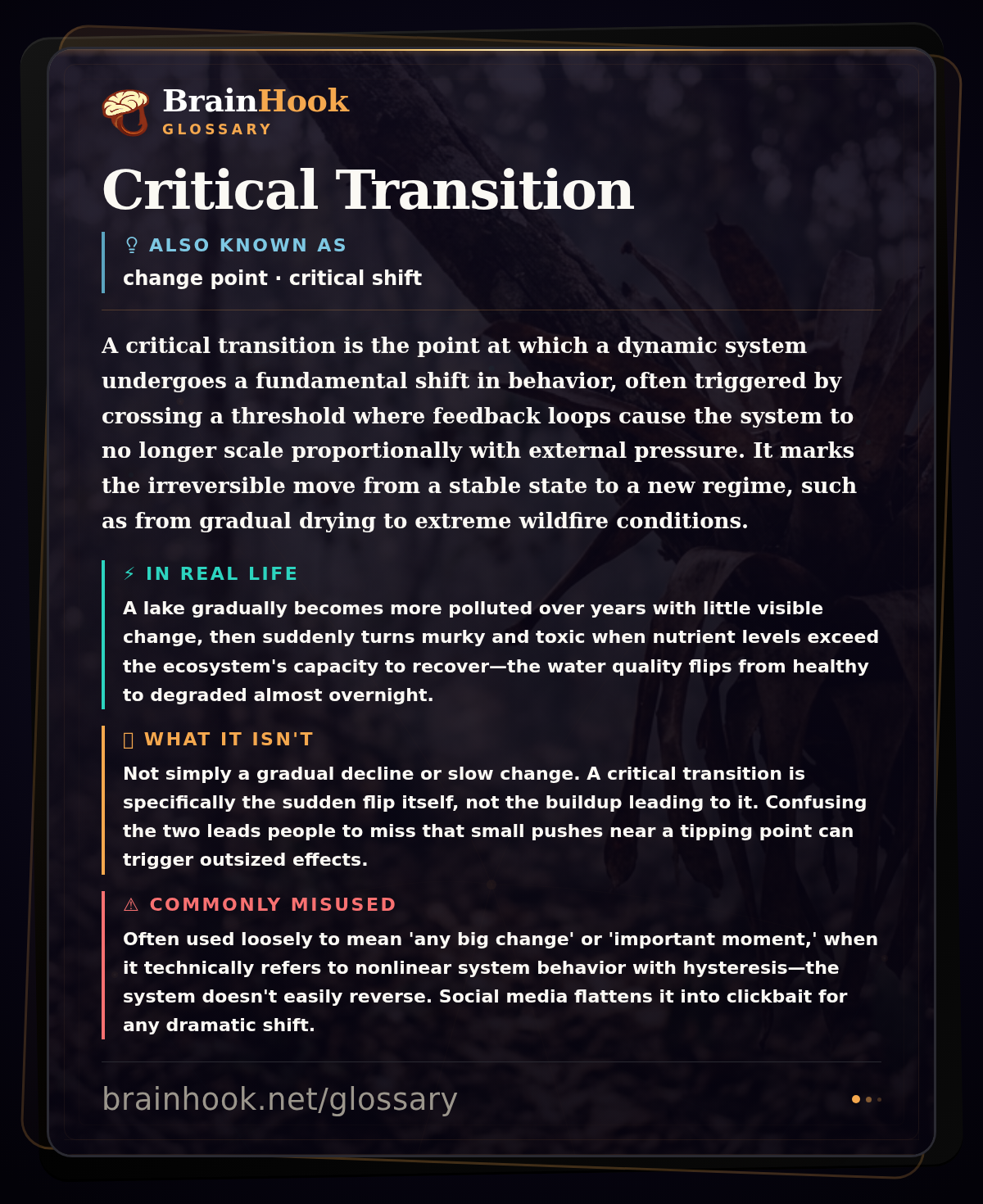
A critical transition is the point at which a dynamic system undergoes a fundamental shift in behavior, often triggered by crossing a threshold where feedback loops cause the system to no longer scale proportionally with external pressure. It marks the irreversible move from a stable state to a new regime, such as from gradual drying to extreme wildfire conditions.
What this means in real life
A lake gradually becomes more polluted over years with little visible change, then suddenly turns murky and toxic when nutrient levels exceed the ecosystem's capacity to recover—the water quality flips from healthy to degraded almost overnight.
What it isn’t
Not simply a gradual decline or slow change. A critical transition is specifically the sudden flip itself, not the buildup leading to it. Confusing the two leads people to miss that small pushes near a tipping point can trigger outsized effects.
Commonly misused online
Often used loosely to mean 'any big change' or 'important moment,' when it technically refers to nonlinear system behavior with hysteresis—the system doesn't easily reverse. Social media flattens it into clickbait for any dramatic shift.
Based on 1 reference source, including primary sources. Last verified July 12, 2026.