The 700-Meter Asteroid That Hid Inside Venus's Orbit for Who Knows How Long
Asteroid 2025 SC79 wasn't hiding cleverly — it was hiding in the one patch of sky we structurally cannot watch, and it took a two-image twilight window to prove it was there at all.
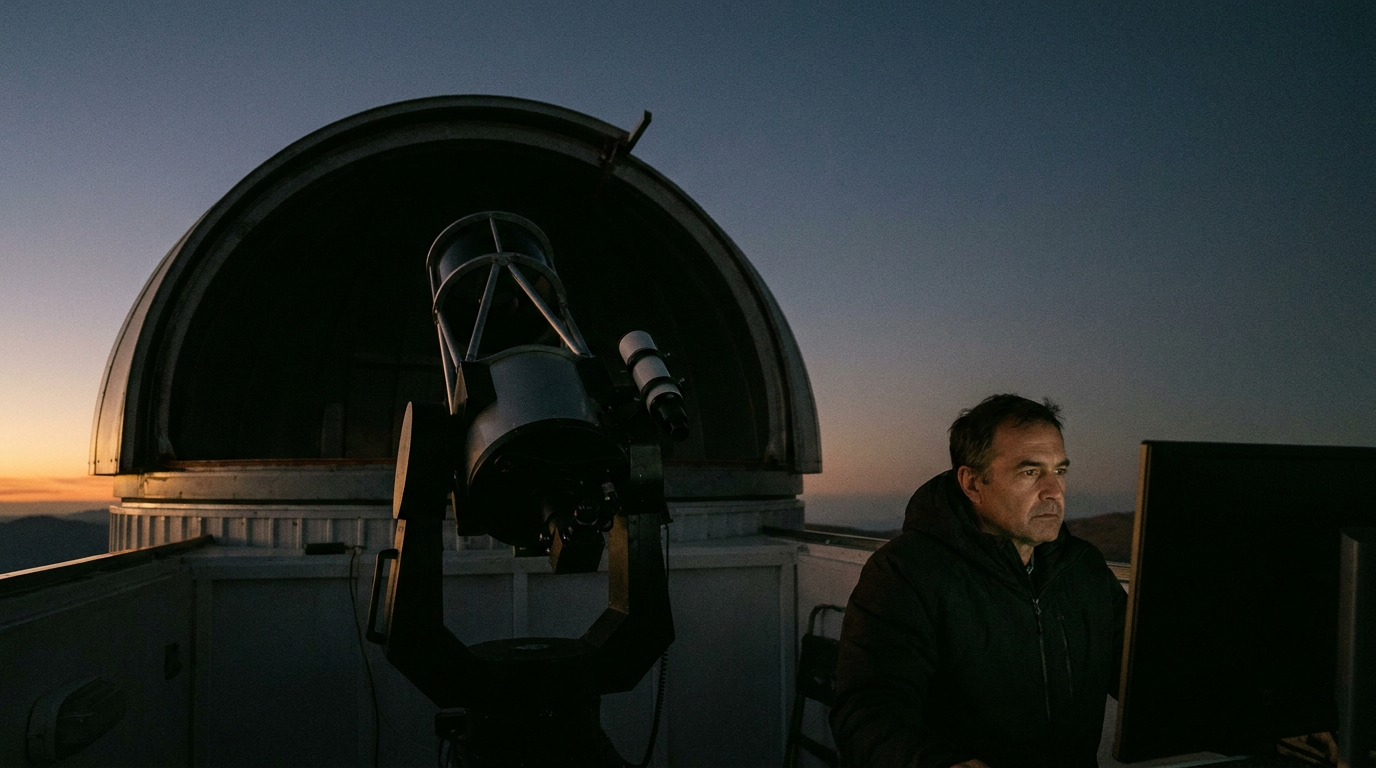
On the evening of a routine survey run, Carnegie Science astronomer Scott Sheppard[3] captured two images through a narrow window of usable sky — a strip of twilight between the horizon and the Sun's glare, lasting only minutes before the geometry closed. Inside those two frames was something that should not have been easy to miss: a roughly 700-meter asteroid orbiting entirely within the orbit of Venus, looping around the Sun every 128 days, moving fast enough to lap Earth twice a year. It had no name yet. It had almost certainly been there for a very long time. We had simply never looked at quite that patch of sky at quite that time of evening in quite the right way to catch it.
The asteroid is now designated 2025 SC79. By size alone, it is not trivial. Seven hundred meters is roughly the height of two Empire State Buildings stacked end to end. An object of that mass, on an Earth-crossing trajectory, would be a civilization-altering event. It is not currently on such a trajectory — let's be precise about that — but its orbit does cross Earth's path on paper, which puts it in a category astronomers classify as potentially hazardous. That classification is not a warning. It is a bookkeeping category. What it does demand, however, is monitoring. And monitoring requires that you can actually see the thing.
The discovery was made possible by a specific telescopic technique developed to probe the inner solar system during twilight: the narrow observational windows just after sunset or just before sunrise when an object like 2025 SC79 swings out far enough from the Sun's direction to become, briefly, detectable. Strip that window away — through bad weather, scheduling conflicts, or simply the absence of a dedicated program — and this object goes undetected. It had been going undetected. For how long is not precisely known, but the orbital dynamics suggest it has been resident inside Venus's orbit for a very long time. Possibly since the early solar system arranged itself. Possibly through every major extinction event on Earth, every empire, every century of human stargazing, every generation of telescopes. Just sitting there.
That is not a triumphant story about the power of modern astronomy, although it is sometimes being framed as one. It is a story about a structural gap in our ability to observe the inner solar system — a gap that a single researcher with a dedicated program and some careful timing just barely managed to partially illuminate. The question worth sitting with is not how we found 2025 SC79. It is how many we have not.
The Sun's Blind Spot Is Not a Metaphor
Every major asteroid survey currently operating is pointed outward. Pan-STARRS, the Catalina Sky Survey, the upcoming Rubin Observatory — these systems are designed and optimized to catch near-Earth objects coming at us from the outer solar system, from the direction of dark sky, where telescopes function the way they are supposed to. They are very good at this. They have found hundreds of thousands of objects. But they share a common geometric limitation that is not a design flaw so much as a physical reality: you cannot point a telescope at the sky near the Sun during the day, and at night, objects orbiting well inside Earth's orbit — inside Venus's orbit especially — spend most of their time in directions too close to the Sun to observe at all.
Asteroids in this class are called Atiras, named for the first confirmed member. They orbit entirely within Earth's orbit, which means they are perpetually near the Sun from our line of sight. Some Atiras swing wide enough to be spotted in twilight occasionally. Others, hugging tighter orbits, may spend years or decades without ever presenting a clean observational window from Earth's surface. 2025 SC79, with a semi-major axis tucked even inside Venus, is an especially deep example. Its observational window is not just narrow — it is structurally constrained in a way that makes sustained tracking genuinely difficult. A few twilight images are enough to establish that it exists and to reconstruct an approximate orbit. They are not enough to know it well.
“The Sun's blind spot is not a gap in our attention. It is a gap in the geometry, and geometry does not care how good your telescope is.”
Space-based observatories partially address this. NASA's NEOWISE mission observed in infrared and catalogued many near-Earth objects, including some inner-solar-system residents, though its operational life has ended. The proposed NEO Surveyor mission, currently in development, is designed to observe from a vantage point closer to the Sun's direction and could substantially improve inner-solar-system coverage. But these programs are funded incrementally, launched on schedules measured in years and decades, and cannot retroactively tell us what was orbiting in the dark while we waited. The catalog we have reflects the sky we have been able to watch, not the sky that exists.
What 128 Days Around the Sun Actually Means
An orbital period of 128 days is fast by solar system standards. Mercury, the innermost planet, takes 88 days. Venus takes 225. 2025 SC79 sits between them in distance and speed, completing more than two and a half orbits for every one Earth completes. At its closest approach to the Sun — its perihelion — it likely swings inside Mercury's orbit. At its farthest — aphelion — it reaches toward Venus. This elongated path, technically classified as an Apollo-type orbit because it crosses Earth's orbital distance even if it rarely approaches Earth itself, is what earns the potentially hazardous designation.
Orbital mechanics, accumulated over long timescales, are not entirely predictable. Gravitational nudges from the inner planets, especially Venus and Mercury, can shift an asteroid's path across centuries. An orbit that crosses Earth's distance today may not have done so a hundred thousand years ago, and may not do so in another hundred thousand. Conversely, a currently benign trajectory can drift toward something less comfortable. This is why the planetary defense community wants to know about objects like 2025 SC79 as early as possible — not because the near-term risk assessment is alarming, but because orbital prediction accuracy degrades steeply without long observation arcs, and long observation arcs require that you first know the object exists.
Two images taken during a twilight window is a beginning. It establishes existence and provides a rough orbital solution. But the uncertainty bounds on a two-image arc are wide. Getting a tighter orbital solution requires repeated observation, ideally across multiple apparitions — multiple windows where the object is detectable from Earth. For an Atira like 2025 SC79, those apparitions may be separated by months and may offer only minutes of useful observation each time. This is not a crisis, but it is a real operational constraint, and it is worth being honest about. We know this thing is there. We do not yet know it as well as its size probably warrants.
How Many Are We Missing
“Completeness estimates for the Atira population remain rough precisely because the geometry that hides them also prevents the surveys needed to measure how many there are.”
Planetary scientists have attempted to model the expected population of inner-solar-system asteroids using what they know about the broader near-Earth object distribution, combined with dynamical simulations of how objects migrate from the main belt inward over geological time. These models suggest the Atira class is relatively small compared to the outer near-Earth populations — but small is a relative word when the objects in question are potentially hundreds of meters across. The models also carry significant uncertainty because the observational data used to calibrate them is necessarily incomplete. Completeness estimates for the Atira population remain rough precisely because the geometry that hides them also prevents the surveys needed to measure how many there are.
What we can say is that the current known Atira catalog is sparse. At the time of 2025 SC79's discovery, fewer than two dozen confirmed Atiras were known, with most of those discovered in the past decade as dedicated twilight survey programs have expanded. That number is almost certainly not representative of the true population. It reflects the limits of what we have been able to observe. Objects at 700 meters should, in principle, be bright enough to detect under favorable conditions — which means the likeliest explanation for not having found them sooner is simply that the favorable conditions almost never occur, and when they do, they last a few minutes.
Scott Sheppard's program at Carnegie Science, which uses the Dark Energy Camera on the 4-meter Blanco telescope at Cerro Tololo[2] in Chile, is one of the few dedicated efforts targeting this exact problem. The strategy is deliberate: observe during twilight, in the direction of the inner solar system, as frequently as conditions allow, and accept that each session will yield narrow windows and modest photon counts. It is painstaking work with a high frustration-to-discovery ratio. The discovery of 2025 SC79 is evidence that the approach can work. It is also evidence that the approach needs to happen more often and with more resources, because each successful detection is also a reminder of how long that object had been sitting there undiscovered.
Planetary Defense Is Only as Good as the Catalog
In 2005, the United States Congress directed NASA to identify 90 percent of near-Earth objects larger than 140 meters by 2020. That deadline passed without the goal being met. Current estimates suggest we have found somewhere around 40 percent[4] of objects in that size range, with significant variation depending on which orbital families you are counting. The Atiras and inner-solar-system residents are among the worst-characterized populations. The congressional mandate was not wrong to set the goal. The problem is that reaching it requires more than good intentions and the continuation of existing programs.
The DART mission demonstrated in 2022 that we can meaningfully alter the trajectory of an asteroid if we need to — a real and important proof of concept. But DART works on a known target with years of lead time. The part of planetary defense that precedes deflection, the part where you find and track and understand the object well enough to make a decision, is where the catalog gap matters. An asteroid discovered in a two-image twilight window with a wide orbital uncertainty is not a target you can plan a deflection mission around. It needs to be observed for months or years first. Which is fine, as long as months or years are available. The assumption buried inside most planetary defense timelines is that we will have adequate warning. That assumption rests on having adequate catalogs.
The Twilight Survey Problem Is Solvable, But Not Automatically
“The DART mission proved we can move an asteroid. The discovery of 2025 SC79 is a reminder that before you can move one, you have to find it — and finding it requires watching a sky we have mostly agreed to leave dark.”
The observational challenge posed by inner-solar-system asteroids is real but not permanent. NEO Surveyor, if fully funded and launched on schedule, would operate from an orbit that gives it substantially better access to the sky near the Sun than any ground-based telescope can achieve. A space-based infrared observatory positioned near the L1 or L2 Lagrange points, or in a Venus-like orbit, would have persistent visibility over the inner solar system that Earth-based twilight surveys can only approximate in brief windows. These are known solutions to a known problem. They are engineering challenges, not physics barriers.
The harder question is one of priority. Planetary defense funding is substantial compared to what it was twenty years ago, but it competes with every other demand on scientific and governmental budgets. The case for investing in inner-solar-system survey capability is straightforward: the objects are there, some of them are large, we are structurally blind to most of them, and the cost of a dedicated space-based survey is modest compared to the cost of responding to an undetected impactor. That case has been made repeatedly and convincingly by people who study this for a living. The catalog we have built is genuinely impressive. What 2025 SC79 illustrates is that the catalog we have built does not describe the solar system we actually live in.
A 700-meter asteroid orbiting inside Venus has presumably been right there through every century of human astronomy — through Galileo's first telescopic survey of the sky, through the systematic comet-hunts of the 18th century, through the photographic plate era, through the digital revolution in sky surveys. It was not hiding in any exotic or clever sense. It was simply in the part of the sky that every generation of astronomers had good structural reasons not to look at carefully. Scott Sheppard's two-image detection is genuinely significant. But the more significant fact is what it says about all the two-image detections we have not yet made, and the objects still circling, unremarked, in the Sun's long shadow.
References
- 51 USC Ch. 711: NEAR-EARTH OBJECTS (uscode.house.gov)
Establishes Congressional mandate for NASA to track near-Earth objects as a national threat, providing policy context for planetary defense efforts. - A Deep and Wide Twilight Survey for Asteroids Interior to Earth and Venus (doi.org)
- Fast Moving Asteroid Found Suns Glare (carnegiescience.edu)
Identifies Scott Sheppard as Carnegie Science astronomer who discovered asteroid 2025 SC79 using twilight observation techniques. - How NASA's Planetary Defense Budget Grew By More Than 4000% in 10… (planetary.org)
Provides the 40 percent completion figure for near-Earth object surveys that the article cites as context for detection gaps.
About Rowan Ellery
Rowan Ellery writes about anomalies, unexplained sightings, strange signals, and the uneasy border between observation, misinterpretation, and genuine mystery. Their work focuses on keeping curiosity alive without letting evidence dissolve into folklore.
More like this
We've Found Over 5,000 Exoplanets. Almost None of Them Are Like Earth.
The most common world in the galaxy sits in a size range our solar system completely skipped — and planetary scientists aren't sure whether that's physics or blind spot.
ESA Built a Machine That Creates Solar Eclipses on Demand
ESA's Proba-3 mission flies two spacecraft in lockstep formation to block the sun on demand — unlocking a continuous view of the solar corona that has defeated astronomers for a century.
The 1950s Sky Survey That Just Became a UAP Evidence Problem
Researchers combing declassified nuclear test records against Palomar Observatory's 1950s photographic sky survey found a statistical correlation that mundane explanations haven't fully absorbed yet.