Something Is Watching Earth's Orbit and We Put It There by Accident
Defunct satellites and rocket bodies now scatter enough light and radio energy to generate false detections in major sky surveys — and the field hasn't fully reckoned with what that means for anything we think we've found.
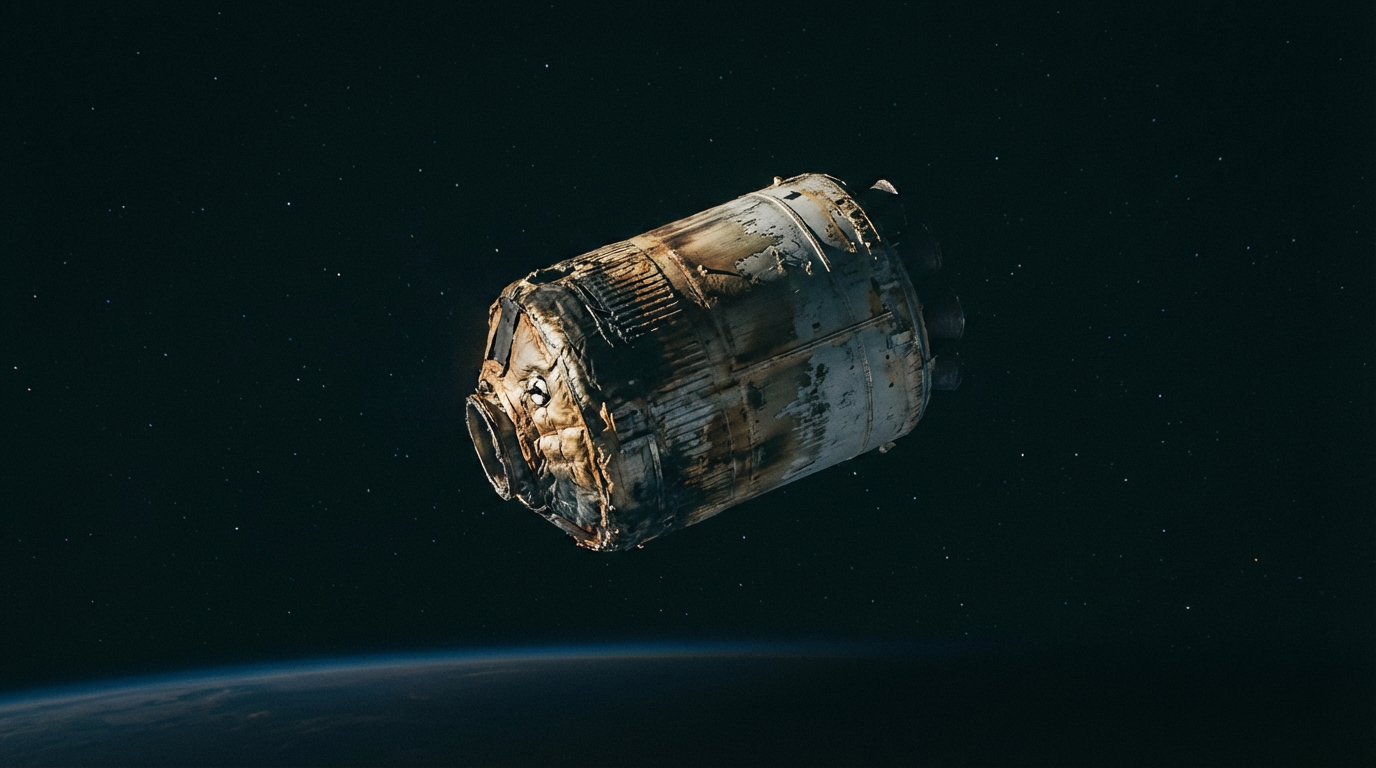
On a clear night in late 2020, a small automated sky survey flagged an object moving through its field of view at an unusual trajectory. The brightness profile was odd. The angular velocity didn't immediately match any known asteroid in the catalogue. For a few hours, before follow-up observations resolved the geometry, it sat in the queue marked as a candidate near-Earth object — something to watch, something unclassified, something potentially real. It was a rocket body. It had been up there for decades. The survey had simply never looked at that patch of sky at that angle, in that light, with that instrument, at that moment.
That kind of event happens more often than most astronomy coverage acknowledges. The number of defunct satellites, spent rocket stages, fragmentation clouds, and miscellaneous hardware orbiting Earth now runs into the tens of thousands of tracked objects, with estimates of untracked debris in the centimeter-and-smaller range reaching into the millions[1]. This population doesn't just threaten active spacecraft. It reflects sunlight. It scatters radio waves. It crosses telescope fields of view. And as ground-based sky surveys grow more sensitive — scanning wider areas, detecting fainter magnitudes, flagging transient signals at increasing speed — the contamination problem these objects generate is quietly becoming one of the most underreported classification headaches in observational astronomy.
The word contamination is doing precise work here. It doesn't mean the data is ruined or that astronomy is broken. It means that the sky surveys designed to find genuinely novel things — near-Earth asteroids, fast radio burst counterparts, optical transients, anomalous radio sources — are now operating inside an environment they didn't fully anticipate when their detection pipelines were designed. The shell of human hardware surrounding Earth has grown dense enough to become a persistent source of ambiguous signals. Some of those signals get correctly filtered. Some don't. And some sit in unresolved catalogues for months before anyone checks them twice.
This is not a story about aliens. It is a story about what happens when the instruments designed to listen for the genuinely strange can no longer cleanly separate the universe from the shell of junk we've wrapped around our own planet.
A Shell of Reflecting Hardware
The visual problem was the first to get serious attention. When SpaceX began launching Starlink constellation batches, astronomers tracking long-exposure images noticed bright streaks cutting through their frames — each one a satellite catching sunlight at the wrong moment. A single Starlink train passing through a wide-field exposure doesn't just leave a streak across one image. It can compromise multiple exposures in a sequence, corrupt the photometric calibration of nearby pixels, and force software pipelines to flag large sections of data as unreliable. For surveys like the Vera C. Rubin Observatory's Legacy Survey of Space and Time[2], which is designed to image the entire southern sky repeatedly and look for anything that changed, moved, or appeared where nothing was before, this is not a marginal annoyance. It is a structural problem embedded in the observing environment.
The brightness of individual satellites varies dramatically depending on their orientation, altitude, and surface material. A tumbling defunct satellite catches and releases sunlight in irregular pulses that can, at certain moments, resemble the brightness curve of a rotating asteroid or the fading afterglow of a transient event. Automated detection pipelines — which flag anything that appears, moves, or changes brightness in a way that doesn't match the stellar background — are not naturally equipped to distinguish between a slowly tumbling piece of Soviet-era hardware and a genuine near-Earth object making a close pass. The geometry that produces the detection is, at the moment of detection, often identical.
“The shell of human hardware surrounding Earth has grown dense enough to become a persistent source of ambiguous signals.”
The Radio Problem Is Quieter and Harder
The optical contamination is at least visible. The radio contamination is harder to isolate precisely because radio waves don't care about line of sight the same way photons do. Defunct satellites still carry electronic components. Those components can emit residual radio-frequency energy — not intentionally, not coherently, but detectably — as they tumble through temperature cycles that alternately stress and relax their circuitry. This phenomenon, sometimes called unintentional electromagnetic emission, is well documented in the radio frequency interference literature but has received less attention in the context of radio astronomical surveys that are looking for transient or anomalous signals.
Active satellites are already a massive source of radio frequency interference for ground-based radio telescopes. The mitigation strategies are real but imperfect: geographic isolation, shielding, frequency exclusion zones, and software flagging of known satellite frequencies. What those strategies are less equipped to handle is the irregular, broadband, and spatially distributed emission from dead hardware whose emission profile hasn't been catalogued because nobody was specifically listening for it when it was decommissioned. A spent rocket stage doesn't broadcast on a licensed frequency. It leaks, intermittently and unpredictably, as its residual charge dissipates or its materials respond to the thermal and electromagnetic environment of low Earth orbit.
Radio surveys hunting for fast radio bursts — extraordinarily brief, intensely energetic pulses of radio emission whose origins are still being mapped and debated — apply sophisticated detection algorithms that look for signals with specific dispersion characteristics. A genuine fast radio burst disperses as it travels through intergalactic plasma, arriving at lower frequencies slightly later than higher ones, and that dispersion measure is one of the key signatures used to classify a detection as real. But debris-generated radio interference can, under the right conditions, mimic partial dispersion signatures, especially when it interacts with the ionosphere or when the detection pipeline is working near its sensitivity threshold. Most of these cases get caught. The literature on radio frequency interference rejection is extensive and active. But caught is not the same as easily caught, and sensitivity thresholds are continuously being pushed lower as instruments improve.
What the Catalogues Don't Show You
“Caught is not the same as easily caught, and sensitivity thresholds are continuously being pushed lower as instruments improve.”
There's a layer of this problem that almost never surfaces in public-facing astronomy coverage, and it lives in the classification queues. Automated sky surveys generate enormous volumes of candidate detections — objects or signals that don't immediately match anything in the reference catalogue and get queued for follow-up. The vast majority of these are handled efficiently. Some resolve into known asteroids, some into variable stars, some into satellite streaks that the pipeline flagged correctly. What the public rarely sees is the fraction that sit unresolved longer than expected, either because follow-up resources are limited, because the object moved out of the accessible sky window before a second observation could be scheduled, or because the detection parameters were just unusual enough to resist quick categorization.
This is where the debris contamination problem becomes epistemically interesting rather than just operationally annoying. An unresolved candidate in a sky survey catalogue is not a mystery in the dramatic sense. It is usually a classification problem waiting for better data. But if the rate of debris-generated false or ambiguous candidates is rising as the orbital population grows — and it is rising, measurably, across surveys that have been tracking this — then the signal-to-noise ratio of the candidate queue degrades over time. Finding a genuinely anomalous object becomes harder not because the object is better hidden, but because the environment around it has become noisier.
The clearest example of this dynamic came with the recurring classification debates around interstellar object detections. When 'Oumuamua was detected in 2017, its trajectory and light curve produced intense discussion because several of its characteristics didn't fit neatly into existing models for comets or asteroids. Whatever 'Oumuamua was — and the debate over its nature continues — the tools used to identify it as interstellar depended on a reasonably clean background environment. As debris populations grow and the baseline rate of unusual-trajectory detections increases, the statistical threshold for flagging something as genuinely anomalous has to be recalibrated. You cannot determine that something is surprising without a reliable sense of what the ordinary looks like.
The Mitigation Gap
Astronomers are not ignoring this. There are active working groups within major survey collaborations focused specifically on satellite constellation interference, debris streak removal, and the development of machine learning classifiers trained to distinguish artificial from natural objects. The streak removal techniques have improved substantially in recent years. Satellite position databases, when they're accurate and current, allow pipelines to predict when and where known objects will cross a given field of view and mask those intervals in advance. The Rubin Observatory, for example, has been working on mitigation strategies since before first light, precisely because the problem was foreseeable and the survey's science goals are sensitive to it.
But mitigation has structural limits. The publicly available orbital catalogues — primarily maintained by the United States Space Surveillance Network[4] — track objects above roughly ten centimeters in size. Everything smaller is statistically estimated rather than individually tracked. That means a significant fraction of the debris population has no predictable position, no known trajectory, and no entry in the databases that sky survey pipelines use for cross-referencing. A tumbling fragment from a 1990s fragmentation event doesn't appear in the masking catalogue. It just appears in the image.
There's also a governance dimension that keeps the mitigation gap open. Satellite operators are not currently required, under any binding international framework, to consider ground-based astronomical observability as a design constraint. Brightness mitigation measures — like the sunshades SpaceX experimented with[3] on some Starlink units — have been explored but not universally applied or required. The radio interference landscape is regulated through the International Telecommunication Union, but those frameworks were built for active transmitters, not for the residual emissions of defunct hardware. The gap between what the science requires and what the regulatory environment currently enforces is real and widening as launch rates accelerate.
Why This Matters Past the Technical Annoyance
“You cannot determine that something is surprising without a reliable sense of what the ordinary looks like.”
The contamination problem is often framed as a nuisance — extra work for pipeline engineers, extra caution required for transient astronomers, extra columns in the false-positive log. That framing is accurate but incomplete. The deeper issue is that the sky surveys now coming online represent humanity's best near-term tools for detecting genuinely anomalous phenomena: objects with unusual trajectories, signals with unexpected characteristics, anything that doesn't fit the established map of the local universe. The value of those tools depends entirely on the reliability of the baseline against which detections are measured. If the baseline is increasingly contaminated by a population of human-made objects whose full properties are incompletely catalogued, the sensitivity of those tools to genuine anomalies is eroded in ways that are difficult to quantify from the outside.
This matters for asteroid detection, for transient astrophysics, for the search for interstellar objects, and yes, for UAP research — which has recently attempted to incorporate data from astronomical survey instruments as part of a more rigorous observational framework. Any serious effort to use sky survey data to characterize unidentified phenomena requires understanding what fraction of anomalous detections in those surveys are generated by the debris environment itself. That fraction is not negligible. It is probably not dominant. But it is not zero, and it is growing.
The strangest part of this situation is the recursion of it. Humanity built instruments to look outward, past itself, at a universe full of genuinely unknown phenomena. To do that, it put hardware in orbit — hardware that is now old, defunct, tumbling, and reflecting. And the signals from that hardware now fill some portion of the detection logs those outward-looking instruments generate. We are, in a quiet and unintentional way, watching ourselves — in every survey image with a streak through it, in every unresolved candidate that turns out to be a rocket body, in every radio detection that has to be laboriously separated from the electromagnetic afterlife of our own discarded machines. The noise floor of the universe, as measured from Earth, now includes us.
References
- ARES | Orbital Debris Program Office (orbitaldebris.jsc.nasa.gov)
Provides the estimate that untracked orbital debris in the centimeter-and-smaller range reaches into the millions. - Lsst Statement Regarding Increased Deployment Satellite Constellations (lsst.org)
Identifies the Vera C. Rubin Observatory's Legacy Survey of Space and Time as a wide-field sky survey vulnerable to satellite contamination. - SpaceX to test Starlink “sun visor” to reduce brightness (spacenews.com)
Documents SpaceX's experimental VisorSat brightness-reduction technology designed to address astronomer concerns about Starlink satellite interference with observations. - United States Space Surveillance Network (en.wikipedia.org)
Defines the U.S. Space Surveillance Network's role in detecting, tracking, and cataloging artificial orbital objects including satellites, rocket bodies, and debris.
About Rowan Ellery
Rowan Ellery writes about anomalies, unexplained sightings, strange signals, and the uneasy border between observation, misinterpretation, and genuine mystery. Their work focuses on keeping curiosity alive without letting evidence dissolve into folklore.
More like this
The Galileo Project Watched 80,000 Objects. 144 Broke the Rulebook.
The Galileo Project's first major sky survey didn't produce a smoking gun — it produced a data problem so precise it finally tells us what kind of evidence we actually need.
The Brightest Radio Flash Ever Detected Has a Silence Problem
For the first time, astronomers pinpointed a record-breaking fast radio burst to a region smaller than most star clusters — and what they found there quietly threatens the theory meant to explain all of them.
The FRB That Fired Once, Left a Partner Behind, and Broke the Rulebook
A fast radio burst caught inside a binary star system just overturned the leading explanation for what produces them — and the real problem is that the burst only fired once.