The Pentagon's New UAP Files Have a Sensor Problem No One Is Talking About
The May 2025 PURSUE disclosure is historic — but the cases that stayed unexplained share a quiet technical flaw that changes what 'unresolved' actually means.
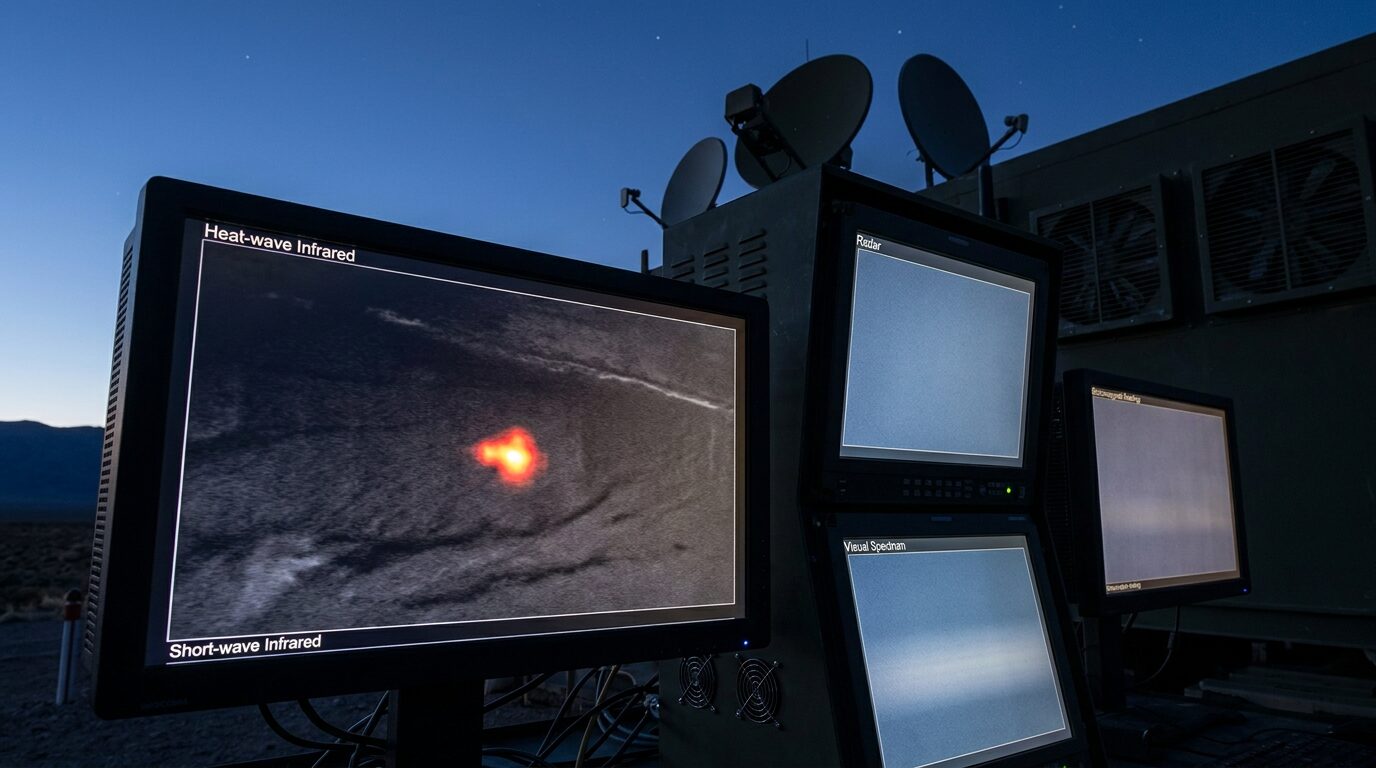
In May 2025, the Pentagon released 162 records under what it called the PURSUE initiative[1] — documents drawn from the Department of Defense, NASA, the FBI, and the State Department, representing the most multi-agency UAP disclosure the United States government has produced in a single release. The coverage was predictable: headlines about government transparency, arguments about what was and wasn't included, the usual negotiations between believers who felt vindicated and skeptics who felt underwhelmed. What most of that coverage missed was something quieter and considerably more interesting. If you read the unresolved cases carefully — not for smoking guns but for structural patterns — a specific technical signature keeps appearing. The objects that remained unexplained were, with striking regularity, the ones that only one instrument caught.
That is not a political observation. It is a sensor architecture observation, and it matters for reasons that have almost nothing to do with whether any of the objects in question were extraordinary. Classification in observational science — whether you are sorting astronomical signals, tracking atmospheric phenomena, or evaluating aircraft — depends on corroboration across detection modes. A visual return, an infrared signature, a radar track, an electromagnetic reading: the more independent channels capture the same object simultaneously, the more confident any classification can be. When only one channel fires, you have a detection, but you do not yet have a characterization. The PURSUE release, read through that lens, is less a revelation about UAPs specifically and more a revelation about how poorly configured the current detection ecosystem is for resolving what it flags.
The clearest single example of this problem is a sighting over Greece — the specific incident that Aviation Week reported on in its coverage of the PURSUE materials — in which the object was detected exclusively on short-wave infrared and absent from every other concurrent sensor mode. No radar return. No visible-light capture. No corroborating electromagnetic anomaly. Just a thermal signature in one narrow spectral band, tracked for a limited interval, then gone. Under normal analytical conditions, that is not the foundation for a confident classification in either direction. You cannot rule the object in as extraordinary, and you cannot rule it out as mundane, because the data you would need to do either simply was not captured. What you have is a genuine detection of something real — infrared does not hallucinate — and almost no information about what that something was.
The temptation, in discussions like this, is to read that information gap as a kind of dark invitation — a space where the most dramatic hypothesis can set up residence because nothing can evict it. That instinct is worth resisting. The Greece sighting is not a mystery because it was probably extraordinary. It is a mystery because the instrumentation was not designed to answer the question the detection raised. That is a different problem, and it has a different set of solutions.
What the PURSUE Release Actually Contains
The 162 records in the PURSUE release are not uniform. Some are thoroughly documented incidents with multi-sensor data, witness accounts from trained military or aviation personnel, and coherent follow-up analysis. A number of these have already moved toward tentative explanation — balloon drift, sensor artifact, atmospheric lensing, orbital debris on unusual trajectories. The cases that received explanations tended to be the ones with richer data sets. That correlation is not surprising, but it is significant. Resolution follows instrumentation. Where the instrumentation was layered and redundant, cases closed or at least narrowed. Where it was thin, cases stayed open.
The multi-agency nature of the release adds an important wrinkle. FBI and State Department records tend to involve different observational contexts than DoD and NASA materials — ground-based sightings near sensitive facilities, diplomatic incident reports, observations without specialized sensor platforms. When those records contain unresolved cases, the reasons for non-resolution are often administrative rather than physical: no instrument was positioned to capture the event in the first place, documentation was collected after the fact from human witnesses only, or the available data was flagged but never formally analyzed. These are significant failures of process, but they are not the same as the sensor-architecture problem that characterizes the more technically documented unresolved cases. Both matter. They just mean different things.
“Resolution follows instrumentation. Where the data was layered and redundant, cases closed. Where it was thin, cases stayed open.”
The Infrared Problem, Explained Without Hype
Short-wave infrared — SWIR, in sensor parlance — detects thermal radiation in a wavelength range roughly between 1,000 and 2,500 nanometers[4]. It is particularly useful for detecting heat-emitting objects against cooler backgrounds, which is why it features heavily in military surveillance platforms. An object that appears clearly on SWIR but leaves no trace in visible-light imaging could be operating at a thermal signature inconsistent with its visual profile — which might indicate something unusual about its surface temperature, its reflectivity, or its behavior in relation to ambient light. Or it could indicate a mundane object whose geometry and material properties simply made it harder to resolve optically at the relevant range and lighting conditions.
The Greece sighting sits in this interpretive gap. SWIR-only detection is not automatically anomalous. Certain natural atmospheric phenomena — ice crystal formations at altitude, particulate concentrations with unusual thermal properties, even some classes of plasma phenomena associated with thunderstorm activity — can produce detectable infrared signatures without prominent visible-light returns. Military and research platforms operating in that region of the spectrum exist, and their signatures are not always publicly catalogued. The honest answer to what the Greece object was is that the available data does not support a confident answer. What it does support is a pointed question about why a platform detecting something in one spectral band was not simultaneously capturing data in adjacent ones.
That question points to a structural gap in how UAP detection is currently handled. The All-domain Anomaly Resolution Office — AARO, the Pentagon body established in 2022[3] to systematize UAP investigation — has publicly described its intent to build toward multi-sensor corroboration as a baseline standard. The PURSUE release suggests that standard is aspirational rather than operational. Many of the detection events documented in the files were captured by whatever sensor happened to be looking in the right direction at the right moment, not by a coordinated detection architecture designed to generate classifiable data.
Why Classification Without Corroboration Fails Everyone
“A SWIR-only detection is a real measurement of something real. It is not a measurement of what that something is.”
The classification problem here is not exotic. It is the same problem that confronts any field that relies on remote sensing to characterize objects it cannot directly sample. Astronomers dealing with fast radio bursts[2] — transient, high-energy signals of cosmological origin that were genuinely unexplained for years after their discovery — made limited progress until multi-wavelength follow-up observations became standard practice. A detection in radio frequencies tells you one set of things about a phenomenon. Simultaneous X-ray, optical, and infrared data tells you a different and vastly richer set of things. The burst that looks bizarre in one spectral window often resolves into a recognizable physical mechanism when you see it across several. The ones that remain anomalous across all windows are the ones worth sustained investigation.
The same logic applies to UAP detection, and its absence from the current sensor architecture is why so many PURSUE cases produce exactly the wrong kind of unresolved: not the eerie, evidence-rich ambiguity of a well-documented anomaly that resists mundane explanation, but the frustrating, evidence-poor ambiguity of an event that was never set up to be understood. A SWIR-only detection is a real measurement of something real. It is not a measurement of what that something is. Treating those two statements as equivalent — as much UAP coverage implicitly does — produces conclusions that neither the evidence nor the instruments can support.
There is also a signal-to-noise problem embedded in how these files will be interpreted in public. The PURSUE release will generate months of analysis, and most of that analysis will focus on the unresolved cases, because resolved cases are boring and unresolved cases are interesting. That selection effect means the cases with the worst data quality will receive the most sustained public attention, while the cases that were actually classifiable — and were classified as mundane — will recede. This is not a conspiracy. It is just how information about uncertainty behaves in media environments. The practical effect is a persistent public overestimate of how many genuinely anomalous events the disclosure contains.
What a Functional Detection Architecture Would Look Like
The fix, in principle, is not complicated to describe. A detection event that cannot be characterized in one spectral mode should automatically trigger cross-modal capture if the infrastructure exists to enable it. Radar, visible-light, infrared, and electromagnetic monitoring should ideally be co-located or networked in areas designated as high-UAP-activity zones — locations near sensitive installations, busy airspace corridors, and the geographic clusters that appear repeatedly in AARO's own reporting. Telemetry from the detecting platform should be logged automatically, with timestamps precise enough to enable post-event reconstruction. Chain of custody for sensor data should be standardized so that different agencies contributing to a multi-agency release are providing data in formats that can be meaningfully compared.
None of this is speculative technology. It is largely a question of resource allocation, interoperability standards, and institutional commitment to treating UAP detection as a genuine data problem rather than a public relations problem. The PURSUE release, whatever its limitations, is evidence that the institutional will to document and disclose has grown. What has not grown at the same pace is the physical and procedural infrastructure needed to generate data that could actually resolve what gets documented. That gap is the most important technical story in the 162 records, and it has received almost none of the attention it deserves.
What Unresolved Should and Shouldn't Mean
“The cases that stayed unexplained were not necessarily the strangest events. They were the ones the instruments were least equipped to answer.”
There is a version of the PURSUE coverage that treats every unresolved case as a data point in favor of extraordinary hypotheses, and a version that treats every unresolved case as evidence of nothing more than bureaucratic noise. Both versions are intellectually lazy in the same direction: they substitute a preferred conclusion for the actual texture of what the evidence says. The actual texture is that the cases that stayed unexplained were not necessarily the strangest events in the files. They were the ones the instruments were least equipped to answer. That is a meaningful distinction. It means the strangeness of a case and the explanatory difficulty of a case are not the same variable, and conflating them produces a distorted picture of what the PURSUE release actually reveals.
The Greece sighting stays in the mind not because it is probably extraordinary but because it illustrates the category problem with unusual clarity. Something was detected. The detection was real. The instrument that captured it was functioning correctly. And the detection tells us almost nothing classifiable about the object because the sensor ecosystem around that moment was not designed to generate classifiable data. That is a solvable problem. It requires investment, coordination, and the institutional recognition that "we don't know" is only useful as a scientific statement when it is accompanied by a genuine plan to find out. The PURSUE release, for all its historic scope, mostly documents how far that recognition still has to travel.
References
- PURSUE initiative (war.gov)
Provides the official Pentagon PURSUE initiative framework that released 162 records in May 2025 across multiple agencies. - The discovery and scientific potential of fast radio bursts (science.org)
Supplies the fast radio burst example demonstrating how multi-wavelength corroboration resolves transient astronomical phenomena, paralleling UAP detection challenges. - All-domain Anomaly Resolution Office (en.wikipedia.org)
Confirms AARO was established in July 2022 as the Pentagon body tasked with systematizing UAP investigation. - Short-Wave Infrared (SWIR) Imaging for Robust Material Classification: Overcoming Limitations of Visible Spectrum Data (mdpi.com)
Provides the wavelength range definition for short-wave infrared detection used to explain the Greece sighting's thermal signature.
About Rowan Ellery
Rowan Ellery writes about anomalies, unexplained sightings, strange signals, and the uneasy border between observation, misinterpretation, and genuine mystery. Their work focuses on keeping curiosity alive without letting evidence dissolve into folklore.
More like this
The Pentagon Released 162 UAP Files. The Unresolved Ones Are the Interesting Part.
The May 2025 file release is historic, but the official language used to explain every unresolved case quietly reveals something more useful than any alien hypothesis.
The Pentagon's Infrared Footage Has a Star Tracker Problem No One Is Naming
A sensor distortion accidentally catalogued during the November 2025 solar storm turns out to be exactly the kind of artifact that makes infrared UAP footage look most dramatic — and most unreliable.

The Declassified UAP Files Are Real. They're Also a Classification Problem.
The National Archives' 2025 UAP release is the most transparent disclosure in decades — and it exposes a problem that has nothing to do with aliens.