The 1950s Sky Survey That Just Became a UAP Evidence Problem
Researchers combing declassified nuclear test records against Palomar Observatory's 1950s photographic sky survey found a statistical correlation that mundane explanations haven't fully absorbed yet.
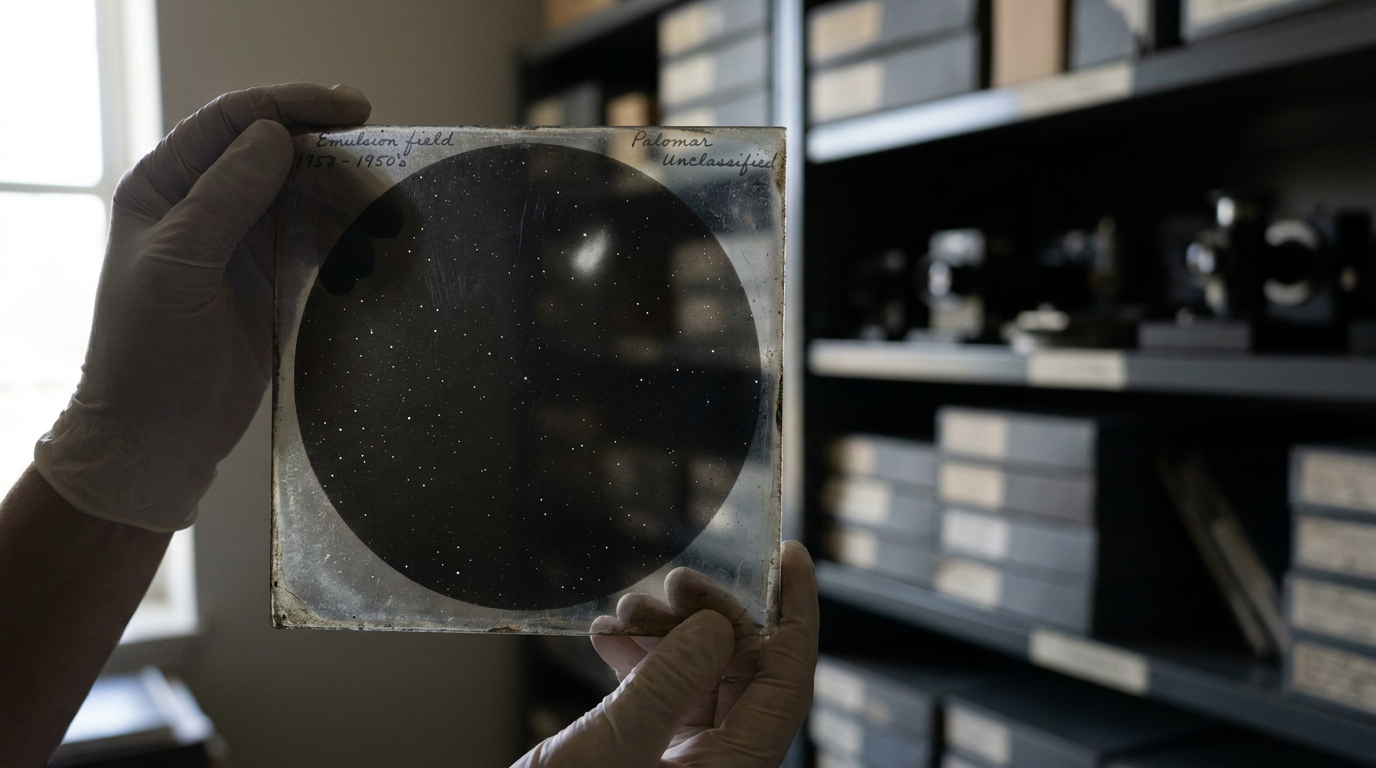
Sometime in the early 1950s, a photographic plate at Palomar Observatory captured a brief, star-like flash of light at a position in the sky where no known star belonged. Then it was gone. The plate was archived, the anomaly went unclassified, and for roughly seven decades the image sat in a collection of glass plates that together constitute one of the most comprehensive sky surveys ever assembled. It was, on its own, unremarkable. A dot. A smudge. A data point without a narrative.
What changed recently is that someone started counting. A peer-reviewed study published in Scientific Reports[2] systematically cross-referenced a catalog of these transient, unidentified light sources — sometimes called optical transients or simply anomalous flashes — found in the Palomar Sky Survey plates against the documented timeline of Cold War nuclear weapons tests. The result was a correlation that stopped several researchers mid-sentence: anomalous flashes in the plates were approximately 45 percent more likely to occur within a day of a nuclear detonation than chance would predict. That figure has since become the kind of number that is simultaneously hard to explain and easy to misread.
The Palomar Sky Survey, conducted primarily between 1948 and 1958, was not designed to catch anything strange. It was designed to be thorough. Using the 48-inch Samuel Oschin Schmidt telescope[1], astronomers photographed the northern sky in two wavelength bands — blue and red — producing glass plates of exceptional sensitivity. The survey became a foundational reference document for twentieth-century astronomy. When researchers began digitizing those plates decades later, they were looking for variable stars, asteroids, and other catalogued objects. What some of them found, quietly, was a population of light sources that appeared on one plate and nowhere else — no repeat detection, no follow-up confirmation, no match in any stellar catalog.
Those single-appearance flashes are not new to astronomy. They have been examined before and usually filed under the loose heading of plate artifacts, cosmic ray strikes, or observational noise — the standard garbage bin for data that doesn't resolve cleanly. The new study does not argue that the flashes are obviously extraordinary. It argues that if they were pure noise, you would not expect their distribution in time to cluster near anything in particular. And yet they cluster. Near nuclear tests. By a margin that, depending on how you run the statistics, is difficult to wave away.
What the Plates Actually Contain
Before reaching for an interpretation, it helps to understand what a Palomar plate is and what it isn't. Each plate is a glass sheet coated in photographic emulsion, exposed for several minutes during a single observing session, then chemically developed and stored. A typical plate covers several square degrees of sky and records objects down to roughly twentieth magnitude — faint enough to detect objects far beyond naked-eye visibility. The plates are not time-series data. They are snapshots. If something appeared in a patch of sky during one exposure and then vanished, the survey would record it once and never again, because the same region might not be re-photographed for months or years. This is both the power of the archive and its central limitation. You can establish that something was there. You cannot establish what its behavior was before or after.
The anomalous objects in question are described as point sources — meaning they appear star-like rather than extended — with no spectral classification, no proper motion consistent with solar system objects, and no counterpart in any modern catalog. The study's authors applied careful filtering to exclude objects with plausible explanations: known variable stars, catalogued minor planets, obvious cosmic ray strikes with the characteristic shape of a single ionized track rather than a diffuse exposure. What remained after filtering was a residual population of events that passed basic quality checks but lacked any satisfying assignment.
“When something survives the garbage bin of known explanations, it doesn't become proof of something unknown — it becomes a harder problem.”
The residual population is not enormous. The study is working with dozens of candidate events across a multi-year observing window, not hundreds. Small sample sizes amplify statistical noise and make correlation easier to find by accident. The researchers are aware of this — the paper discusses correction methods and confidence intervals in some detail — but it is the first caveat any honest reading of the work must hold. A 45 percent elevated probability is striking. It is not conclusive. Statistics computed over small, heterogeneous samples can mislead in ways that do not become apparent until someone attempts independent replication.
The Nuclear Test Timeline as a Control Variable
Between 1945 and 1963, the United States and Soviet Union conducted hundreds of atmospheric nuclear tests[3]. The timeline of those tests is now thoroughly declassified, logged to the day, and in many cases to the hour. This makes nuclear detonations an unusually clean control variable for historical correlation work — you know exactly when they happened, and you can ask whether any other documented phenomenon clusters around those dates at a rate above baseline.
Several plausible physical mechanisms could, in principle, link atmospheric nuclear detonations to transient optical phenomena. A high-altitude nuclear blast produces an electromagnetic pulse, a fireball visible from enormous distances, and a wave of ionizing radiation that interacts with the upper atmosphere for hours afterward. It generates charged particles that propagate along geomagnetic field lines. It produces artificial radiation belts — the Starfish Prime test in 1962[4] is the most documented example, having generated a trapped electron belt that damaged satellites for months. Any of these effects could, under the right geometric and atmospheric conditions, produce an optical phenomenon that a ground-based photographic survey might record. The question is not whether such mechanisms are physically coherent. The question is whether they are sufficient to account for the observed correlation, and whether the geometry actually works.
“Physically coherent is not the same as demonstrated — and that gap is where this study currently lives.”
The geometry is where the mundane explanation starts to creak. Palomar Observatory sits in Southern California. The major atmospheric test sites during the relevant period were Nevada, the Pacific Marshall Islands, and Soviet Kazakhstan. A Nevada test and a Palomar observation share roughly the same atmosphere and magnetic field geometry. A Pacific or Soviet test does not. For a geomagnetic or ionospheric disturbance mechanism to explain the correlation globally — across test sites at very different magnetic latitudes and distances from the observatory — you would need a physical pathway that operates with remarkable consistency regardless of geometry. That pathway has not been demonstrated. It has been proposed, sketched, and discussed. It has not been closed.
Why the Boring Explanations Are Struggling
Plate artifacts remain the most tempting mundane explanation, and they should be taken seriously. Photographic emulsions are chemically reactive. They can be damaged by temperature fluctuations during storage, by low-level radiation exposure, by chemical contamination during development. A population of archival glass plates stored over seventy years in various conditions could develop spurious features — false point sources, density variations, pinhole defects — that look like transient astronomical events if examined without knowing their origin. Cosmic ray strikes are also common in long-exposure astrophotography, though they typically leave a distinctive track pattern rather than a clean point source, and the filtering used by the study authors is specifically designed to remove them.
The difficulty is that artifact explanations do not straightforwardly predict a temporal correlation with nuclear tests. If the plates were simply accumulating damage over time, you would expect the artifact rate to track storage duration or temperature, not nuclear detonation schedules. If cosmic rays were the culprit, their rate is set by cosmic ray flux, which is modulated by solar activity — not by weapons programs. You could construct a scenario in which nuclear tests happened to co-occur with elevated cosmic ray periods due to solar cycle phasing, but that explanation would require its own demonstration and has not been offered. The artifact hypothesis accounts for why strange things appear in old plates. It does not account for why those strange things appear when they do.
There is also the question of what the mundane explanations leave behind once stacked. Each individually plausible explanation — artifacts, cosmic rays, atmospheric distortion, cataloguing errors — explains some fraction of the anomalous population. But explaining fractions of a population is not the same as explaining the temporal clustering of whatever fraction remains after each cut is applied. If the study's filtering was performed competently, the residual correlation is not being driven by the events that were easily explained. It is being driven by the events that survived explanation.
What the UAP Connection Actually Means
The paper has been picked up, predictably, in UAP-adjacent circles, and that framing is worth examining without either embracing it or reflexively discarding it. The study does not claim to have found unidentified aircraft, anomalous objects, or anything of extraterrestrial origin. What it claims — carefully, in academic language — is that a class of unidentified optical transients in historical astronomical data correlates temporally with documented atmospheric nuclear activity at a rate above statistical expectation, and that the available mundane explanations are insufficient to fully account for that correlation.
The UAP framing matters in a narrower, more useful sense: it places this work inside a growing methodological effort to apply rigorous archival analysis to anomalous historical observations rather than either dismissing them outright or treating them as evidence for predetermined conclusions. The U.S. government's formal shift toward treating UAP as a legitimate intelligence and scientific problem — rather than a cultural embarrassment to be managed — has created space for peer-reviewed work that would previously have had difficulty finding a serious journal home. This study is part of that opening. Its value is not that it answers a question. Its value is that it asks the question in a form that can be tested.
“The best thing this study does is refuse to be satisfied with the explanation that almost fits.”
What Needs to Happen Before This Means Anything Definitive
Independent replication using a separate plate archive is the most obvious next step, and the most important one. The Palomar plates are not the only twentieth-century photographic sky survey in existence. The Digitized Sky Survey draws on multiple source collections. The Harvard Observatory plate stacks cover a century of observations. If the correlation found at Palomar appears in independent archives with different storage histories, different observing geometries, and different instrument characteristics, the artifact hypothesis becomes nearly untenable and the temporal mechanism becomes something that demands serious physical modeling. If the correlation does not replicate, the Palomar result shrinks to an interesting anomaly in one dataset — real but inconclusive.
Physical modeling of the proposed ionospheric and geomagnetic pathways also needs to be done properly. The question of whether a nuclear test at a given site, on a given date, in a given atmospheric state, could produce an optical transient detectable from Southern California at a specific time is a tractable physics problem. It is not a trivial one — it requires propagation modeling through a realistic 1950s-era atmosphere, accurate geomagnetic field data for the period, and assumptions about the test's yield and altitude. But it is the kind of problem that can be scoped, computed, and compared to the observed event characteristics. If the mechanism cannot produce optical transients of the right brightness, duration, and positional distribution, it does not explain the correlation. If it can, you have a physically grounded hypothesis that can be tested in multiple ways.
Seventy years ago, a photographic plate captured something above Palomar that no one has adequately named. The event lasted for the duration of a single exposure. It left a dot of light on glass. At roughly the same time — within twenty-four hours — somewhere on Earth, a nuclear weapon detonated in the atmosphere. The plate has no opinion about the connection. The statistics suggest one exists. The physics has not yet confirmed or denied it. That is not a mystery wrapped in drama or dressed up in language borrowed from science fiction. It is a genuine open problem in observational science, documented on archival glass, sitting in the uncomfortable middle space between what was seen and what can be concluded. That middle space is where the work actually is.
References
- The 48-inch Samuel Oschin Telescope (sites.astro.caltech.edu)
Describes the 48-inch Samuel Oschin Schmidt telescope's wide-field imaging capabilities and its use in the Palomar Sky Survey between 1948 and 1958. - Transients in the Palomar Observatory Sky Survey (POSS-I) may be associated with nuclear testing and reports of unidentified anomalous phenomena (nature.com)
The peer-reviewed Scientific Reports study that found anomalous transients in Palomar plates clustered 45 percent more frequently within a day of nuclear detonations than chance would predict. - List of nuclear weapons tests (en.wikipedia.org)
Establishes that hundreds of atmospheric nuclear tests occurred between 1945 and 1963, providing the declassified timeline used as the study's control variable. - Starfish Prime (en.wikipedia.org)
Documents the 1962 Starfish Prime high-altitude nuclear test that created artificial radiation belts, exemplifying the type of ionospheric disturbance mechanism that could theoretically produce optical phenomena.
About Rowan Ellery
Rowan Ellery writes about anomalies, unexplained sightings, strange signals, and the uneasy border between observation, misinterpretation, and genuine mystery. Their work focuses on keeping curiosity alive without letting evidence dissolve into folklore.
More like this
The Galileo Project Watched 80,000 Objects. 144 Broke the Rulebook.
The Galileo Project's first major sky survey didn't produce a smoking gun — it produced a data problem so precise it finally tells us what kind of evidence we actually need.
The FRB That Fired 11,553 Times Has a Math Problem. The Standard Model Can't Solve It.
A hyper-active fast radio burst has already burned through most of what a magnetar can store — and the source was still going when astronomers stopped watching.
The UAP Files Mention 'Green Fireballs' 209 Times. Nobody Can Explain Them.
The newly declassified DoD UAP documents don't prove anything extraterrestrial — but the geography and repetition of the sightings reveal a clustering pattern that official explanations still can't fully account for.