The Brightest Radio Flash Ever Detected Has a Silence Problem
For the first time, astronomers pinpointed a record-breaking fast radio burst to a region smaller than most star clusters — and what they found there quietly threatens the theory meant to explain all of them.
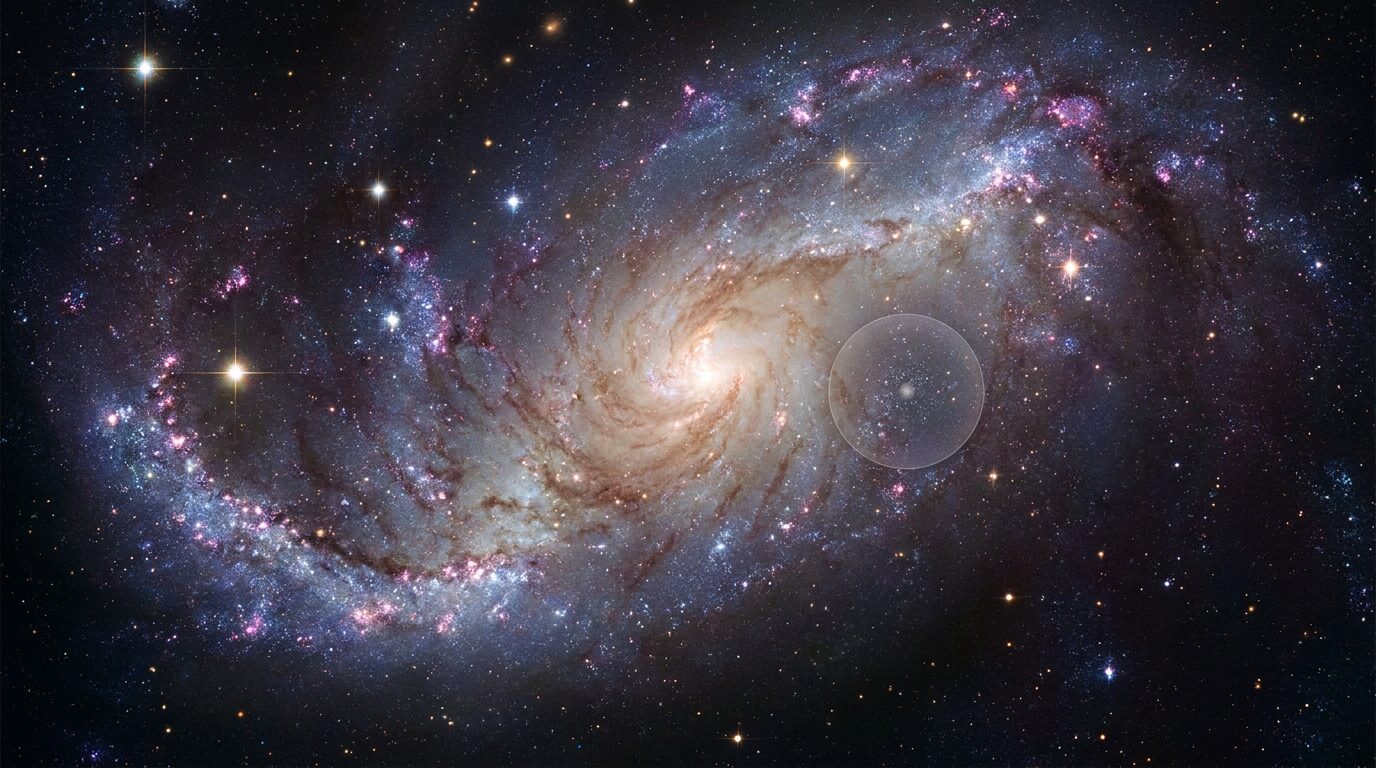
On March 16, 2025, radio telescopes on Earth detected a burst of electromagnetic energy that lasted perhaps a millisecond and carried more power than any fast radio burst previously on record. FRB 20250316A — already acquiring the nickname RBFLOAT in working discussions — crossed 130 million light-years of space and announced itself to the CHIME telescope array in British Columbia with a signal-to-noise ratio that, by the standards of this field, was almost indecent. Astronomers do not use the word "brightest" loosely. They mean it in a precise sense: apparent brightness as received at Earth, corrected for distance, placing this burst in a genuinely unusual category of energetics.
What followed was a demonstration of how much localization technology has matured since CHIME first began cataloguing fast radio bursts several years ago. CHIME's newly operational Outrigger stations — physically separated telescope sites that function as a very-long-baseline interferometry network with CHIME at its core — cross-referenced their arrival times for RBFLOAT with a precision that previous single-dish or even paired-dish observations could not reach. The result was a position refined to a region roughly 45 light-years across within the host galaxy. That is not a coordinate on a map the way street addresses are coordinates. It is a volume of space that, at a distance of 130 million light-years, represents an angular resolution achievement worth pausing over. You are constraining the origin of a millisecond event to a region smaller than the distance between our sun and the nearest stellar neighbor.
That localization matters for a specific reason that goes beyond the satisfaction of knowing where something came from. Fast radio bursts arrive without warning, last a fraction of a second, and leave no trail that optical or X-ray telescopes can reliably follow. The only evidence is the radio burst itself, plus whatever multi-wavelength follow-up happens to be watching the right patch of sky at the right moment. When you can pin a burst to a 45-light-year region in a specific galaxy, you can start asking what is actually in that region — what stellar populations, what interstellar medium density, what compact object candidates. That is a different and more answerable kind of question than pointing at a smeared probability cloud covering thousands of light-years and speculating.
Here is the part that deserves careful attention: since March 16, RBFLOAT has not repeated. Not once. Months of monitoring, multiple instruments, coordinated follow-up campaigns — silence. And in a field where the loudest signal ever recorded going quiet is the main finding, silence is not nothing. Silence is the data.
Two Families, One Theory That Increasingly Has to Choose
The fast radio burst field has been living with a categorization problem for years. Some FRBs repeat — sometimes irregularly, sometimes in apparent cycles, sometimes with no discernible pattern but with enough recurrence that follow-up campaigns can characterize their emission spectra and drift rates in detail. Some FRBs, as far as anyone can determine after sustained observation, fire once and stop. The obvious question this raises is whether these two behaviors represent the same underlying physics expressing itself differently, or genuinely different physical mechanisms producing events that happen to look similar in their radio signatures.
The dominant theoretical framework for some years has leaned heavily on magnetars — neutron stars with extraordinarily intense magnetic fields, capable of releasing enormous energy in short bursts through starquakes, magnetic reconnection events, or related mechanisms. The case for magnetars was significantly strengthened in 2020 when a burst was detected from SGR 1935+2154[1], a known magnetar in our own galaxy, with properties consistent with what extragalactic FRBs look like from a distance. That was a genuinely important data point: a smoking-gun mechanism, in our backyard, producing something FRB-like. The field moved toward a working consensus that magnetars were probably the dominant, possibly universal, engine.
“A single mechanism explaining all fast radio bursts was a tidy theory — and RBFLOAT is the kind of data point that makes tidy theories uncomfortable.”
The problem is that magnetars — at least based on what we observe from SGR 1935+2154 and the small number of other galactic magnetars we can study in detail — repeat. They are not one-shot emitters. They go through active phases and quiet phases, but the underlying engine is persistent. If RBFLOAT came from a magnetar, the prediction is straightforward: given its extraordinary brightness, a subsequent burst at even a tiny fraction of that energy would still be detectable. The monitoring campaigns have had the sensitivity. The time baseline is growing. And the source continues to say nothing.
What the 45-Light-Year Window Actually Tells You
A 45-light-year localization region is both impressive and frustrating in equal measure. Impressive because it constrains the source to something — a region that might contain a globular cluster, a dense stellar nursery, a specific interstellar environment with unusual dispersion characteristics. Frustrating because 45 light-years still encompasses a lot of candidates at 130 million light-years' distance, and the host galaxy has not been fully characterized in ways that would immediately tell you what sits at those coordinates.
What the localization does allow is a more rigorous assessment of the dispersion measure — the amount of plasma the radio signal passed through on its way to Earth. Dispersion measure is one of the primary diagnostic tools in FRB analysis. A burst traveling through dense plasma will have its lower-frequency components delayed relative to its higher-frequency components, and that delay encodes information about the integrated electron column density along the line of sight. RBFLOAT's dispersion measure, now that its host galaxy is pinned down, can be decomposed into contributions from the intergalactic medium, the host galaxy's interstellar medium, and any local environment surrounding the source itself. Early work suggests the local contribution is not negligible — meaning whatever produced this burst may be embedded in a relatively dense environment. That is itself a clue, even if it does not close the case.
Dense local environments around FRB sources have shown up before in repeating bursts. FRB 20121102A, the first confirmed repeater, showed extreme and variable Faraday rotation[2] — a signal of a highly magnetized local medium — suggesting it lived near something producing strong fields, possibly a pulsar wind nebula or a young magnetar remnant. The comparison is informative but not conclusive. A dense local environment could indicate a young compact object. It could also indicate a chance alignment with a dense interstellar cloud. The dispersion measure alone does not distinguish these scenarios.
Non-Repeating Mechanisms Are Back on the Table
“The silence after RBFLOAT is not a failure of observation — it is an observation, and it is pointing somewhere the field has been reluctant to go.”
Before magnetars became the default answer, the fast radio burst literature contained a much wider zoo of proposed mechanisms. Cataclysmic events — collisions between neutron stars, a neutron star collapsing into a black hole, white dwarf mergers — were serious candidates precisely because they would produce a single enormous burst and then nothing, because the source no longer exists. These scenarios fell somewhat out of fashion as repeating FRBs accumulated and it became awkward to propose both cataclysmic and non-cataclysmic origins for what looked like the same phenomenon. The parsimony argument for a unified mechanism was reasonable. It still is, as a prior. But priors update when the data pushes.
RBFLOAT's energy scale is worth taking seriously in this context. The brightest burst ever recorded is not just a superlative for press releases. It places a real constraint on how efficient the energy release mechanism had to be. A cataclysmic merger between two neutron stars releases energy on a scale that can accommodate the observed luminosity without requiring implausible efficiencies. A magnetar starquake — while capable of producing enormous radio luminosity — has more difficulty scaling to RBFLOAT's numbers without approaching the edge of plausible emission models. This is not a definitive argument. Emission physics in these extreme environments is poorly constrained, and unusual geometry or beaming could shift the apparent energetics considerably. But the numbers are worth flagging.
There is a subtler possibility that the field has been discussing: a single physical object class — say, magnetars — could produce both repeating and non-repeating bursts depending on parameters that vary between objects. Age, magnetic field strength, spin-down state, surrounding environment, orientation relative to the observer. A very young magnetar in its most active phase might produce a single catastrophically bright burst and then enter a quiescent phase lasting years before any subsequent emission falls within detectable thresholds. This would technically still be a repeater, but would look, on current timescales, indistinguishable from a one-off event. The distinction matters for theory but is genuinely hard to test without much longer monitoring campaigns than anyone currently has resources to run.
The Outrigger Advantage and What Comes Next
CHIME's Outrigger array represents a meaningful shift in what the field can actually measure rather than infer. Previous localizations of one-off FRBs often came with position uncertainties spanning hundreds or thousands of light-years in the host galaxy frame — wide enough that you could not confidently associate the burst with any particular structural feature. The difference between a burst originating in a spiral arm, in a globular cluster, or in the central regions of a galaxy is physically significant. Spiral arms are rich in young stars and therefore young compact objects. Globular clusters are old, dense, and host dynamics — close binary encounters, neutron star mergers — that are statistically unlikely in the field. The central regions carry their own complications including possible AGN contamination of the radio signal.
With Outrigger precision, those distinctions are becoming resolvable. RBFLOAT's 45-light-year localization region can, in principle, be cross-referenced against deep optical and infrared imaging of the host galaxy to determine whether it falls in a star-forming region, an older stellar population, or something more ambiguous. That work is ongoing and represents exactly the kind of multi-wavelength follow-up that the field has long argued is necessary but rarely been able to do rigorously for non-repeating events. The Outrigger is providing the localization. The rest of the observational apparatus — Hubble-class imaging, X-ray monitoring, radio follow-up at other wavelengths — now has a target precise enough to be worth pointing.
Why the Silence Has to Be Part of the Answer
“Unresolved does not mean uninformative — in fast radio burst astronomy, the events that refuse to repeat are increasingly the ones that most need explaining.”
There is a tendency in science communication — and sometimes in scientific practice — to treat unexplained silences as temporary inconveniences waiting to be resolved by more data. Sometimes that is right. In RBFLOAT's case, more monitoring time will eventually either produce a repeat burst or push the non-repeating hypothesis further into statistical confidence. But it is worth being honest about the asymmetry here. A future repeat burst would be decisive: it would definitively place RBFLOAT in the repeater category and revive magnetar-class models for this object. The continued absence of a repeat is less decisive on any given day, but grows more informative as time accumulates without detection. At some point — and the field has not agreed on exactly where that point is — "no detected repeat" becomes strong evidence that no repeat is coming, rather than evidence that a repeat simply hasn't arrived yet.
What RBFLOAT represents, in the current state of the field, is a case where the detection quality has finally outrun the theoretical resolution. For years, FRB localizations were poor enough that one could argue the apparent non-repetition of certain bursts was simply an artifact of monitoring strategies, sensitivity limits, or bad luck. RBFLOAT closes those escape hatches considerably. The burst was bright enough that any subsequent emission from the same source, at even a small fraction of the original energy, should have been detectable with existing infrastructure. The localization is precise enough that confusion with a different nearby source is not a serious concern. What remains genuinely open is the physics — and that is a harder, more interesting problem than a simple data gap.
The fast radio burst field is not in crisis. It is in the more productive state of having a constraint it did not ask for and cannot comfortably ignore. RBFLOAT fired once, at unprecedented power, from a 45-light-year region in a galaxy 130 million light-years away, and then stopped. That sequence of facts does not prove cataclysmic origin, does not disprove magnetars, and does not resolve the repeater classification problem. What it does is place a very loud, very precisely located, very quiet data point directly in the middle of a theory that needed a challenge. That is not a problem. That is how the evidence is supposed to work.
References
- A fast radio burst associated with a Galactic magnetar (nature.com)
Established that magnetars can produce millisecond radio bursts with properties consistent with extragalactic fast radio bursts, supporting the magnetar theory. - An extreme magneto-ionic environment associated with the fast radio burst source FRB 121102 (nature.com)
Documented extreme and variable Faraday rotation in repeating FRB source FRB 121102A, indicating a highly magnetized local environment around the source. - FRB 20250316A: A Brilliant and Nearby One-off Fast Radio Burst Localized to 13 pc Precision (iopscience.iop.org)
Provides the observational data and analysis for FRB 20250316A (RBFLOAT), the record-breaking fast radio burst detected on March 16, 2025.
About Rowan Ellery
Rowan Ellery writes about anomalies, unexplained sightings, strange signals, and the uneasy border between observation, misinterpretation, and genuine mystery. Their work focuses on keeping curiosity alive without letting evidence dissolve into folklore.
More like this
The FRB That Fired Once, Left a Partner Behind, and Broke the Rulebook
A fast radio burst caught inside a binary star system just overturned the leading explanation for what produces them — and the real problem is that the burst only fired once.
The FRB That Fired 11,553 Times Has a Math Problem. The Standard Model Can't Solve It.
A hyper-active fast radio burst has already burned through most of what a magnetar can store — and the source was still going when astronomers stopped watching.
The Radio Burst Lasted a Millisecond. The Argument About It Has Lasted Years.
Fast radio bursts arrive from across the universe in under a millisecond — brilliant, violent, and until recently, assumed to be unrepeatable. A handful of them have since proved that assumption wrong, and the physics debate that followed is far from over.