We've Found Over 5,000 Exoplanets. Almost None of Them Are Like Earth.
The most common world in the galaxy sits in a size range our solar system completely skipped — and planetary scientists aren't sure whether that's physics or blind spot.
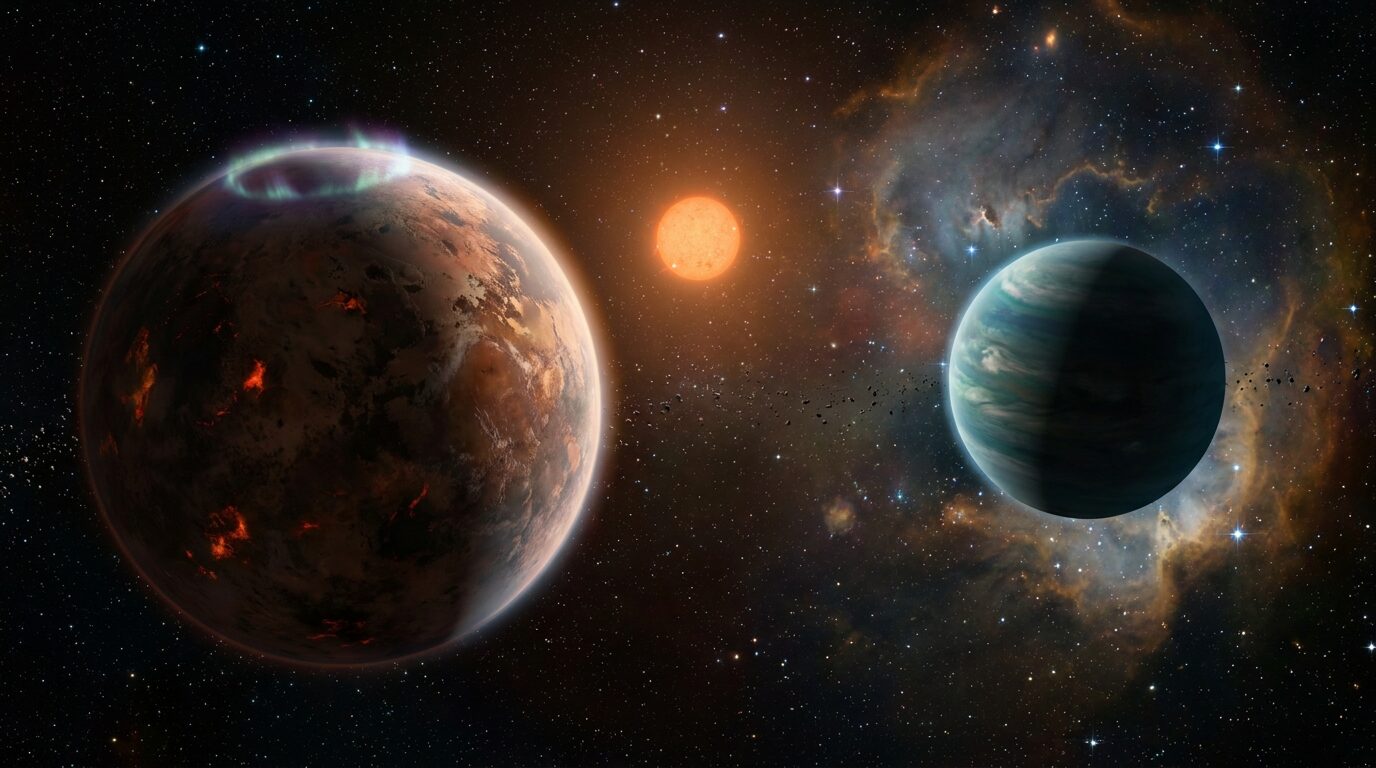
The number 5,000 arrived in March 2022, when NASA's exoplanet archive crossed that threshold[2] and briefly became a headline. Five thousand confirmed worlds beyond our sun. The number is striking, and the word "confirmed" matters — these are planets whose existence has been independently validated through transit timing, radial velocity measurements, or both, not just candidates flagged by an algorithm. The real catalog, including unconfirmed candidates from the TESS mission, runs considerably higher. But even at 5,000, it is enough to do something that was impossible thirty years ago: describe the distribution of planets across a wide statistical sample and ask what the galaxy actually makes.
What the galaxy apparently makes, in enormous numbers, are worlds that fall into two size categories that do not exist in our own solar system. The first category is the super-Earth — rocky planets roughly 1.2 to 1.6 times the radius of our own, with masses perhaps two to ten times what Earth carries. The second is the mini-Neptune, a gas-wrapped world between about 1.7 and 3.5 Earth radii, smaller than Neptune by a wide margin but sharing its basic character: a substantial hydrogen-helium envelope sitting over a rocky or icy core. Together, these two categories account for a substantial fraction of the confirmed exoplanet catalog. Our solar system, which built four rocky planets and four gas giants with nothing in between, appears to be the exception.
Planetary scientists call the gap between super-Earths and mini-Neptunes the radius gap, or more commonly the Fulton gap, named after the analysis that first cleanly isolated it in Kepler mission data around 2017. It sits at roughly 1.5 to 1.7 Earth radii — a zone where relatively few confirmed planets appear. Below the gap, planets tend to be dense and rocky. Above it, they tend to carry thick atmospheric envelopes. The gap itself implies that something physical is happening at that boundary, some process that pushes planets toward one category or the other rather than leaving them distributed smoothly across all possible sizes. Figuring out what that process is has become one of the more productive arguments in planetary science.
None of this was visible before space-based photometry reached the sensitivity Kepler brought to the problem. Ground-based telescopes had found planets, mostly large ones — hot Jupiters grazing their stars at orbital distances that make Mercury look like a distant wanderer. Those early discoveries, made through the radial velocity method, which tracks the tiny wobble a planet induces in its host star, were genuine but skewed. Massive planets close to their stars produce the most detectable signals. They are not necessarily the most common planets. Kepler changed the accounting by staring at a single patch of sky for four years, monitoring the brightness of over 150,000 stars simultaneously and watching for the tiny, regular dips in light that indicate a planet crossing the stellar disk. The catalog it produced was the first large enough to be treated as a statistical picture of planetary demography rather than a list of remarkable individuals.
What Kepler Was Actually Measuring
A transit event — the dip in starlight as a planet passes between its star and the telescope — tells you the planet's size relative to the star, its orbital period, and the fraction of stellar flux it receives. From the period and the stellar mass, you can calculate the orbital radius. From the orbital radius and the stellar luminosity, you can estimate the equilibrium temperature — a rough measure of whether liquid water could exist on the surface under idealized conditions. What Kepler could not directly measure is mass. Mass requires radial velocity follow-up from ground-based spectrographs, a slower process that has been completed for only a fraction of the confirmed catalog. This matters because size and mass together give you density, and density is what lets you distinguish a rocky world from a water-rich one from a gas-enveloped one of the same apparent radius. The catalog is rich in sizes. It is sparser in densities.
TESS — the Transiting Exoplanet Survey Satellite, launched by NASA in 2018[3] — covers a far wider fraction of the sky than Kepler did, monitoring sectors of roughly 24 by 96 degrees for 27 days at a stretch before rotating to the next field. Where Kepler went deep on a narrow window, TESS casts wide. Its strength is finding planets around nearby, bright stars — close enough that ground-based spectrographs can follow up and measure masses more efficiently. It is also, as a consequence, better positioned to find the planets that would be easiest to study with the James Webb Space Telescope. TESS does not replace Kepler's statistical depth, but it extends the catalog outward and gives transmission spectroscopy — the technique JWST uses to probe atmospheric composition during transits — a larger set of accessible targets.
“The most common planet in the galaxy appears to be one that our solar system never bothered to build.”
The Physics Behind the Gap
Two competing explanations have dominated discussion of the Fulton gap, and both are probably partly right. The first is photoevaporation: intense ultraviolet and X-ray radiation from a young star strips the hydrogen-helium envelope from a close-in planet over hundreds of millions of years. If a planet is too small or too close to its star, its gravity cannot hold onto the envelope against that radiation pressure, and it loses the gas to space, settling into a bare rocky configuration. Planets massive enough to retain their envelopes despite the bombardment persist as mini-Neptunes or larger. The gap marks the boundary between the two outcomes. Simulations of photoevaporative mass loss reproduce a gap at roughly the observed location, which counts in favor of the model.
The second explanation is core-powered mass loss[1], a related but mechanically distinct process. Here, the heat radiating outward from a planet's rocky core — residual energy from formation — continues to inflate and drive off the atmosphere over billion-year timescales, even without direct stellar irradiation being the primary driver. Both mechanisms predict a bimodal size distribution. Distinguishing between them requires precise measurements of how the gap location shifts with stellar age, stellar type, and orbital distance. Younger planetary systems should show different gap positions than older ones if photoevaporation dominates, since the stellar radiation flux declines with time. The data currently available are not deep enough to cleanly resolve this. Both mechanisms are almost certainly operating; the open question is their relative importance.
The Instrument Bias Problem
Before reading too much into the shape of the exoplanet catalog, it is worth sitting with a persistent methodological difficulty. Transits are easiest to detect when planets are large and orbital periods are short — meaning the planet passes in front of its star frequently, and the dip it creates is deep enough to clear the noise floor. This is why the catalog is dominated by close-in planets. A planet at Earth's orbital distance from a sun-like star transits once per year, and you need to see multiple transits to confirm a periodic signal. For Kepler's four-year mission, that meant catching at most three or four transits for an Earth-analog — barely enough for statistical confidence. Planets at greater distances, or around stars that were observed only briefly, are systematically underrepresented. The Fulton gap is robust enough to survive these corrections in the Kepler data, but the true frequency of Earth-sized planets in the habitable zones of sun-like stars — the so-called eta-Earth value — carries substantial uncertainty.
“The catalog tells us what our instruments could see, which is not quite the same thing as what the galaxy contains.”
This is not a failure of the missions. It is an inherent property of the transit method. Kepler was designed to determine whether Earth-like planets were common, and it succeeded in constraining the answer to a useful range. But the constraint is a range, not a point. Estimates of how often sun-like stars host rocky planets in temperate orbits span from a few percent to over fifty percent depending on assumptions made about orbital geometry, stellar variability, and how strict a definition of "temperate" one applies. The Roman Space Telescope, formerly WFIRST, is expected to extend the statistical reach further when it launches in the late 2020s, particularly through microlensing surveys sensitive to planets at wider orbital separations.
What the Distribution Implies About Formation
The prevalence of super-Earths and mini-Neptunes is not just an observational curiosity. It raises substantive questions about how planetary systems form and why our solar system's architecture is so different. One hypothesis is that the inner solar system was swept clean of material early on by Jupiter's formation and migration. Jupiter is massive enough that its gravitational influence during the disk phase — the period when the sun was still surrounded by gas and dust — could have disrupted the inward migration of proto-planetary cores that might otherwise have grown into super-Earths. Simulations suggest that in systems without a Jupiter analog, such cores accumulate and migrate inward readily, ending up as the close-in super-Earths and mini-Neptunes that Kepler found in abundance. Systems with early-forming giant planets may be rare. The architectures they produce — four small rocky worlds in the inner system, gas giants at multi-AU distances — may be rarer still.
This has direct implications for the frequency of Earth-like environments. A super-Earth is not simply a larger Earth. Its higher gravity, different interior convection dynamics, and potentially thicker atmosphere alter everything from geochemistry to whether plate tectonics operates — a process Earth scientists consider important for long-term carbon cycling and habitability. A mini-Neptune is almost certainly inhospitable to surface life as we understand it; its hydrogen-dominated atmosphere creates pressures and chemical conditions at depth that are extreme by any biological standard. Whether surface life could exist on a large rocky world with significantly different bulk properties than Earth is a genuinely open question, but one that cannot be answered by transit photometry alone. JWST has begun probing mini-Neptune atmospheres in transmission, looking for the composition of gases that filter the host star's light as the planet passes in front of it. The early results have been intriguing and the detections technically impressive, but they have not yet resolved whether any of these worlds could support biology.
Where the Catalog Goes From Here
“Five thousand planets is enough to see the shape of the distribution — and the shape is telling us something about our own solar system we are still working out how to hear.”
The confirmed exoplanet count will continue climbing. TESS is still operating. CHEOPS, the European Space Agency's Characterising Exoplanets Satellite, is refining radii of known planets to precision that improves density estimates. PLATO, another ESA mission targeting longer-period planets around sun-like stars, is scheduled for launch in 2026. Ground-based spectrographs like ESPRESSO at the Very Large Telescope are pushing radial velocity precision deep enough to detect Earth-mass planets. And JWST, when it turns its 6.5-meter mirror toward a transiting world with an appropriate atmosphere, can detect the presence of water vapor, carbon dioxide, methane, and potentially other molecules with a specificity that was not possible before 2022. The exoplanet field has moved from a census phase to a characterization phase — from asking how many to asking what they are made of, how they formed, and whether the conditions for life exist elsewhere.
What the catalog has already delivered is a reframing of our assumptions. For most of human history, the solar system was the only planetary system anyone could study, which made it easy to treat its architecture as normal, even expected. Eight planets, rocky inward, gaseous outward, nothing between about 0.4 and 3.9 Earth radii. The Kepler data made clear that this configuration, whatever its merits, is not the universe's default. The universe's default, to the extent that term applies to anything as complex as planetary formation, appears to be something in the 1.5-to-2.5 Earth radii range, orbiting close enough to its star that it receives substantial irradiation, retaining or losing its envelope depending on the details of its history. Earth — rocky, temperate, at one astronomical unit, with a giant planet parked several times further out — sits at the edge of what the catalog reveals, not at its center. Understanding why requires not just more planets, but more planet science: better interior models, more atmospheric observations, and a clearer account of the early conditions that shaped each system's fate. The question is no longer whether planets are common. The question is what kind of place this is, that the common kind is nothing like home.
References
- Core-powered mass loss and the radius distribution of small exoplanets (arxiv.org)
Presents core-powered mass loss as a mechanism explaining the radius valley, where cooling rocky cores erode light atmospheres while preserving heavy ones. - Cosmic Milestone: NASA Confirms 5,000 Exoplanets (jpl.nasa.gov)
Confirms the March 2022 milestone of 5,000 confirmed exoplanets in NASA's archive, establishing the dataset size underlying the article's analysis. - The Transiting Exoplanet Survey Satellite - NASA (nasa.gov)
Documents TESS's 2018 launch and mission design to survey bright nearby stars for transiting exoplanets, enabling follow-up mass measurements. - The California-Kepler Survey. III. A Gap in the Radius Distribution of Small Planets* (iopscience.iop.org)
Provides the 2017 Kepler analysis that first clearly identified the Fulton gap in exoplanet radius distribution.
About Elias Voss
Elias Voss writes about astronomy, space missions, telescope discoveries, and cosmic anomalies - and why it matters to us here on Earth. When the universe's physics reaches down and touches life on our planet, he follows it there too. He specializes in translating dense data into vivid, precise stories without sacrificing accuracy.
More like this
JWST Found a Planet That Shouldn't Exist — Orbiting a Dead Star, Raining Diamonds
A Jupiter-mass planet orbiting a millisecond pulsar carries a helium-and-carbon atmosphere that no known formation pathway can produce — and the physics of what falls from its sky is stranger still.
No Star Required: How Rogue Planets Could Hold Liquid Water in the Dark
Planets flung into interstellar space were assumed to be dead on arrival — but geothermal heat and hydrogen-rich atmospheres may keep some of them warm enough for liquid water, billions of miles from any sun.
Ghosts of the First Stars: What Ancient, Metal-Poor Suns Are Telling Us About the Universe's Earliest Chemistry
A small population of stars in the Milky Way's outer halo carries chemical signatures from before the universe knew how to make iron — and what spectrometers are finding in them is forcing a rethink of how fast the early cosmos grew complex.