ESA Built a Machine That Creates Solar Eclipses on Demand
ESA's Proba-3 mission flies two spacecraft in lockstep formation to block the sun on demand — unlocking a continuous view of the solar corona that has defeated astronomers for a century.
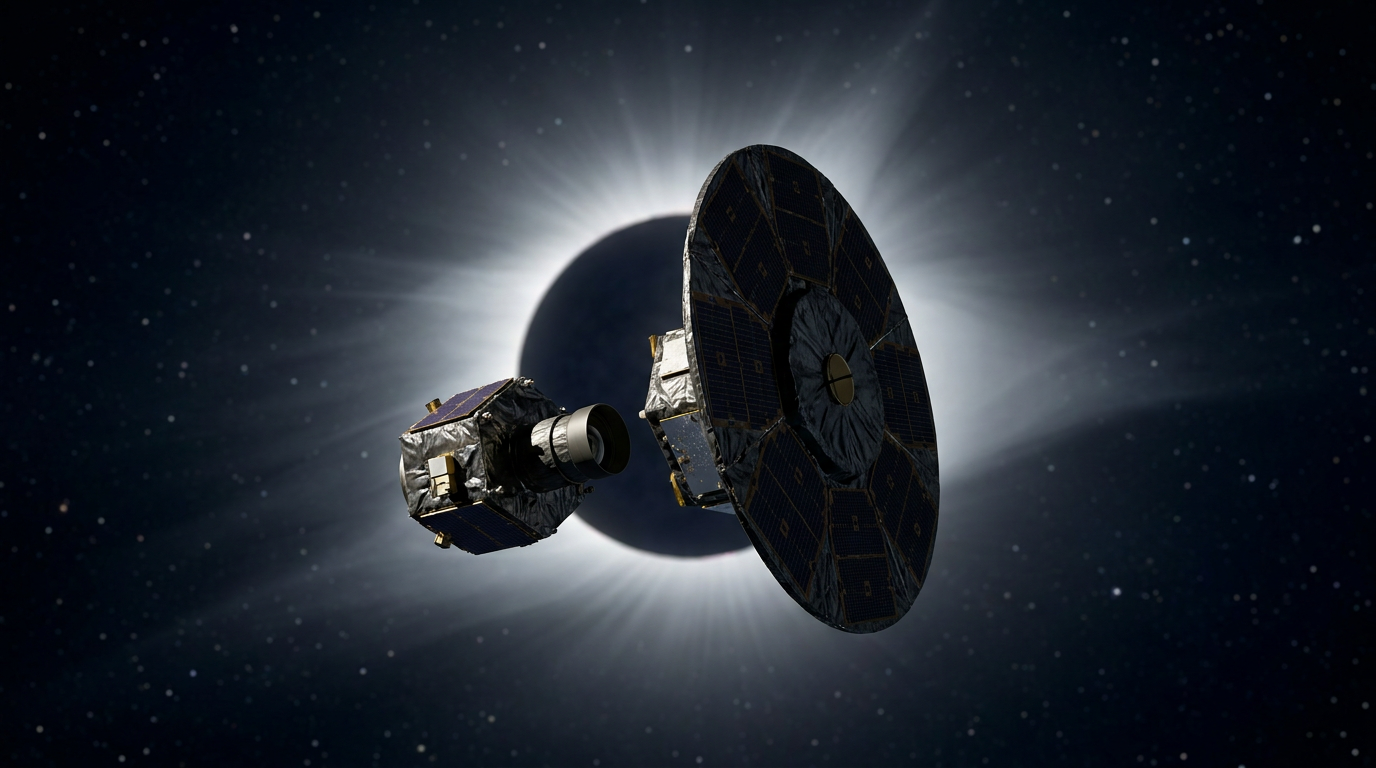
On a clear day in 2024, a total solar eclipse crossed North America and millions of people looked up. For a few minutes, the moon slid in front of the sun with startling geometric precision, the corona bloomed out from the darkened disk like a white flame frozen in the middle of its own leap, and then it was over. Scientists stationed along the path of totality scrambled to collect every second of usable data. They had been planning for years. They got four minutes, maybe six if they were stationed near the centerline. Then the sky brightened and the corona vanished back into the sun's overwhelming glare.
This is the central frustration of solar corona science. The corona is the sun's outer atmosphere, stretching millions of kilometers into space, superheated to temperatures that still have no fully accepted explanation — a million degrees Celsius or more, compared to the roughly 5,500-degree surface below it. Understanding it matters enormously: the corona drives the solar wind, spawns coronal mass ejections, and determines the space weather conditions that can disrupt satellites, power grids, and GPS networks on Earth. Yet the corona is almost impossible to observe continuously from the ground, because the sun's photosphere — the bright disk we see in daylight — outshines it by a factor of roughly a million. Natural eclipses are too short, too rare, and too geographically constrained to fill the observational gaps.
The European Space Agency's Proba-3 mission is built around one idea: what if you could manufacture an eclipse, on demand, in space, and hold it for hours at a time? The mission launched in December 2024 on a PSLV-XL rocket from India's Satish Dhawan Space Centre[2] and placed two small spacecraft into a highly elliptical orbit. The larger one, called the Coronagraph Spacecraft, carries a solar telescope. The smaller one, called the Occulter Spacecraft, carries a precise circular disk. Together, in formation, they recreate the geometry of a total solar eclipse with a precision that no natural phenomenon can match.
The two satellites fly roughly 150 meters apart — about the length of one and a half football fields — in a coordinated alignment so exact that the occulter disk blocks the sun's photosphere to within a millimeter of the desired shadow boundary at the coronagraph's aperture. The result is a continuous, high-quality view of the inner corona, the region closest to the sun's surface, for approximately six hours per orbital pass. That is not a four-minute scramble on a field in Texas. That is sustained, instrumented, repeatable observation from a stable platform above Earth's turbulent atmosphere.
The Formation-Flying Problem
The word "formation" understates what Proba-3 actually requires. Two spacecraft flying near each other is one thing. Two spacecraft holding a fixed relative orientation with millimeter-level accuracy, across 150 meters of empty space, while both are in motion around Earth, is an engineering problem of a different order entirely. The pair use a combination of GPS, inter-satellite radio links, optical cameras, and lateral thrusters to maintain alignment. An onboard metrology system — essentially a laser-based measurement tool — continuously monitors the distance and angular relationship between the two vehicles and issues correction commands in near real time. The Occulter Spacecraft is essentially being used as a precision optical element by the Coronagraph Spacecraft, and it has to behave like one.
“The two satellites must hold their relative position to within a millimeter across 150 meters of open space — not once, but continuously, for hours.”
The orbit itself is chosen to enable this. Proba-3 follows a highly elliptical path that swings it from about 600 kilometers above Earth at perigee out to roughly 60,500 kilometers at apogee. The formation-flying science runs near apogee, where the spacecraft are moving slowly relative to Earth and external perturbations are minimized. Near perigee, the spacecraft operate independently, recharge, downlink data, and prepare for the next science window. This means the artificial eclipse is not continuous over days, but it is reproducible across every orbit — and each session delivers more uninterrupted inner-corona data than most ground-based programs collect in a year.
Ground-based coronagraphs have existed since Bernard Lyot designed the first workable one in the 1930s[3]. They use an internal occulting disk to block the sun's disk inside the telescope itself. The problem is that Earth's atmosphere scatters sunlight in all directions, flooding the instrument with stray light and making the innermost corona — the region from about 1.05 to 1.5 solar radii — essentially unobservable from the ground. Space-based coronagraphs like LASCO aboard the SOHO spacecraft and the instruments on the STEREO probes have done better, but they use internal occulters positioned close to the detector. That proximity creates diffraction effects, optical scatter, and a central zone that remains blocked by the disk support structure. Proba-3 removes the occulter from the telescope entirely and puts it 150 meters away. At that distance, the disk casts a genuinely clean geometric shadow, and the inner corona becomes accessible in a way it simply was not before.
What the Corona Is Actually Doing
The corona's temperature inversion is one of the stranger unresolved problems in solar physics. Energy in a star flows outward from the core. You would expect temperatures to fall as you move from the surface into the surrounding atmosphere. Instead, they rise dramatically — from roughly 5,500 degrees Celsius at the photosphere to somewhere between one and three million degrees in the corona, depending on the region and the method of measurement. Two leading mechanisms have been proposed for decades: wave heating, in which Alfvén waves propagating along magnetic field lines deposit energy into the coronal plasma, and nanoflare heating, in which enormous numbers of tiny reconnection events in tangled magnetic fields release cumulative energy too small to detect individually but significant in aggregate. The honest answer is that neither mechanism has been definitively confirmed or ruled out, and the two may both be operating in different proportions in different coronal structures.
What Proba-3's coronagraph can contribute is time-resolved, spatially resolved imaging of the inner corona — specifically the region where most of the heating likely happens and where the solar wind is first accelerated. The ASPICS instrument aboard the Coronagraph Spacecraft images in visible white light, which is photospheric light scattered off free electrons in the coronal plasma. This tells scientists about the density structure of the corona, the shapes of streamers and plasma sheets, and the trajectories of propagating features. When a coronal mass ejection — a billion-tonne plasma eruption — lifts off from the surface, its earliest moments of propagation happen in exactly this inner zone. Previous instruments have regularly missed or poorly resolved this initiation phase. Proba-3, by holding its artificial eclipse steady, catches it in the act.
Space Weather, Scaled to Something Real
“A coronal mass ejection carries roughly a billion tonnes of magnetized plasma — and we still cannot reliably predict when the next one will leave the sun's surface.”
To understand why inner-corona observation matters practically, consider what a major coronal mass ejection actually does when it reaches Earth. The Carrington Event of 1859, the largest geomagnetic storm on record[4], overloaded telegraph systems across Europe and North America, sparked fires at telegraph stations, and generated auroras visible as far south as Cuba. A comparable event today would find a civilization with a vastly larger dependence on magnetically sensitive infrastructure: satellite navigation systems, power grids with long-distance transmission lines, high-frequency radio communications used by aviation, deep-sea communications cables. Insurance estimates for a Carrington-class event in the modern era run into the trillions of dollars. The difference between a one-hour warning and a twelve-hour warning for an incoming CME is the difference between an orderly grid shutdown and a catastrophic one.
Current space weather forecasting relies heavily on data from the DSCOVR spacecraft, which sits at the L1 Lagrange point[1] between Earth and the sun, about 1.5 million kilometers upstream. DSCOVR measures the solar wind's speed, density, and magnetic field direction as it arrives — which provides roughly fifteen to sixty minutes of warning before the material hits Earth's magnetosphere. That is useful but insufficient for complex grid protection. The deeper goal is to predict CME launches from the sun itself, hours or days before arrival. That requires understanding the pre-eruption configuration of coronal magnetic fields, the structural changes in coronal streamers that precede eruption, and the dynamics of coronal plasma in the initiation zone. All of that happens in the inner corona. All of that is exactly what Proba-3 is positioned to watch.
The Data No Other Instrument Produces
Proba-3 is not operating in isolation. ESA has coordinated the mission to run simultaneously with observations from the Solar Orbiter spacecraft, which carries its own suite of solar instruments and is progressively tightening its orbit around the sun. Solar Orbiter's METIS coronagraph and its extreme ultraviolet imager provide complementary views of the solar atmosphere from a different vantage point and at different wavelengths. Together, the two missions offer something close to stereoscopic, multi-spectral coverage of the corona during overlapping observation windows. Solar Orbiter sees the corona's high-temperature plasma in extreme ultraviolet. Proba-3's ASPICS instrument images its density structure in white light. Combining the two gives a more complete picture of coronal structure than either can provide alone.
The mission also serves as a proof-of-concept for precision formation flying at a scale that makes space scientists attentive for a different reason. The techniques developed for Proba-3 — the metrology systems, the onboard autonomy, the lateral thruster coordination — are directly applicable to future missions that would require multiple spacecraft to act as a single distributed instrument. Proposed mission concepts for very-long-baseline space interferometry, for extremely large aperture telescopes assembled in orbit, and for distributed gravitational wave detectors all depend on variations of exactly this capability. Proba-3 is demonstrating them for the first time at operational precision. What it learns will inform spacecraft designs that do not yet have funding or names.
Six Hours Beats Six Minutes
There is something worth sitting with in the basic geometry of what Proba-3 does. The moon's shadow crosses North America once every decade or so at any given location, arrives without adjustment, and departs on its own schedule. It cannot be aimed. It cannot be paused. It lasts as long as orbital mechanics permit and not a second longer. Proba-3 points where it is told, runs its eclipse sequence when the science window opens, and holds it for as long as the fuel budget and orbit allow. It is not a spectacle. It produces no auroras, no diamond ring effect, no crowd gathered in a field. But it delivers structured, repeatable, instrument-grade darkness on a schedule, and that turns a phenomenon that once required luck and geography into something that functions more like laboratory equipment.
“It is not a spectacle — it produces no auroras, no diamond ring effect, no crowd in a field — but it delivers instrument-grade darkness on a schedule, and that is worth considerably more to solar physics.”
The corona has been the sun's most consequential mystery for most of the history of astrophysics — not because it is the most exotic thing in the universe, but because it is close, it affects us directly, and it has resisted straightforward explanation despite being, in astronomical terms, practically in our backyard. Proba-3 does not solve the heating problem on its own, and it will not eliminate the forecasting gaps in space weather prediction in a single mission cycle. What it does is change the quality and continuity of the evidence. It replaces an opportunistic, weather-dependent, geography-constrained data source with a controlled, repeatable, space-based one. In observational science, that is rarely a small upgrade.
References
- DSCOVR - NASA Science (science.nasa.gov)
Describes DSCOVR's location at the L1 Lagrange point, approximately one million miles from Earth, used for current space weather forecasting. - Eclipse-making double satellite Proba-3 enters orbit (esa.int)
Confirms Proba-3 launched from India's Satish Dhawan Space Centre and describes the mission's formation-flying capability to millimeter precision. - Bernard Ferdinand Lyot (britannica.com)
Confirms Bernard Lyot designed the first workable ground-based coronagraph in the 1930s, establishing the historical baseline for corona observation technology. - Carrington Event (en.wikipedia.org)
Documents the Carrington Event of 1859 as the largest geomagnetic storm on record, establishing the historical baseline for space weather risk.
About Elias Voss
Elias Voss writes about astronomy, space missions, telescope discoveries, and cosmic anomalies - and why it matters to us here on Earth. When the universe's physics reaches down and touches life on our planet, he follows it there too. He specializes in translating dense data into vivid, precise stories without sacrificing accuracy.
More like this
The Sun's Surface Is 5,500°C. Its Atmosphere Is 2,000,000°C. Something Is Wrong.
Solar physicists have known about the corona's impossible heat for eighty years, and a spacecraft now flying closer to the sun than any instrument before it is finally close enough to catch the culprit in the act.
The 700-Meter Asteroid That Hid Inside Venus's Orbit for Who Knows How Long
Asteroid 2025 SC79 wasn't hiding cleverly — it was hiding in the one patch of sky we structurally cannot watch, and it took a two-image twilight window to prove it was there at all.
We've Found Over 5,000 Exoplanets. Almost None of Them Are Like Earth.
The most common world in the galaxy sits in a size range our solar system completely skipped — and planetary scientists aren't sure whether that's physics or blind spot.