The Gamma-Ray Burst That Fired for 7 Hours Doesn't Fit Any Known Physics
GRB 250702B lasted nearly twice as long as any gamma-ray burst ever recorded, and the two leading explanations for it are mutually incompatible — which means at least one of them has to be wrong.
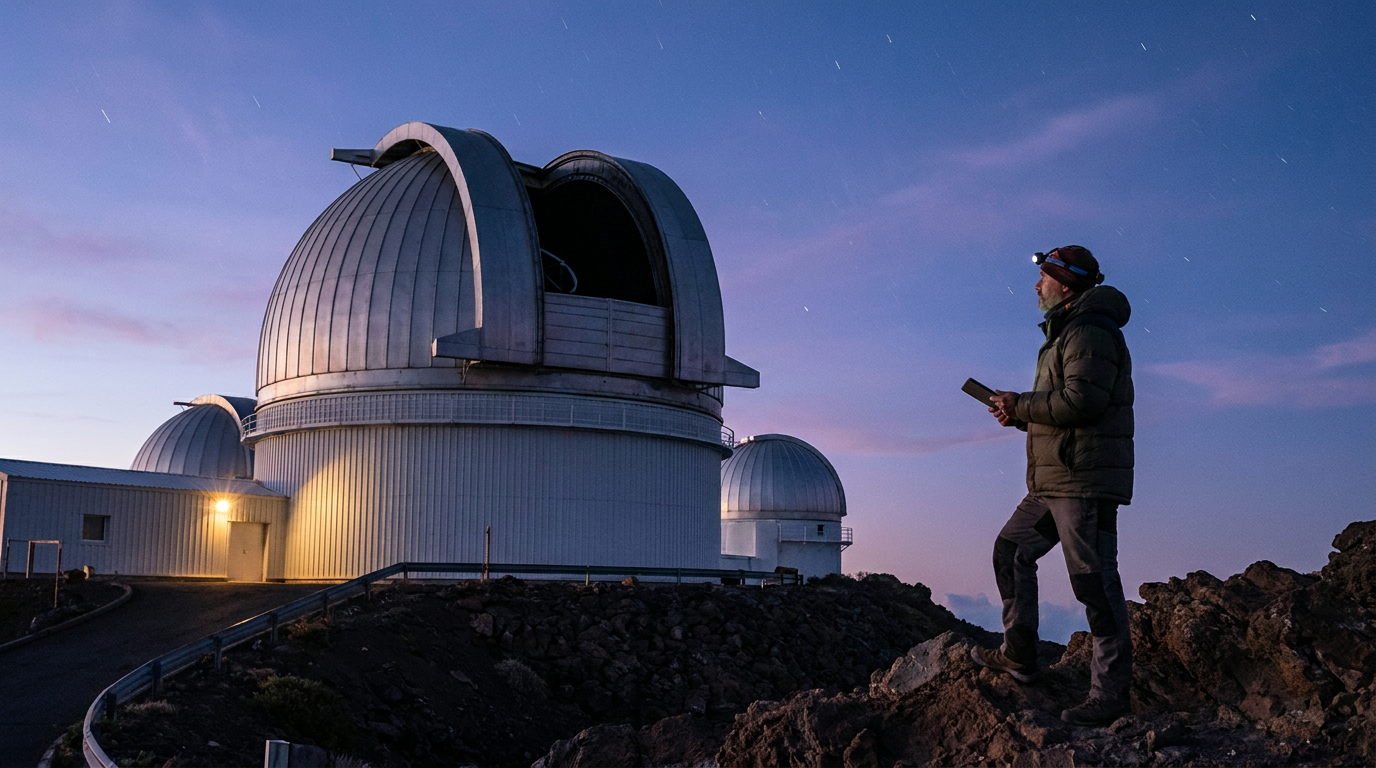
On July 2, 2025, the Fermi Gamma-ray Space Telescope registered an event that should not have taken as long as it did.[1] A burst of gamma radiation — the most energetic form of light in the electromagnetic spectrum — began arriving from a distant region of sky and kept arriving, in a sustained and structured flux, for roughly seven hours. Fermi's Gamma-ray Burst Monitor, a detector array tuned to catch exactly these kinds of transients, flagged the event almost immediately. Within minutes, NASA's Neil Gehrels Swift Observatory had slewed its X-ray Telescope onto the same coordinates. By the time ground-based observatories had joined and the Chandra X-ray Observatory had locked on, it was already clear that this event, designated GRB 250702B, was going to require some explanation that nobody currently had ready.
The record for the longest gamma-ray burst before this one stood at around four hours[2], set by a peculiar class of events already considered outliers. Most gamma-ray bursts fall into one of two clean categories: short bursts, typically under two seconds, produced when two neutron stars or a neutron star and a black hole merge in a violent collision; and long bursts, lasting from a few seconds to several minutes, produced when a massive star collapses catastrophically and its core punches a relativistic jet through the infalling stellar envelope. Seven hours fits neither category. It is not a longer version of a long burst the way a long sentence is a longer version of a short one. It is something else, operating on a timescale that the standard machinery of gamma-ray burst physics was not designed to sustain.
The James Webb Space Telescope was later directed at the host region, and what it returned has made the situation more interesting rather than less. JWST's near-infrared and mid-infrared instruments can resolve host galaxy environments at cosmological distances with a clarity that no prior facility could manage, and its spectral data began placing constraints on what kind of system could have generated an event of this duration and energy output. Those constraints are, unfortunately, pointing in two different directions depending on which physical model you are trying to fit. The data are real and the readings are clean. The problem is interpretation.
This is not a story about ambiguous instrumentation or a borderline detection. Every observatory that observed GRB 250702B saw the same thing: a prolonged, structured gamma-ray and X-ray emission event at a position consistent with a distant galaxy, with a light curve that showed internal variability rather than a simple exponential fade. That variability matters. It implies an engine — something that was still making decisions, still pumping energy into a relativistic outflow, hours after any standard progenitor system should have exhausted itself. The universe does not usually run engines for seven hours at gamma-ray luminosities. When it apparently does, the job of physics is to say why.
What the Instruments Actually Measured
Fermi's Gamma-ray Burst Monitor covers the full sky and operates continuously, making it the natural first detector for transient events like this one. It records photon counts across a broad energy range and can resolve the temporal structure of a burst — when it brightens, when it dims, whether the emission is smooth or spiky. GRB 250702B showed pronounced internal variability during its first several hours: multiple emission episodes separated by relative lulls, then a gradual softening of the spectrum as it extended into its later phase. That spectral softening — a drift toward lower photon energies over time — is what you would expect from a central engine that is still active but whose output power is declining on a particular curve. Swift's X-ray Telescope tracked the afterglow through this period, providing a continuous light curve that Fermi's higher-energy monitor was not designed to capture alone. Chandra came in later with sharper spatial resolution, pinning the X-ray source to a sub-arcsecond position that corresponded cleanly with a faint extended object in archival imaging — the host galaxy. JWST's follow-up data gave the host galaxy's redshift and resolved its structure. The burst source sits in the outskirts of a compact, relatively low-metallicity galaxy at a redshift that places it several billion light-years away — far enough that the gamma-ray photons Fermi recorded left their source when the universe was considerably younger than it is now.
“The light curve showed internal variability rather than a simple fade — which implies an engine still running, hours after any standard model says it should have stopped.”
Low metallicity in the host galaxy is a notable detail. Metallicity in astrophysics is a measure of how much of a galaxy's mass is locked up in elements heavier than helium — the accumulated output of previous generations of stellar burning and supernovae. Low-metallicity environments produce stars that lose less mass to stellar winds during their lives, which means those stars can retain more angular momentum and die with more of their original rotational energy intact. For the stellar-collapse models of long gamma-ray bursts, this is important: you need a rapidly rotating core, and a low-metallicity progenitor star is more likely to deliver one. That much fits the data. The duration does not.
The Two Models That Cannot Both Be Right
The leading explanations being advanced for GRB 250702B are fundamentally different animals, and the problem is not that scientists cannot choose between them on aesthetic grounds — it is that the same dataset provides support for each while simultaneously containing features the other struggles to accommodate. The first hypothesis is a tidal disruption event involving an intermediate-mass black hole. In this scenario, a star wanders too close to a black hole with a mass somewhere between a few hundred and roughly one hundred thousand solar masses — too big to be a stellar remnant, too small to be the supermassive variety found in galactic centers — and the black hole's tidal gravity shreds the star. Material accretes onto the black hole in a sustained, chaotic infall, and if the geometry is right, a jet forms and fires toward us. Tidal disruption events are known to produce extended emission, sometimes lasting days or longer, and recent observational work on ultra-long duration transients has tried to link certain gamma-ray events to this class. The JWST data somewhat support this: the source position in the galaxy's outskirts is consistent with where an intermediate-mass black hole might lurk in a dense stellar cluster, and the extended duration is natural if you are feeding a several-hundred-solar-mass black hole rather than a collapsing stellar core. The difficulty is the burst's internal variability. Tidal disruption accretion tends to produce smoother emission profiles. The sharp emission episodes in GRB 250702B's early light curve are hard to reconcile with the relatively gradual and irregular feeding process that tidal disruption produces.
The second hypothesis draws from theoretical work on compact binary systems involving a small stellar-mass black hole accreting from a companion star. In this model, the central engine is not a freshly formed object but an existing black hole — perhaps five to twenty solar masses — that has been in a binary orbit with a massive companion and begins accreting from it in a dynamically unstable phase. If the mass transfer rate escalates rapidly, the black hole can sustain a jet-producing accretion disk for far longer than the few minutes typical of a collapsar. This model handles the internal variability somewhat better: accretion instabilities in a disk around a stellar-mass black hole naturally produce flares and intermittent emission. What it struggles with is the total energy budget. Seven hours of sustained gamma-ray emission at the inferred luminosity — corrected for the source's distance — requires an enormous energy output. A stellar-mass black hole eating a companion star at physically plausible accretion rates runs into hard limits before it can sustain that output for that long. You either need a very optimistic efficiency for converting accreted mass into radiation, or you need to be willing to stretch the model past what its own physics comfortably allows.
“Both models explain some of what Fermi and Chandra recorded. Neither explains all of it — and that gap is exactly where the physics gets interesting.”
What JWST Adds — and What It Cannot Resolve
The James Webb Space Telescope has become, in the last two years, the instrument that astronomers reach for when they need to understand the environment around an extreme transient. Its ability to resolve host galaxies at cosmological distances, measure their star formation rates, and probe the chemistry of gas along the line of sight has already recontextualized several classes of mysterious events — including certain extremely red and compact objects that forced observers to invent new classification categories. For GRB 250702B, JWST's near-infrared camera and MIRI instrument provided host galaxy photometry and spectroscopy that pinned down the redshift and gave a rough estimate of stellar mass and star formation rate. The host appears to be a low-mass, star-forming galaxy with a relatively high specific star formation rate per unit of stellar mass — a young, active system. That profile is broadly consistent with both models, since such galaxies are known to produce massive stars efficiently and may also harbor intermediate-mass black holes in dense cluster environments. What JWST cannot tell us, at least not yet, is whether the emission came from the galaxy's nucleus or its periphery with enough precision to definitively support or rule out the intermediate-mass black hole scenario. The burst's afterglow had faded significantly by the time JWST was scheduled for follow-up, leaving only a faint residual X-ray source and the host itself to work with. The critical question — exactly where within that galaxy did this happen — is currently a few arcseconds beyond confident resolution at this distance.
Why Duration Changes Everything
It is worth being specific about why the duration of GRB 250702B matters so much, beyond the fact that it broke a record. Gamma-ray burst physics is essentially engine physics. The central engine — whatever it is, black hole plus accretion disk, magnetar, or something else — has to sustain a relativistic jet against enormous energy losses. The jet has to remain collimated, remain pointed at us, and carry enough Lorentz factor to produce gamma rays rather than slower radiation. Every one of those requirements becomes harder to maintain over time. The jet loses coherence. The accretion reservoir depletes. The central object's rotational energy — if it is a magnetar — spins down. A few seconds is easy. A few minutes is a remarkable achievement of energy concentration. A few hours is already pushing against fundamental limits. Seven hours is asking the engine to do something that none of our tested models have demonstrated it can do, and that is not a small gap to paper over. The event does not merely extend the tail of the known distribution. It sits in a region of parameter space that studies of ultra-long gamma-ray bursts have been flagging as poorly understood for over a decade, and it sits there with more complete multiwavelength coverage than almost any prior event in that class.
There is a third possibility being discussed more quietly, and it is the one that tends to make theorists uncomfortable: that GRB 250702B is not a single event but two events that happened to occur close together in angle on the sky and overlapped in time. Coincidental superposition of transients at gamma-ray energies is extremely rare, and the probability of two independent gamma-ray bursts overlapping within the same Fermi field for seven consecutive hours is vanishingly small. Most researchers working on GRB 250702B are treating this as a single physical system. But the multi-episode light curve, with its distinct emission phases, has prompted at least some discussion of whether a reactivation or delayed energy release from a jet-cocoon system could be mimicking what looks like one long event. Similar ambiguity, if readers recall, has attended certain repeating fast radio bursts whose emission statistics challenged the cleanest single-source models.
An Open Engine
“Seven hours is not a longer version of a gamma-ray burst. It is a different problem entirely.”
What makes GRB 250702B genuinely important rather than merely record-breaking is that the multiwavelength coverage is good enough that the standard escape routes are largely closed off. In previous ultra-long events, ambiguity in the data left enough room that competing models could coexist without either being disproven. Here, the combination of Fermi's temporal resolution, Swift's continuous X-ray light curve, Chandra's precise localization, and JWST's host-galaxy spectroscopy has reduced that breathing room considerably. Both leading models have real purchase on parts of the data. Neither can be made to fit all of it without invoking parameters at the edge of what the models are designed to handle. That is exactly the situation in which astrophysics tends to make progress — not when observations confirm what was already expected, but when something arrives that is specific enough to be wrong about. GRB 250702B fired for seven hours, was watched by four of the most capable observatories currently operating, and deposited a dataset that the field does not yet know how to fully interpret. The engine, whatever it was, has stopped. The argument about what it was is just beginning.
References
- Researchers Unlock Clues to the Origin of the Longest Gamma-ray Burst Ever Observed (cmu.edu)
Confirms Fermi's detection of GRB 250702B on July 2, 2025, and that it lasted more than seven hours with multiple bursting episodes. - Longest gamma-ray burst confounds astrophysicists (cerncourier.com)
Establishes the previous record for longest gamma-ray burst at around four hours, providing the baseline for GRB 250702B's unprecedented seven-hour duration.
About Elias Voss
Elias Voss writes about astronomy, space missions, telescope discoveries, and cosmic anomalies - and why it matters to us here on Earth. When the universe's physics reaches down and touches life on our planet, he follows it there too. He specializes in translating dense data into vivid, precise stories without sacrificing accuracy.
More like this
The FRB That Fired 11,553 Times Has a Math Problem. The Standard Model Can't Solve It.
A hyper-active fast radio burst has already burned through most of what a magnetar can store — and the source was still going when astronomers stopped watching.
The Brightest Radio Flash Ever Detected Has a Silence Problem
For the first time, astronomers pinpointed a record-breaking fast radio burst to a region smaller than most star clusters — and what they found there quietly threatens the theory meant to explain all of them.
The Radio Burst Lasted a Millisecond. The Argument About It Has Lasted Years.
Fast radio bursts arrive from across the universe in under a millisecond — brilliant, violent, and until recently, assumed to be unrepeatable. A handful of them have since proved that assumption wrong, and the physics debate that followed is far from over.