The Butterfly Nebula Is Not a Death. It's a Crime Scene.
JWST peered inside the Butterfly Nebula and found not chaos, but a structured record — jets, rings, and buried dust encoding five billion years of stellar biography.
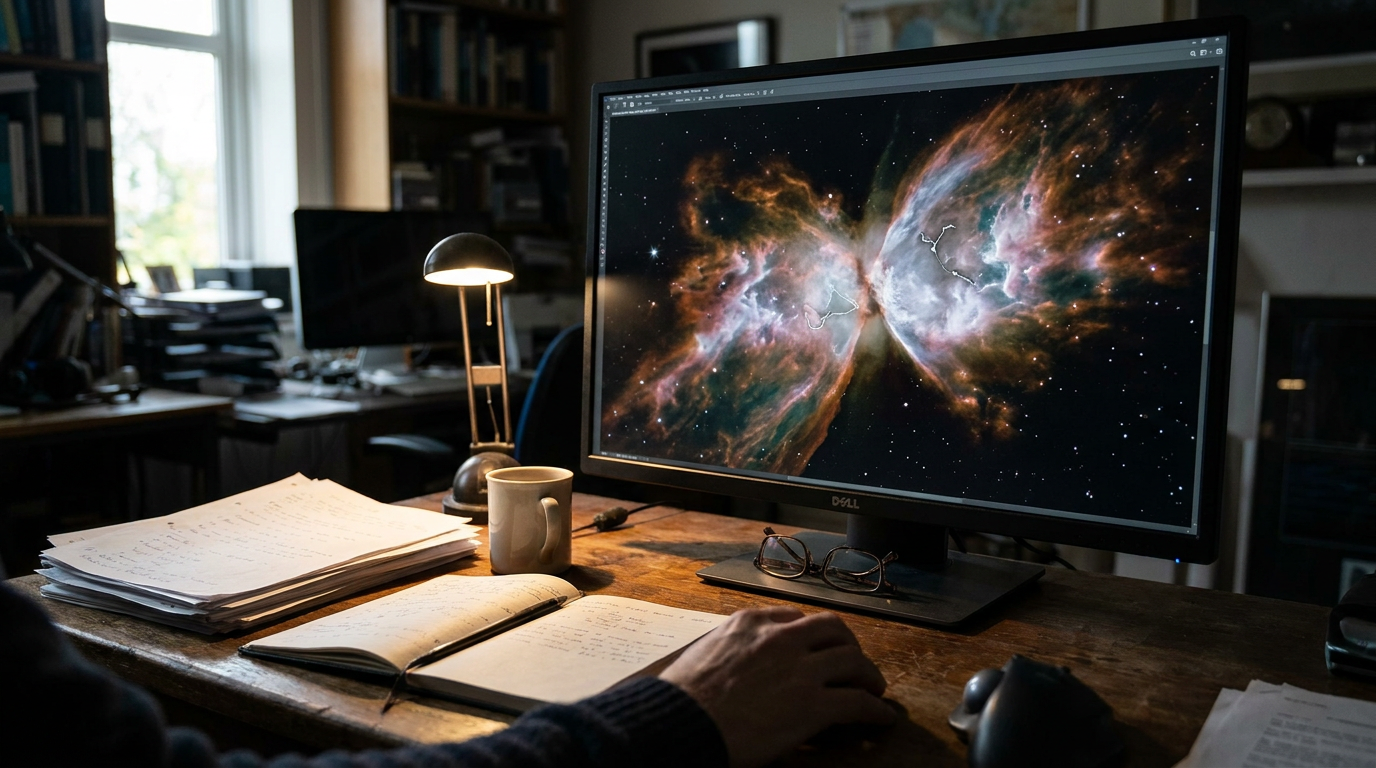
The wings are a lie, or at least a distraction. When astronomers photograph NGC 6302 — the object popularly known as the Butterfly Nebula — what catches the eye are those luminous lobes of gas spreading outward from a central waist, a shape that genuinely does resemble something with wings. The image is beautiful. It is also, if you know where to look, a crime scene. Every streamer of ionized gas, every pinched corridor of dust, every collimated jet driving outward at hundreds of kilometers per second carries physical evidence of a death that was neither quiet nor simple. The star that made this did not go gently. It went in stages, over thousands of years, shedding mass in pulses and eruptions, shaping its own ejecta with winds and magnetic fields and a geometry that still is not fully understood. What JWST has now given us is the ability to read that evidence at a resolution and a wavelength range we have never had before. And what it is showing us looks less like a death cloud and more like a structured archive.
NGC 6302 sits roughly 3,800 light-years away in the constellation Scorpius. The central star — the white dwarf remnant responsible for everything we see — is among the hottest known stellar cores in the Milky Way, with a surface temperature estimated at well above 200,000 Kelvin. It is so hot, and so intensely ultraviolet-bright, that it ionizes the gas around it out to enormous distances, making the nebula glow. But the star itself, for most of astronomical history, was invisible to us. Buried inside a thick equatorial band of dust called a torus, it refused to show itself at optical wavelengths. You could see the wings. You could not see the body. This matters because the torus is not incidental to the story. It is one of the story's most important chapters.
Planetary nebulae — the category NGC 6302 belongs to, despite the name having nothing to do with planets — are what happens when a low-to-intermediate mass star runs out of hydrogen fuel in its core and begins its terminal sequence. The star expands into a red giant, begins fusing helium, periodically sheds its outer layers in thermal pulses, and eventually exposes its hot degenerate core to open space. That core becomes a white dwarf. The expelled material becomes the nebula. The whole process takes tens of thousands of years. The nebula itself, expanding and thinning, will eventually dissolve into the interstellar medium and become undetectable over timescales of perhaps a hundred thousand years. What JWST is observing right now is a moment somewhere in the middle of that dissolution — a still-readable record before it disperses beyond recovery.
What makes NGC 6302 unusual is not just its beauty or its extreme central star temperature. It is the violence and the layering. The nebula shows evidence of multiple mass-loss episodes at different velocities and different orientations, jets that appear to have shifted direction over time, molecular gas coexisting with fully ionized plasma in distinct spatial zones[4], and a dust chemistry that tells a different story depending on which direction you look. It is not a single explosion. It is a palimpsest — a surface written on, partly erased, and written on again. Reading it requires instruments that can see across a wide span of wavelengths simultaneously. That is exactly what JWST was built to do.
The Torus That Swallowed the Evidence
The equatorial dust torus of NGC 6302 is the structure that controls almost everything else about the nebula's shape. In the simplest physical picture, a torus of dense gas and dust around a dying star acts as a nozzle[1]: the stellar wind, which would otherwise expand spherically, is squeezed toward the poles, producing lobes instead of a sphere. This is one of the leading explanations for why so many planetary nebulae are bipolar — elongated and winged rather than round — and NGC 6302 is one of the most dramatically bipolar examples known. But the JWST observations are revealing that the torus in NGC 6302 is not a single simple structure. It has internal stratification. There are regions of warmer dust nearer the hidden white dwarf, and cooler dust farther out, suggesting that the torus was built up gradually across multiple mass-loss events rather than deposited all at once. Some portions appear chemically distinct — carbon-rich dust signatures in certain zones, oxygen-rich mineral signatures in others. The star, in other words, changed its atmospheric chemistry as it evolved, and the torus preserved those changes in layers, the way a sedimentary rock column preserves the history of a sea floor.
“The torus is not incidental debris. It is the most chemically detailed chapter in the star's biography, written in dust.”
This chemical layering has real implications. Stars on the asymptotic giant branch — the evolutionary stage before planetary nebula formation — undergo a process called third dredge-up[2], where convection carries carbon produced in the helium-burning shell up into the star's outer layers. Over successive thermal pulses, a star that begins as oxygen-rich on its surface can become carbon-rich. The dust it sheds changes accordingly. An oxygen-rich star sheds silicate grains; a carbon-rich star sheds carbonaceous dust. Finding evidence of both types in the torus of NGC 6302 is not paradoxical — it is a record of the star passing through that transition, shedding different material at different points in its evolution. The torus is not a snapshot. It is a timeline.
Jets That Changed Direction Mid-Story
The wings themselves are not a single smooth outflow. JWST's near-infrared and mid-infrared imaging, combined with spectroscopic data, are showing that the lobes of NGC 6302 contain multiple distinct outflow components moving at different velocities and at slightly different angles. Some of these were clearly launched earlier than others. The outer tips of the lobes carry older, faster ejecta; interior structures are associated with more recent mass-loss events. And there are regions where the jets appear to have precessed — tilted — over time, leaving faint arcs and knots in the nebular gas that trace the history of that shift. Jet precession in planetary nebulae is not well understood. One favored mechanism involves a binary companion: if the dying star has a companion star orbiting it, gravitational interaction can cause the accretion disk around the companion to wobble, redirecting the jets periodically. There is indirect evidence that NGC 6302's central system may be binary, though direct detection of the companion has not yet been confirmed. The jet geometry itself is part of the argument — the precession signature is there in the gas, preserved in the pattern of knots and arcs, even though the mechanism producing it remains contested.
“The jets did not fire once and stop. They rotated, stuttered, and fired again — and the gas cloud remembered every angle.”
The velocities involved deserve a moment of attention. The fastest outflows in NGC 6302's lobes are moving at roughly 600 to 800 kilometers per second in some reconstructed models. These are not gentle exhalations. They are supersonic flows fast enough to cross the distance between Earth and the Moon in under ten minutes. Where these high-velocity jets slam into the slower-moving gas that preceded them, they create shock fronts — compression zones where kinetic energy is rapidly converted into heat and radiation. JWST can detect the emission signatures of those shocks: molecules like molecular hydrogen that survive in the cooler outer regions but are dissociated at the shock front, leaving behind atomic emission as a tracer. Mapping these shock regions gives astronomers a way to reconstruct the history of the outflows in chronological order, from oldest and outermost to youngest and most interior. The nebula, read this way, is a velocity-coded timeline.
What the Gas Remembers
One of the more striking features emerging from JWST observations of NGC 6302 is the coexistence of gas phases that should not, in a simple model, occupy the same space at the same time. Fully ionized plasma and cold molecular gas are separated by distances that seem too small given how energetically the central star is radiating. This is a version of a broader puzzle in nebular physics: the fact that molecules survive inside planetary nebulae at all, given the intense ultraviolet flux from the central white dwarf, implies that they are shielded — either self-shielded in dense clumps, or protected by surrounding dust. The clumps themselves, visible in JWST imagery as small dense knots embedded in the diffuse gas, are likely the remnants of instabilities that developed at the interface between fast and slow winds early in the nebula's expansion. They are, in a sense, compressed fossils — pockets of gas that were squeezed by the collision of outflows and have survived because their density made them harder to ionize. In a few tens of thousands of years, they will be gone. Right now, they are still readable.
The molecular inventory JWST can detect at mid-infrared wavelengths is particularly valuable here. Water ice, polycyclic aromatic hydrocarbons, carbonaceous compounds, and silicate minerals each have distinct spectral fingerprints in the infrared. By mapping the spatial distribution of these signatures across the nebula, astronomers can trace not just where the dust is, but what the star was doing when it shed that particular material. This is stellar archaeology conducted with light. The dust grains drifting outward through NGC 6302 today were forged inside the star's outer envelope under specific temperature and pressure conditions. They carry that manufacturing history encoded in their crystal structure and chemical composition. Some of those grains, when the nebula eventually disperses, will drift through the interstellar medium and eventually be incorporated into the next generation of star-forming clouds. Some fraction of the dust in our own solar system came from previous stars that died in exactly this way. The calcium in teeth and the silicon in rock passed through something like this before the Sun existed.
The Star at the Center of Everything
The white dwarf hidden inside the torus is the author of all this, and it remains frustratingly difficult to study directly. Its temperature has been estimated from the ionization state of the surrounding gas: certain ionic species require extremely energetic photons to produce, and the presence of those species sets a lower bound on how hot the central source must be. The resulting estimates — well above 200,000 Kelvin[3], possibly higher — make this one of the hottest white dwarfs currently known. By comparison, the surface of the Sun sits at around 5,778 Kelvin. The white dwarf in NGC 6302 is more than thirty times hotter. It radiates overwhelmingly in the extreme ultraviolet and soft X-ray range, energy that the dust torus absorbs and then reradiates at infrared wavelengths — which is partly why the torus is so bright in JWST's infrared channels. The star is powering everything, including its own obscurement.
What this star was before it became a white dwarf is a matter of inference. Its current mass — reconstructed from various lines of evidence — suggests the original star may have been somewhere between three and five times the mass of the Sun, possibly more. A star of that mass lives a few hundred million years, burns through its fuel relatively quickly by stellar standards, and ends with more dramatic mass-loss than a Sun-like star would. The total mass of gas and dust expelled to form NGC 6302 is estimated at something close to a solar mass — an enormous quantity of material, thrown outward over the course of the star's final few hundred thousand years. The brightness and complexity of the nebula both reflect that original mass. Heavier stars die louder.
Reading the Archive Before It Disperses
There is a clock embedded in this observation that is easy to overlook. NGC 6302's lobes are expanding. The outer edges are moving outward into space right now, thinning and cooling as they go. The molecular clumps will eventually be eroded by the UV radiation from the central star. The dust torus will thin and dissipate. The shock fronts will run out of fresh material to compress. In perhaps fifty to one hundred thousand years — a span short by astronomical standards — NGC 6302 will no longer look like this. The white dwarf will cool over billions of years and become a dark, invisible cinder. The gas and dust will have spread so thin that no telescope will see them as a discrete object. The record will be gone. JWST is observing this nebula at a moment when its biography is still legible, still internally structured, still full of evidence that has not yet been scattered beyond reading. That is not a dramatic metaphor. It is a literal observational window, and it is closing.
“In fifty thousand years, the record will be too dispersed to read. We are looking at it right now, at the last moment it makes sense.”
What NGC 6302 is offering us, through JWST's infrared eyes, is not just a beautiful image or a catalog of features. It is a demonstration that stars do not simply die — they compose. Every thermal pulse, every change in surface chemistry, every precession of the jets, every shock front where fast gas caught slow gas, has left a physical imprint in the expanding shell. A star that burned for several hundred million years compressed the record of that entire life into an object we can now photograph and analyze before it dissolves. The universe is not quiet. It is full of structures exactly like this — records of violence and transformation, written in gas and dust and electromagnetic radiation, waiting to be read by whatever instruments are sensitive enough to catch the signal before it fades. The Butterfly Nebula is not the remains of a star. It is the star's last complete statement about itself.
References
- Bipolar planetary nebulae from common-envelope evolution of binary stars (aanda.org)
Explains the physical mechanism by which an equatorial dust torus acts as a nozzle to redirect stellar wind toward the poles. - Carbon chemistry in Galactic bulge planetary nebulae (academic.oup.com)
Describes the third dredge-up process that allows stars to transition from oxygen-rich to carbon-rich atmospheres during evolution. - Detection of the Central Star of the Planetary Nebula NGC 6302 (arxiv.org)
Establishes that NGC 6302's central white dwarf has a surface temperature exceeding 200,000 Kelvin, making it one of the hottest known stellar cores. - molecular gas coexisting with fully ionized plasma in distinct spatial zones (academic.oup.com)
Provides observational evidence that molecular gas and fully ionized plasma coexist in distinct spatial zones within NGC 6302.
About Mira Solen
Mira Solen writes about deep time, cosmic history, extinct stars, ancient impacts, and the long memory stored in rock, dust, and light. Her work specializes in making the oldest stories in the universe feel vivid, physical, and strangely near.
More like this
Ghosts of the First Stars: What Ancient, Metal-Poor Suns Are Telling Us About the Universe's Earliest Chemistry
A small population of stars in the Milky Way's outer halo carries chemical signatures from before the universe knew how to make iron — and what spectrometers are finding in them is forcing a rethink of how fast the early cosmos grew complex.
JWST Found a Planet That Shouldn't Exist — Orbiting a Dead Star, Raining Diamonds
A Jupiter-mass planet orbiting a millisecond pulsar carries a helium-and-carbon atmosphere that no known formation pathway can produce — and the physics of what falls from its sky is stranger still.
The Universe's Oldest Supernova Just Rewrote What Stars Could Do at Cosmic Dawn
JWST confirmed a supernova from when the universe was just 730 million years old — and its unsettling resemblance to modern explosions is forcing astronomers to rethink what the earliest stars were even supposed to be.