A Neutron Star Just Did Something Physics Says Shouldn't Happen That Fast
When a magnetar erupts, it releases staggering energy in an instant — but the faint oscillations buried inside those bursts are the real discovery, and they point straight to what nuclear matter does under pressure nothing on Earth can replicate.
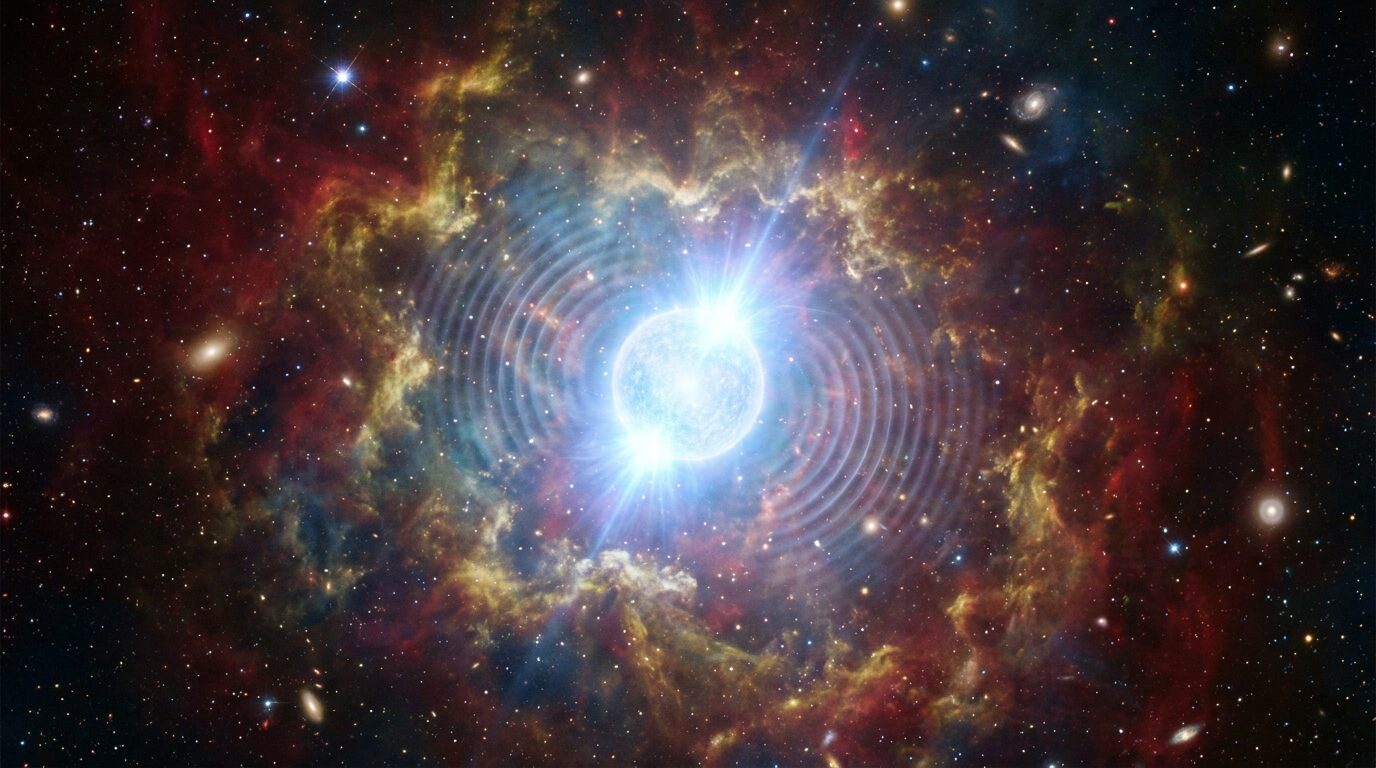
On January 22, 2009, a pulse of gamma-ray energy arrived at Earth from a magnetar designated SGR 1550−5418, a collapsed stellar remnant sitting roughly 30,000 light-years away in the direction of the southern constellation Norma. The burst was brief — a few hundred milliseconds from first photon to last. In that interval, SGR 1550−5418 released more energy than the sun will emit across the next 10,000 years. Instruments aboard NASA's Fermi Gamma-ray Space Telescope caught it cleanly, and when researchers worked through the time-resolved data, they found something quieter inside the violence: a faint, repeating oscillation, a periodic wobble in brightness cycling roughly 93 times per second[1], riding inside the burst like a tone buried under thunder.
This kind of signal is called a quasi-periodic oscillation, or QPO, and its presence inside a magnetar flare is not a side note. It is the measurement itself. The frequency at which a neutron star's outer crust vibrates after a catastrophic energy release is, if you know what to listen for, a direct readout of the crust's composition, thickness, and mechanical stiffness. In other words, it is a probe of nuclear matter under conditions no terrestrial laboratory has ever produced or plausibly could. The crust of a neutron star is not rock in any sense that maps comfortably onto geology. It is a lattice of nuclei compressed so hard that the neutrons have begun to bleed out of them, structured into phases of matter that do not have clean names in ordinary physics.
The analogy that keeps appearing in the technical literature — and it is a constrained one, not a loose metaphor — is a ringing bell. Strike a bell, and the tone you hear depends on the metal's density, its elastic moduli, its geometry. The bell encodes its own composition in its sound. A neutron star crust, when a magnetar eruption injects enough energy to set it oscillating, does something structurally similar. The QPO frequency that comes out carries information about the material properties of something no human instrument has ever directly touched. Seismology built by remote detection, across tens of thousands of light-years.
In recent years, improved analysis of archival burst data from Fermi's Gamma-ray Burst Monitor, along with detections from ESA's INTEGRAL satellite and the now-retired Rossi X-ray Timing Explorer, has sharpened the picture considerably. Researchers are not just confirming that QPOs exist inside magnetar flares. They are measuring multiple simultaneous oscillation frequencies within individual bursts and comparing them against families of theoretical neutron star models. The comparison is starting to rule things out — which, in physics, is often more useful than ruling things in.
What a Magnetar Actually Is
A neutron star forms when a massive star's iron core collapses at the end of its life, typically in a matter of milliseconds, compressing roughly 1.4 times the mass of the sun into a sphere about 20 kilometers across. The density that results is nearly impossible to scale intuitively. A single teaspoon of neutron star material, transported to Earth, would outweigh every human being alive by a margin too large to usefully express in familiar units. The interior pressure is so extreme that individual protons and neutrons are packed essentially touching, and theorists genuinely disagree about whether the deepest core maintains neutrons at all, or whether the quarks inside them deconfine into something else entirely — a quark-gluon plasma, or more exotic phases like strange quark matter, that have no direct laboratory analog.
Magnetars are a subset of neutron stars distinguished by magnetic fields that dwarf even the already extraordinary fields of ordinary pulsars. Where a typical pulsar might sustain a surface magnetic field of around 10 to the 12th gauss — already roughly a trillion times stronger than a refrigerator magnet — magnetars reach 10 to the 15th gauss or beyond. Fields that strong are not passive. They stress the crust. They drive electric currents through the magnetosphere. When the internal magnetic field evolves, twists, or suddenly reconnects, it can fracture the crust in an event analogous in mechanism, though nothing like in scale, to a starquake. The energy deposited in that fracture, and in the associated magnetic flare above the surface, is what produces the giant burst — the event that makes the crust ring.
“The frequency at which a neutron star's crust vibrates after an eruption is a direct readout of nuclear matter under conditions no laboratory has ever replicated.”
The Signal Inside the Storm
Detecting a QPO inside a magnetar burst requires both the right instrument and careful statistical work. The burst itself is overwhelmingly bright in gamma rays and hard X-rays — a flash that would, from close range, represent a threat no spacecraft shielding could address. From 30,000 light-years, it is detectable, but the oscillation riding within it is a second-order feature, a variation in brightness on the order of a few percent of the total flux, cycling at frequencies between roughly 18 and several hundred hertz depending on the event and the mode being observed. To extract that signal from the noise, researchers compute Lomb-Scargle periodograms or Fast Fourier Transforms on the burst's time-series photon data, then compare the resulting power spectra against null-hypothesis distributions to determine whether a periodic peak is statistically robust.
The landmark events that anchored this field were the giant flares from SGR 1900+14 in 1998 and the extraordinary December 27, 2004 flare from SGR 1806−20, which remains one of the most energetic events ever observed in the Milky Way. The 2004 event briefly outshone the full X-ray sky and was detected by instruments not specifically designed to handle anything near that intensity. RHESSI, Rossi XTE, INTEGRAL, and a collection of other spacecraft all recorded some portion of it. Within the long pulsating tail that followed the initial hard spike, researchers identified QPOs at multiple frequencies — 18, 26, 30, 92, 150, 625, and 1840 hertz[2], among others — a rich spectrum that looked, and was eventually modeled, as a set of overlapping torsional vibration modes, the crust twisting against itself at harmonically related frequencies.
These are not the only mechanisms theorists have proposed. The oscillations may also couple to the neutron star's fluid interior — specifically to a superfluid of neutrons that likely fills much of the star's volume — and to the magnetosphere itself. Disentangling which modes are purely crustal from which involve the full star's elastic response is an active modeling problem. But even in their ambiguity, the frequencies constrain the possibilities. You cannot produce an 18-hertz shear mode in a crust with the wrong thickness or the wrong composition. The data do not care about the model's elegance. They prefer whichever crust description makes the right tones come out.
The Equation of State Problem
The equation of state of dense nuclear matter is one of the central unsolved problems in high-energy astrophysics. What it describes, in practical terms, is the relationship between pressure, density, and temperature inside a neutron star — a relationship that determines the star's size for a given mass, how stiff or soft its interior is, and whether exotic states of matter exist at its core. Different theoretical proposals for this relationship generate different predictions for neutron star radii and maximum masses. In the last decade, two separate lines of observational constraint have sharpened this. Gravitational wave detections from neutron star mergers, particularly GW170817 observed by LIGO and Virgo in 2017[3], placed limits on the tidal deformability of neutron stars — essentially how easily they distort under each other's gravity before merger. Simultaneous X-ray timing and spectroscopy from the Neutron Star Interior Composition Explorer, NICER, mounted on the International Space Station, has directly measured the radius and mass of several neutron stars by tracking how X-ray hotspots on their surfaces shift in brightness as they rotate.
“The QPO spectrum from a single burst can rule out entire families of neutron star interior models — not by matching theory, but by refusing to.”
QPO asteroseismology from magnetar flares adds a third leg to this constraint triangle. Where LIGO and NICER measure bulk properties — mass, radius, deformability — the crust oscillation frequencies probe the solid outer layer specifically: its shear modulus, its breaking strain, the density gradient between the outer ionic lattice and the deeper neutron-rich regions where theoretical structures called nuclear pasta are predicted to exist. These pasta phases — named unsatisfyingly but accurately after their shapes: spaghetti, lasagna, gyroids — are what nuclear matter is predicted to form when density becomes high enough that individual nuclei lose their identity and merge into extended geometric structures. Whether those phases actually exist, and how they alter the crust's mechanical properties, can in principle be read out from whether the observed oscillation frequencies match the theoretical modes that a pasta-containing crust would produce versus one that transitions more sharply to a fluid interior.
What the Recent Detections Are Ruling Out
Analysis of QPOs from smaller, more frequent magnetar bursts — not just the giant flares but the moderate events that Fermi's Gamma-ray Burst Monitor detects multiple times per year from active magnetars like SGR J1935+2154 — has begun generating a body of data large enough to run statistical comparisons across event populations. The emerging picture from this work is that certain classes of equation-of-state models, particularly the softest ones that predict the most compressible, smallest-radius neutron stars, struggle to reproduce the observed frequency distributions across multiple sources. Models requiring a thick, stiff crust with a high shear modulus produce overtone frequencies inconsistent with what the data show. This is constraint by elimination, which is slower and less dramatic than a single confirming measurement, but it is how physics actually works in regimes where no direct experiment is available.
There is also a newer complication that has energized the modeling community. The April 2020 detection of a fast radio burst from SGR J1935+2154 — the first fast radio burst ever confirmed to originate from within the Milky Way[4] — added a layer to the magnetar picture. Fast radio bursts are intense millisecond pulses of coherent radio emission that, when observed from distant galaxies, have seemed to demand explanations involving compact object activity. The SGR J1935+2154 event linked them directly to magnetar flares. That association raises the question of whether the same crustal dynamics driving QPOs also couple to the radio emission mechanism, and whether QPO frequencies in X-ray bursts and the timing structure of associated radio pulses carry complementary information about the same underlying physical event. The data pipeline for investigating this is still being built.
The Instruments Still in Play
The observational campaign targeting magnetar QPOs is not resting on archival data alone. NICER continues timing observations of known magnetars between burst events, tracking pulse profile evolution that can indicate when the magnetic field configuration is shifting — a possible precursor to burst activity. ESA's XMM-Newton and NASA's Chandra X-ray Observatory have contributed high-resolution spectral data from magnetar surfaces during quiescent periods, constraining surface temperatures and emission geometries that feed into structural models. The planned ESA mission NewAthena, an X-ray observatory with significantly larger collecting area than any current instrument, is expected to transform burst time-series analysis by delivering far higher photon counts from individual events — which means better QPO statistics, tighter frequency measurements, and the ability to track oscillation amplitude decay in detail, not just locate the dominant frequency.
“A neutron star does not offer direct samples, but it offers signals — and those signals, properly decoded, carry the same information a sample would.”
On the theoretical side, nuclear physicists working in dense matter are beginning to run detailed elastic wave calculations through realistic crustal models that incorporate recent improvements in nuclear interaction potentials — the forces governing how individual neutrons and protons interact at high density. Those calculations are starting to make sharper frequency predictions than the previous generation of models, which means the observational targets are getting more precisely specified. The loop between instrument, detection, statistical analysis, and theoretical refinement is closing, slowly but visibly.
What a Ringing Crust Actually Tells Us
It is worth holding the geometry of this problem clearly in mind. The crust of a neutron star is roughly one kilometer thick on a body 20 kilometers across. That crust is supported beneath by a superfluid interior and above by a magnetosphere threading through at field strengths that make MRI machines look negligible. When a fracture releases enough energy to set this layer oscillating, the oscillation frequency depends on how quickly shear waves propagate through the material — which depends on the stiffness of the nuclear lattice, which depends on the density and charge distribution of the nuclei arranged within it, which depends on the underlying nuclear force at densities 10 to 14 times that of ordinary atomic nuclei. There is no other way to probe this regime. Particle accelerators compress matter at high temperature; neutron star crusts compress it at comparatively low temperature and extreme density. The physics is distinct. The neutron star is not a collider result scaled up. It is doing something different, and the QPO is, at present, one of very few windows into it.
What makes this moment particularly interesting is not that we have solved the equation of state. We have not. The constraints from QPO asteroseismology, NICER radius measurements, and LIGO tidal deformability are beginning to overlap, and their overlap region is narrowing — which tells us we are circling the answer — but the residual uncertainty is still large enough to leave room for meaningfully different pictures of what occupies the deep interior. The fact that the data are doing the work of elimination, ruling out specific model families through disagreement rather than through ignorance, is what marks this as a different phase of the problem than the one physicists were working in twenty years ago. A magnetar flare lasts half a second and burns with the luminosity of galaxies. The faint oscillation buried inside it lasts a few seconds longer, cycling dozens of times before it damps out. That fading ring, measured photon by photon by instruments orbiting Earth, is one of the most physically informative signals the universe currently allows us to receive.
References
- Quasi-Periodic Oscillations in Short Recurring Bursts of the magnetars SGR 1806-20 and SGR 1900+14 Observed With RXTE (arxiv.org)
Provides detection of 93 Hz quasi-periodic oscillation in magnetar bursts from SGR 1806-20 using Rossi X-ray Timing Explorer data. - The 2004 Hyperflare from SGR 1806-20: Further Evidence for Global Torsional Vibrations (ntrs.nasa.gov)
Documents multiple oscillation frequencies (18, 26, 30, 92, 150, 625, 1840 Hz) detected in the December 2004 SGR 1806-20 hyperflare. - Properties of the Binary Neutron Star Merger GW170817 (link.aps.org)
Provides gravitational wave constraints on neutron star tidal deformability from the GW170817 merger event observed by LIGO and Virgo. - SGR 1935+2154 (en.wikipedia.org)
Identifies SGR 1935+2154 as a magnetar in the Milky Way that produced the first confirmed fast radio burst from within our galaxy.
About Elias Voss
Elias Voss writes about astronomy, space missions, telescope discoveries, and cosmic anomalies - and why it matters to us here on Earth. When the universe's physics reaches down and touches life on our planet, he follows it there too. He specializes in translating dense data into vivid, precise stories without sacrificing accuracy.
More like this
The FRB That Fired 11,553 Times Has a Math Problem. The Standard Model Can't Solve It.
A hyper-active fast radio burst has already burned through most of what a magnetar can store — and the source was still going when astronomers stopped watching.
The Radio Burst Lasted a Millisecond. The Argument About It Has Lasted Years.
Fast radio bursts arrive from across the universe in under a millisecond — brilliant, violent, and until recently, assumed to be unrepeatable. A handful of them have since proved that assumption wrong, and the physics debate that followed is far from over.
Astronomers Watched a Magnetar Be Born. The Universe Was Blinking.
A supernova's strange, rhythmic afterglow gave astronomers their clearest look yet at the moment one of the universe's most extreme objects switches on.