A Skirt Kept in a Freezer for 61 Years Finally Told Its Story
The Mary Theresa Simpson case wasn't solved by a lucky database hit — it was solved by coaxing a usable genetic profile out of 0.4 nanograms of sixty-year-old biological material, then tracing it through living relatives to a grave.
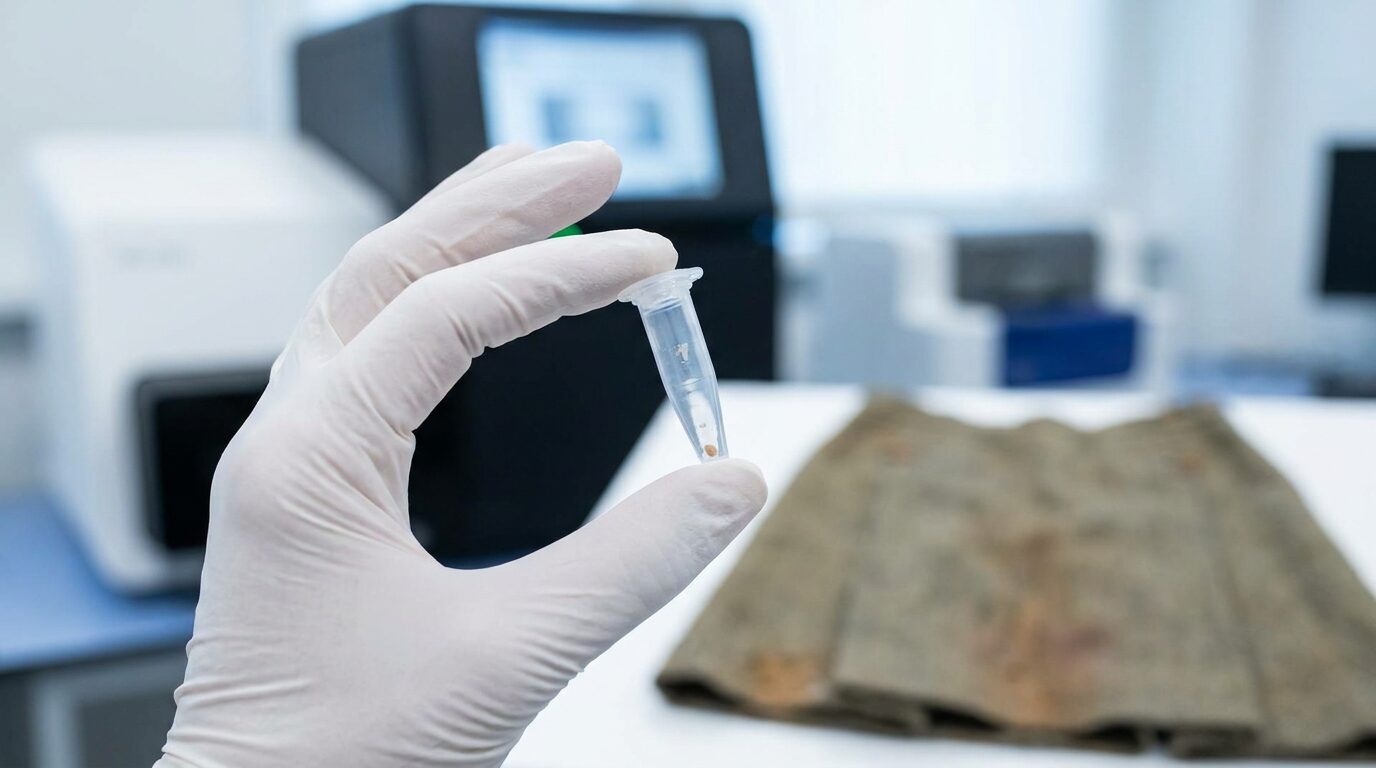
The skirt had been sitting in a freezer at Elmira Police Department headquarters for decades. Not displayed. Not discussed. Just stored, in the dim bureaucratic faith that evidence worth keeping might someday be evidence worth reading. The officers who first bagged it in March 1964 had no way to sequence a genome. The concept didn't exist. They preserved the clothing anyway, the way careful investigators always have — because physical matter holds a record of events whether or not the tools to read it have been invented yet.
Mary Theresa Simpson was twelve years old when she was last seen walking home from visiting relatives in Elmira, New York, on the evening of March 15, 1964. Four days later, her body was found in a wooded area seven miles from her home, partially hidden under four heavy stones, her mouth stuffed with dirt and twigs. She died from asphyxiation. By October of that year, police had already questioned 300 suspects. No arrest was ever made. The case went cold — not for lack of trying, but for lack of the instrument that would eventually matter most.
What investigators ultimately had to work with was approximately 0.4 nanograms of DNA[3] — an amount invisible to the naked eye, according to lead investigator Sgt. William Goodwin. "The limited quantity of DNA played a role in both the complexity and the time required to move this case forward," Goodwin said. "When DNA testing is performed, the DNA itself is consumed in the process. There are no do-overs, and we understand that if a usable SNP profile cannot be developed, we would've likely exhausted all remaining DNA evidence in this case." That was the entire bet. One sample. One run. No second chance.
What 0.4 Nanograms Actually Means
To understand what happened in this case, it helps to understand what DNA degradation actually does to a biological sample over sixty years. DNA is not a stable archive. Upon an organism's death, enzymatic repair ceases, exposing the genome to free cellular nucleases and proliferating microorganisms that cause DNA loss; and preservation is highly dependent on environmental conditions, with less favorable environments accelerating that degradation. Semen on fabric stored frozen fares far better than most biological evidence left in soil or open air — cold temperature slows enzymatic activity, limits microbial access, reduces oxidative stress on the sugar-phosphate backbone of the DNA strand itself. But even under good conditions, six decades of molecular entropy take a toll. The double helix fractures. Long sequences break into shorter and shorter fragments. Information that was once continuous becomes interrupted, like a document shredded into confetti and then left in a damp drawer.
Conventional forensic DNA profiling — the kind that checks the roughly twenty short tandem repeat markers used in the Combined DNA Index System, known as CODIS — depends on being able to amplify those specific regions reliably. When a sample is sufficiently degraded, the target sequences are too fragmented to amplify cleanly. In 2003, thirty-nine years after the murder, DNA found from semen on the skirt was entered into the national database. It was re-submitted again in 2014. Still nothing. No match means no hit — but it doesn't necessarily mean the sample held no information. It means the tools being used couldn't read what was there.
“The double helix fractures. Long sequences break into shorter and shorter fragments. Information that was once continuous becomes interrupted, like a document shredded into confetti and left in a damp drawer.”
The shift that made Mary Theresa's case solvable was a methodological one. Othram, the Texas-based laboratory that eventually received the sample, specializes in extracting and sequencing DNA from challenging evidence — old, degraded, or present only in trace amounts — using what they call Forensic-Grade Genome Sequencing[2] to build a comprehensive profile from hundreds of thousands of genetic markers. That is an entirely different operation than conventional CODIS profiling. Rather than targeting twenty fixed loci, whole-genome sequencing reads across the entire accessible genome — however fragmented — and assembles overlapping short reads into a coherent profile. The more markers you read, the more you can infer ancestry, family relationships, and ultimately, identity. Advances in DNA technologies have substantially increased the successful analysis of aged, degraded, limited, or otherwise compromised biological evidence — meaning crime scene samples once thought unsuitable for testing may now yield usable profiles. The sample hadn't changed. The instrument had.
A Family Tree Built From a Ghost
The Elmira Police Department, partnering with the FBI and backed by a 2022 grant from the nonprofit Season of Justice, sent the evidence to Othram in 2023. Investigators then partnered with Othram and students from Russell Sage College to conduct genealogical analysis. What Othram produced from that invisible fragment wasn't a name — it was a SNP profile, a pattern of single-nucleotide polymorphisms, the tiny one-letter variations scattered across the genome that distinguish one person's DNA from another's. That profile was uploaded into public genealogy databases, the same repositories that millions of people populate when they spit into a tube and mail it to a company to learn about their ancestry. The technique is called investigative genetic genealogy, and it works because DNA inheritance is predictable: the closer the biological relationship, the more SNPs two people share. If the killer's DNA had been uploaded somewhere, even distantly, the pattern would leave a shadow in the family trees of anyone related to him. As we've covered at BrainHook, this approach fundamentally changed cold-case investigation after 2018 — and it keeps producing results that conventional database searches cannot.
By 2025, investigators had identified Alfred Murray Jr., who had died in 2004, as a suspect. They then collected a DNA sample from his son, which confirmed that his DNA was related to the DNA found on Simpson's skirt. A living relative's voluntary buccal swab — just cells scraped from the inside of a cheek — confirmed the biological relationship. Analysis determined that the SNP profile was identified as the biological parent of the sample donor. Murray's son's DNA pointed back to his father the way a compass needle points north: not by naming Murray directly, but by establishing that whoever left that biological material on Mary Theresa's skirt had the same genome that would have produced this man's cells.
Exhuming the Certainty
In November 2025, Elmira Police and the District Attorney's office exhumed the grave of the person believed to be involved, with financial assistance from the National Center for Missing and Exploited Children, for testing by a forensic anthropologist from Detroit. Exhuming remains to extract DNA for comparison has become a recognized step in cases where the primary suspect is dead — bone, particularly dense cortical bone, can preserve nuclear DNA for decades under the right burial conditions. The sample recovered from Murray's remains was compared against the sixty-year-old evidence from the skirt. The comparison confirmed a match. The odds that the DNA belonged to a person other than Murray were less than one in 320 billion.
That number is worth pausing on. One in 320 billion is not a probabilistic suggestion. There are roughly eight billion people alive on Earth. The figure means that if you sampled every human being currently living, you would expect to find fewer than one person other than Alfred Murray Jr. whose genome could have produced that evidence. The match is, for all practical purposes, singular. Murray had never previously been considered a suspect in the case. The Elmira Police Department's formal announcement on February 10, 2026 made this the eighteenth case in the state of New York solved by Othram.
“One in 320 billion is not a probabilistic suggestion. There are roughly eight billion people alive on Earth. The figure means the match is, for all practical purposes, singular.”
The Logistics Were Nearly as Fragile as the DNA
FBI Special Agent Kenneth Jensen, who was assisting the Elmira Police Department, knew what was at stake when the sample was finally ready to ship. If it failed, the case would likely die with it. He packed the fragile evidence in dry ice in a cooler and sent it to the Texas lab. Then everything froze. An ice storm had shut down the FedEx hub in Memphis — the largest in the world — where the package was routed. The shipment sat stranded. If the dry ice gave out, decades of waiting would end in irreversible loss. The DNA inside that cooler would not wait for weather. Dry ice sublimates continuously; it does not pause. Eventually, a bureau liaison to the FedEx hub located the stranded package after what Goodwin described as a massive scavenger hunt. An FBI agent found it just in time, put the DNA in the bureau's freezer until the ice storm ended, then shipped it to the lab. The science that followed was extraordinary. Getting there was almost not.
The Infrastructure That Makes This Possible — and the Questions It Opens
Cases like Mary Theresa Simpson's don't close themselves. They require a specific combination of preserved physical evidence, analytical technology capable of reading degraded samples, genealogy databases large enough to contain a partial relative, and investigators tenacious enough to keep submitting grant applications years after the trail has gone cold. Remove any one of those elements and the case remains open. NIST released a new forensic DNA reference material in early 2026[1] — the first to include degraded DNA as well as mixtures of high-quality DNA from different individuals — specifically to help crime laboratories accurately analyze genetic evidence that has degraded or contains DNA from multiple people. The field is actively building the infrastructure to handle the kinds of samples that were once considered unworkable. The same week the Elmira announcement was made, a separate cold case in Charlotte was closed using probabilistic genotyping software, a forensic tool that uses mathematical algorithms and biological modeling to analyze complex or degraded DNA samples. These are not isolated breakthroughs. They are the early returns of a systematic investment in reading evidence that previous generations had to set aside.
None of this is without tension. Investigative genetic genealogy works by searching databases built from people who uploaded their DNA voluntarily for personal reasons — ancestry, health screening, curiosity — and then using their profiles to trace biological relatives they may never have met, including relatives who committed crimes. The privacy implications of that search radius extend well beyond any individual user's consent. The use of investigative genetic genealogy is not without debate. It raises important questions about genetic privacy and consent. The Department of Justice has issued interim guidelines, but this remains a developing area of law and ethics that the forensic community must navigate carefully. The same technique that finally named the man who killed a twelve-year-old girl in 1964 pulls on threads connecting millions of people who simply wanted to know where their great-grandparents came from.
More than 61 years after Mary Theresa Simpson was killed, advanced forensic DNA sequencing and genetic genealogy identified her killer. According to NCMEC, it is the oldest case ever solved with DNA. Alfred Murray Jr. died in 2004, twenty-two years before the announcement. He was never interviewed, never charged, never confronted with what he had done. "If Murray was alive, he would be charged with murder," Police Chief Kristen Thorne said. The biology produced its answer anyway. The evidence was already in the fabric. It took six decades, a freezer, a storm-stranded cooler, a laboratory in Texas, a willing son's cheek swab, and a grave opened in November to finally let it speak.
References
- NIST Releases New Forensic Genetic Reference Material to Help Crime Laboratories Analyze Challenging Cases (nist.gov)
- Using DNA to Solve Cold Cases: Special Report | Office of Justice Programs (ojp.gov)
Establishes that forensic-grade genome sequencing can extract usable profiles from aged, degraded, or trace-amount biological evidence unsuitable for conventional testing. - Justice after 61 years: Solving the murder of 12-year-old Mary Theresa, one for record books (missingkids.org)
Provides the 0.4 nanogram DNA quantity and confirms the sample's invisibility to the naked eye, establishing the extreme scarcity of evidence investigators worked with.
About Aris Thorne
Aris Thorne is a microbiologist who writes about the hidden mechanics of ordinary life: the microbes running your home, the chemistry unfolding in food and water, the physics built into familiar objects, and the biological systems quietly keeping the human body alive. His work follows science from kitchens, bathrooms, dust, soil, and city air into wounds, immune responses, infections, medicines, cells, and other worlds. He is most interested in the moment something familiar stops looking simple and reveals the living machinery underneath.
More like this
DNA Genealogy Solved a 39-Year-Old Sex Crime—Two Days Too Late
Forensic genealogy just closed a 39-year-old kidnapping and sexual assault—but the man charged died before investigators could reach his door.
The Government Called Unidentified Remains a 'Silent Disaster.' Now DNA Is Naming the Dead.
America's unidentified dead have been piling up in morgues for decades — and the forensic genealogy companies working to name them are doing it with science that would have seemed impossible fifteen years ago.

The Paper Bag Solved a 38-Year Murder Nobody Was Looking At
A 1987 homicide stayed cold not because the evidence was lost, but because the right question wasn't asked until 38 years later — and the answer was inside the most unremarkable items at the scene.