The Paper Bag Solved a 38-Year Murder Nobody Was Looking At
A 1987 homicide stayed cold not because the evidence was lost, but because the right question wasn't asked until 38 years later — and the answer was inside the most unremarkable items at the scene.
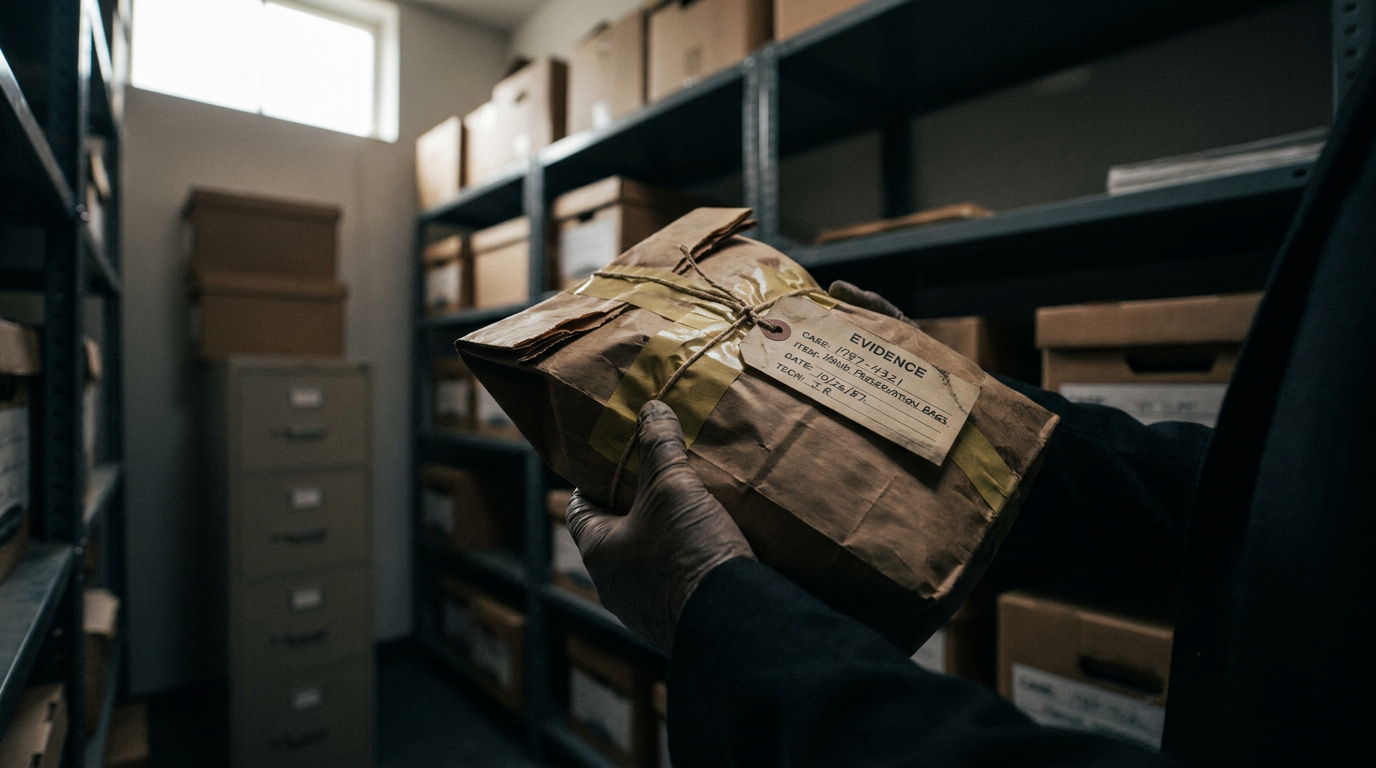
The paper bags were not exotic evidence. They were procedure — the kind of decision a crime scene technician makes in under thirty seconds, without much deliberation, because the manual says to do it and the reasoning is sound. When a body shows signs of a struggle, you preserve the hands. You slide a brown paper bag over each one and secure it at the wrist, creating a sealed environment that protects whatever fibers, soil, or biological material might be caught under the fingernails or pressed into the skin. Paper, not plastic, because plastic traps moisture and degrades what you're trying to save. The bags go into the evidence log. The body goes to the medical examiner. And in most cases from the 1980s, that is where the hands stop mattering — because the technology to fully interrogate that environment didn't exist yet, or didn't exist cheaply enough, or the case moved in a different direction before anyone thought to go back.
In 2025, investigators working a 1987 homicide cold case submitted those original evidence bags for modern DNA analysis[4]. What came back from the lab was a profile. The profile was run against the national database. And the match that returned was not an unknown subject — it was a convicted serial killer, already incarcerated, already linked to other deaths in other jurisdictions. The case that had sat unresolved for thirty-eight years was resolved, at least in terms of identifying a perpetrator, by material that had been in a storage facility the entire time. Properly catalogued. Properly sealed. Waiting.
This is not a story about a dramatic breakthrough. There was no new witness, no deathbed confession, no tip phoned in after a true crime documentary aired. The evidence didn't surface from a landfill or get rediscovered in a box mislabeled in a basement. It was exactly where the chain of custody said it was. The story is more uncomfortable than a dramatic breakthrough, because it raises a question with real operational weight: how many other paper bags are sitting in storage right now, from cases where nobody has yet asked the question that 2025 technology could answer?
The answer, based on what forensic archivists and cold case units have documented in recent years, is almost certainly: a lot.
What Paper Bags Actually Do
The hand-bagging protocol has been standard practice in American homicide investigation since at least the mid-twentieth century, though its widespread codification came gradually through the 1970s and 1980s as crime scene processing became more systematized. The rationale is straightforward and still valid. Hands are contact surfaces. In violent crimes, they accumulate transfer evidence: the attacker's skin cells shed during a grip, fibers from clothing, hair, soil tracked from a secondary location, and biological material deposited during a struggle. The bag creates a microenvironment. It prevents loss during transport. It prevents contamination from external sources. And paper specifically allows the contents to breathe enough to prevent the condensation cycles that degrade biological samples.
What investigators in 1987 could do with the contents of those bags was limited by the technology of 1987. Serology could tell you blood type. Microscopy could analyze fiber and hair morphology. Touch DNA — the recovery of genetic material from skin cells deposited through casual contact — did not become a practical forensic tool until the early 2000s[3], and even then, sensitivity varied enormously by lab and sample. The idea that a killer's genetic profile might be recoverable from the interior surface of a paper bag, drawn from cells shed during a grip or a struggle recorded on the victim's skin, was not a realistic operational expectation in the late 1980s. The bags were preserved anyway. That is the decision that matters.
“The evidence didn't fail the case. The question failed the evidence.”
Why Cold Cases Have Survivable Evidence
DNA is not infinitely durable. It degrades under exposure to heat, light, moisture, oxygen, and microbial activity. A sample left in an uncontrolled environment — a damp storage locker, a box exposed to temperature swings, a bag that was opened and resealed multiple times — may yield nothing usable after a few decades. But a sample that was properly sealed and stored in a climate-controlled evidence facility can retain testable genetic material for much longer than most people expect. There are documented cases of DNA successfully extracted from biological evidence more than fifty years old[2]. The variables that matter are not primarily time — they are storage conditions and whether the sample was ever meaningfully disturbed.
Paper bags, counterintuitively, are good long-term storage containers for biological trace evidence precisely because they are low-tech. They don't seal airtight, which means they don't trap the humidity cycles that plastic creates. They are inert. They don't off-gas chemicals that would accelerate degradation. A paper bag placed over a hand at a 1987 crime scene and then boxed, tagged, and stored under standard evidence conditions represents a nearly ideal passive preservation environment for the material inside — not because anyone designed it that way for future DNA analysis, but because the design happened to be compatible with what future analysis would need.
This is a pattern that has appeared in other cold case resolutions. Touch DNA recovered from the adhesive side of aging tape. Genetic profiles extracted from old postage stamp licking residue. Cellular material recovered from the interior of gloves that had been tagged and shelved decades earlier. The recurring theme is not ingenuity at the original scene — it is the combination of correct routine procedure, adequate storage, and a later investigator with a newer question. The cases that stay cold are often not the ones where the evidence was destroyed. They are the ones where no one went back to ask what the preserved material might now be able to say.
Serial Killers and the Database Problem
The match in this case came through CODIS — the Combined DNA Index System maintained by the FBI[1], which holds genetic profiles from convicted offenders, arrestees in participating states, and unidentified remains. When a crime scene profile is uploaded and hits a known offender profile in the database, it doesn't solve a case automatically. It identifies a person of interest who can then be evaluated against the full evidentiary record. But in cold case work, a CODIS hit is often the pivot point that transforms a stalled investigation into a prosecutable one.
The detail that makes this particular resolution striking is not just that a match was found — it is who the match was. A convicted serial killer, already in the system for other crimes, already linked to other victims. This is a known phenomenon in cold case forensics: serial offenders, by definition, leave traces across multiple crime scenes, multiple jurisdictions, multiple evidence logs. The problem is that those traces are often analyzed in isolation. A case in one county does not automatically trigger a search of evidence from a similar pattern in a neighboring county. CODIS helps with that, but only when someone takes the step of submitting the sample. The sample in this case was not submitted for thirty-eight years — not because it was forgotten, but because it had never been successfully analyzed under the technologies available at the time, and the case had not been formally reopened.
“Serial offenders leave traces across multiple crime scenes, multiple jurisdictions, multiple evidence logs — but those traces are often analyzed in isolation, by design.”
The implication is uncomfortable. If a serial killer's profile was recoverable from 1987 evidence in 2025, the question is not just whether his other crimes might now be linkable — it is whether any of those other crimes left evidence bags of their own, sitting in their own storage facilities, never submitted because the original investigators didn't know what they'd find. Cold case units in several states have begun systematic audits of exactly this kind: going through older evidence logs, identifying physical materials that were collected but never tested or tested only with now-obsolete methods, and submitting them through current technology. The results, according to reporting on those programs, have not been uniformly dramatic — but they have not been empty, either.
The Evidence Archive as Unfinished Business
Every major police evidence storage facility in the United States holds materials from unsolved cases. Some of those materials are well-documented and actively tracked. Many are not. The challenge is partly logistical — storage capacity, chain of custody documentation, the cost of submitting samples for analysis — and partly conceptual. Evidence collected at a crime scene is collected in response to the investigative questions active at that moment. A 1987 investigator bagging a victim's hands was preserving evidence for 1987 analysis. The idea that those bags might be primary evidence for a 2025 question was not a frame anyone was operating inside.
Forensic archivists — a specialty that has grown significantly in the past two decades — are increasingly working to reframe this. The argument, documented in criminology and forensic science literature, is that physical evidence from a crime scene should be understood not as static documentation of a single investigation but as a resource that will be interrogated differently across time as analytical methods evolve. This sounds obvious in retrospect. It was not operationally obvious in the years when labs were backlogged with current cases and cold case units were underfunded or nonexistent. The reframing is a practical one: it changes how evidence is catalogued, how storage conditions are maintained, and critically, how cold case reviews are prioritized.
What it does not change is the basic fact that the evidence has to survive to be reanalyzed. Purged evidence files, evidence destroyed after a statutory period, materials lost in institutional moves or storage facility failures — these are permanent losses. The 1987 case resolved in 2025 worked because the bags were still there. That is not guaranteed. Several states have statutory provisions allowing evidence destruction in certain categories of closed or cold cases, provisions that were written before the current generation of DNA technology existed and before anyone had a clear picture of how much survivable genetic material ordinary evidence packaging could hold.
What the Interval Actually Costs
Thirty-eight years is a long interval to carry an unresolved case. For the victim's family, it is a different kind of interval entirely — one measured in the absence of finality, in the particular weight of a death that was never publicly explained. Cold case advocacy groups have documented extensively what that duration costs families: the repeated requests for updates, the anniversaries that pass without news, the specific grief of a violent death that stays officially open. The resolution of a case at thirty-eight years does not erase that interval. It closes it, which is different.
“The case didn't stay cold because the evidence disappeared. It stayed cold because nobody had yet asked the question that the evidence could answer.”
There is also a cost calculated in the interval between a killer's first documented offense and the moment his profile enters a searchable database. A serial killer convicted of later crimes and only then entered into CODIS represents a gap — the years between an early, unresolved homicide and the later conviction during which the database match could not be made. That gap is not unique to this case. It is structural. CODIS only contains profiles from people who have been convicted or arrested in jurisdictions that participate and require submission. Someone who committed a murder in 1987 and was not arrested until years later for a different crime in a different state spent those intervening years outside the database. The 1987 evidence existed. The comparison profile did not yet.
The Question That Keeps Not Getting Asked
What happened in this case is replicable, in principle. The technology exists. The databases exist. The evidence, in many cold cases, still exists. What has historically not existed is the systematic framework for connecting stored physical materials to the right analytical question at the right moment. Cold case units do this work, but they are resource-constrained and triage accordingly. The cases that get reviewed are often the ones with active family pressure, media attention, or a lucky connection to a current investigation. The ones that stay cold are often the ones where the advocacy network is thin, where the original investigation was poorly documented, or where there is simply no trigger to cause anyone to pull the box.
The paper bags in this case were preserved correctly. They were stored correctly. They were eventually submitted correctly. And they held a matching DNA profile for thirty-eight years without anyone knowing, because knowing required a specific action that wasn't taken until 2025. The procedural decision made in thirty seconds at a 1987 crime scene turned out to be the most consequential decision in the entire investigation. The person who made it almost certainly didn't think about it again.
There is no clean lesson here, no tidy policy prescription that wraps the problem. What the case documents — precisely and without embellishment — is that the archive of unasked forensic questions is large, physical, and sitting in climate-controlled storage facilities in every state. Some of those questions have answers already preserved inside them. The gap between preserved evidence and answered question is not always science. Sometimes it is simply the interval between the right technology and someone deciding to use it on materials everyone had quietly assumed were spent.
References
- Codis And Ndis Fact Sheet (fbi.gov)
Identifies CODIS as the FBI's Combined DNA Index System that matched the crime scene profile to a convicted offender in the database. - Using DNA to Solve Cold Cases: Special Report (ojp.gov)
Documents that DNA can be successfully extracted from biological evidence more than fifty years old when properly collected and stored. - Advances In Touch Dna Forensics Where Are We Now And What Does The Future Hold 30563 (labmanager.com)
Establishes that touch DNA became a practical forensic tool in the early 2000s, explaining why 1987 investigators could not have used this method. - Nearly Four Decades Later, the 1987 Murder of Rhonda Marie Fisher Has Been Solved - Douglas County Sheriff's Office (dcsheriff.net)
Confirms the 1987 Fisher homicide case and that investigators submitted original evidence bags for modern DNA analysis resulting in a match.
About Silas Crane
Silas Crane writes from the edges of the record: cold cases, cryptids, declassified files, strange disappearances, forensic science, fringe science, mysterious illnesses, eerie technologies, serial killers, cults, state experiments, UAPs, and claims that cannot be cleanly proved or dismissed. His work also examines crime, deviance, corruption, policing, punishment, and the institutions that decide which harms are investigated, sensationalized, ignored, or allowed to continue. A documentarian at heart, he builds unease from verifiable detail and is always drawn back to the gap the file cannot close.
More like this
A Skirt Kept in a Freezer for 61 Years Finally Told Its Story
The Mary Theresa Simpson case wasn't solved by a lucky database hit — it was solved by coaxing a usable genetic profile out of 0.4 nanograms of sixty-year-old biological material, then tracing it through living relatives to a grave.
The Government Called Unidentified Remains a 'Silent Disaster.' Now DNA Is Naming the Dead.
America's unidentified dead have been piling up in morgues for decades — and the forensic genealogy companies working to name them are doing it with science that would have seemed impossible fifteen years ago.
DNA Genealogy Solved a 39-Year-Old Sex Crime—Two Days Too Late
Forensic genealogy just closed a 39-year-old kidnapping and sexual assault—but the man charged died before investigators could reach his door.