STR Markers
STR markers are genomic spots where DNA sequences repeat countably, providing unique profiles for forensic identification without revealing physical traits or disease risks.
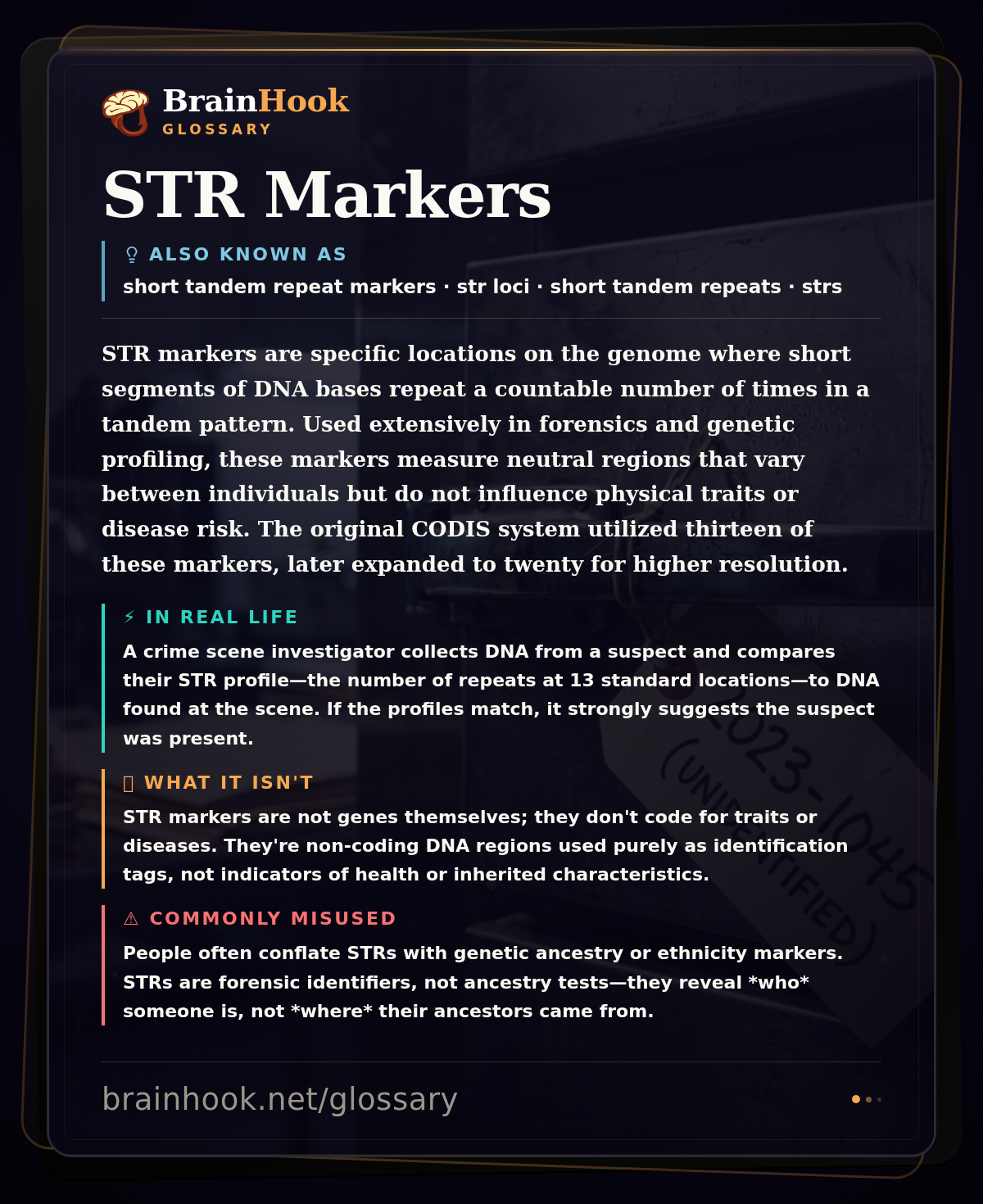
STR markers are specific locations on the genome where short segments of DNA bases repeat a countable number of times in a tandem pattern. Used extensively in forensics and genetic profiling, these markers measure neutral regions that vary between individuals but do not influence physical traits or disease risk. The original CODIS system utilized thirteen of these markers, later expanded to twenty for higher resolution.
What this means in real life
A crime scene investigator collects DNA from a suspect and compares their STR profile—the number of repeats at 13 standard locations—to DNA found at the scene. If the profiles match, it strongly suggests the suspect was present.
What it isn’t
STR markers are not genes themselves; they don't code for traits or diseases. They're non-coding DNA regions used purely as identification tags, not indicators of health or inherited characteristics.
Commonly misused online
People often conflate STRs with genetic ancestry or ethnicity markers. STRs are forensic identifiers, not ancestry tests—they reveal *who* someone is, not *where* their ancestors came from.