The Government Called Unidentified Remains a 'Silent Disaster.' Now DNA Is Naming the Dead.
America's unidentified dead have been piling up in morgues for decades — and the forensic genealogy companies working to name them are doing it with science that would have seemed impossible fifteen years ago.
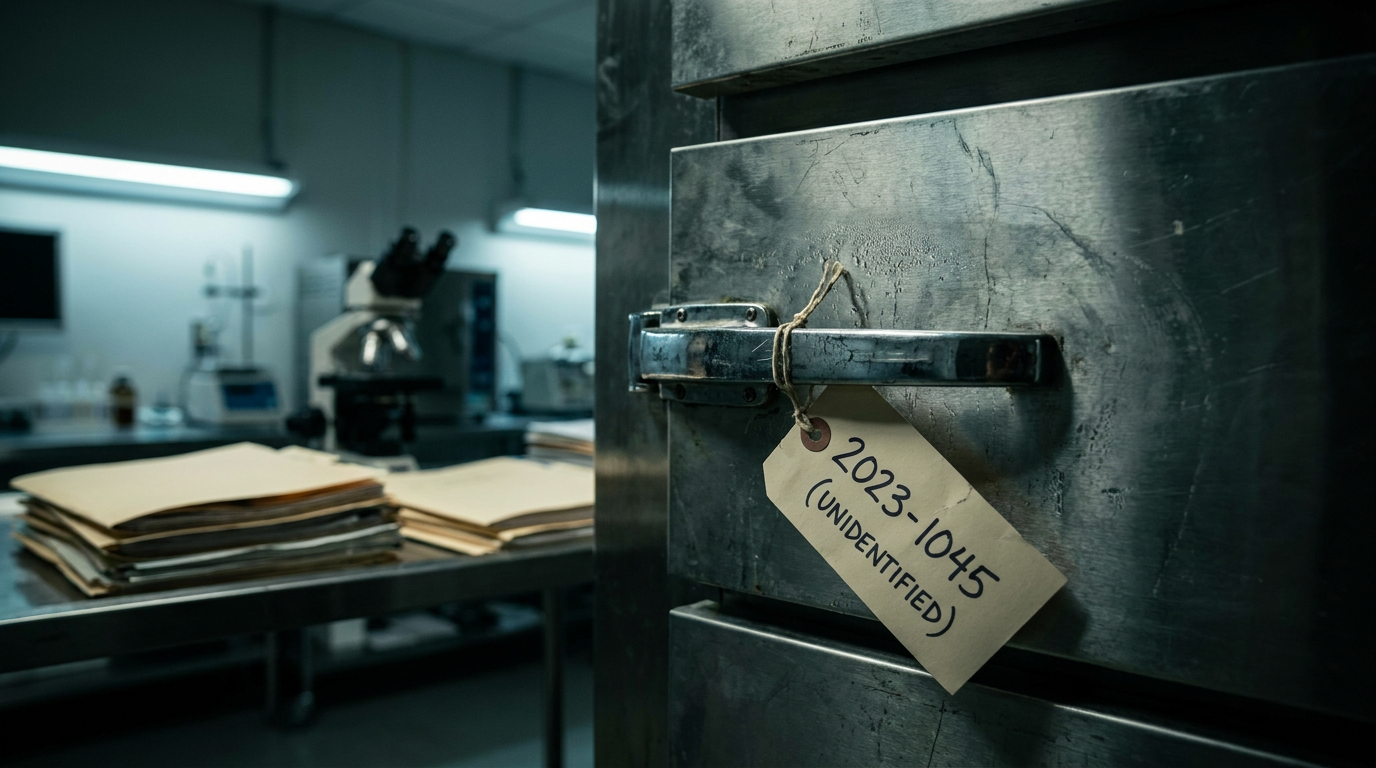
Somewhere in the United States, right now, there is a set of human remains sitting in a refrigerated drawer with a number instead of a name. The number is not a failure of effort, in most cases. It is a failure of available technology meeting the physical reality of decomposed, fragmented, or badly degraded tissue that traditional forensic methods cannot extract useful information from. The person in that drawer may have family who filed a missing persons report years ago. They may have been reported missing and later assumed to be a runaway. They may have never been reported missing at all. What connects them to every other unidentified set of remains in every other drawer in every other county morgue across the country is a single, administrative fact: no one has been able to close the loop between their body and their identity.
The Department of Justice used a specific phrase in reports on this problem: silent disaster. It is a careful, bureaucratic phrase, and it earns its weight. By the DOJ's own accounting, an estimated 40,000 sets of unidentified human remains[4] currently exist in the American system, spread across coroner offices, medical examiner facilities, university forensic labs, and law enforcement evidence storage. Roughly 4,400 new unidentified remains[1] enter that system every year. They are not all homicide victims, though many are. They include people who died alone, in wilderness, in water, in fires. People whose identities were stripped away by time, chemistry, or simple institutional neglect. The word disaster is accurate. Silent is the part that tends to get people's attention.
For most of the twentieth century, the tools for identifying human remains were limited to what the body could still show you: dental records, fingerprints, physical characteristics, clothing, tattoos, and surgical hardware. All of those methods require either an intact body or a prior record to match against. When the body is skeletonized, when the fingertips are gone, when no one ever had their teeth X-rayed, the file goes cold. DNA testing improved the situation starting in the 1990s, but standard forensic DNA profiling — the CODIS system, which compares short tandem repeat markers across genetic loci — requires a reference sample to match against. If no family member has provided a sample, and no suspect has been entered into the database, the profile simply sits there, unmatched, waiting.
What changed, in the last decade, is the intersection of two things that were not originally designed to find each other: consumer genealogy databases built from curiosity, and a generation of forensic scientists who understood that those databases could close cases that standard profiling never would. The result is a technique called forensic investigative genetic genealogy, and the companies doing the most technically demanding version of it — working with the worst samples, from the oldest cases, on the longest-cold remains — are doing something that sits at the far edge of what modern molecular biology can accomplish.
What 'Degraded DNA' Actually Means
When a biologist says a DNA sample is degraded, they mean the double-stranded molecule has been chemically damaged: broken into shorter and shorter fragments by heat, moisture, microbial activity, oxidation, and time. A fresh sample has long, intact strands carrying millions of readable base pairs. A sample recovered from remains that have been underground for ten years might yield fragments so short that standard sequencing can barely find a starting point. Remains exposed to water, fire, or freeze-thaw cycles can be worse. The biology is not being dramatic — it is simply describing a molecule doing what molecules do when the cellular machinery that normally repairs them is no longer running.
The company Othram, founded in 2018 and based in The Woodlands, Texas, built its laboratory workflow specifically for this problem. The approach they use is called genome-by-sequencing or, more precisely, forensic-grade whole genome sequencing scaled to work with low-quantity, highly degraded inputs. Rather than looking for specific genetic markers the way CODIS does, they sequence as much of the available genome as possible — sometimes a very small fraction of it — extract the single nucleotide polymorphisms, or SNPs, that are distributed across that sequence, and build a profile with enough data points to work with genealogical databases. A typical consumer ancestry profile might use around 700,000 SNPs. A degraded forensic sample might yield far fewer, but even a fraction of that — if the right computational methods are applied — can still generate enough genetic signal to find relatives in a large enough database.
“The DNA is not missing. It is broken — and the science has gotten very good at reading broken things.”
The extraction itself is painstaking. For skeletal remains, the preferred source of DNA is not the long bones most people picture — femur, tibia — but the dense inner portion of the petrous bone[2], the pyramid-shaped section of the skull that surrounds the inner ear. It is the most structurally protected piece of bone in the human body, and it tends to preserve DNA longer than almost any other tissue. Teeth are a close second. The lab grinds a small sample, dissolves the mineral matrix in a chelating solution, and then works through a series of extraction and purification steps designed to isolate whatever DNA remains from the background noise of contamination, degradation products, and microbial genetic material that has colonized the sample over time. The entire process is performed under strict anti-contamination protocols, because at these input quantities, a single stray skin cell from a technician can swamp the signal.
The Genealogy Database Problem
Once a profile exists, the investigative genealogy work begins — and this is where the science meets something that looks more like detective work. The profile is uploaded to a consumer genomics database that accepts third-party uploads, historically GEDmatch and FamilyTreeDNA, both of which have policies that allow law enforcement searches under certain conditions. The search is not looking for a direct match to the unidentified person. It is looking for partial matches — people who share enough DNA to be cousins, second cousins, or more distant relatives. Those matches are the starting point for building a family tree outward and then back inward toward the person whose remains are on the table.
The genealogical reconstruction is not automated. It requires a trained genetic genealogist who can read the centimorgan values — the unit measuring how much DNA two people share — interpret the likely relationship range they imply, cross-reference with traditional genealogical records like birth certificates, census data, newspaper archives, and obituaries, and then reason backward through possible family structures to identify a set of candidates who fit the biological profile of the remains. Age at death, biological sex, and physical characteristics from the forensic anthropology report constrain the candidate pool. The genealogist works until the tree produces one name, or a small handful of names, that can be taken to law enforcement for confirmation.
“The genealogist is not reading the dead person's DNA. They are reading their family's — and working backward to find the person that family tree is missing.”
Cases the Old Methods Left Untouched
Othram has publicly documented identifications in cases where remains had been unidentified for decades. Some of the cases involve individuals who died in the 1970s and 1980s, before the infrastructure for DNA evidence in criminal justice existed at all. The remains were collected, profiled as best the technology of the time allowed, and then stored — sometimes carefully, sometimes not. Samples degraded further in storage. Paper records were lost or transferred incompletely between jurisdictions. When the cases were eventually submitted for forensic genealogy, the lab was working with material that had spent thirty or forty years in conditions that were never designed to preserve DNA for sequencing. The fact that a profile could be generated at all from some of these samples is less a tribute to miraculous technology and more a testament to how much genetic information is packed into bone tissue and how well the petrous bone specifically tends to hold it.
Not every case resolves. The databases are large — GEDmatch had over a million profiles at its peak of law enforcement accessibility, and FamilyTreeDNA's opted-in pool is substantial — but they skew heavily toward people of European descent, which means cases involving individuals of other ancestries are harder to resolve through genealogical matching simply because fewer relatives are likely to appear in the database. This is a documented limitation of the method, not a fringe concern. Researchers in forensic genetics and bioethics have written about it directly. The technique works best when the databases are most representative, and they are not currently representative of everyone.
The Ethics That Sit Alongside the Science
Consumer genealogy databases were built on a straightforward premise: people voluntarily submit their DNA to find out where they came from and who they are related to. When law enforcement began uploading forensic profiles to search those same databases, it introduced a different logic — one where a person's decision to upload their own genome effectively makes them, and every genetic relative they have, partially searchable by investigators without anyone else's consent. The relative who uploaded their ancestry results in 2017 because they were curious about whether the family legend about Cherokee ancestry was true did not agree, in any explicit sense, to having their genome used to identify a murder victim's remains or to implicate a distant cousin in an unresolved case.
GEDmatch changed its terms of service in 2019[3], shifting from opt-out to opt-in for law enforcement searches after significant public pressure. The proportion of users who opted in was substantially smaller than the total database. FamilyTreeDNA made a different choice, working with the FBI directly and allowing law enforcement searches within specific parameters. The legal framework governing all of this remains genuinely unsettled. There is no comprehensive federal statute that specifically regulates forensic investigative genetic genealogy. Guidelines issued by the DOJ in 2019 established voluntary standards for when the technique can be used — generally, violent crimes and unidentified remains — but those guidelines are not law, and compliance is not uniformly monitored.
The ethical tension here is real and does not resolve cleanly. The people being identified from cold cases have families who have spent years not knowing. The technique has given names back to people who had none. It has also, in criminal cases, generated investigative leads from a genetic database that millions of people contributed to under a different understanding of what it would be used for. Both of those things are true simultaneously, and the policy apparatus has not caught up to either one.
What Happens After the Name
“A name is not the end of anything. It is the beginning of a different kind of grief.”
When forensic genealogy produces a candidate name, it does not produce a confirmed identification. The name goes to law enforcement, who must then locate living relatives and request a direct DNA comparison — a reference sample from a family member, or sometimes a personal item from the deceased that might carry their own genetic material. The genealogical reconstruction is the map. The confirmation is the match that closes the record. In some cases, the family has been searching. In some cases, they had given up. In some cases, the person's absence was never formally reported, and the news that human remains have been identified as a family member is the first moment anyone official has acknowledged that the person is gone.
The National Missing and Unidentified Persons System, NAMUS, maintained by the DOJ's National Institute of Justice, is the national clearinghouse where missing persons cases and unidentified remains are supposed to be linked. The database is functional and useful, but entry into it has historically been voluntary for agencies, meaning that cases sometimes exist in local coroner records without ever making it into the national system. Legislative efforts have pushed toward mandatory reporting with incomplete success. The infrastructure for tracking the unidentified has improved significantly since the early 2000s, but the backlog it inherited — decades of unresolved cases, some with no digital record at all — is still being worked through, one degraded sample at a time.
There is a specific kind of silence that surrounds the unidentified dead — not the silence of a cold case with suspects and theories and conflicting witness accounts, but the silence of a person whose existence in the record stops completely at the moment they stopped being alive and visible. Forensic genealogy does not solve a crime when it names unidentified remains. It does something narrower, and in its own way more fundamental: it puts a person back in the record. It says this person existed, they had family, they had a life that preceded the drawer and the number. The science that makes that possible is genuinely remarkable. The fact that it is still necessary at this scale — 40,000 sets of remains, 4,400 new ones a year — is the part that should be harder to sit with quietly.
References
- About (namus.nij.ojp.gov)
Establishes that approximately 4,400 new unidentified remains enter the system annually. - Optimal Ancient DNA Yields from the Inner Ear Part of the Human Petrous Bone (doi.org)
Scientific basis for the article's explanation that the petrous bone's inner ear portion is the preferred DNA source for skeletal remains. - GEDmatch (en.wikipedia.org)
Provides user scale (1.45 million profiles in Fall 2020) and confirms GEDmatch's role as a law enforcement-accessible genealogy database for DNA matching. - Enhancing NamUs: National Missing and Unidentified Persons System (rti.org)
Provides the DOJ estimate of 40,000 unidentified human remains currently in the American system across morgues and forensic facilities.
About Silas Crane
Silas Crane writes from the edges of the record: cold cases, cryptids, declassified files, strange disappearances, forensic science, fringe science, mysterious illnesses, eerie technologies, serial killers, cults, state experiments, UAPs, and claims that cannot be cleanly proved or dismissed. His work also examines crime, deviance, corruption, policing, punishment, and the institutions that decide which harms are investigated, sensationalized, ignored, or allowed to continue. A documentarian at heart, he builds unease from verifiable detail and is always drawn back to the gap the file cannot close.
More like this
Before 2018, DNA at a Crime Scene Only Helped If You Had a Name. One Database Changed That.
Before 2018, crime-scene DNA could only confirm a suspect you already had. Then investigators ran a killer's genome through a public genealogy database — and the entire logic of forensic identification broke open.
DNA Genealogy Solved a 39-Year-Old Sex Crime—Two Days Too Late
Forensic genealogy just closed a 39-year-old kidnapping and sexual assault—but the man charged died before investigators could reach his door.
A Skirt Kept in a Freezer for 61 Years Finally Told Its Story
The Mary Theresa Simpson case wasn't solved by a lucky database hit — it was solved by coaxing a usable genetic profile out of 0.4 nanograms of sixty-year-old biological material, then tracing it through living relatives to a grave.