Opting Out of DNA Databases No Longer Keeps You Out of DNA Databases
Forensic genetic genealogy has solved hundreds of murders — by running crime-scene DNA against databases millions of people joined to find their grandparents.
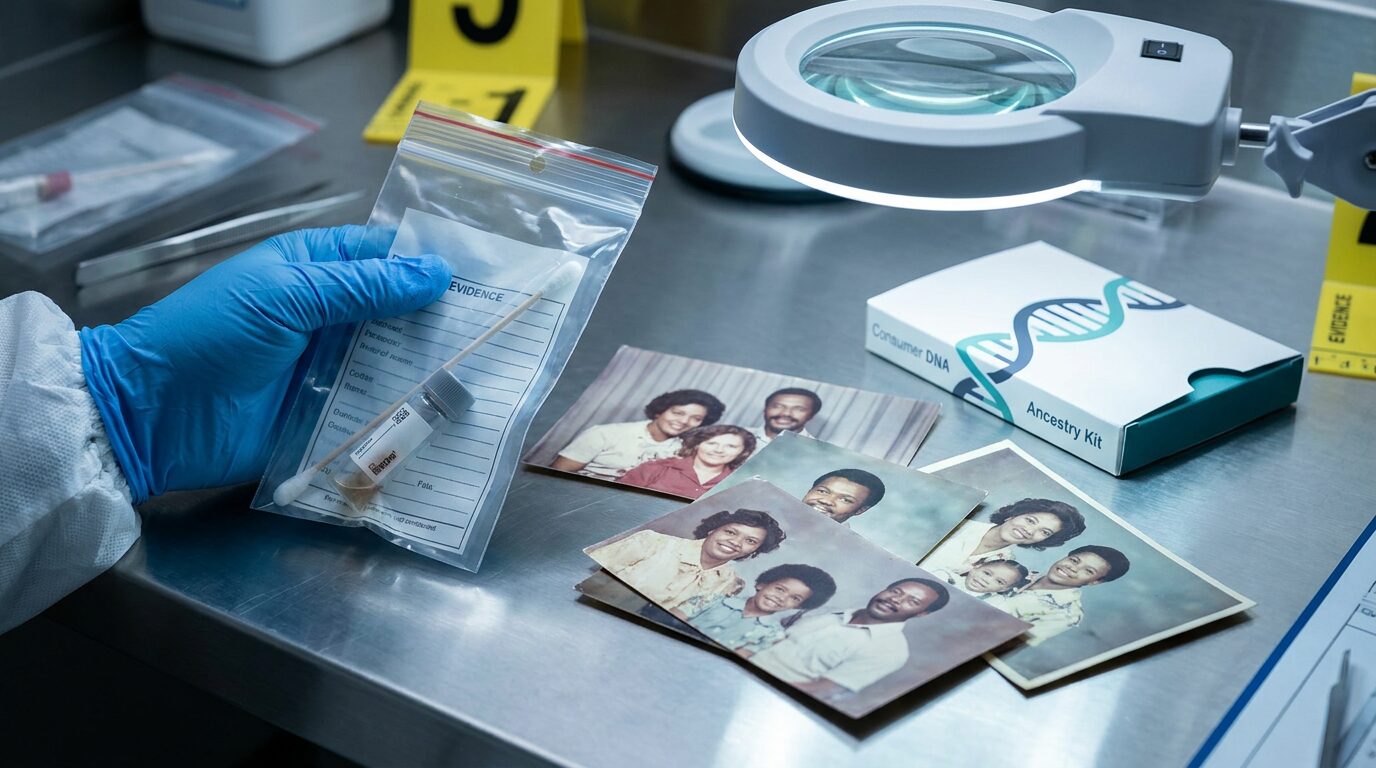
You did not submit your DNA to any database. You never bought a kit, never swabbed your cheek, never clicked a terms-of-service box you didn't read. It may not matter. An investigator using genetic genealogy begins by looking for DNA matches at the level of third cousin or closer — a category that, for most people, includes around 800 individuals. If any one of those 800 relatives has chosen to submit their DNA to a database, an investigator may be able to identify you, even though you shared nothing yourself. The file on you does not begin with your decision. It begins with someone else's.
Investigative genetic genealogy — also known as forensic genetic genealogy — is the emerging practice of utilizing genetic information from direct-to-consumer companies to identify suspects or victims in criminal cases. As of December 2023, the technology had contributed to solving 651 criminal cases[4], producing 318 identified perpetrators. The case that made it famous is the Golden State Killer: law enforcement used GEDmatch, a public website that produces possible familial matches from users' genetic profiles, uploading a crime-scene profile under a fake name. The site returned a partial match to a distant relative, allowing investigators to narrow the suspect pool to a single family tree and deploy traditional investigative techniques — ultimately identifying former police officer Joseph DeAngelo. That arrest, in 2018, turned a niche forensic technique into something close to standard practice.
What followed the DeAngelo arrest was not a careful regulatory reckoning. It was a rush. At the time of the Golden State Killer case, law enforcement's use of public and commercial DNA databases was entirely unregulated. The infrastructure — the databases, the genealogists, the third-party forensic labs — scaled faster than any law governing it. The question of who owned your genome once it reached the cloud, and who could legally look at it, was left largely to the private companies holding the data and to the discretion of individual investigators. That gap is still open.
The Database You Didn't Know You Were In
The architecture here matters, because public confusion about it is close to total. In a survey of genealogy conference attendees, almost a quarter believed 23andMe allowed law enforcement database access, and close to 40% believed Ancestry did. Both beliefs are wrong — but only just, and only for now. Both Ancestry and 23andMe forbid police and the genetic genealogists who work with them from accessing their data for crime-fighting purposes. Ancestry does not voluntarily cooperate with law enforcement; contents of communications and any data relating to the DNA of an Ancestry user will be released only pursuant to a valid search warrant from a government agency with proper jurisdiction. 23andMe maintains a similar posture, with the explicit language that it will use "all practical legal and administrative resources" to resist such requests. The two largest consumer DNA repositories are, at least by policy, walled off.
The actual investigative infrastructure runs through different pipes. At the time of writing, the only genetic genealogy databases that explicitly allow law enforcement use for forensic genetic genealogy purposes are GEDmatch PRO, FamilyTreeDNA, and DNASolves. GEDmatch is particularly instructive because its history is essentially the history of the policy problem. In May 2019, GEDmatch began requiring users to make an active privacy selection — opt-out or opt-in — to allow law enforcement agencies access to their profiles for forensic investigations. By May 2020, roughly 260,000 GEDmatch users had opted in. That sounds like a meaningful consent mechanism. But for new uploads, "opt in" is the default selection actively recommended for users — which sheds doubt on whether this could be truly "opt-in." Moreover, what is being opted into is not explicitly stated.
FamilyTreeDNA took the opposite approach, making its consumers opt-out. Research indicates that many consumers do not take the time to read terms and conditions or privacy policies when signing up for a service — meaning law enforcement could access the genetic data of thousands of FamilyTreeDNA customers without their knowledge, or at least without their recognizing that law enforcement access was a condition of the service. The opt-out/opt-in distinction sounds procedural. Its real-world consequence is whether hundreds of thousands of people's genomic data is functionally available to police by default.
“The file on you does not begin with your decision. It begins with someone else's.”
The Warrant That Overrode Everyone's Settings
In November 2019, a Florida judge signed a warrant that collapsed the opt-in/opt-out framework entirely. A Florida law enforcement agency requested access to the full GEDmatch database. The warrant covered all user DNA profiles, including those of the vast majority of users who had not opted in — at that point, approximately 185,000 of 1.3 million users had consented. GEDmatch complied. In a single judicial action, the privacy preferences of over a million people were overridden. The search warrant, issued by a state judge, had disregarded the DOJ interim policy's privacy protections by compelling GEDmatch to open up its full database[2]. There is no publicly available record establishing that the investigation it served produced an arrest. What it did establish, clearly, is that opting out is not the same as being protected.
This is the gap the EFF has been flagging since before most people knew forensic genealogy existed. FGG searches are, in the EFF's framing, fishing expeditions through millions of innocent people's DNA, leaving it to an officer's discretion to determine who to investigate further and who to arrest. Defendants who try to challenge an FGG search in court face a specific legal obstacle: they may lack standing to object, because the privacy interest at issue belongs not to them but to the biological relatives who uploaded the data in the first place. You cannot assert a Fourth Amendment claim over a file you never contributed to.
Innocent People in the Tree
The way the matching process actually works is worth sitting with. A genealogical search in a direct-to-consumer database typically generates an initial list of around 850 hits, which can eventually be narrowed down — based on geographic location, age, and sex — to a list of 16 or 17 possible suspects. Those 16 or 17 people are, in the overwhelming majority of cases, entirely innocent. They appear on the list because of a biological relationship to someone else — a relationship they did not choose, cannot alter, and may not even know the full extent of. In at least one documented murder investigation, police used a false story about an unidentified body to retrieve DNA samples from relatives for the genealogy investigation — the son of one of those participating relatives was subsequently arrested. The relatives were props in an investigation they were deceived into joining.
The Christopher Tapp case is often cited as forensic genealogy working correctly. Tapp had served nearly two decades in prison for the 1996 murder of Angie Dodge in Idaho Falls — a conviction driven by a disputed confession — before genealogical database work identified Brian Dripps, who had lived across the street from the victim. Starting with database profiles, Parabon NanoLabs built a family tree that led to Dripps. Using a discarded cigarette butt, they compared his DNA with the crime-scene sample and confirmed a match. Dripps confessed, saying he had acted alone and did not even know Tapp. The technique, in this instance, freed an innocent man. But note the mechanism: the investigation passed through the DNA of relatives who had uploaded their own profiles, people who had no idea they were providing the thread that would eventually exonerate a stranger. The database is a net, not a scalpel. It catches what it catches.
Despite forensic genealogy's apparent success, its use has not avoided serious scrutiny. A year prior to the arrest of DeAngelo, an individual was wrongly identified as a suspect in the murder of Angie Dodge — before genealogy tools had produced Dripps's name. That wrongful identification circulated inside the investigation. It is not the only documented instance of the technique pointing the wrong direction before finding the right one. Many users do not fully understand the potential implications of possible arrest of their relatives as suspects in investigations, including potential false positive results that create burden for innocent individuals — most of whom never consented to this kind of search at all.
The Regulation That Only Goes So Far
In 2019, the U.S. Department of Justice released guidelines on how federal investigators and federally funded investigations could use genetic genealogy to track down suspects. The policy states that forensic genetic genealogy should be limited to solving violent crimes — such as murder and rape — and identifying human remains. Agencies are instructed not to arrest a suspect based solely on a genetic association; traditional genealogy research and other investigative work is required to determine actual identity. These are meaningful constraints on paper.
Blaine Bettinger, a genetic genealogy expert and author, finds the policy insufficient: "The DOJ guidelines are a good start, but it's not clear to what extent they'll apply to most labs — especially commercial labs — and there's no clear penalty for violating the rules." The DOJ policy binds federal agencies and those that receive federal funding. State and local agencies operating without federal grants exist in a patchwork of state-level rules that vary dramatically. Critics argue the Fourth Amendment bars law enforcement from running warrantless familial DNA searches using consumer databases, even among users who have given consent. Several states have passed legislation banning or severely restricting such searches. Several others have passed nothing at all.
In 2023, The Intercept reported that forensic genetic genealogists had skirted GEDmatch's own privacy rules by searching users who had explicitly opted out of sharing DNA with law enforcement. The mechanism was a loophole: genealogists working with law enforcement could access protected profiles through a back channel built into GEDmatch's own system. In November 2023, GEDmatch issued a press release acknowledging the failure to maintain data privacy and the breach of its own terms of service by forensic genealogy practitioners who had circumvented user privacy settings. The company that held your data had been unable to protect it from the investigators it had also agreed to help. That is not a description of a system in careful balance. It is a description of a system that had not yet decided what it was.
Who Owns the Genome in the Cloud
“The opt-out/opt-in distinction sounds procedural. Its real-world consequence is whether hundreds of thousands of people's genomic data is available to police by default.”
The ownership question does not have a clean legal answer. Law enforcement has argued that people using genetic genealogy services have no expectation of privacy in their genetic data because users have willingly shared it with the genetics company and with other users, and have "consented" to a company's terms of service. The Supreme Court rejected a structurally similar argument in Carpenter v. United States[3], ruling that even though cell phone location data is shared with or stored by a phone company, users retain a reasonable expectation of privacy. Whether Carpenter extends to genomic data held by a private genealogy company, accessible to investigators through a relative's upload, remains an open constitutional question that no court has fully resolved.
And the data does not sit still. DNA samples at Ancestry are stored indefinitely by default, and destroying them requires a separate request beyond account deletion. Once data has been used in research, withdrawal of consent cannot undo completed or published studies. In a corporate acquisition, your data may transfer to the new owner. GEDmatch itself is the clearest illustration: originally founded by two amateur genealogists, it was acquired by Qiagen and is now operated by Verogen Inc., a forensic testing company specializing in law enforcement DNA research. A database built for hobbyist genealogists is now owned by a company whose core business is helping police solve crimes. The users who uploaded their genomes to the original site did not consent to that transfer of institutional purpose.
Although GEDmatch likely encompasses only about 0.5% of the U.S. adult population, research shows 60% of white Americans can already be identified from its users[1]. The same research shows that once GEDmatch's users encompass just 2% of the U.S. population, 90% of white Americans will be identifiable. This is the structural reality that makes individual consent almost beside the point. You can opt out. You can delete your kit. You cannot opt your cousins out of their own accounts, and you cannot un-upload the DNA your aunt submitted in 2016 to find out if she had Irish ancestors. The database grows, the coverage expands, and the gap between people who have uploaded and people who can be found closes a little more every year.
The documented cases of cold murders solved — the names finally attached to unidentified remains, the wrongly convicted men finally freed — are real, and they are not nothing. But the architecture that produced those outcomes was built without the people inside it knowing what they were building. The genealogist who uploaded to find a third cousin, the retiree who wanted to know his ethnic heritage, the woman who discovered she was adopted: none of them agreed to become part of the forensic infrastructure. The record shows that regulators moved slowly, that private companies made up the rules as they went, that at least one warrant overrode a million people's stated privacy preferences, and that a documented loophole let investigators access profiles that were explicitly locked against them. What the record does not show is anyone having definitively answered the underlying question — who owns your genome once it is in the cloud — before law enforcement started treating the answer as already settled.
References
- Identity inference of genomic data using long-range familial searches (science.org)
Provides research data on the proportion of white Americans identifiable through forensic genealogy database searches. - Judge Said Police Can Search Dna Millions Americans Without Their Consent What S Next (science.org)
Documents the November 2019 Florida warrant that overrode GEDmatch users' privacy settings, compelling access to the full database regardless of opt-in status. - Carpenter v. United States (supreme.justia.com)
Establishes Fourth Amendment precedent relevant to privacy claims over genetic data not directly contributed by the defendant. - Forensic Genetic Genealogy Project version December 2023 (data.mendeley.com)
Provides the December 2023 dataset documenting that forensic genetic genealogy had solved 651 criminal cases with 318 identified perpetrators.
About Silas Crane
Silas Crane writes from the edges of the record: cold cases, cryptids, declassified files, strange disappearances, forensic science, fringe science, mysterious illnesses, eerie technologies, serial killers, cults, state experiments, UAPs, and claims that cannot be cleanly proved or dismissed. His work also examines crime, deviance, corruption, policing, punishment, and the institutions that decide which harms are investigated, sensationalized, ignored, or allowed to continue. A documentarian at heart, he builds unease from verifiable detail and is always drawn back to the gap the file cannot close.
More like this
Before 2018, DNA at a Crime Scene Only Helped If You Had a Name. One Database Changed That.
Before 2018, crime-scene DNA could only confirm a suspect you already had. Then investigators ran a killer's genome through a public genealogy database — and the entire logic of forensic identification broke open.
The Government Called Unidentified Remains a 'Silent Disaster.' Now DNA Is Naming the Dead.
America's unidentified dead have been piling up in morgues for decades — and the forensic genealogy companies working to name them are doing it with science that would have seemed impossible fifteen years ago.
DNA Genealogy Solved a 39-Year-Old Sex Crime—Two Days Too Late
Forensic genealogy just closed a 39-year-old kidnapping and sexual assault—but the man charged died before investigators could reach his door.