Your Phone Is the Escape Route. That's Exactly the Problem.
A 90-day study tracking real phone behavior found that using your screen to escape bad feelings doesn't quiet the anxiety or the depression — it quietly locks them together.
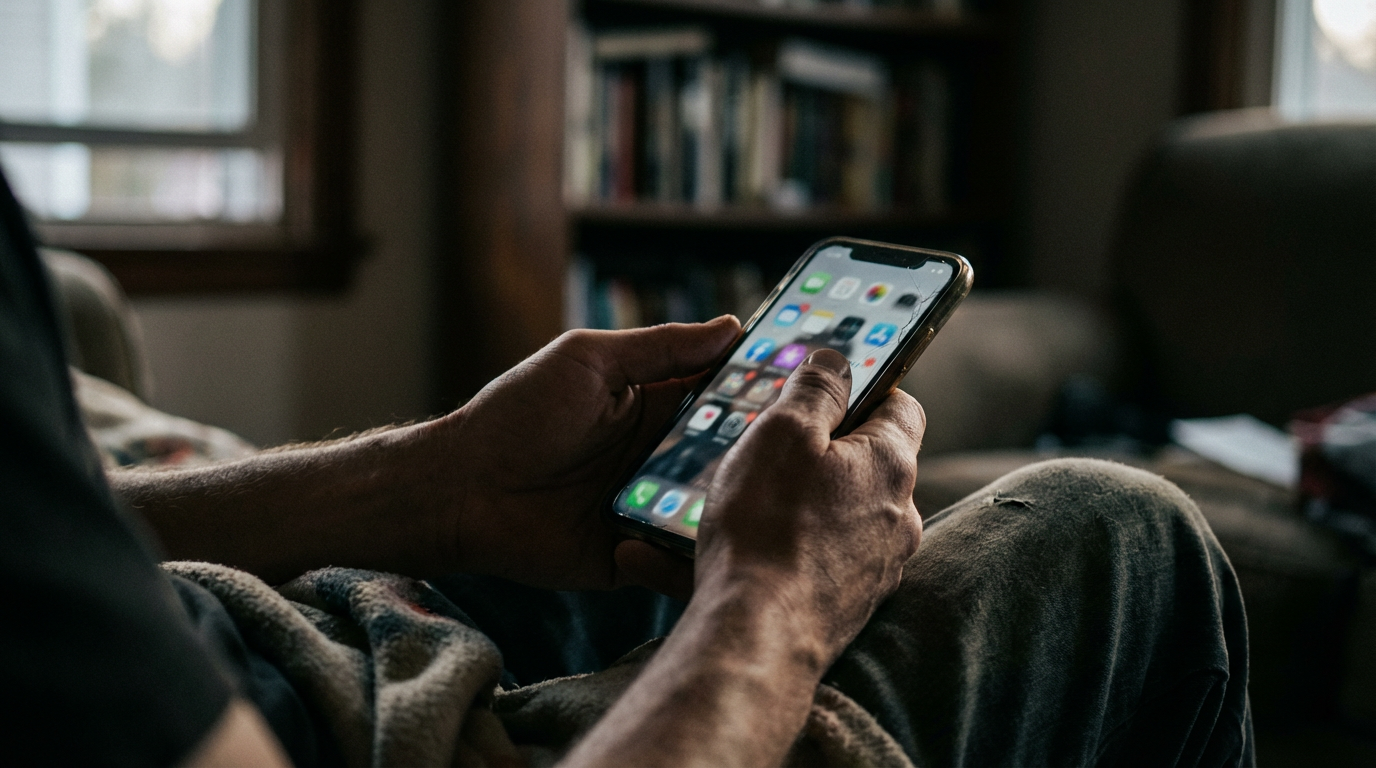
You know the feeling. Something uncomfortable moves through you — a low dread you can't name, a conversation you're not ready to have, a task sitting at the edge of your attention like a bruise you keep pressing. And before you've made any conscious decision at all, your phone is in your hand. Not because you needed to check anything. Not because something urgent arrived. Just because the alternative was sitting with whatever that was, and this — the scroll, the feed, the tap — is frictionless in a way that sitting still is not.
Most people read this as a bad habit. A weakness, maybe. Something to fix with more willpower or a screen time limit set on a Tuesday when you're feeling resolute. But a 2025 preprint out of OSF — drawing on 90 days of passive phone sensing data collected from real people living their actual lives — suggests the problem runs considerably deeper than habit. What the researchers were tracking wasn't screen time in the aggregate. They were tracking avoidance. Specifically, whether people were using their phones to escape aversive internal states: anxiety, low mood, the restless discomfort of depression. And what they found was not that this behavior fails to help. It was that it actively makes things worse, and does so in a way that is structurally almost impossible to notice from the inside.
The study is notable partly for how it was designed. Instead of asking people to self-report their phone use — which we are famously bad at, dramatically underestimating both the volume and the emotional trigger — it used passive sensing. The phone itself recorded patterns: frequency of unlocks, duration of sessions, time of day, behavioral rhythm over weeks. That kind of data catches things that self-report misses entirely, including the two-in-the-morning scroll you don't fully remember, and the twenty unlocks in an hour that don't feel like avoidance because each one only lasts ninety seconds.
What emerged from three months of this data was a pattern the researchers described in terms of the comorbidity between anxiety and depression — the way these two conditions, which are often treated as separate problems with separate solutions, tend to travel together and reinforce each other. The phone-as-escape behavior wasn't just correlated with higher anxiety and depression scores. It appeared to be a mechanism sustaining the link between them. The screen was not the symptom or the cause in any simple sense. It was the hinge.
What Avoidance Actually Does to Your Nervous System
To understand why this matters, it helps to know what avoidance does at a functional level — not morally, not as a personal failure, but as a nervous system strategy. When you encounter something that generates psychological discomfort — a difficult emotion, an unresolved situation, the ambient pressure of dread — your brain registers it as a threat. The discomfort is real. The impulse to relieve it is not irrational; it is exactly what nervous systems are built to do. Avoidance works, in the short term, the way a painkiller works. The discomfort recedes. Your system gets a moment of relief. That relief is registered, filed, and remembered.
The problem is what happens on the other side of that relief. The thing you avoided didn't resolve. The internal state you were escaping didn't process or discharge; it just got paused. And your nervous system, which learned that avoidance produced relief, is now slightly more primed to reach for avoidance the next time discomfort appears. Over enough repetitions, avoidance stops being a strategy you choose and starts being a reflex that chooses you. This is not a character flaw. It is operant conditioning[2], running on biological hardware that evolved long before smartphones existed.
“The phone doesn't just distract you from the feeling. It interrupts the process by which the feeling would have resolved.”
What makes phones specifically effective as avoidance tools — and therefore specifically dangerous in this context — is their stimulus density. A scroll through almost any app delivers a continuous, variable stream of novelty, social information, mild reward, and occasional emotional provocation. That variability is not an accident; it is the architecture. It keeps the brain just engaged enough that the underlying discomfort can't fully surface, but it doesn't provide anything that actually discharges that discomfort either. You come up for air ten minutes later — or forty — and the original feeling is still there, often slightly heavier for having been ignored.
Why Anxiety and Depression Get Stuck Together
Anxiety and depression co-occur at rates that consistently surprise people encountering the statistics for the first time. Estimates suggest that somewhere between 45 and 60 percent of people with a depressive disorder[3] also meet criteria for an anxiety disorder, and the reverse is similarly high. They are often talked about as though one caused the other — anxiety wears you out until you become depressed, or depression makes you anxious about the state you're in — but the relationship is considerably less linear than that framing implies.
What researchers in this area have increasingly focused on is the role of maintaining behaviors: the things people do, usually with the intention of coping, that keep both conditions in place. Avoidance is one of the clearest examples. In anxiety, avoidance prevents the exposure that would allow the nervous system to learn that the feared thing is survivable. In depression, avoidance interrupts behavioral activation — the engagement with meaningful or pleasurable activity that is one of the few reliable levers for improving low mood. When you are anxious, avoidance tells your brain the threat is real. When you are depressed, avoidance confirms the flatness, because nothing you avoid can give you anything back.
The OSF study's contribution is showing, through behavioral data rather than self-report, how phone-based avoidance functions as a common maintaining mechanism for both. It feeds the anxiety loop by substituting escape for exposure. It feeds the depression loop by substituting passive consumption for engagement. And because it happens dozens of times a day, in fragments too brief to feel significant, it does so below the threshold of what most people would identify as a coping strategy at all. It just feels like being on your phone.
The Trap Is That It Feels Like Resting
“Scrolling feels like doing nothing, which feels like it should be equivalent to rest. It is not rest. It is high-stimulus distraction wearing rest's clothes.”
This is the part that is genuinely hard to convey to someone who hasn't thought carefully about it, because the subjective experience of phone-based avoidance is indistinguishable, in the moment, from a legitimate break. You've been carrying something heavy — stress, a low mood, a running thread of worry — and you lie down with your phone and an hour passes in a way that feels, at minimum, like not-suffering. That feels like recovery. It looks like recovery from the outside, too. You were resting. You took a break.
But recovery from psychological stress requires something phones specifically don't provide: an absence of demand. Rest, in the sense that actually restores a stressed nervous system, involves low stimulation, low cognitive engagement, and ideally some degree of mind-wandering — the mental state associated with the default mode network[4], which plays a role in emotional processing, memory consolidation, and self-referential thought. Scrolling actively suppresses mind-wandering. It keeps the brain reactive and externally oriented. Cognitively, it looks less like sleep and more like a slightly numbed version of working. You are processing a continuous stream of inputs. The processing is shallow, but the engagement is real.
The result is something that feels like rest while preventing the actual recovery that rest would provide. You get up from the couch an hour later having not done the thing that was making you anxious and also not having genuinely recovered from the anxiety. You have, in a very precise sense, spent an hour going nowhere while feeling like you were standing still. The dread is where you left it. The fatigue is sometimes worse.
Ninety Days Is a Long Time to Watch a Pattern
One of the things that makes passive sensing research valuable is the timescale. A survey captures a snapshot. A passive sensing study running for three months captures something closer to a lifestyle — the texture of how someone actually moves through their days, not how they remember or characterize those days when asked. And across 90 days, patterns that might look like noise in a single week become legible as structure.
What this design reveals, which self-report cannot, is the daily loop quality of the behavior. This is not people making a conscious choice to use their phone as a coping tool on hard days. This is a behavior that has been automated into the rhythm of the day, triggered by internal states that may not even be fully conscious, repeating across weeks and months with a consistency that looks, in the data, less like a choice and more like a fixed response. The phone is not a tool people reach for when they decide they need help. It is where people go automatically when discomfort reaches a certain threshold — and in someone managing both anxiety and depression, that threshold is crossed frequently.
There is also a temporal dimension worth naming. The study was able to examine how phone behavior at one time of day related to mood and symptom scores later. This matters because one of the arguments people often make in their own defense — reasonably — is that they use their phones more when they're already anxious or depressed, not that the phone use is making things worse. The data suggested the relationship runs in both directions. Elevated distress predicts increased phone-based avoidance, and increased phone-based avoidance predicts worse distress later. Both things are true simultaneously. The arrow points both ways, which is precisely what makes it a loop and not just a symptom.
What Actually Interrupts the Loop
The answer here is not to demonize phones or perform a detox and feel briefly virtuous. That framing misunderstands what is happening. The phone isn't the villain. Avoidance is the engine, and the phone is simply the most available, most frictionless, most stimulus-rich vehicle for avoidance that has ever existed in human history. If you removed the phone, the avoidance would find somewhere else to go. The target has to be the behavior pattern, not the object.
In clinical psychology, the intervention most directly aimed at this pattern is exposure — graduated, deliberate contact with the discomfort you've been escaping, in conditions controlled enough to demonstrate that the discomfort is survivable and finite. This is the evidence base behind exposure therapy for anxiety and behavioral activation for depression[1], and they work, when they work, by doing the opposite of what avoidance does: instead of interrupting the discomfort before it can resolve, they allow it to arc through its full curve. The nervous system gets to learn something. Most unpleasant internal states, if you don't flee them, do not escalate forever. They peak, they plateau, they subside. Avoidance prevents that learning from happening because you always leave before the lesson finishes.
“Avoidance keeps you safe from the feeling. Exposure lets you learn that the feeling has an end.”
This does not mean the solution is to white-knuckle your anxiety unaided or to force yourself through depression by sheer willpower. It means that the orientation toward discomfort matters enormously, and that the repeated practice of escaping it — even in fragments, even via something as innocuous-feeling as checking your phone — has compounding costs that are invisible in the moment and legible only over time. Some people will need support to interrupt this pattern: therapy, medication, structured behavioral support. That is not a moral failing. It is just a realistic appraisal of what ninety days of reinforced avoidance can build.
The small practical moves — putting friction between yourself and the phone, noticing the moment of impulse before it becomes action, choosing one tolerable version of sitting with the discomfort rather than escaping it entirely — are not cures. But they are interruptions. And an interruption is how a loop begins to lose its rhythm. You don't have to feel ready for discomfort to let it stay a little longer before you reach for relief. You just have to not pick up the phone quite yet. That gap — the pause between the impulse and the escape — is where something different can begin to happen.
The 90-day window in this research is, in its own way, a kind of mirror. It shows you what daily life looks like when it is captured honestly, without the edits and revisions that self-report applies. And what it shows is that the loop between feeling bad and reaching for the screen is not occasional, not dramatic, and not particularly conscious. It is quiet, frequent, and cumulative. Which means the way out of it is also not dramatic. It is also quiet, frequent, and cumulative — small tolerances, practiced daily, until the nervous system learns something it has been prevented from learning for months.
References
- behavioral activation for depression (pmc.ncbi.nlm.nih.gov)
- Rethinking Avoidance: Toward a Balanced Approach to Avoidance in Treating Anxiety Disorders (pmc.ncbi.nlm.nih.gov)
Explains operant conditioning as the biological mechanism by which avoidance becomes a reinforced reflex rather than a conscious choice. - The Critical Relationship Between Anxiety and Depression (psychiatryonline.org)
Provides the 45-60 percent comorbidity statistic showing how frequently anxiety and depression co-occur in the same individuals. - The Journey of the Default Mode Network: Development, Function, and Impact on Mental Health (mdpi.com)
Describes the default mode network's role in emotional processing and mind-wandering, contrasting it with the suppression caused by phone scrolling.
About Leanne Ward
Leanne Ward writes about burnout, spirals, numbness, avoidance, coping, overload, and the quiet mechanics of getting through the day when your mind is not cooperating. Her work focuses on lived mental health with honesty, nuance, and zero appetite for fake healing slogans.
More like this

Your Phone Knows You're Avoiding. Researchers Just Proved It.
A new study tracked GPS, texts, and screen time for three months and found that avoidance leaves measurable digital traces — but anxiety and depression leave completely different ones.
Overstimulation Doesn't Peak When Things Get Loud. It Peaks at 6 PM.
A new study tracked sensory overload across real weeks in real people, and what it found reframes the moment you think you fell apart.

Loneliness Doesn't Make You Want People Less. It Makes You Afraid of Them.
Research is revealing that long-term loneliness doesn't just hurt — it quietly rewires how the nervous system reads other people, turning the cure into something that feels like danger.