Loneliness Doesn't Make You Want People Less. It Makes You Afraid of Them.
Research is revealing that long-term loneliness doesn't just hurt — it quietly rewires how the nervous system reads other people, turning the cure into something that feels like danger.
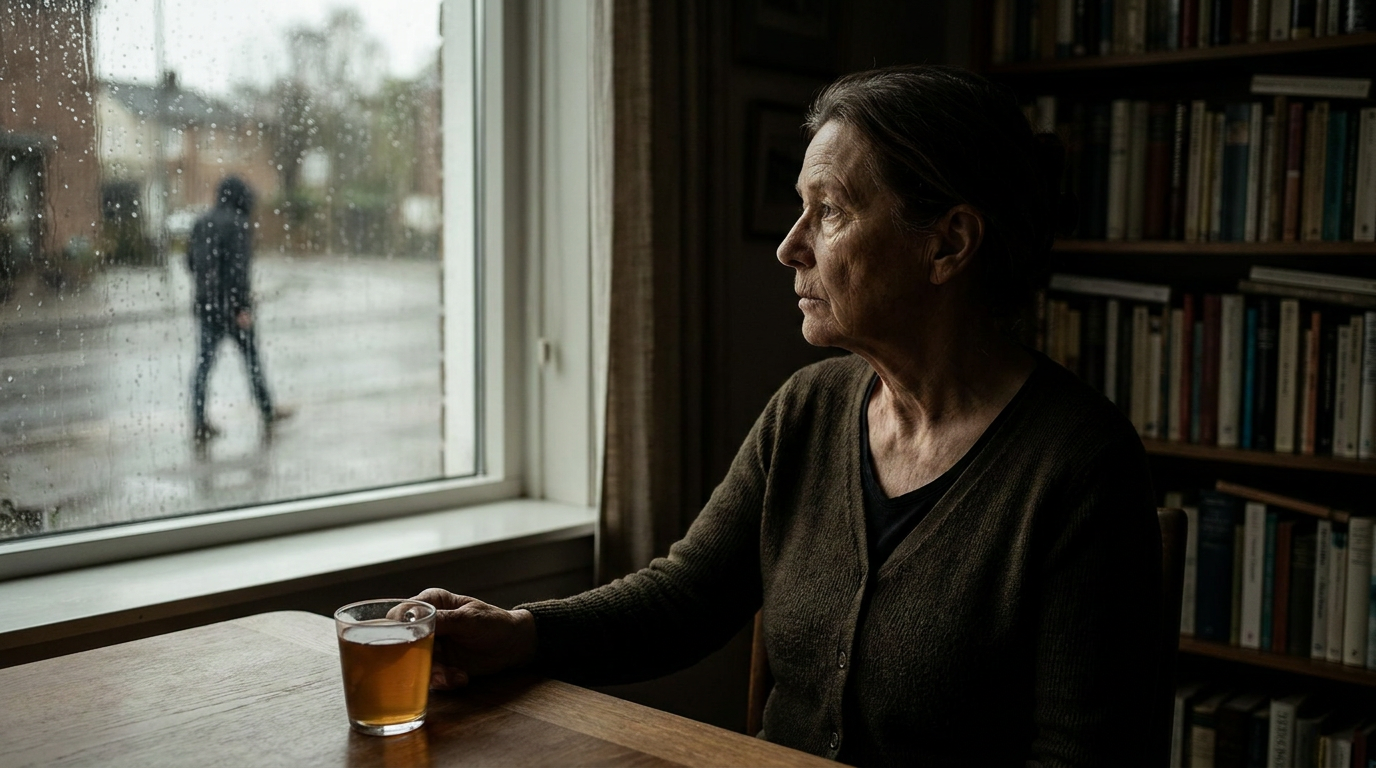
You cancel the thing. You told yourself you wanted to go, and you did want to go, in the way you want things when they are still safely in the future. Then the day arrives and the wanting curdles into something closer to dread, and you text an excuse that is mostly true, and you feel — for about twenty minutes — relieved. Then you feel worse. Then you scroll through other people's evenings and feel worse still. You go to bed having spoken to almost no one, and you wonder, not for the first time, what is wrong with you. Why, if you are lonely, you keep doing this.
The common understanding of loneliness is that it hurts, and the hurt makes you reach toward people. That is how it works in the short term. But there is a different version, the kind that has been sitting with you for months or years, that behaves in almost the opposite way. Chronic loneliness does not straightforwardly increase your appetite for social contact. Research published in the Annals of the New York Academy of Sciences[3] and in Psychophysiology has been building a more complicated, and considerably darker, picture: extended loneliness changes how the nervous system processes other people. It tilts threat perception. It raises the baseline cost of interaction. Over time, the people who could relieve the loneliness start to register, below the level of conscious thought, as something to be cautious around. The cure becomes the stressor.
This is not a character flaw and it is not self-pity performing as introversion. It is a measurable physiological shift, one with roots in how the nervous system was always designed to work. Understanding it does not automatically fix anything — but it does explain a loop that millions of people are trapped inside without any useful language for what is happening to them.
The loop goes roughly like this: loneliness creates pain; pain the nervous system associates with social environments; social environments become subtly aversive; you withdraw more; the loneliness deepens; the threat signal strengthens. Repeat. What looks from the outside like someone who simply prefers to be alone is often someone whose nervous system has learned, through accumulated experience, that people are where the hurt lives.
What Loneliness Does to a Nervous System Over Time
Short-term loneliness and chronic loneliness are not the same thing wearing different intensities. They produce meaningfully different neurobiological states. Acute loneliness — the missing-someone variety, the first night in a new city, the aftermath of a breakup — tends to spike motivation toward connection. It operates similarly to hunger: the absence creates a drive. Chronic loneliness, the kind that has been present long enough to feel like a personality trait rather than a circumstance, does something else. It appears to shift the nervous system's resting orientation toward hypervigilance in specifically social contexts.
Research in this area, much of it built on the foundational work of the late social neuroscientist John Cacioppo and extended by subsequent investigators, has documented that chronically lonely individuals show elevated markers of physiological stress, heightened cortisol reactivity, and disrupted sleep architecture[2] — even when no acute stressor is present. The nervous system is, in effect, running an alarm system on low-level continuous activation. And that alarm, over time, becomes tuned toward social stimuli. Studies using psychophysiological measures have found that lonely individuals show faster and stronger threat responses to ambiguous social cues[1]: a neutral face reads as slightly hostile; a pause in conversation registers as rejection before it has been evaluated consciously.
“The nervous system does not wait for evidence. It pattern-matches, and loneliness has quietly trained it to find threat in ordinary human faces.”
This is not irrational in evolutionary terms. The dominant theoretical framework here, sometimes called the hypervigilance hypothesis of loneliness, holds that prolonged social isolation was historically life-threatening for humans. A nervous system that had been separated from its group for long enough had good reason to treat other humans with caution — strangers who found you isolated were not necessarily safe. The body's threat-detection systems, which are not especially good at distinguishing ancient savanna problems from modern apartment problems, apply the same logic. Extended loneliness reads as exposure, and the response is to fortify.
Reading the Room Wrong, Every Time
The practical effect of this physiological shift is a consistent bias in social perception. Chronically lonely people tend to interpret ambiguous social information in the more threatening direction. This is not a distortion they are choosing, and it is not low self-esteem making them catastrophize. It is a processing difference, measurable at the level of neural response, that precedes conscious interpretation. By the time the thought arrives — she seemed annoyed with me, he was being short, they probably did not actually want me there — the nervous system has already filed its report and moved on.
What this produces, behaviorally, is a self-confirming pattern. The lonely person enters a social situation already running slightly elevated threat detection. They notice micro-signals of possible rejection more readily than non-lonely individuals, and they weight those signals more heavily. This does not mean they are imagining slights — sometimes they are reading real ones. But they are also catching false positives at a higher rate, and they are less likely to catch the countervailing signals: the warmth, the interest, the openness that is also present. The social environment ends up feeling, consistently, colder and more dangerous than it probably is. Each experience that confirms that reading — and in a sufficiently large sample of social interactions, confirmations will come — reinforces the original threat calibration.
This is worth sitting with. The lonelier someone has been for longer, the more accurately their nervous system expects rejection, and the more that expectation shapes what they notice, how they behave in response to what they notice, and therefore how others actually respond to them. Not because lonely people are difficult or broken, but because nervous systems that anticipate threat behave in ways that communicate wariness, and wariness in social contexts can, in fact, generate the cooler responses it was bracing for. The self-fulfilling quality of it is not a moral failure. It is a feedback loop doing what feedback loops do.
The Body Cost of Showing Up
“For someone whose nervous system has been running a quiet social threat alarm for years, a dinner party is not a pleasant event — it is a physiological expenditure.”
Psychophysiological research has found that chronically lonely individuals show greater cardiovascular reactivity in social evaluation contexts — situations where they believe they are being judged or observed. The heart rate and cortisol responses in these contexts suggest that social engagement, for someone in a chronic loneliness state, is genuinely more effortful at a bodily level. It takes more regulatory resources. It costs more. This is a significant thing to understand about why lonely people often find social situations depleting rather than replenishing, even when they go well. It is not ingratitude. It is physiology.
There is also evidence that sleep is a mediating factor in this loop, which matters because it makes the whole system harder to escape. Chronic loneliness is associated with worse sleep quality[4] — more fragmented, less restorative — and poor sleep makes threat detection worse, emotional regulation harder, and social motivation lower. A person who is chronically lonely and sleeping badly is running their threat-biased social perception system on a depleted brain. The interactions that might, under better conditions, feel manageable or even good start to feel like exposure therapy no one signed them up for.
The canceling of plans, then, is not weakness. It is withdrawal from something the body has learned to experience as high-cost and risky. That understanding does not make it less isolating. But it relocates the problem. The obstacle is not motivation in the willpower sense. The obstacle is a nervous system running an outdated threat model and a sleep-deprived brain with limited capacity to override it.
Why Telling Someone to Just Get Out More Is Useless
The standard social prescription for loneliness is increased social exposure. Join a club. Say yes more. Put your phone down. And there is nothing wrong with the underlying logic — connection does require presence, and presence does require getting out of the house. The problem is that this advice treats loneliness as though it were simply an absence of social contact, rather than a nervous system state in which social contact has become associated with threat. Recommending more social exposure to someone in a chronic loneliness cycle is a bit like recommending that someone with a noise sensitivity cure themselves by going to louder places. Technically, the antidote is in there somewhere. But the dose, the framing, and the internal conditions required to make that exposure positive rather than confirming all get ignored.
What the research suggests is more nuanced. The experiences that seem to actually interrupt the chronic loneliness loop are not high-stakes social events with lots of ambiguous signals to misread. They tend to be lower-stakes, lower-ambiguity, more predictable interactions — the kind where the nervous system gets enough safety cues to downgrade its threat estimate, even briefly. Repeated low-threat contact, in which rejection is genuinely unlikely and warmth is not difficult to read, appears to be what slowly recalibrates the model. This is part of why structured social environments — community groups, volunteer work, recurring classes — sometimes help in ways that open-ended socializing does not. The predictability and repeated exposure to known people reduce the ambiguity that the lonely brain tends to interpret in the worst direction.
Therapeutic approaches that directly target social cognition — specifically the threat-bias in how social cues are read and interpreted — are an area of active investigation, precisely because the physiological components of chronic loneliness are not fixed by the presence of people alone. The interpretation layer has to shift too. That is slower work. It is also more realistic about what loneliness actually is at this level of persistence.
The Private Embarrassment of Needing Something You Fear
There is a particular shame that sits inside this loop, and it deserves to be named. Lonely people are generally aware, at least consciously, that they want connection. They are often not aware that their nervous system has reorganized its threat model around social situations. So what they experience is not a clean, legible dread — they experience something murkier. An inexplicable resistance. A relief at canceling that should not feel like relief. A flatness that descends after interactions that were, objectively, fine. A private suspicion that there is something fundamentally wrong with them for not being able to want, simply and easily, the thing they clearly need.
“Loneliness that has lasted long enough stops feeling like an ache for people and starts feeling like a private suspicion that you are not someone people are for.”
The shame is not incidental to the problem. It is load-bearing. It tends to prevent people from talking honestly about where they are, which removes one of the few mechanisms by which the threat model gets genuine disconfirming evidence. It produces avoidance of exactly the kind of lower-stakes, higher-warmth interactions that might actually help. And it keeps the story internalized — not a pattern with understandable causes that can be worked with, but a verdict about who you are.
What the research is doing, at its best, is offering an alternative story. Not a comforting one — there is nothing comfortable about learning that the condition you are in actively works against the thing that would relieve it. But a more accurate one. Chronic loneliness is not a personality. It is not a choice. It is not evidence that you are fundamentally unappealing or broken for human contact. It is a nervous system state with identifiable mechanisms and a feedback structure that makes sense once you can see it. That does not make the loop easy to exit. But it does mean that the problem is located in a different place than most lonely people have been taught to look — not in their character, and not in some essential unfitness for human company, but in an adaptive system that has been running a threat model that no longer serves them, in a situation that has lasted long enough to change how they read the world.
References
- Loneliness and implicit attention to social threat: A high-performance electrical neuroimaging study (pubmed.ncbi.nlm.nih.gov)
Provides neuroimaging evidence that lonely individuals show faster, stronger threat responses to ambiguous social cues. - Loneliness Matters: A Theoretical and Empirical Review of Consequences and Mechanisms (pmc.ncbi.nlm.nih.gov)
Foundational work establishing that loneliness increases vigilance for threat, alters psychological processes, and disrupts sleep quality. - Social isolation (nyaspubs.onlinelibrary.wiley.com)
Published research demonstrating that chronic loneliness changes how the nervous system processes other people and tilts threat perception. - Toward a neurology of loneliness (pmc.ncbi.nlm.nih.gov)
Provides the theoretical framework explaining how prolonged social isolation triggers nervous system hypervigilance as an evolutionary survival response.
About Leanne Ward
Leanne Ward writes about burnout, spirals, numbness, avoidance, coping, overload, and the quiet mechanics of getting through the day when your mind is not cooperating. Her work focuses on lived mental health with honesty, nuance, and zero appetite for fake healing slogans.
More like this

Loneliness Isn't Waiting to Be Fixed. It's Actively Making Itself Worse.
Research now shows chronic loneliness doesn't just hurt — it distorts the social signals you need to escape it, which is why the standard fix makes the problem worse.
The Lonely Algorithm Problem Nobody at Meta Wants to Talk About
New longitudinal research reveals that loneliness doesn't just make Instagram feel worse — it warps how users perceive the algorithm itself, creating a feedback loop the platform is structurally built to ignore.

Chronic Loneliness Rewires the Brain — And the Damage Is Not Metaphorical
Prolonged social isolation doesn't just feel bad; it triggers a cascade of stress signaling and neuroinflammation that measurably reshapes the aging brain.