You're Not Too Sensitive. You're Overstimulated. There's a Difference.
New research tracked sensitive people in real time and found their overload doesn't strike randomly — it builds in predictable daily arcs, which changes everything about how to handle it.
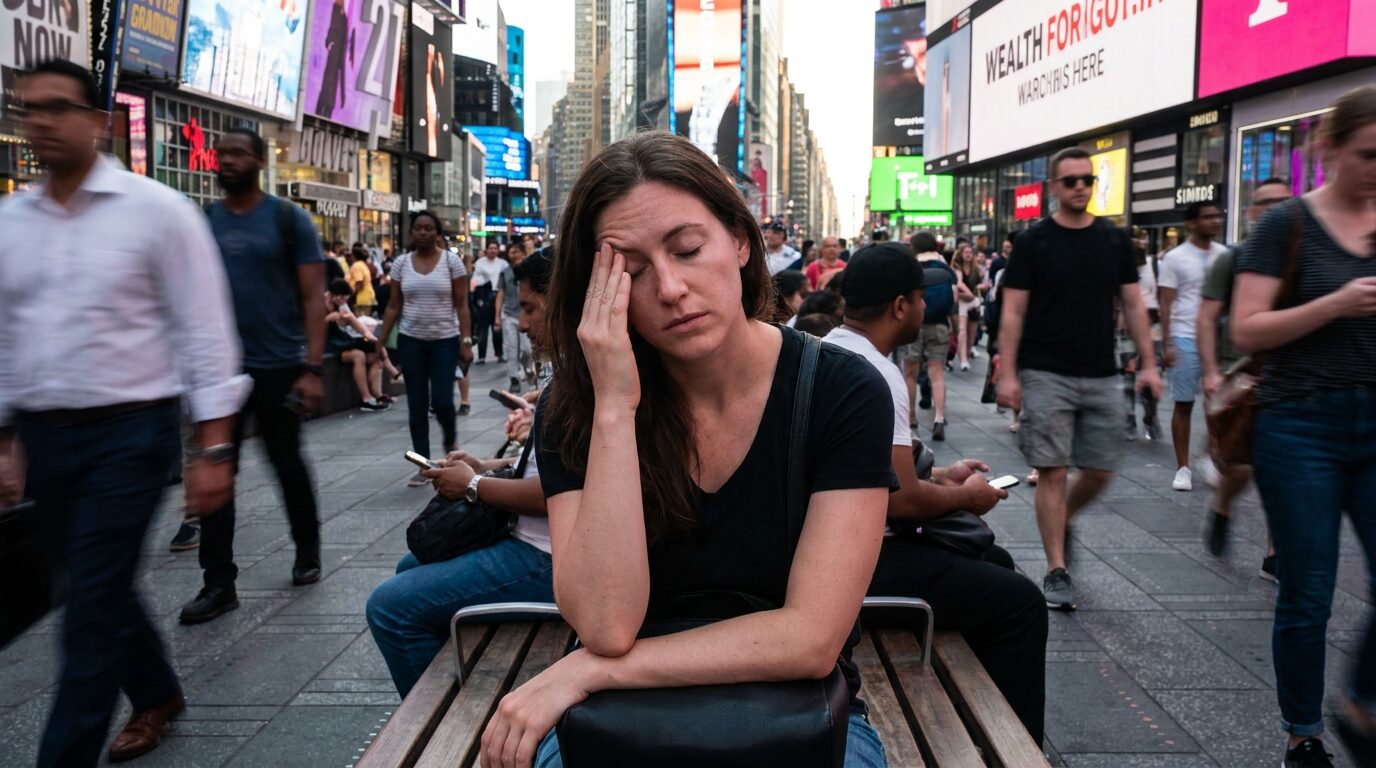
By mid-afternoon, something shifts. Not dramatically — there's no single moment you can point to. It's more that the background hum gets louder, the small requests feel larger, and the mental bandwidth you had at nine in the morning has quietly evaporated. You snap at someone you like. You stare at a screen without reading it. You feel, faintly and guiltily, that you need everyone to stop. If you've been told your whole life that you're too sensitive, you'll probably file this under character flaw and carry on. But that framing is both imprecise and, it turns out, genuinely unhelpful.
Sensory Processing Sensitivity — the trait researchers use to describe a nervous system that processes experience more deeply and thoroughly than average — has been studied for about three decades, mostly through personality questionnaires and lab tasks. What's been harder to capture is what sensitivity actually looks like as it moves through an ordinary day: not a fixed state, but a dynamic one, building and cresting and sometimes crashing. A 2025 study out of KU Leuven[2] used experience sampling methodology to track participants in real time, pinging them throughout the day and asking how they were actually doing at that moment. What the researchers found was not that sensitive people are simply more reactive than everyone else as a general condition. It was that their overload accumulates across the day in patterns that are, to a meaningful degree, predictable.
That distinction matters more than it might first appear. There's a significant difference between being wired for intensity — which is a stable trait — and currently running on fumes after six hours of too much input. One describes who you are. The other describes what is happening right now, and crucially, what caused it, what comes next, and what can actually interrupt it. The sensitive people who struggle most are often the ones who've collapsed those two things into one: I feel destroyed because I am like this, rather than I feel destroyed because today was genuinely a lot and it's been adding up since breakfast.
The internet has not helped. The past decade produced a small industry of highly sensitive person content — personality profiles, temperament tests, explainer videos, community hashtags — that celebrates sensitivity while doing almost nothing to explain its mechanics. That content mostly says: you feel things deeply, you need more rest, you're probably very empathetic, honor your needs. Which isn't wrong, exactly. But it tends to treat sensitivity as a permanent weather condition rather than a system with daily rhythms and identifiable pressure points. What the KU Leuven research offers is something more operationally useful: a map.
What Sensory Processing Sensitivity Actually Is
Sensory Processing Sensitivity, or SPS, is a trait — not a disorder, not a diagnosis — that describes individual differences in how deeply the nervous system processes sensory and social information. People high in SPS tend to notice more: subtle changes in mood, environmental details, the emotional texture of interactions, the minor inconsistencies in a plan. They process what they notice more thoroughly, often making richer and more nuanced associations but also using more cognitive and emotional resources to do it. The trait, identified and named by psychologist Elaine Aron in the 1990s[3], appears across cultures and, interestingly, across species — it shows up in other animals as a behavioral strategy[4] associated with caution, deep processing, and environmental attunement.
What SPS is not is synonymous with fragility, neuroticism, or social anxiety, though it can co-occur with any of them. It's also not the same thing as introversion, although there's overlap — roughly 30 percent of highly sensitive people are extroverted, which tends to confuse both them and everyone around them. The trait includes four broad dimensions: depth of processing, overstimulation, emotional reactivity and empathy, and sensitivity to subtleties. It's that second dimension — overstimulation — that tends to cause the most practical difficulty, and it's the one that the KU Leuven study examined with the most granularity.
“Sensitive people don't just feel more — they accumulate more, hour by hour, in ways that follow a pattern most of them have never been given language for.”
The Accumulation Problem
Experience sampling methodology works by interrupting people during their actual lives and asking how they're doing right now, rather than relying on retrospective self-report, which is notoriously shaped by mood, memory bias, and the stories we tell about ourselves. The KU Leuven study used this approach to track fluctuations in affect, fatigue, and overload across the days of people with varying levels of Sensory Processing Sensitivity. The key finding wasn't simply that high-SPS participants reported more negative states overall — it was that their distress showed a cumulative structure across the day. Overload didn't peak randomly. It followed an arc.
The mechanics behind this are consistent with what we know about cognitive load and nervous system regulation more broadly. Every interaction, sensory demand, decision, and emotional event requires processing resources. For most people, the cost of any single event is relatively small and the system recovers between demands without much difficulty. For people high in SPS, the processing is deeper and more resource-intensive — which means the cost per event is higher, and the system recovers more slowly. Early in the day, this is manageable. By midday, the account is getting thin. By late afternoon, what would have registered as a minor irritant in the morning can land like a genuine crisis — not because of drama or irrationality, but because there's simply nothing left to cushion it with.
This explains something that highly sensitive people often describe but find difficult to justify: why the same thing can feel completely fine on Monday and genuinely devastating on Thursday. Or why they can handle a difficult conversation in the morning but fall apart if the same conversation happens at seven in the evening. It's not inconsistency, and it's not instability. It's math. Resources vary across the day and across the week, and when they're depleted, even ordinary inputs register differently. The environment hasn't changed. The nervous system's ability to process it without friction has.
Why the 'Just Toughen Up' Advice Makes Things Worse
The standard advice given to sensitive people — in childhood, in workplaces, in relationships — tends to be some variation of exposure and grit. Feel the feeling and push through it. Don't let things get to you. Build a thicker skin. This advice is not entirely baseless when applied correctly: exposure-based approaches genuinely work for certain kinds of anxiety, and tolerating discomfort is a real skill. But it is catastrophically misapplied when the problem is not avoidance of discomfort but cumulative overload of a processing system.
Pushing through overload doesn't build tolerance. It depletes the system further and, over time, tends to produce a particular kind of burnout that highly sensitive people describe as shutdown — a flattening of responsiveness, a numbing of the very capacities that make them perceptive and attuned in the first place. The nervous system doesn't become more resilient through repeated overextension; it becomes more reactive, more prone to dysregulation, more easily tipped. The clinical analog here is relevant: what we know about allostatic load[1] — the cumulative physiological cost of chronic stress — suggests that systems under prolonged strain become less regulated, not more.
“Pushing through overload doesn't build tolerance. It just runs the account further into the red.”
There's also a shame mechanism at work that makes the grit advice particularly damaging. When sensitive people can't push through — when the overload breaks the surface and they cry at work, or snap at their partner over something small, or have to leave a party earlier than everyone else — the ambient message they've absorbed is that this is weakness. A failure of character. Something to be ashamed of and corrected. That shame adds its own processing load. Monitoring yourself for signs of excessive sensitivity, preemptively managing other people's perceptions of your reactions, internally criticizing yourself for every emotional bleed that shows — all of it costs something. You end up depleted faster, and with less room to recover.
What It Actually Looks Like to Manage This Well
The practical implication of the KU Leuven findings is that managing sensitivity effectively looks less like getting stronger and more like getting more architecturally thoughtful about where the demands go in a day. If overload follows a predictable arc, then timing matters — when you schedule cognitively and emotionally expensive tasks, when you build in recovery, and what you're asking of your nervous system in the back half of the day when your buffer is thin.
This is not the same as avoidance. Avoidance is organizing your life around never encountering difficulty. What works for overstimulation is more like load management: doing hard things when your resources are there to handle them, protecting recovery time with the same seriousness you'd give to any other logistical need, and treating the late-afternoon crash not as evidence of fragility but as information about where the day's demands have landed. People who do this well tend to have some explicit understanding of their own arc — they know roughly when they're most functional, what drains them fastest, and what tends to tip them into shutdown. They treat that knowledge as practical rather than shameful.
Sensory breaks deserve specific mention because they're often dismissed as indulgence. Stepping outside, sitting somewhere quiet, reducing visual and auditory input for ten or fifteen minutes — these aren't treats for people who can't cope. They're legitimate processing resets. There's decent evidence that reducing sensory demand, even briefly, allows the autonomic nervous system to downregulate from a sympathetic-dominant state. For someone high in SPS, who may spend a larger portion of their day in that heightened processing mode without necessarily knowing it, these breaks function less like comfort and more like maintenance.
The Language We're Missing
One of the underappreciated consequences of the too-sensitive framing is that it gives people the wrong vocabulary for their own experience — and vocabulary shapes what you can do with an experience. If the frame is I'm too sensitive, the implied action is to feel less or become less. If the frame is I'm currently overstimulated and it's been building since morning, the implied action is to manage the load, take a break, be strategic about what comes next. These are very different kinds of agency, and one of them is actually available.
There's also a relational dimension to getting the language right. The people around someone high in SPS — partners, colleagues, friends, parents — often interpret overload reactions as disproportionate because they're reading the triggering event rather than the accumulated context. The reaction looks like a lot for what just happened, because what just happened is the last item in a long sequence that the other person hasn't been tracking. Having language for that sequence — not as an excuse but as an explanation — changes how the dynamic can go. It opens up the possibility of someone saying I'm getting close to my limit today rather than simply imploding and then explaining it afterward.
“The reaction looks like a lot for what just happened, because what just happened is the last item in a long sequence no one else has been tracking.”
Sensitive Is Not the Whole Story
There's something worth being careful about here, which is that not every intense emotional reaction is explained by Sensory Processing Sensitivity, and not everyone who resonates with the label is high in the trait. SPS has a genuine research base, but it exists in a landscape where self-identification is extremely common and not always accurate. Anxiety disorders, ADHD, autism spectrum conditions, trauma histories, and mood disorders all affect emotional regulation and can produce experiences that look similar to SPS overload from the inside. The mechanisms differ, and so do the most effective interventions. Getting the right framework matters — not for categorical identity reasons, but because you can only work with something once you understand what it actually is.
What the KU Leuven research contributes, regardless of exactly where someone sits on the SPS spectrum, is the useful reminder that states are dynamic and context-dependent. How you feel at four in the afternoon after a dense day of social and sensory input is not a fixed report on your character or your baseline. It's a reading of a system under current conditions. That system has patterns. Those patterns can be understood, anticipated, and — with more precision than most people have been given tools for — worked with. That's not a cure. But it's a substantially more honest and useful place to start than the instruction to simply feel less.
References
- Allostatic Load: Importance, Markers, and Score Determination in Minority and Disparity Populations (pmc.ncbi.nlm.nih.gov)
Defines allostatic load as cumulative physiological stress burden showing that systems under prolonged strain become less regulated, supporting the article's claim about overload effects. - Sensory processing sensitivity and overstimulation in daily life: an experience sampling method study (nature.com)
Provides the 2025 experience sampling study finding that overstimulation in sensitive people accumulates predictably across the day in measurable patterns. - psp73020345.tif (hsperson.com)
Establishes that psychologist Elaine Aron identified and named Sensory Processing Sensitivity as a trait in the 1990s. - Sensory Processing Sensitivity (journals.sagepub.com)
Documents that Sensory Processing Sensitivity appears across animal species as a behavioral strategy linked to caution and environmental attunement.
About Leanne Ward
Leanne Ward writes about burnout, spirals, numbness, avoidance, coping, overload, and the quiet mechanics of getting through the day when your mind is not cooperating. Her work focuses on lived mental health with honesty, nuance, and zero appetite for fake healing slogans.
More like this
Overstimulation Doesn't Peak When Things Get Loud. It Peaks at 6 PM.
A new study tracked sensory overload across real weeks in real people, and what it found reframes the moment you think you fell apart.

Rejection Sensitivity Doesn't Start with a Broken Heart. It Starts with a Worried Child.
New research on rejection sensitivity's environmental roots reveals something most adults who carry it were never told: it wasn't a flaw they were born with, it was a strategy they built.

Your Phone Is the Escape Route. That's Exactly the Problem.
A 90-day study tracking real phone behavior found that using your screen to escape bad feelings doesn't quiet the anxiety or the depression — it quietly locks them together.