Overstimulation Doesn't Peak When Things Get Loud. It Peaks at 6 PM.
A new study tracked sensory overload across real weeks in real people, and what it found reframes the moment you think you fell apart.
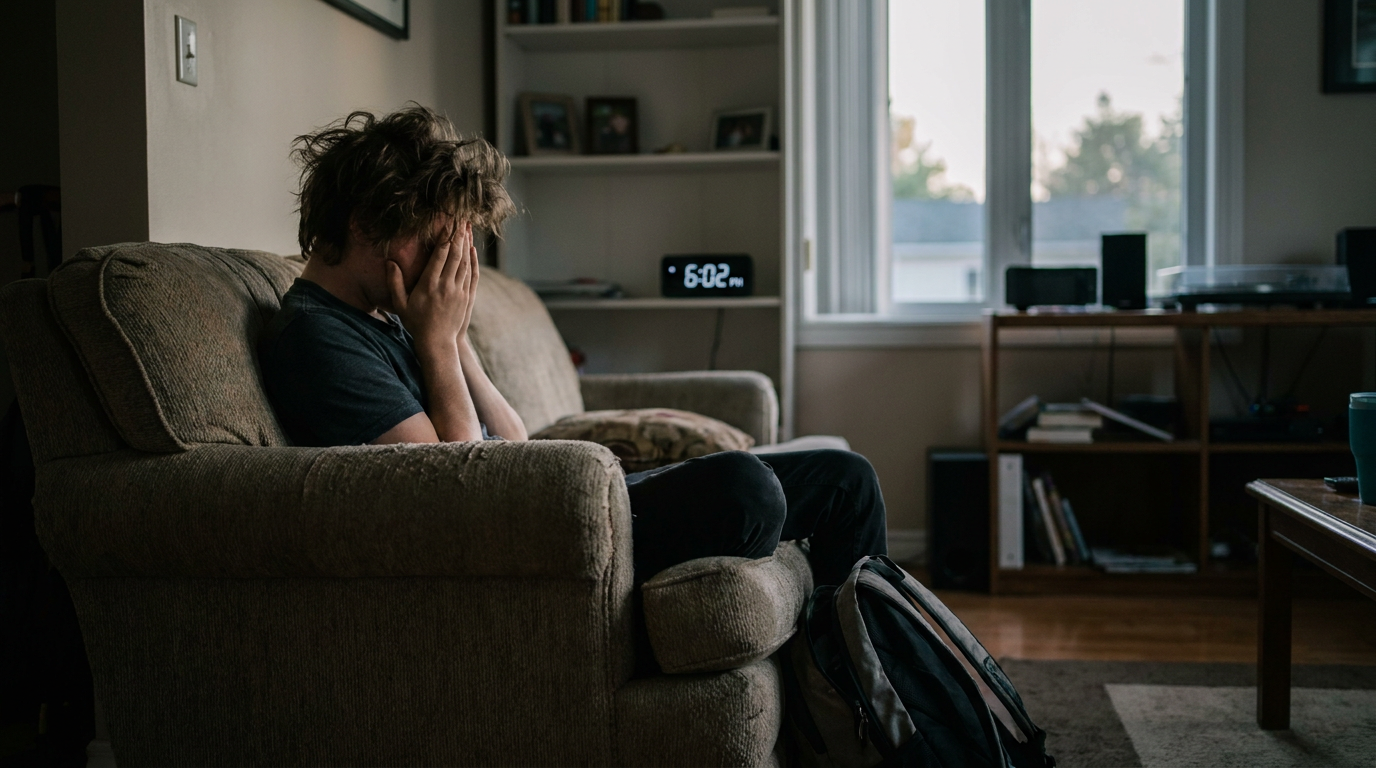
You made it through the commute, the back-to-back meetings, the fluorescent office air, the lunch you ate at your desk while answering something that probably could have waited. By mid-afternoon you were tired but functional, even a little proud of yourself for holding it together. Then you came home, someone asked what you wanted for dinner, and something inside you gave way. Not dramatically — there was no dramatic breakdown, no obvious trigger. Just a short answer where a kind one was possible, a sudden need to be alone in a room, an inexplicable desire to stare at nothing for twenty minutes. If you're used to reading yourself reasonably well, this moment probably confused you. The hardest part of the day was over. Why now?
The gap between the stressor and the crash is one of the more disorienting features of overstimulation, partly because it looks, from the outside and even from the inside, like a reaction to the wrong thing. You didn't snap during the meeting. You snapped when someone put a spoon down too loudly. You didn't cry during the hard conversation. You cried later, alone, for reasons that felt embarrassingly vague. The moment of collapse is rarely the moment of cause, and this mismatch has been quietly distorting how people understand their own limits for a long time.
A 2025 study published in Scientific Reports[1] attempted to track this phenomenon with some rigour, following participants through a full week of ordinary life and measuring sensory overload not in a lab but in the actual texture of their days — at home, at work, in transit, in the ambient soup of modern existence. The researchers used ecological momentary assessment[4], a method that prompts people at irregular intervals to report what they're experiencing in real time, which captures the messiness of lived experience far better than any retrospective survey. What they found confirmed something many overstimulated people have suspected but struggled to articulate: the peak of overload almost never coincides with the most objectively demanding moment. It accumulates. And it tends to land somewhere around the early evening.
This is not a small distinction. If you believe you fell apart because of dinner, or the question about dinner, or the sound of the spoon, you will spend your energy in the wrong place — managing symptoms, apologizing for reactions, feeling confused about your own fragility. The study's findings point somewhere more structural and, once you understand it, considerably less mysterious.
What Sensory Load Actually Means
Sensory overload is one of those terms that gets used loosely enough that it has started to lose its edges. In everyday conversation it tends to mean something like too much noise or too many people, a crowded party, a busy train, a chaotic open-plan office. These are real triggers, but they describe only the input side of the equation. The research picture is broader and more cumulative. Sensory processing involves not just the volume of incoming information but the sustained cost of filtering, prioritizing, and responding to it. Your brain is always making decisions about what to attend to and what to suppress. In a quiet environment with few demands, that filtering is largely automatic and effortless. As environments become more complex — noisier, more socially demanding, more visually cluttered, more digitally fragmented — the filtering work increases, and it draws from the same cognitive and physiological reserves that you're using for everything else.
Researchers studying sensory processing sensitivity and interoception have noted that the nervous system doesn't simply respond to peak intensity; it responds to duration and accumulation too. A moderately loud environment sustained over seven hours may generate more overall load than a very loud one experienced for thirty minutes. This is partly why open offices are so exhausting even when nothing especially dramatic happens in them — the exposure is constant, the filtering never stops, and the body has no quiet interval in which to discharge the background tension it has been carrying. The crash at 6 PM is not irrational. It is, in a sense, physiologically punctual.
“The crash at 6 PM is not irrational. It is, in a sense, physiologically punctual.”
The Accumulation Problem
The Scientific Reports study used the term sensory load budget informally in its discussion — not an official clinical designation, but a useful way of thinking about what the data showed. Each person seemed to arrive at the day with a finite capacity for sensory processing and regulatory effort. As the day progressed, that capacity was drawn down incrementally. The draw was not always proportional to the obvious difficulty of any given moment. Social interactions that required sustained attention, digital environments that demanded rapid context-switching, transit experiences full of unpredictable noise and proximity to strangers — all of these extracted cost regardless of whether the person consciously registered them as difficult.
This is the part that feels counterintuitive until you've sat with it: the budget gets spent on things that don't feel like effort. Looking at a screen isn't experienced as a drain. Managing polite attention in a meeting isn't experienced as a drain. Filtering out the ambient noise of an office, or the sensory information of a packed subway car, isn't experienced as a drain — until, hours later, you're standing in your kitchen and you have nothing left for the question about dinner. The reserves were spent on things that registered as ordinary.
The study's real-time data also captured something that retrospective accounts almost always miss: the absence of meaningful recovery windows throughout the day. Participants who had short, genuinely low-stimulus intervals — even ten or fifteen minutes of comparative quiet, physical stillness, and reduced social demand — showed measurably slower accumulation of load scores as the day progressed. The ones who moved from one stimulating context to another without interruption arrived at the evening in a far more depleted state, even when their objective daily demands were similar. The buffer wasn't rest in the conventional sense. It was absence — specifically, the absence of incoming information the nervous system had to do something with.
Why the Trigger Gets the Blame
Human memory for emotional events is not neutral. We tend to associate our worst feelings with whatever was happening when we became aware of them, and we tend to underweight the long, unremarkable buildup that preceded the moment of awareness. This is partly just how narrative memory works — it needs an event to hang the feeling on — and partly how we're socialized to think about emotional reactions. Reactions are supposed to match their causes in scale and proximity. If you reacted badly, there should have been a bad thing nearby that justified it.
This creates a specific kind of shame spiral that many overstimulated people know intimately: you overreacted, you know you overreacted, the trigger was objectively small, and this makes you feel either defective or fraudulent, depending on the day. What the accumulation model suggests is that you didn't overreact to the trigger. You reacted proportionally to the entire day, using the trigger as the exit. This is not the same thing. It doesn't mean the reaction was okay or that the person on the receiving end wasn't genuinely affected. But it does mean the source was not the spoon, and it was not a character flaw. It was something structural, and structural problems have structural solutions.
“You didn't overreact to the trigger. You reacted proportionally to the entire day, using the trigger as the exit.”
Who Feels This Most Acutely
The 6 PM pattern is not universal in its intensity. Research into sensory processing sensitivity[2] — a trait associated with deeper nervous system responsiveness to environmental and emotional stimuli — consistently shows that higher sensitivity is associated with faster load accumulation and steeper evening crashes. Estimates suggest that somewhere between fifteen and twenty percent of the population scores high on sensory processing sensitivity, though the trait exists on a continuum rather than as a binary category. People with anxiety disorders, ADHD, autism, PTSD, or chronic fatigue conditions also report heightened vulnerability to sensory accumulation, though the underlying mechanisms differ across those groups.
What's worth noting is that high sensory processing sensitivity is not a disorder, and being susceptible to overload does not mean your nervous system is broken. The same depth of processing that makes a person more vulnerable to environmental noise tends to make them more attuned to nuance, more empathetic in social situations[3], and more responsive to beauty, connection, and positive emotional experience. The trait has survival-relevant upsides that tend to get entirely eclipsed in a culture organized around constant stimulation and the expectation that competent people should be able to sustain full function indefinitely without their nervous system filing a complaint.
The Scientific Reports data did not isolate sensitivity as the only predictor of evening load crashes, though. The pattern appeared across the full participant range, more severe in higher-sensitivity individuals but present even in those who scored in the moderate range. Which suggests this is less about a subset of fragile people and more about a broadly human interaction with environments that were not particularly designed with human nervous systems in mind.
What Recovery Actually Requires
Here is where a lot of well-intentioned advice goes wrong. If you experience a 6 PM crash and someone tells you to take a bath, go for a walk, do some deep breathing, or practice gratitude, they are offering you tools designed for acute stress relief — which is genuinely useful, but aimed at the wrong mechanism. You do not primarily need to calm down. You need to process and discharge accumulated sensory load, and these are somewhat different things.
Processing accumulated load means giving your nervous system a genuine break from incoming information: low-stimulation environments, reduced social demand, physical stillness that is not being asked to be productive. It means the absence of screens that demand attention-switching, the absence of background noise that requires passive filtering, and the absence of social interactions that require you to monitor and respond to another person's state while managing your own. For many people this looks like lying down in a quiet room doing nothing in particular, which is embarrassing to admit in a culture that pathologizes stillness as laziness. But what is actually happening in those moments is not nothing. The nervous system is clearing a backlog.
The study's findings around midday recovery windows suggest another implication worth taking seriously: load management is not only a problem to solve at the end of the day. Where intervals of genuine low-stimulus rest can be built into the earlier hours — even briefly — the evening crash tends to arrive later and with less force. This is not about midday meditation retreats. It is about fifteen minutes somewhere between noon and three without a screen in your face, a social demand on your attention, or ambient noise you're trying to ignore. Brief but real. The nervous system appears to take what it can get.
“What is actually happening in those moments of doing nothing is not nothing. The nervous system is clearing a backlog.”
The Shape of the Day, Once You Can See It
There is something quietly useful about having language for a pattern that has probably been disrupting your evenings, your close relationships, and your sense of yourself for years. Not because language fixes the pattern — it doesn't — but because misidentifying the cause costs you something real. If you believe the problem is the trigger, you'll keep trying to control triggers. You'll become vigilant about evening environments, manage other people's behavior, and apologize compulsively for reactions that still keep arriving on schedule. If you understand the problem is accumulation, you start looking at the whole shape of the day: where the load is heaviest, where a recovery window might exist or be borrowed, what you're carrying through the afternoon that you weren't conscious of carrying.
This is less about optimization and more about honest accounting. What does the day actually cost, hour by hour, at the level of your nervous system? The commute. The fluorescent light. The open office. The context-switching between tasks and screens and conversations. The lunch at the desk. The sustained attention your work requires, even when the work itself feels manageable. Each of these has a number attached to it, even if no one ever told you that. And by the time dinner arrives, you've spent them all. The spoon wasn't the problem. It just had the bad luck of landing last.
References
- Sensory processing sensitivity and overstimulation in daily life: an experience sampling method study (nature.com)
Provides the 2025 Scientific Reports study data on sensory load accumulation throughout the day using real-time ecological momentary assessment. - Sensory Processing Sensitivity in the context of Environmental Sensitivity: A critical review and development of research agenda (sciencedirect.com)
Establishes that sensory processing sensitivity is a trait associated with faster load accumulation and steeper evening crashes in vulnerable populations. - The highly sensitive brain: an fMRI study of sensory processing sensitivity and response to others' emotions (pmc.ncbi.nlm.nih.gov)
- Using Experience Sampling Methods/Ecological Momentary Assessment (ESM/EMA) in Clinical Assessment and Clinical Research: Introduction to the Special Section (pmc.ncbi.nlm.nih.gov)
Explains ecological momentary assessment methodology, the real-time tracking method the article's core study used to capture sensory overload in daily life.
About Leanne Ward
Leanne Ward writes about burnout, spirals, numbness, avoidance, coping, overload, and the quiet mechanics of getting through the day when your mind is not cooperating. Her work focuses on lived mental health with honesty, nuance, and zero appetite for fake healing slogans.
More like this
You're Not Too Sensitive. You're Overstimulated. There's a Difference.
New research tracked sensitive people in real time and found their overload doesn't strike randomly — it builds in predictable daily arcs, which changes everything about how to handle it.

Your Phone Is the Escape Route. That's Exactly the Problem.
A 90-day study tracking real phone behavior found that using your screen to escape bad feelings doesn't quiet the anxiety or the depression — it quietly locks them together.

You're Not Faking Fine. You're Burning Through the Last of Your Resources.
A major 2025 meta-analysis found that pretending to feel emotions you don't is one of the fastest routes to depression — and the reason why changes everything about how you actually recover.