Forensic Science Just Recovered Fingerprints From a Fired Bullet. That Changes Everything.
A mild electrical current and a chemical bath just unlocked fingerprints from fired bullet casings — and the implications for cold cases and wrongful convictions are only beginning to surface.
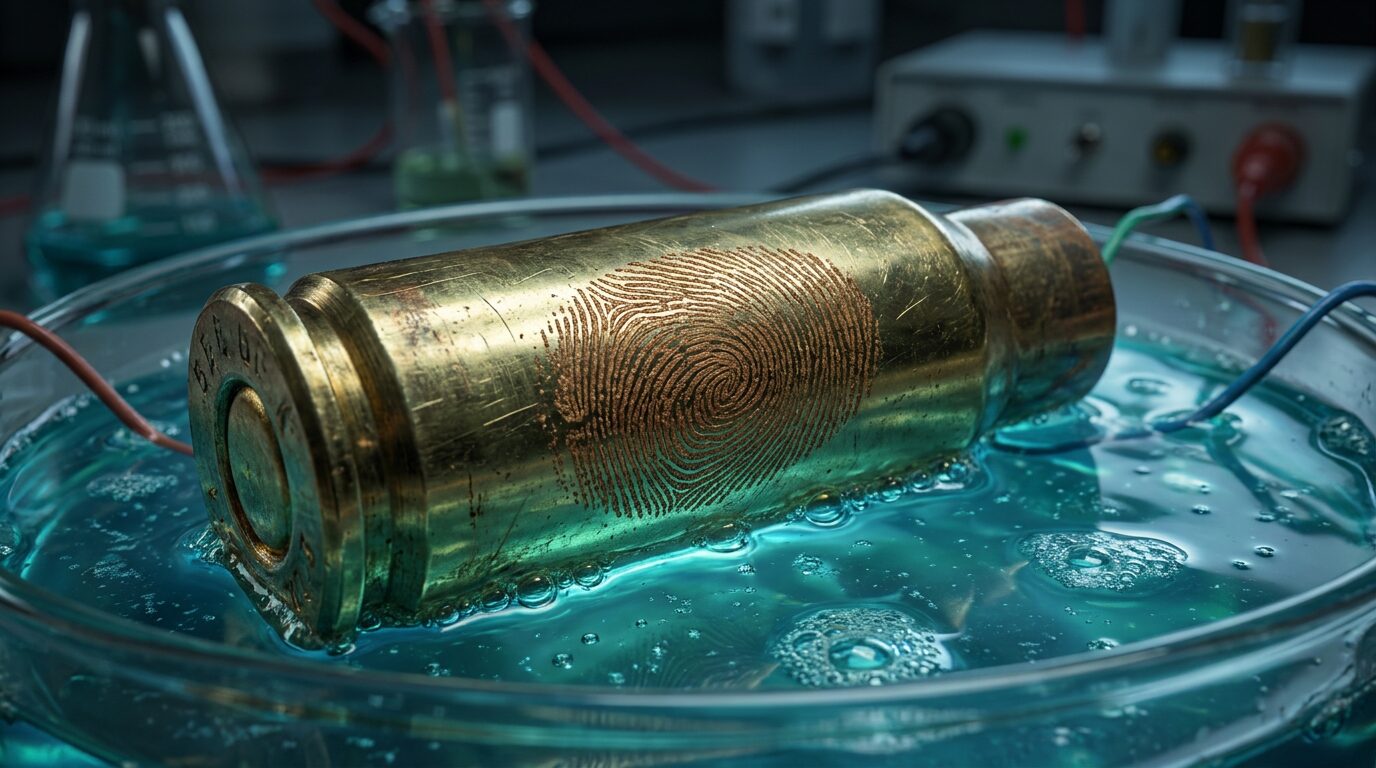
The problem has been sitting in forensic science for decades, not because anyone stopped caring about it, but because heat and pressure were understood to win. When a gun fires, the casing undergoes an almost instantaneous transformation — temperatures spike, gases expand at extreme velocity, and the soft brass is slammed against the chamber wall with force measured in tens of thousands of pounds per square inch. Whatever was on that surface before the trigger was pulled — skin oils, ridge detail, sweat salts — was assumed to be gone. Not degraded. Not faint. Gone. The casing would be recovered, logged, and examined for headstamp markings, extractor striations, and firing-pin impressions. Fingerprints were not a realistic part of that conversation.
Researchers at Maynooth University in Ireland have published findings[1] that reframe the assumption. Using an electrochemical process — mild, controlled, and non-destructive to the ballistic evidence itself — the team demonstrated that latent fingerprint residue can survive on spent brass casings and can be recovered in a form usable for analysis. The technique works by passing a small electrical current through the casing in a chemical bath, exploiting the fact that the salt compounds deposited by fingerprint sweat are electrochemically distinct from the surrounding brass. The result is a developed impression. Not always complete, not always clean, but in documented trials, identifiable.
The forensic science community has a phrase for conclusions that resist revision: settled. The question of fingerprints on fired brass was settled. What Maynooth has done is unsettled it — not with a theoretical argument but with a recoverable impression on a surface that, for decades, the field agreed could not yield one.
The downstream consequences are not abstract. They run directly into the case review process, into the architecture of cold case files, and into the contested terrain of wrongful convictions. To understand why, it helps to understand exactly what the old consensus was built on — and why the electrochemistry of skin oil turned out to be more durable than anyone expected.
What Survives the Firing Sequence
A cartridge casing does not experience a gun's firing the way a bystander might imagine. The heat is intense but brief — microseconds, not seconds — and it is concentrated unevenly. The base of the casing absorbs the most energy. The neck and shoulder, where a handler's fingers are most likely to have rested when loading a magazine or chambering a round, experience a different pressure-and-heat signature. This unevenness matters. It means that while the overall environment of firing is destructive, the destruction is not uniform.
Fingerprint residue is a cocktail of eccrine and sebaceous secretions — water, salt compounds, amino acids, fatty acids, and proteins deposited in the ridge pattern of a finger's skin. The water evaporates quickly. The organic compounds degrade. But the inorganic salt residues, particularly chlorides and other ionic compounds, are considerably more stable. They don't burn off cleanly. They bind to the metal surface through electrochemical interaction, and the Maynooth team's key insight was that this binding survives the firing event in forms that a properly calibrated current can later distinguish. The ridge detail isn't visible to the eye after firing. But the chemical signature of it persists in the metal's surface layer, and electrochemistry can read that signature where traditional optical and powder-based methods cannot.
“The ridge detail isn't visible to the eye after firing — but the chemical signature of it persists in the metal, and electrochemistry can read what the eye cannot.”
Standard fingerprint development techniques — powder dusting, cyanoacrylate fuming, ninhydrin reagents — work by adhering to or reacting with the organic components of fingerprint residue. After firing, most of those organic components are compromised. The electrochemical approach sidesteps them entirely, targeting the inorganic residue instead. The casing is placed in an electrolytic solution and connected to a circuit. Minute differences in electrical conductivity between the brass surface and the residue deposits cause the development to occur differentially — the ridge pattern, where residue was deposited, responds differently than the bare metal between ridges. The result is a contrast-based impression that can then be imaged and analyzed.
What the Old Evidence Chain Was Missing
Cold cases accumulate a specific kind of gap: not the gap of destroyed evidence, but the gap of evidence never looked for, because looking was understood to be pointless. Shell casings recovered from crime scenes are routinely processed for ballistic evidence and then archived. In many jurisdictions, they have been archived for years, some for decades, in the reasonable belief that they had told the investigator everything they could. The Maynooth findings raise a harder question: how many of those archived casings have fingerprint residue that was never sought?
This is not a minor procedural question. Fingerprints are among the most legally persuasive forms of physical evidence in criminal proceedings. A latent print recovered from a fired casing and matched to a suspect places that person's hand on the ammunition — a specific, physical contact that occurs during loading, which typically precedes the crime. It does not prove they fired the weapon, but it narrows the chain of custody in ways that can be decisive. Conversely, the absence of a suspect's fingerprints on recovered casings, or the presence of an unidentified print, can be equally significant. Both directions of that analysis were previously unavailable for fired brass.
“A latent print on a fired casing places a specific person's hand on the ammunition before the crime — a chain of custody the forensic record has never been able to document from that surface until now.”
In wrongful conviction reviews, the implications are more acute. Organizations that conduct post-conviction forensic analysis — innocence-focused legal and advocacy bodies — work primarily with what the original investigation collected. If a casing was logged and archived, and the print it carried was never developed, that archive now potentially contains evidence that was invisible to the original investigators through no fault of theirs. The consensus said it wasn't there. The Maynooth method suggests it sometimes is. What follows from that — legally, procedurally, practically — is not yet mapped.
The Limits That Remain
The technique is real and documented, but it is not a universal solution, and the field would be poorly served by treating it as one. Several factors constrain what the electrochemical method can recover. Time is the most obvious: the inorganic residue that the method targets is stable relative to organic compounds, but it is not inert. Casings stored in humid or chemically contaminated environments degrade differently than those kept in controlled conditions. The original deposit also has to have been substantial enough to survive the firing event in identifiable form — a casing handled briefly with dry hands may yield nothing. Surface condition matters. Corrosion, cleaning agents, and contamination can all interfere with the electrical differentiation the process depends on.
The quality of what is recovered also varies. A partial ridge impression from a fired casing may be insufficient for a definitive match by fingerprint examiners using current standards. Fingerprint analysis has its own documented history of errors — the Brandon Mayfield misidentification in the 2004 Madrid bombing investigation[3] is the case most frequently cited in forensic literature as evidence of how confidence can outpace accuracy. A new method that produces fragmentary impressions from a previously impossible surface creates new opportunities for error if those limitations are not clearly communicated at every stage of the evidence chain: from the lab to the investigator to the court.
There is also the question of validation at scale. The Maynooth findings represent a significant step, but moving from documented laboratory results to standardized, court-admissible procedure requires replication across multiple labs, across different casing types, ammunition compositions, environmental storage conditions, and firing scenarios. That process takes time, and it should. The alternative — rushing a novel technique into evidentiary use before its failure modes are well-characterized — is how wrongful convictions happen, not only how they are corrected.
Where Forensic Science Has Been Before
The history of forensic science is, in significant part, a history of settled questions being reopened. DNA typing, when it arrived in the 1980s[2], was not welcomed uniformly as a revolution. It was contested, challenged, and gradually integrated — and then it began overturning convictions based on evidence that had seemed unimpeachable. Touch DNA, luminol, digital forensics, and stable isotope analysis all followed a version of the same arc: a technical capability that preceded the legal and investigative infrastructure needed to use it responsibly. Each one required laboratories, standards bodies, courts, and review organizations to build frameworks they had not previously needed.
The National Academy of Sciences report on forensic science issued in 2009[4] — a document that reverberated through the field for years — found that many forensic disciplines had been admitted into court proceedings without adequate scientific validation of their reliability. Bite mark analysis, hair analysis, and certain blood pattern interpretation methods took particularly heavy criticism. The report was not a condemnation of forensic science as a whole, but it was a clear finding that the courtroom had consistently moved faster than the laboratory. Fingerprint analysis itself, though among the older and more studied methods, was not exempt from the report's scrutiny around examiner subjectivity and error rate quantification.
“The courtroom has consistently moved faster than the laboratory — and the history of wrongful convictions includes, in its margins, the cost of that gap.”
The Maynooth electrochemical method arrives into that context. It is a genuine technical advance in a field that needs genuine technical advances. But the researchers themselves, in documented public statements about the work, have framed it carefully: a proof of concept, a foundation for further study, a demonstration that the assumption of impossibility was wrong. That framing is appropriate. The technique deserves serious attention from standards bodies, from cold case review organizations, from innocence project investigators. It does not yet deserve a script.
The Archive Problem
The most practically complicated question raised by this development is not what to do with future crime scenes. Investigators going forward can incorporate the method into standard protocol once validation is complete. The more difficult question is retrospective: what is the obligation to the archive?
Evidence storage across law enforcement agencies in the United States and elsewhere is inconsistent in ways that have been documented extensively. Some jurisdictions maintain meticulous records and controlled storage. Others have suffered from evidence degradation, mislabeling, and loss. The 2009 national report noted that evidence handling practices varied enormously and that chain of custody documentation was not uniformly reliable. For a technique that depends on recovering minute chemical residue from a surface archived years or decades ago, that inconsistency is not a minor footnote. The casings most likely to yield useful impressions under the new method are precisely the ones that were stored most carefully — which is not the same as the cases most in need of review.
There is also the question of resources. Running retrospective electrochemical analysis on archived casings across open cold cases is not a trivial undertaking. It requires funding, trained personnel, validated protocols, and a triage system for determining which cases warrant priority. None of those systems exist yet for this specific application. Building them is work that falls to policymakers, budget committees, and standards bodies — none of whom move at the speed of a scientific publication.
The Gap That Stays Open
What Maynooth has documented is not a magic key. It is a demonstration that the lock existed — that the surface was never truly blank, only unreadable with the tools available at the time. That distinction carries weight in both directions. For investigators working cold cases, it is a reason to pull certain archived evidence back into active consideration. For anyone already convicted on the basis of a gunshot-related investigation, it is a reason to ask whether the physical record was ever fully read.
The forensic file on fired brass just got longer. Not closed — longer. Which is usually how it works when a settled question turns out not to have been settled at all. The cases that were built around the assumption that those casings carried no fingerprint evidence are still standing. The science that supported that assumption is not. What happens in the interval between those two facts — in courts, in review organizations, in archive rooms, in laboratories still working through validation — is, for now, genuinely unresolved. That is not a comfortable place. But it is an accurate one, and the record deserves to be read clearly even when it doesn't close neatly.
References
- Electrodeposition of redox materials with potential for enhanced visualisation of latent finger-marks on brass substrates and ammunition casings. (doi.org)
Documents the Maynooth University electrochemical technique that recovers fingerprints from fired brass casings using mild electrical current in chemical bath. - Introduction (ncbi.nlm.nih.gov)
Provides historical context that forensic typing methods using biological markers arrived in the 1980s, establishing the timeline for when fingerprint analysis became standard. - Brandon Mayfield (en.wikipedia.org)
Illustrates how fingerprint misidentification errors can occur, cited as cautionary example for new fragmentary impression recovery methods. - Strengthening Forensic Science in the United States (nationalacademies.org)
Provides context for the article's discussion of forensic science's history of resource constraints and need for systematic advancement.
About Silas Crane
Silas Crane writes from the edges of the record: cold cases, cryptids, declassified files, strange disappearances, forensic science, fringe science, mysterious illnesses, eerie technologies, serial killers, cults, state experiments, UAPs, and claims that cannot be cleanly proved or dismissed. His work also examines crime, deviance, corruption, policing, punishment, and the institutions that decide which harms are investigated, sensationalized, ignored, or allowed to continue. A documentarian at heart, he builds unease from verifiable detail and is always drawn back to the gap the file cannot close.
More like this
The Paper Bag Solved a 38-Year Murder Nobody Was Looking At
A 1987 homicide stayed cold not because the evidence was lost, but because the right question wasn't asked until 38 years later — and the answer was inside the most unremarkable items at the scene.
Your Blood Tells Time. Scientists Are Learning to Read It.
A bloodstain isn't just evidence of violence — it's a chemical clock quietly ticking through a sequence of molecular changes, and new spectroscopic techniques are finally precise enough to read it.
Forensic Labs Are Drowning in Evidence. Cold Cases Are Paying the Price.
State crime labs are sitting on years of untested evidence while proposed federal cuts threaten the one funding stream keeping the system alive — and the cases that disappear into the wait rarely come back.