Forensic Labs Are Drowning in Evidence. Cold Cases Are Paying the Price.
State crime labs are sitting on years of untested evidence while proposed federal cuts threaten the one funding stream keeping the system alive — and the cases that disappear into the wait rarely come back.
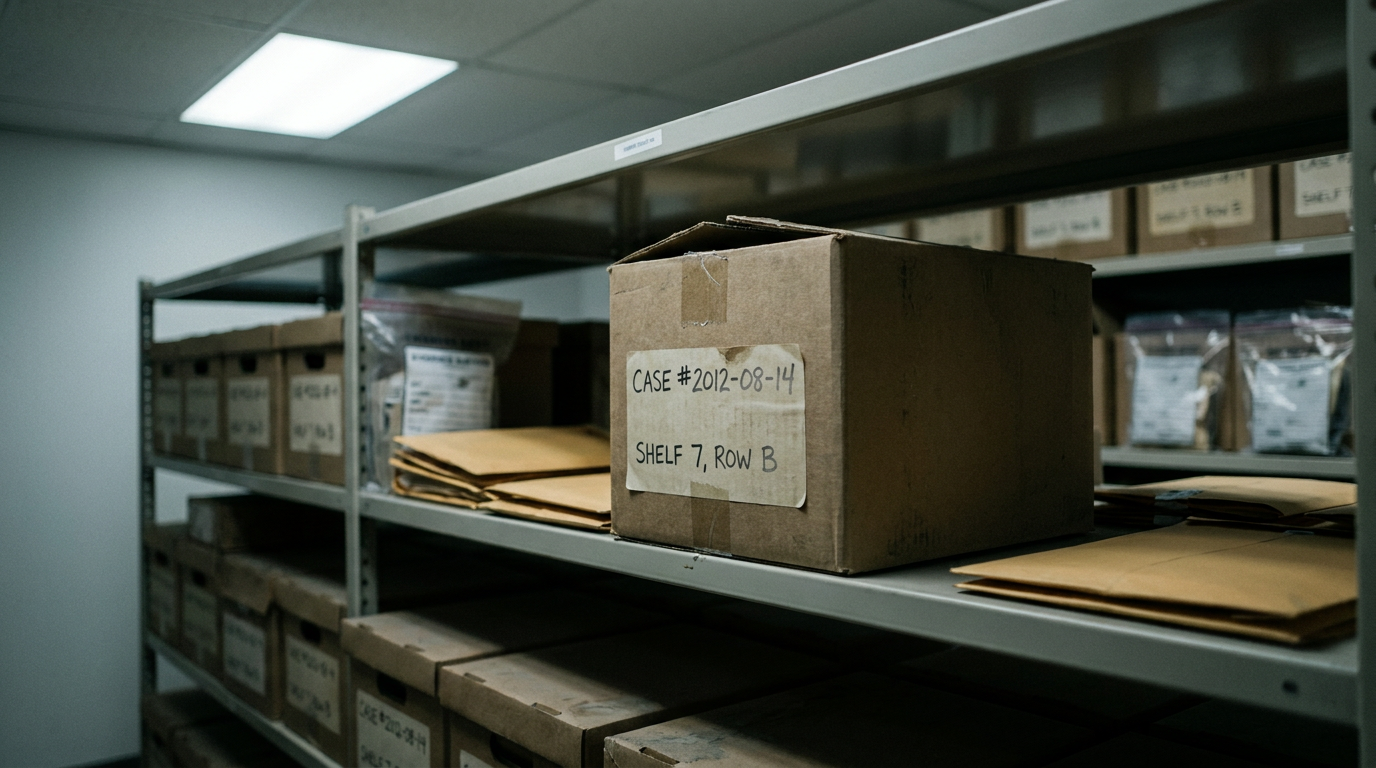
Somewhere in a temperature-controlled storage room in a mid-size American city, there is a sexual assault kit with a case number and a date written in marker on the side. The date is more than a decade old. The kit has not been tested. It is not lost. It is not forgotten, exactly. It is in the queue — which, depending on the state, might mean it will be processed in eighteen months, or three years, or not at all before a statute of limitations closes the door on prosecution. The victim was told the investigation was ongoing. That is technically true. The investigation is ongoing the way a fire is ongoing after the oxygen runs out.
The forensic infrastructure of the United States is in a quiet crisis that does not look like a crisis from the outside. Labs still open every morning. Technicians still process evidence. Quarterly reports still go to state legislatures. But underneath that operational surface, the system is running years behind on multiple evidence categories simultaneously — DNA from violent crimes, untested rape kits, ballistics comparisons, digital forensics, toxicology — and the backlog is not a recent accident. It is the accumulated result of decades of underfunding, understaffing, and a steady rise in submitted caseloads that outpaced every capacity expansion the labs managed to make.
The federal government has historically served as the backstop. Programs administered through the Department of Justice — the Paul Coverdell Forensic Science Improvement Grants[2], the Sexual Assault Kit Initiative[1], the DNA Analysis Backlog Elimination Program — have funneled hundreds of millions of dollars to state and local labs since the early 2000s. They are not glamorous programs. They do not generate press releases that move markets or dominate news cycles. They pay for laboratory equipment, staff positions, accreditation support, and the kind of institutional capacity that only becomes visible when it disappears. And disappear it may.
Proposed federal budget frameworks in recent years have repeatedly targeted these grant programs for reduction or elimination, with the most aggressive proposals coming from spending reviews in 2025. The cuts, if enacted, would not shutter labs overnight. What they would do is remove the margin — the grant-funded positions, the equipment leases, the contract processing agreements with private labs — that allows understaffed public facilities to keep their heads even fractionally above water. The cases that would pay the price are disproportionately older, colder, and attached to victims who were already waiting.
What a Backlog Actually Looks Like
The term 'backlog' implies a line. The reality is more like sediment. Evidence accumulates in layers — recent submissions on top, older cases compressing beneath them — and the oldest material is not necessarily the least important. A 2019 homicide might be in the queue behind a 2024 submission if the newer case arrived flagged as a priority. Priority designations exist for legitimate reasons: an active suspect, an imminent trial, a repeat offender still in circulation. But every case that moves to the front pushes something else further back, and what gets pushed rarely announces itself.
The Bureau of Justice Statistics has documented the scope of the problem at intervals since the early 2000s. A 2020 census of publicly funded forensic labs[3] found that labs across the country received roughly 3.8 million requests for services in a single year and reported backlogs in nearly every evidence category. DNA casework consistently showed some of the longest wait times, with some state labs reporting average turnaround times exceeding a year for non-priority submissions. Ballistics — the analysis of bullets, casings, and firearm toolmarks — showed similar strain. Digital evidence, which has expanded dramatically as a category, has created its own crisis: devices submitted for forensic examination sometimes wait eighteen months before a technician opens them.
Sexual assault kits present a category of particular weight. An estimated hundreds of thousands of kits remained untested in storage facilities across the country as of the mid-2010s, when the issue received sustained public attention. Federal initiatives, including the Sexual Assault Kit Initiative launched in 2015[1], funded the testing of large numbers of previously shelved kits and, in documented cases, produced CODIS hits — matches in the national DNA database — that connected serial offenders to multiple victims across jurisdictions. That testing didn't happen because the labs suddenly got more efficient. It happened because targeted federal money created the capacity to do work the ordinary operating budget couldn't reach.
“Every case that moves to the front of the queue pushes something else further back — and what gets pushed rarely announces itself.”
The Staffing Problem Nobody Is Talking About
The equipment problem is real. But the staffing problem is, in many ways, worse. Forensic science is a specialized field requiring years of training, ongoing proficiency testing, and adherence to accreditation standards that have tightened considerably since the National Academy of Sciences released a landmark 2009 report identifying serious deficiencies in the scientific foundations of several forensic disciplines. That report — formally titled 'Strengthening Forensic Science in the United States[4]' — documented inconsistent practices, inadequate research bases for some common techniques, and a systemic absence of quality standards. In the years since, accreditation requirements have increased. That is genuinely good for the reliability of forensic evidence. It is also expensive, and it raises the training floor for new analysts.
Public crime labs are not competitive employers by the standards of the private sector or federal agencies. A DNA analyst at a state lab in a mid-cost-of-living state might earn a salary that looks reasonable until you compare it to what the same analyst could earn in the pharmaceutical industry, biotechnology, or private forensic contracting. The result is predictable: turnover is high, vacancies go unfilled for extended periods, and experienced analysts leave before they've fully transferred institutional knowledge. Grant funding has been used in some jurisdictions to supplement salaries or fund fellowship positions that bridge the gap, but those positions evaporate when the grant cycle ends.
There is also the question of what it does to remaining staff when the queue keeps growing. Quality control in forensic analysis is not separable from analyst attention. A lab running at 140 percent of sustainable caseload is not simply slower — it is operating in conditions where errors become more likely, where documentation shortcuts accumulate, where the kind of careful second review that catches contamination or miscoding gets compressed. The wrongful convictions that have been linked to forensic lab failures — there are documented cases involving serology, hair analysis, bloodstain pattern interpretation, and DNA mixture interpretation — did not emerge from malice. They emerged from a system asked to produce certainty faster than the science could honestly support it.
What Federal Grants Are Actually Paying For
“The cuts wouldn't shutter labs overnight — they would remove the margin, and the margin is what keeps cold cases from becoming permanent ones.”
The Paul Coverdell Forensic Science Improvement Grants[2] have distributed funding to state and local labs for more than two decades, with the explicit mandate of reducing backlogs, improving quality, and supporting accreditation. The grants are not large by federal spending standards — the total annual appropriation has historically run in the range of tens of millions of dollars, distributed across all fifty states — but in the context of lab budgets that are themselves modest, they represent a meaningful share of operational capacity in smaller jurisdictions. A rural state lab with a total annual budget of a few million dollars and a Coverdell grant of several hundred thousand dollars is not receiving a supplement. It is receiving a structural component.
The DNA Analysis Backlog Elimination Program has funded the processing of hundreds of thousands of DNA profiles for entry into CODIS, the national database that enables cross-jurisdictional matching. Without those profiles, cases that a database hit could close remain open. This is not speculative. There are documented instances — in jurisdictions that participated in grant-funded kit testing initiatives — where a CODIS match surfaced a suspect in a homicide that had been cold for a decade or more, because a rape kit from an earlier assault had finally been processed and returned a profile the database recognized. The chain only works if the evidence gets tested. The evidence only gets tested if someone pays for the testing.
The proposed cuts do not emerge from a vacuum. They are part of broader federal discretionary spending reductions that treat grant programs as optional expenditures rather than infrastructure investments. From one accounting perspective, that framing is defensible: public safety is a state responsibility, and federal grants in this area are supplemental by design. From another perspective — one grounded in what the grants actually produce — the framing misunderstands what kind of infrastructure a forensic lab is. It is not a road that deteriorates visibly when maintenance is cut. It is a system where the consequences of underfunding show up quietly, years later, in the form of a case file that never moved, a survivor who waited, a homicide that stayed unsolved.
The Cold Case Calculus
Cold cases do not go cold because investigators stop caring. Most detectives who carry a cold case carry it for years. They return to it when new tools emerge, when a witness resurfaces, when a database expands. What they cannot control is the evidence pipeline. A cold case with biological material in storage is a solvable case — potentially — the moment that material is profiled and run against the database. The moment that remains perpetually deferred is the moment the case stops being cold and starts being closed by attrition: witnesses age out, memories degrade, suspects die, statutes expire.
The cases most vulnerable to this attrition are not random. Research on how investigative resources are distributed within law enforcement consistently shows that homicides with higher-status victims, more media coverage, and more politically connected families receive more sustained attention. Cold cases involving marginalized victims — people experiencing homelessness, sex workers, victims from low-income communities, Indigenous women — are statistically overrepresented in unsolved files. When resources are constrained, triage follows social gradient. That is not a policy anyone announces. It is an outcome of a thousand separate decisions about where to direct limited capacity. The backlog does not discriminate officially. It just produces results that look, in the aggregate, like discrimination.
“A cold case with biological evidence in storage is a solvable case — until the wait becomes permanent.”
The Record That Doesn't Get Filed
There is a version of this story that generates outrage, that names specific cases, that puts a face on the kit in storage. That version exists and is important. But the version that tends to get lost is structural — the story about why the system works the way it does, who decided it should be funded at this level, and what it actually costs to fix it. Forensic labs are not asking for luxury. They are asking for staffing ratios that do not produce burnout, turnaround times that do not outlast witnesses, and equipment replacement cycles that do not require years of grant-writing to fund a single instrument. The federal programs that provide this are the least visible infrastructure in American criminal justice, and they are being considered for elimination at a moment when the backlog has never been larger.
The kit on shelf 7 has a case number. It has a chain of custody log. It has a victim's name somewhere in the file, and a detective who still thinks about it. What it does not have is a processed DNA profile, or a CODIS result, or a match that would let someone make a call that would change the shape of what that victim's family knows about the night everything changed. That is not a mystery. That is a budget decision. And budget decisions, unlike evidence, do not last forever in storage — they get made, and then the window closes, and the case stays cold.
References
- National Sexual Assault Kit Initiative (SAKI) (bja.ojp.gov)
Details the 2015 Sexual Assault Kit Initiative that funded testing of previously untested kits and produced CODIS matches connecting serial offenders across jurisdictions. - Paul Coverdell Forensic Science Improvement Grants Program (bja.ojp.gov)
Describes the Coverdell grant program that distributes tens of millions annually to state and local labs for backlog reduction and accreditation support. - Publicly Funded Forensic Crime Laboratories, 2020 (bjs.ojp.gov)
Provides 2020 census data showing labs received 3.8 million service requests and reported backlogs across nearly every evidence category. - Strengthening Forensic Science in the United States (doi.org)
Documents 2009 findings of inconsistent forensic practices and inadequate scientific foundations that prompted tightened accreditation standards referenced in the article.
About Silas Crane
Silas Crane writes from the edges of the record: cold cases, cryptids, declassified files, strange disappearances, forensic science, fringe science, mysterious illnesses, eerie technologies, serial killers, cults, state experiments, UAPs, and claims that cannot be cleanly proved or dismissed. His work also examines crime, deviance, corruption, policing, punishment, and the institutions that decide which harms are investigated, sensationalized, ignored, or allowed to continue. A documentarian at heart, he builds unease from verifiable detail and is always drawn back to the gap the file cannot close.
More like this
The Paper Bag Solved a 38-Year Murder Nobody Was Looking At
A 1987 homicide stayed cold not because the evidence was lost, but because the right question wasn't asked until 38 years later — and the answer was inside the most unremarkable items at the scene.
The Government Called Unidentified Remains a 'Silent Disaster.' Now DNA Is Naming the Dead.
America's unidentified dead have been piling up in morgues for decades — and the forensic genealogy companies working to name them are doing it with science that would have seemed impossible fifteen years ago.
Before 2018, DNA at a Crime Scene Only Helped If You Had a Name. One Database Changed That.
Before 2018, crime-scene DNA could only confirm a suspect you already had. Then investigators ran a killer's genome through a public genealogy database — and the entire logic of forensic identification broke open.