Fungus Ate Your Agricultural Waste. Now It's Holding up a Wall.
Mycelium composites work by exploiting a fungus mid-meal — and the moment you stop the digestion is the moment the material begins.
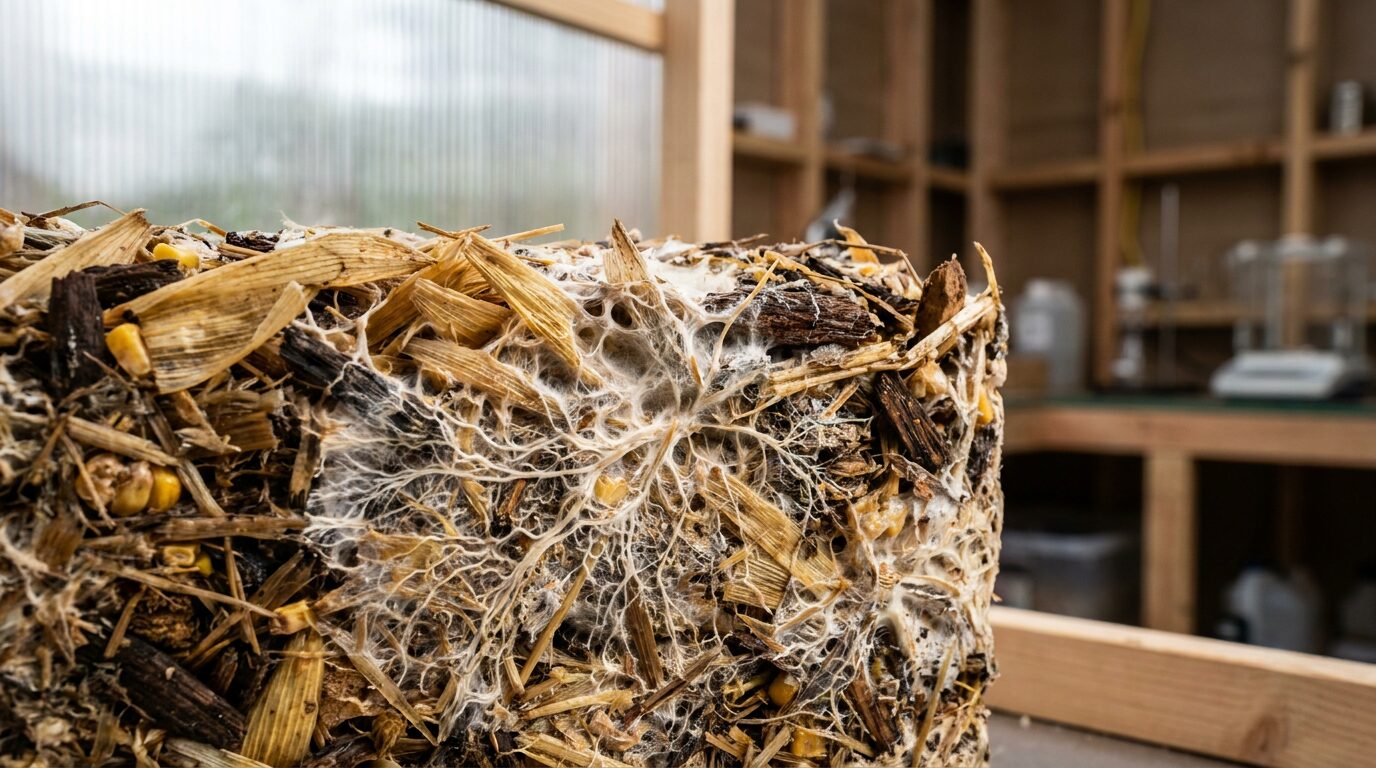
Pull back the bark on a fallen log in a damp forest and you will almost certainly find it — a pale, cobwebby mat clinging to the wood's underside, fanning outward in threads finer than sewing thread. That is mycelium: the living, feeding body of a fungus, not the mushroom cap you recognize but the part doing the actual work. It is dissolving the log. Its hyphae, those branching filaments ranging between one and thirty micrometers in diameter, are secreting enzymes that break down lignin and cellulose, loosening the wood's structure fiber by fiber, pulling nutrients back into the network. The mushroom on top is just the reproductive organ. Down here, in the dark and the damp, the fungus is eating infrastructure and turning it into more of itself.
For a long time, that process was simply called rot. Now a growing body of researchers and companies are looking at it differently — not as destruction, but as manufacturing. The insight is simple and somewhat strange: if you put a fungus inside a mold filled with agricultural waste and let it grow for roughly a week, it will bind that waste into a rigid, lightweight composite. Then you kill it with heat, and what remains is a solid panel that neither the fungus nor the farmer needed to synthesize with fossil fuels. The wall panel grew itself. The trick is knowing exactly when to stop.
How a Fungus Becomes a Building Material
Mycelium is the living body of a fungus. It grows as thin, branching filaments known as hyphae, which spread out in all directions in search of food — and in a forest, these threads help break down leaves, logs, and other organic matter. In a lab or a manufacturing setting, that same biological drive gets redirected. Once mycelium has been mixed with a chosen substrate, it is left to grow in a form in a dark room at ambient temperature for about five days, during which time the fungal mycelial network binds the agricultural substrate together, resulting in a light, robust, and organic material. The substrates read like a composting pile: shredded hemp stalks, corn husks, soybean hulls, and other low-value, non-food agricultural materials.
What the hyphae are doing during those five days is not passive bonding. Unlike plants, which primarily rely on cellulose for structural support, fungi utilize chitin and chitosan — sustainable biopolymers. Chitin, also found in most insect and arthropod exoskeletons, is a polysaccharide with a linear structure. Fungal mycelium, composed of dense and intricate hyphal filament networks, also contains glucans, mannoproteins, chitosan, and small amounts of proteins and glycoproteins. As the hyphae thread through the loose substrate — sawdust, straw, wood chips — they are simultaneously digesting the material's surface and mechanically weaving through it, locking particles together the way rebar locks concrete. These constituents endow mycelium with structural and mechanical characteristics comparable to lignocellulosic materials like wood and cork.
The process ends deliberately. Kiln drying removes water and renders the mycelium inert, so the resulting material stays dry, stable, and strong. The heat kills the living fungus but preserves the chitin scaffold it built — a dead architecture made from what was, days earlier, active biology. The composite does not continue growing or digesting. It does not spontaneously fruit. It is arrested mid-process, frozen at the moment the binding is complete but before further enzymatic digestion would undermine the structure itself. This is the precise point where agricultural waste has become a usable material.
Why the Result Is Lightweight and Insulating
The foam-like quality of mycelium composites comes directly from the way hyphae grow. They do not pack space solid — they thread through it, leaving a tortuous network of air pockets interwoven with fibrous chitin. That porous microstructure is exactly what makes materials thermally resistant: air trapped inside is a poor conductor of heat, and the more interrupted the path a heat wave has to travel, the slower it moves. Across studies, thermal conductivity values for mold-grown mycelium composites typically fall within the range of 0.03–0.08 W m⁻¹ K⁻¹, confirming that mycelium-based materials can achieve insulation-grade performance, though higher values, up to 0.124 W m⁻¹ K⁻¹, highlight the strong influence of density, substrate composition, and internal structure.
To put that in useful context: the lowest thermal conductivity was observed in hemp-based mycelium biocomposites, with a lambda coefficient of 40 mW m⁻¹ K⁻¹, making these composites competitive with non-mycelium insulation materials including synthetic polymers such as EPS and XPS. Additionally, these composites exhibited superior fire resistance compared to various synthetic foams. The performance window is real, but so is its variability — grown from fungal mycelium and lignocellulosic waste, these composites offer low embodied energy, biodegradability, and effective hygrothermal performance, though key challenges are identified, including process standardization, scalability, and durability under real-world conditions. The same biological flexibility that lets you tune the material by changing the species or the substrate also means the properties shift in ways that industrial processes typically do not tolerate.
The acoustic behavior follows from the same porous geometry. Compared to conventional acoustic dampening materials like foam, cork, felt, cotton, and ceiling tiles, mycelium-based panels display comparable acoustic absorption in frequencies around 3,000 Hz and above, while falling short in performance at lower frequencies. Performance is dependent on the mix of substrate, species, and yield, which gives varying absorbance profiles. In other words, the material is already doing something useful for sound — but which sounds it attenuates depends on how it was grown, a variable that opens design possibilities and complicates standardization in equal measure.
The Fire Resistance Claims, Examined
“The char is not a failure of the material. It is the material doing its job — sealing itself off from further combustion.”
The claim that mycelium is fire-resistant gets repeated often enough that it has started to sound like marketing. The underlying mechanism, however, is real and chemically specific. Pyrolysis flow combustion calorimetry evaluations reveal that the combustion propensity of mycelium is significantly lower compared to poly(methyl methacrylate) (PMMA) and polylactic acid (PLA), indicating that it is noticeably less prone to ignition and flaming combustion. The reason traces back to chitin's chemistry. The improved flaming combustion resistance may be attributed to the higher residual char produced by mycelium (23 wt%) in comparison to PMMA (0 wt%) and PLA (0.6 wt%). The presence of char inhibits oxygen migration at the solid/gas phase interface, thereby limiting the flaming combustion process.
In plain terms: when mycelium burns, it turns into a crust rather than a gas. When exposed to extreme heat or fire, mycelium decomposes into a protective char layer which effectively shields underlying layers from the heat. Synthetic foam insulation, by contrast, burns readily, melts, drips, and releases toxic gases — the same chemical complexity that makes it a good thermal insulator also makes it a combustion problem. Mycelium-based composites exhibit superior fire performance compared to synthetic polymers, characterized by low heat release, minimal smoke production, and a high char yield that inhibits flame spread. Some composites have even demonstrated self-extinguishing capabilities.
The honest caveat is that fire-related data remain comparatively scarce and methodologically heterogeneous across studies. Nevertheless, investigations that include fire testing consistently report surface charring, self-extinguishing behavior, and reduced flame propagation, supporting the inherent flame-retardant nature of mycelium-based materials. Results also depend heavily on what the composite is grown from, which species of fungus was used, how dense the final panel is, and whether any additives were incorporated. This is a pattern across every property of mycelium composites: the numbers are promising, and the mechanism is real, but the variance is wide enough that each formulation is essentially its own material.
What It Can Actually Build
The popular imagination around mycelium construction leans toward the dramatic: living walls, mushroom skyscrapers, buildings that breathe and eventually compost. The research picture is more grounded. While unadulterated mycelium blocks are suitable for use as non-structural walls owing to their lower compressive strength, research has found that composites made from sawdust and straw as substrates lacked the compressive strength needed for load-bearing structures. The material compresses. Under load, it creeps. Moisture is a serious adversary. Recent research on the long-term behavior of mycelium-based composites suggests that, while these materials are promising, their utility in humid or soil-contact environments is limited without protective treatment.
Although commercially successful in packaging, the use of mycelium in construction is currently limited to temporary structures. Enhancing its structural and load-bearing properties through further research is essential for widespread use in architecture. The field has produced impressive installations — including the MycoTree at the 2017 Seoul Biennale, a load-bearing branching structure grown from mycelium composite blocks — but these are demonstrations of possibility, not blueprints for a housing development. The gap between an installation and a regulated building product is filled with fire codes, moisture durability standards, long-term creep testing, and the kind of repetitive mechanical consistency that a living organism does not naturally produce.
The more credible near-term territory is exactly where the material's actual properties fit best: insulation panels, acoustic tiles, facade cladding, and packaging. Commercial mycelium-based composites currently available in the market are generally used as insulating panels, packaging materials, interior design applications, and acoustic tiles. These products are manufactured by companies including Ecovative Design and MOGU. The acoustic panels have a noise-reduction coefficient of 0.53 and are sold as a replacement for traditional acoustical ceiling tiles, while also offering good thermal insulation at 0.05 W/mK. The Italian company Mogu produces interior flooring tiles. Ecovative's Mushroom Packaging[5] line replaces expanded polystyrene in protective shipping containers. The entire process to grow the composite takes seven days.
“The material works best not where structures carry loads, but where structures manage heat, sound, and the end of a product's life.”
Hybrid systems are where some researchers see the most immediate promise. Mycelium composites bonded to conventional structural frames, or used as infill insulation within timber or steel construction, sidestep the load-bearing problem by letting each material do what it does well. To improve durability, researchers are exploring natural reinforcement — mixing fibers such as hemp, flax, or other agricultural and construction byproducts to improve strength while keeping the material biodegradable. Others are experimenting with protective coatings: natural waxes, mineral layers, or surface treatments that buffer the composite against moisture without compromising its compostability at end of life. Meanwhile, researchers are harnessing artificial intelligence to adjust temperature, humidity, and nutrient sources during growth, to see if more uniformly dense materials with better passive cooling and structural performance can be produced.
The Carbon Accounting and the Real Obstacles
Part of what makes mycelium composites genuinely interesting — not just aesthetically — is what their production does not require. No melting, no high-pressure synthesis, no petrochemicals. Because the growing fungus fixes carbon from its feedstock, a mycelium composite panel can embody a net carbon sink until it decays, and its manufacturing uses ambient-temperature processes and agricultural by-products, making the overall energy input small. Recent analyses have shown that, on a life-cycle basis, mycelium insulations can outperform both fiberglass and foam insulations in terms of carbon footprint. The substrate feeds the fungus, the fungus builds the panel, and the panel can eventually be composted or returned to soil. This is not a theoretical materials cycle — it is the fungus's ordinary biology, redirected.
The obstacles that remain are procedural as much as material. Mycelium-based materials are not yet a magic solution: they cannot replace most metals, concrete, or high-performance plastics, and outdoor durability is still a significant hurdle. Uniformity is challenging to achieve because mycelium is a living organism rather than an industrial polymer. And, as with any new material, standards and regulations take time to develop. A 2025 review in Energies[1] from the École de Technologie Supérieure identified process standardization, scalability, and durability under real-world conditions as the three central barriers to broader adoption — the same three problems the field has been naming for nearly a decade, which suggests they are genuinely hard. A 2024 study in Frontiers in Sustainable Cities[2] modeling mycelium-wood insulation across all residential buildings in the Helsinki metropolitan area found meaningful emissions-reduction potential but also noted that roof application was excluded because water stagnation on horizontal surfaces poses a durability risk the research hasn't yet resolved.
The fire and thermal property research published in Scientific Reports[3] established that mycelium's combustion propensity is fundamentally lower than common synthetic polymers — but that paper is from 2018, and the field has been accumulating fire-test data with inconsistent protocols ever since, making cross-study comparison difficult. A 2025 study in IOPscience directly linking additive type and fabrication method to fireproofing behavior found that wool reinforcement enhanced structural stability under flame exposure — a useful result that also illustrates how species, substrate, and processing additive together determine the fire behavior of what is technically the same class of material. This is not a flaw in the science. It is an accurate description of biological manufacturing: the inputs are never entirely identical, and the outputs vary accordingly.
What mycelium composites represent is not a revolution in structural engineering but something more interesting: a demonstration that a fungus's normal working life — threading through organic waste, secreting enzymes, building chitin scaffolds across a substrate it is simultaneously dissolving — can be hijacked at exactly the right moment and turned into something you could ship electronics in, hang on a wall to quiet a room, or press into an insulation panel that will eventually decompose in a garden. The material grew itself. It just needed someone to decide when to stop. That is a genuinely different way of thinking about what a building material is — less a thing you make, and more a process you interrupt.
References
- A Review of Mycelium Bio-Composites as Energy-Efficient Sustainable Building Materials (doi.org)
Provides thermal conductivity values (0.03–0.08 W m⁻¹ K⁻¹) and fire resistance data showing mycelium composites' insulation-grade performance. - Mycelium-wood composites as a circular material for building insulation (doi.org)
Supplies comparative thermal conductivity data for hemp-based mycelium biocomposites and documents superior fire resistance versus synthetic foams. - Thermal Degradation and Fire Properties of Fungal Mycelium and Mycelium - Biomass Composite Materials (nature.com)
Provides fire and thermal property research showing mycelium composites produce 23 wt% char versus 0–0.6 wt% for synthetic polymers, supporting the article's explanation of char-based fire resistance. - Influence of additives and fabrication route on the thermal and fireproofing of mycelium-based insulation composites (iopscience.iop.org)
- Mushroom Packaging (mushroompackaging.com)
About Aris Thorne
Aris Thorne is a microbiologist who writes about the hidden mechanics of ordinary life: the microbes running your home, the chemistry unfolding in food and water, the physics built into familiar objects, and the biological systems quietly keeping the human body alive. His work follows science from kitchens, bathrooms, dust, soil, and city air into wounds, immune responses, infections, medicines, cells, and other worlds. He is most interested in the moment something familiar stops looking simple and reveals the living machinery underneath.
More like this
Indoor Mold's Real Threat Isn't the Stain — It's the Air Around It
A new method for detecting airborne mycotoxins confirms what the stain on your wall can't tell you: the toxic part already left.
The Slime You Scrubbed Off the Drain Came Back. That's the Point.
New research shows that household cleaning kills the bacteria inside a biofilm while leaving its scaffold intact — which means the colony doesn't die, it just takes a short nap.
The Atmosphere in Your Kitchen Is More Violent Than You Think
Indoor air quality researchers are discovering that a single pan of sautéed onions can spike ultrafine particle concentrations to levels that would trigger outdoor air quality alerts — and the chemistry happening three feet above your stove is stranger and more consequential than anyone expected.