The Shy Baby You Were Is Still Deciding Who Gets to Know You
Longitudinal research tracking people from infancy to their mid-twenties suggests that the hesitant baby at the edge of the playground may still be quietly running the social decisions of the adult.
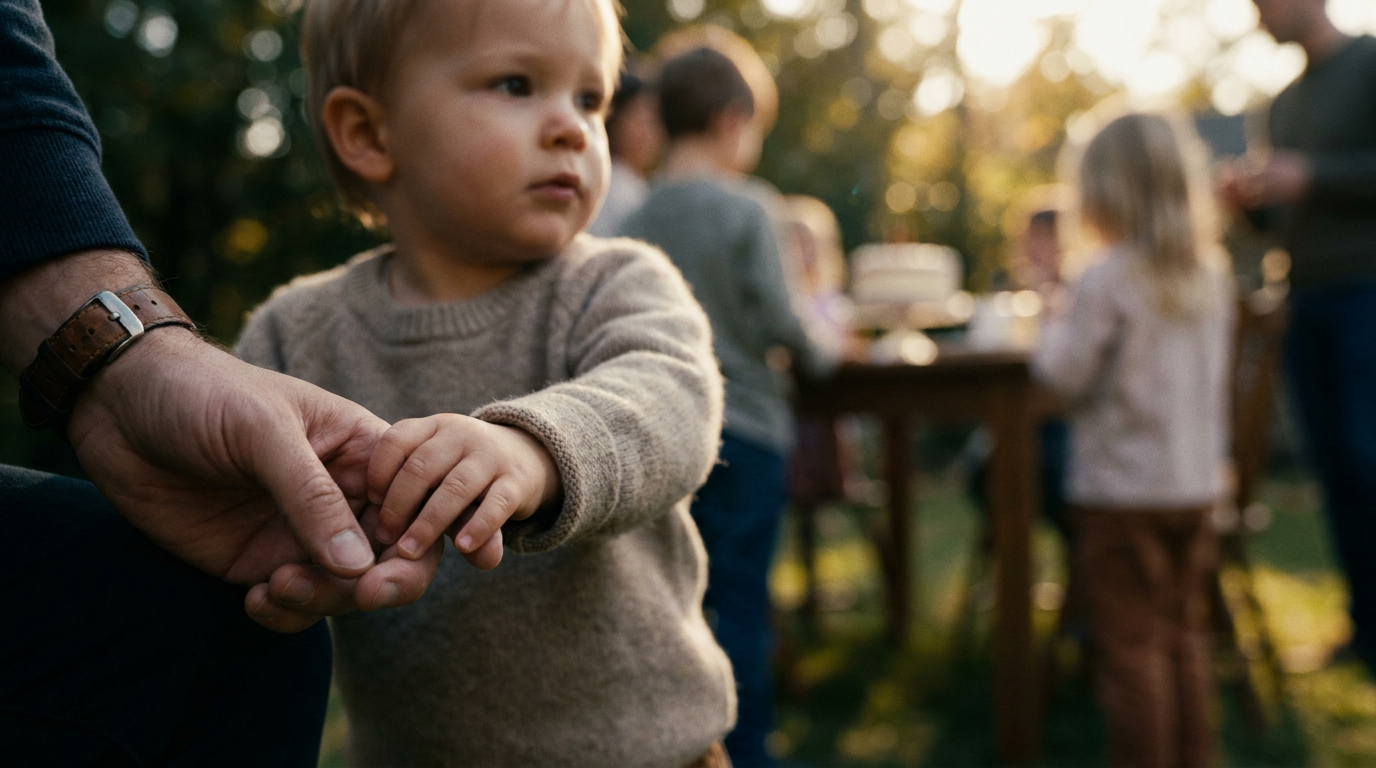
Picture a toddler at a birthday party. The other two-year-olds are already in the middle of it — grabbing cake, chasing a dog, falling into each other with the graceless enthusiasm of people who have not yet learned to worry about what happens next. This child stands at the entrance to the backyard. She watches. Her grip on her mother's hand tightens, then relaxes, then tightens again. She is not upset, exactly. She is not going to cry. She is doing something more specific than crying: she is reading the room before she decides whether she belongs in it.
Developmental psychologists have a name for what this child is doing — or more precisely, for the temperamental style that produces this behavior. They call it behavioral inhibition. The term, which traces its formal lineage to the work of Jerome Kagan and his colleagues beginning in the 1980s[2], describes a consistent pattern of wariness, restraint, and heightened physiological arousal in the face of novelty: new people, new places, new situations that cannot yet be assessed for threat or safety. It shows up reliably in the first year of life, can be measured with reasonable consistency at eighteen months, and — here is the part that deserves more than a passing footnote — predicts a surprising amount about how a person manages social closeness decades later.
A long-running NIMH-funded longitudinal study that tracked participants from infancy through age twenty-six[3] found that children identified as behaviorally inhibited in toddlerhood showed measurably higher rates of social withdrawal, interpersonal anxiety, and guardedness in early adulthood than their uninhibited peers. This is not a small or ephemeral signal. Across more than two decades of living — school, adolescence, relationships, all of the environments that shape a person — the original temperamental signature remained detectable. The child at the door to the backyard had grown up. She was still, in some functional sense, standing at the door.
What makes this research unsettling in an interesting way is what it implies about the stories we tell ourselves about who we are. Many adults who are slow to open up, reluctant to initiate, careful about who they let close, tend to explain this through experience: a friendship that ended badly, a family that valued privacy, a workplace that punished vulnerability. Experience is real and it matters enormously. But the longitudinal data suggests there may be something prior to all of that — a constitutional starting point that arrives before language, before memory, before any particular wound. The question this raises is not a simple one: if your social caution began in your nervous system before you had a self-concept, what does it mean to call it a choice? What does it mean to call it a problem?
What Behavioral Inhibition Actually Is
Behavioral inhibition is not shyness, though the two are related and often conflated. Shyness refers to the discomfort or apprehension a person feels specifically in social situations. Behavioral inhibition is broader — it is a general stance toward novelty and uncertainty, of which social situations are only one category. The inhibited infant may startle more easily, take longer to approach an unfamiliar object, show more distress when a routine changes, and display elevated physiological markers of arousal — higher resting heart rate, stronger cortisol response to new stimuli — compared to uninhibited infants in the same environment. The social wariness is part of the picture, not the whole of it.
The underlying mechanism appears to involve heightened amygdala reactivity[1] — a lower threshold for detecting potential threat in the environment. This is not pathology. It is a variation in how the threat-detection system is calibrated. In ancestral environments, a child with a more reactive threat-detection system may have survived encounters that a bolder child did not. The inhibited temperament is, in a real sense, an old solution. The issue is not that the system is broken. The issue is that a very sensitive alarm can go off in rooms that are not actually on fire.
“A very sensitive alarm can go off in rooms that are not actually on fire.”
Research using neuroimaging has found that adults who were identified as behaviorally inhibited in childhood tend to show stronger amygdala responses to novel faces[4] and ambiguous social cues, even after decades of socialization and experience. The nervous system appears to retain some memory of its original calibration. This does not mean the inhibited adult is always anxious, or that they cannot form close relationships, or that their caution is involuntary in some absolute sense. It means they are working from a system that was built with a lower signal threshold, and that certain social situations — particularly new ones, or ones where judgment feels possible — are genuinely more effortful for them than they are for others.
The Developmental Path from Toddler to Adult
Temperament does not operate in isolation. The longitudinal research is careful about this. A child with high behavioral inhibition who is raised in a warm, low-pressure environment — one that does not shame the hesitation or force premature exposure — tends to show fewer anxiety symptoms in adulthood than an inhibited child raised in an environment that treated the wariness as a problem to be corrected or a weakness to be pushed through. The original temperament interacts with caregiving quality, family dynamics, peer experience, and cultural context. It does not determine outcomes in a straight line.
What the research describes is more like a trajectory with varying degrees of stability. Some children who show high behavioral inhibition at eighteen months moderate considerably by middle childhood, particularly if their social environments are scaffolded in ways that allow gradual approach without punishment for hesitation. Others maintain a stable inhibited profile through adolescence and into adulthood. The variable that seems to matter most is not whether the child is pushed to overcome the temperament but whether the people around them help them develop effective strategies for managing the arousal — teaching them, gradually and without pressure, that novelty can resolve into safety.
Adolescence complicates things considerably. This is the developmental period when social evaluation becomes the central organizing pressure of daily life, and a nervous system calibrated toward threat-detection does not handle that pressure quietly. Inhibited adolescents show higher rates of social anxiety than their uninhibited peers, and — importantly — they are more likely to develop avoidant coping strategies: staying on the edges of social groups, limiting self-disclosure, forming fewer but sometimes more intensely guarded friendships. These strategies are adaptive in the short term. They reduce the frequency of painful exposure. Over time, though, they can consolidate into a self-concept: I am someone who is private. I am someone who takes a long time to trust. I am not someone who opens easily.
“The strategies that protected the adolescent can consolidate into the identity the adult mistakes for simply being themselves.”
When Caution Becomes a Social Style
By adulthood, behavioral inhibition tends to express itself less as obvious hesitation at thresholds and more as a particular texture of social behavior that can be hard to name from the inside. The inhibited adult may not think of themselves as anxious. They often do not feel fearful in the dramatic sense. What they notice instead is a persistent lag before engagement — a beat of assessment that others seem not to take, a need to watch before participating, a preference for depth over breadth in relationships that is genuine but also functions as protection. They may describe themselves as introverted, as selective, as someone who does not trust easily. All of these may be true. They are also the adult vocabulary for what was, at twenty months, a wariness response to the unfamiliar.
This is where temperament and social learning begin to braid together in ways that are difficult to separate. The inhibited child who was teased for being quiet, or told they were unfriendly, or urged constantly to speak up and come out of their shell, has layered shame onto a physiological reality. The shame is not temperament. The shame is learned. But it attaches to the temperament and rides it into adulthood, so that the hesitation at the door to a new social situation is no longer just a nervous system calibration — it now also carries a history of having been found wanting for having that calibration. The arousal and the self-judgment become nearly impossible to distinguish from inside.
People who grew up as inhibited children and were also raised in family environments that emphasized emotional control, privacy, or the social costs of appearing vulnerable are particularly likely to arrive in adult relationships with a style that looks, from the outside, like withholding. It is not exactly withholding. It is more like a sophisticated system for assessing whether the exposure is worth the risk — a system that was useful, once, and that has simply never received a clear signal to update its threat estimates.
What Changes and What Does Not
Here is what the research does and does not promise. Behavioral inhibition is not destiny. The longitudinal studies that track inhibited children into adulthood find a real but imperfect correlation — which means many inhibited children become adults who are socially comfortable, warm, and relatively unguarded, and many uninhibited children become cautious, reserved adults for reasons that have nothing to do with temperament. Development is not a locked trajectory. What the research suggests is more like an initial lean — a direction the system tends to bend under pressure — that interacts with everything that comes after.
What does appear to be stable, even in people who have done significant work on their social anxiety, is the underlying physiological reactivity. The amygdala does not learn to respond less. What changes, with experience, with therapy, with deliberate exposure and good relationships, is the cortical overlay — the part of the nervous system that interprets the alarm signal and decides what to do with it. A person with a highly reactive amygdala who has developed strong regulatory skills is not the same as a person with a low-reactive amygdala. They arrive at similar social behavior through different routes, with different internal costs, and — critically — they may have different thresholds for how much ongoing effort social openness requires.
The Question Underneath the Pattern
There is something useful that happens when you locate a social pattern in temperament rather than only in wound or choice. It is not that it removes responsibility — you still decide, as an adult with a prefrontal cortex, how much you let the calibration run unchallenged. But it changes the quality of the self-observation. The adult who has spent years assuming that their reluctance to open up is a character flaw, or a consequence of one specific painful relationship, or a sign that something in them is fundamentally broken, may find it clarifying to understand that this reluctance has a physiological history that predates any of those explanations. That it began as a protective mechanism in a nervous system that arrived wired toward caution. That it is not a failure of courage. It is the inherited shape of a specific kind of alertness.
“Locating a pattern in temperament does not remove responsibility — it changes the quality of the self-observation.”
At the same time, temperament is not absolution. An explanation of where the pattern came from is not the same as a reason to leave it unchanged. The inhibited adult who understands their nervous system history still has to decide what they want from closeness, and whether the gatekeeping that once kept them safe is now keeping out people and experiences that would be worth the exposure. That is a different kind of question than asking why the gate exists. It is harder, and more personal, and it requires sitting with the discomfort of novelty long enough for the alarm to recalibrate — which is, as it turns out, exactly what the inhibited toddler at the edge of the birthday party was not yet equipped to do. The adult, theoretically, is.
The shy baby at the door was not making a mistake. She was being accurate about her own threshold. What changes, across a lifetime, is not necessarily the threshold itself — it is the growing capacity to know it is yours to work with, not just yours to live inside of.
References
- Alterations in Amygdala Functional Connectivity Reflect Early Temperament (pmc.ncbi.nlm.nih.gov)
Documents heightened amygdala functional connectivity in adults with childhood behavioral inhibition history, supporting the neurobiological basis of the temperament. - Annual Research Review: Developmental pathways linking early behavioral inhibition to later anxiety (pmc.ncbi.nlm.nih.gov)
Establishes Jerome Kagan's foundational 1980s work defining behavioral inhibition as a measurable temperament identified in early life. - Infant behavioral inhibition predicts personality and social outcomes three decades later (pnas.org)
Provides the longitudinal data showing behaviorally inhibited toddlers displayed higher social withdrawal and interpersonal anxiety through age twenty-six. - Inhibited and Uninhibited Infants "Grown Up": Adult Amygdalar Response to Novelty (doi.org)
Demonstrates that behaviorally inhibited adults show stronger amygdala responses to novel faces and ambiguous social cues decades after childhood identification.
About Mara Ellison
Mara Ellison writes about childhood patterns that echo into adult life, including attachment, temperament, rejection sensitivity, emotional learning, family roles, and the early social scripts people keep reenacting without realizing it. Her work focuses on developmental psychology with nuance, clarity, and unusual emotional precision.
More like this

Rejection Sensitivity Doesn't Start with a Broken Heart. It Starts with a Worried Child.
New research on rejection sensitivity's environmental roots reveals something most adults who carry it were never told: it wasn't a flaw they were born with, it was a strategy they built.

The Kid Who Conformed to Survive Is the Adult Who Can't Disagree
Research on rejection-sensitive adolescents reveals a pattern more insidious than shyness: the systematic suppression of their own judgment — and it doesn't stop when childhood does.

The Avoidant Partner Isn't Cold. Their Nervous System Is Doing Its Job.
Attachment avoidance looks like indifference, but researchers have found something far more organized underneath — and what it's actually defending against changes how you reach someone wired this way.