Detection Threshold
The minimum signal strength an instrument must detect before scientists can confidently say something is actually present rather than just noise.
Not to be confused with: Noise Floor
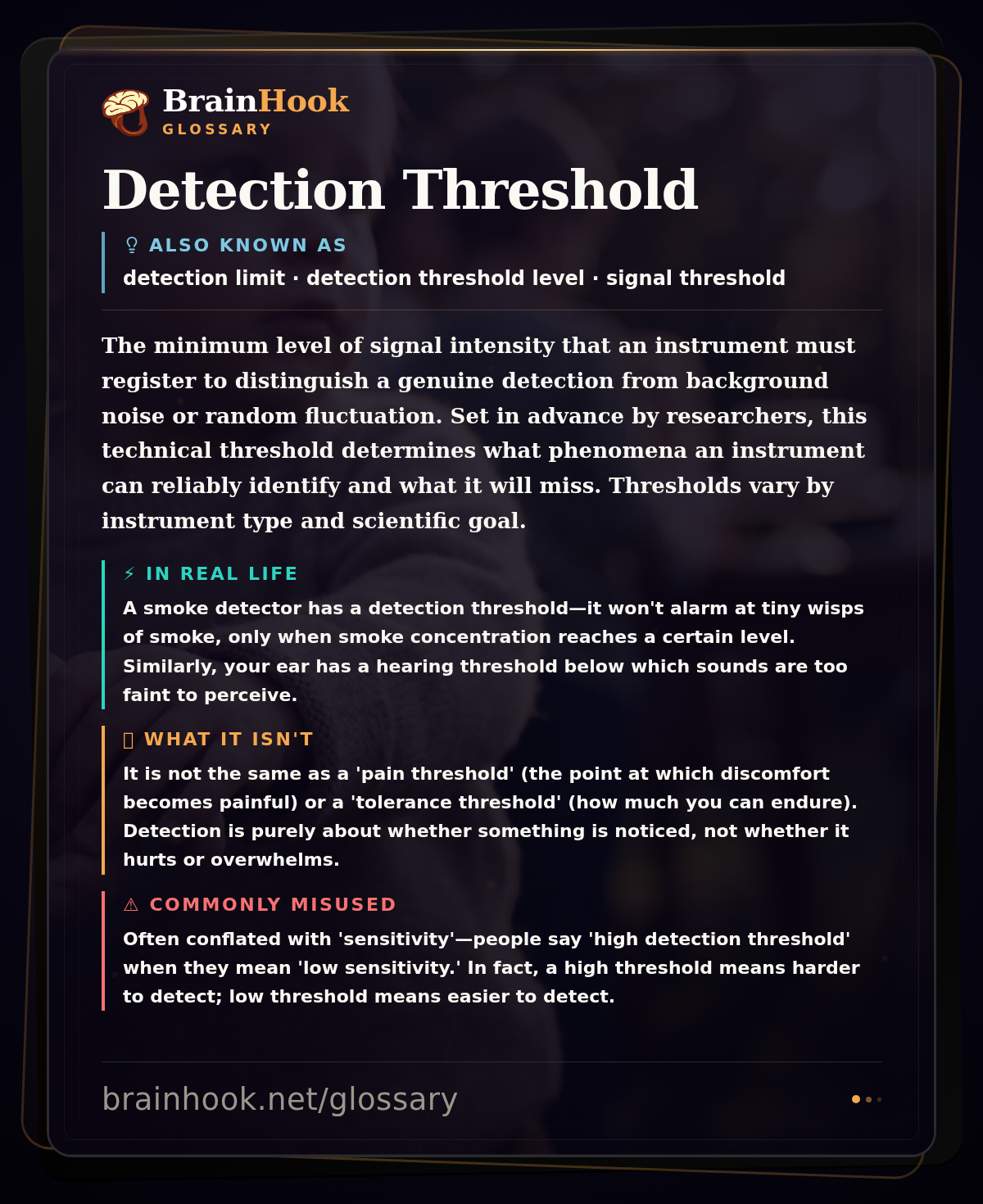
The minimum level of signal intensity that an instrument must register to distinguish a genuine detection from background noise or random fluctuation. Set in advance by researchers, this technical threshold determines what phenomena an instrument can reliably identify and what it will miss. Thresholds vary by instrument type and scientific goal.
What this means in real life
A smoke detector has a detection threshold—it won't alarm at tiny wisps of smoke, only when smoke concentration reaches a certain level. Similarly, your ear has a hearing threshold below which sounds are too faint to perceive.
What it isn’t
It is not the same as a 'pain threshold' (the point at which discomfort becomes painful) or a 'tolerance threshold' (how much you can endure). Detection is purely about whether something is noticed, not whether it hurts or overwhelms.
Commonly misused online
Often conflated with 'sensitivity'—people say 'high detection threshold' when they mean 'low sensitivity.' In fact, a high threshold means harder to detect; low threshold means easier to detect.