RSD Isn't a Personality Flaw. Schools Are Helping Create It.
New research argues that rejection sensitive dysphoria isn't simply a trait some people are born with — it's a pattern that certain environments create, and that distinction quietly shifts who bears the responsibility.
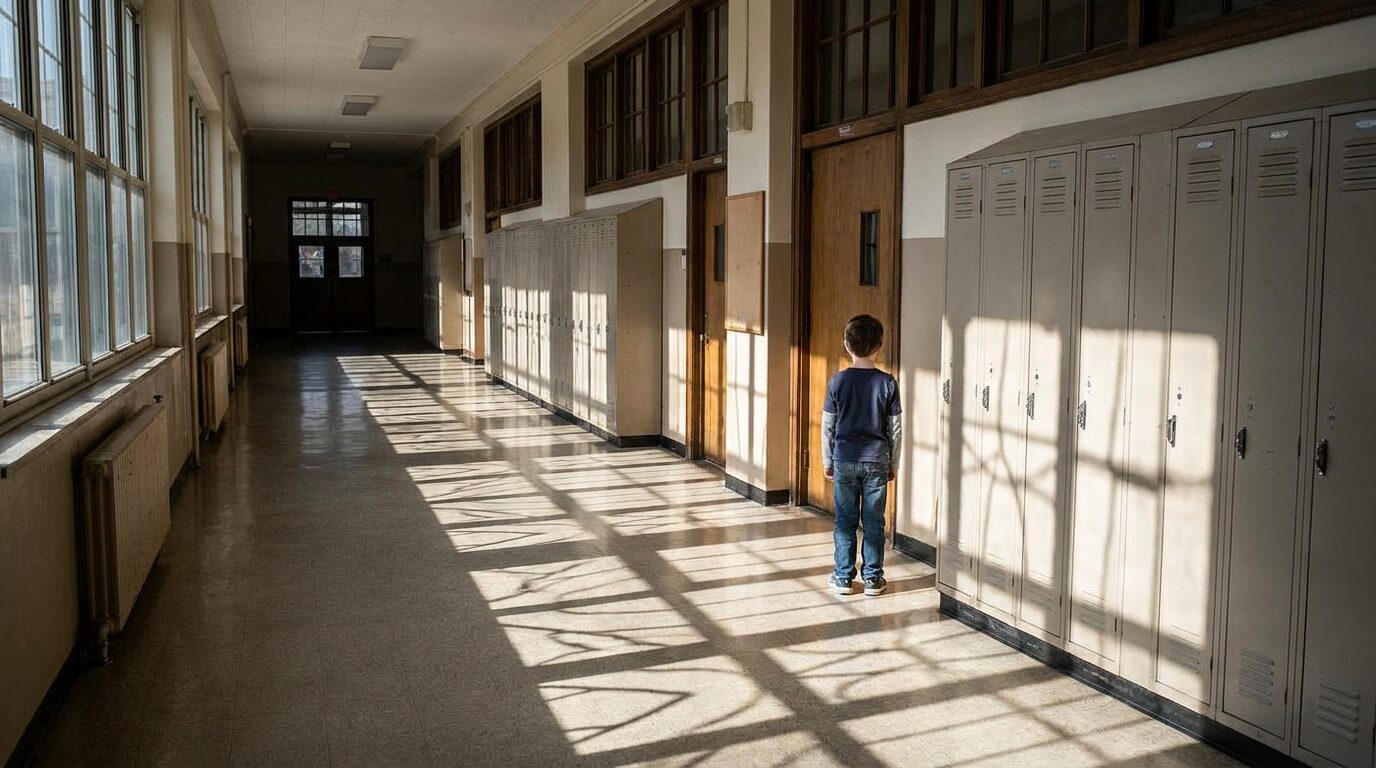
There is a specific kind of pain that adults with rejection sensitive dysphoria describe, and it is not quite like ordinary disappointment. It arrives faster than thought, disproportionate to the trigger, somewhere between embarrassment and grief, and occasionally overwhelming enough to shut a person down entirely. Someone doesn't reply to a message within the expected window. A coworker's tone shifts by half a degree. A friend cancels plans. And what follows is not a reasonable sense of let-down but something that feels, in the moment, closer to devastation. The person experiencing it usually knows, even in the middle of it, that the response is too large for what just happened. That knowledge does not make it smaller.
RSD — rejection sensitive dysphoria[3] — has spent the past several years making its way from clinical literature into broader cultural conversation, largely carried by the ADHD community, where it appears with striking frequency. The common shorthand for it is that it is neurological, something wired in, part of the same package as attention dysregulation and impulsivity. That framing has been both useful and incomplete. It gave people a name for a real experience and relieved them of unnecessary shame. But it also suggested a kind of biological destiny, a trait you simply have or don't, a switch positioned at birth and left there.
A 2025 study from the University of Birmingham[1] is pushing back on that picture in a way that deserves serious attention. The researchers argue that rejection sensitive dysphoria is not simply hardwired — that specific environments, including classrooms, actively contribute to its development, its intensity, and its persistence. This is not a minor academic refinement. If RSD can be caused and shaped by the rooms children learn in, then the conversation shifts from "what is wrong with this person" to "what did this environment teach this person to feel."
That shift matters enormously, both for how adults understand their own emotional patterns and for how schools, parents, and clinicians think about what is being created inside ordinary institutional spaces every day.
What Rejection Sensitive Dysphoria Actually Is
The word "dysphoria" is important here. It points toward a state of emotional distress, not just heightened sensitivity but a kind of flooding. People with RSD are not simply more aware of rejection than others — they experience rejection-related emotions with an intensity that can feel physiologically extreme, and they often anticipate that intensity before the rejection has even occurred. The anticipatory quality is where RSD does a great deal of its damage. A person who has learned to expect devastating pain from disapproval will often begin organizing their behavior around avoiding that pain, sometimes before anyone has shown any sign of rejecting them at all.
Because RSD appears frequently alongside ADHD — and to a meaningful degree alongside autism, anxiety, and mood disorders — researchers have historically located it primarily inside the nervous system. Executive function difficulties, emotional regulation challenges, dopaminergic pathways that process social reward and threat differently. There is good evidence for all of this. The biology is real. But biology and environment do not operate independently of each other, and the Birmingham research team's contribution is to examine what environmental inputs, particularly during childhood, might amplify, sustain, or even partially generate the pattern.
“The anticipatory quality is where RSD does a great deal of its damage — reorganizing behavior around a pain that hasn't happened yet.”
The School as an Emotional Conditioning Environment
It is worth pausing to take schools seriously as psychological environments, not just academic ones. A child in a classroom is spending six or seven hours a day inside a system that is continuously evaluating them — their answers, their behavior, their social choices, their compliance, their output. They are graded, ranked, corrected publicly, grouped by ability, and compared to peers, sometimes explicitly and sometimes through the invisible arithmetic children are always performing on each other. For most children this is manageable, not because it isn't stressful but because the feedback loop is reasonably consistent and the relationship with adults feels basically safe.
For a child with a nervous system already more reactive to social threat, the same environment can operate very differently. A raised eyebrow from a teacher becomes data. Being called on when you don't know the answer is not embarrassing but briefly annihilating. Being excluded from a group project, even incidentally, registers somewhere closer to rejection than to inconvenience. Research in developmental psychology has long documented what is called hypervigilance to social cues — a tendency to allocate more attentional resources to scanning for signs of disapproval, exclusion, or threat. In children with elevated rejection sensitivity, this scanning can become near-constant, and the environments that activate it most intensely are social environments with high evaluation stakes.
Classrooms are extremely high-evaluation environments. This is not a design flaw, exactly — evaluation is pedagogically necessary. But the Birmingham findings point toward the way evaluation is conducted, and the emotional conditions surrounding it, as significant variables. When correction is public and shame is incidental but frequent, when children with attention or learning differences are consistently out of step with the pace and format of instruction, when belonging feels contingent on performance rather than secure by default — these conditions do not just feel bad. They train something.
How Environments Teach the Nervous System What to Expect
Emotional learning is not mystical. It follows fairly legible principles. When a particular kind of situation is repeatedly paired with a particular kind of pain, the nervous system begins to generate the pain signal earlier and earlier in the sequence — eventually, in anticipation of the situation rather than in response to it. This is a form of pattern recognition, and it is adaptive. If disapproval has been intense, unpredictable, or hard to recover from, learning to brace for it before it arrives is not irrational. It is a calibration.
The problem is that calibrations made in one environment are not automatically reset when the environment changes. A child who learned in a classroom — or at home, or in both — that disapproval arrives fast, hits hard, and doesn't resolve easily may carry that calibration into adulthood. Their nervous system is not broken. It is running a program that once made sense, on a stage where that program increasingly does not.
This is where the Birmingham work connects to a broader body of developmental research on what attachment theorists call the internal working model: the implicit, largely unconscious set of expectations about how relationships work, how safe connection is, and how likely disapproval is. Internal working models are updated by experience, but they are also sticky. Early patterns carry more weight than later ones, and patterns that were emotionally intense carry more weight still. A child who experienced approval as conditional, correction as sharp, and belonging as something that had to be continuously earned may develop an internal working model in which rejection is always lurking just beyond the next interaction. That model can harden into something that looks a great deal like what clinicians describe as rejection sensitive dysphoria.
“A calibration made under old conditions doesn't automatically reset when the conditions change — it runs forward, into rooms it was never designed for.”
The ADHD Overlap, Reconsidered
Children with ADHD receive, on average, significantly more corrective feedback than their neurotypical peers — not because they are worse people but because the structure of most classrooms is genuinely more difficult for them to navigate. Instructions are often verbal and sequential. Transitions are abrupt. Tasks require sustained, internally generated attention in environments full of more interesting stimuli. Sitting still is treated as a sign of engagement. The child who cannot reliably do these things is corrected more often, redirected more visibly, and sometimes publicly distinguished from peers who are managing what the environment demands.
If you spend six hours a day being told, in various tones, that your natural way of being is slightly wrong — not once, not occasionally, but as a persistent drumbeat across years — that experience does not stay in the classroom. It becomes part of how you understand yourself in relation to other people's approval. It becomes the emotional subtext of belonging. And for a nervous system that already processes social feedback more intensely, the accumulated weight of that correction can shift the set point for what feels threatening. By the time these children are teenagers, and then adults, the oversized reaction to a withheld response or a tone change that puzzles other people may not be purely neurological. It may be neurological plus a decade of emotional data.
This is not an argument against ADHD neurology. It is an argument that neurology and experience are always in conversation. A nervous system that is more reactive to social threat will be shaped differently by an environment heavy with social threat than one without it. The two amplify each other, and the result is a pattern that cannot be fully explained by pointing at only one.
Responsibility Without Blame
What the Birmingham research is really proposing is a shift in the unit of analysis — from the individual to the environment the individual developed inside. This is not a comfortable shift for institutions. Schools are not designed to think of themselves as emotional conditioning systems, and most teachers are not deliberately creating rejection sensitivity in their students. The corrective feedback, the public evaluation, the contingent belonging — these are often the result of structural pressures, class sizes, curriculum demands, and assessment cultures, not individual cruelty. Acknowledging the environment's role does not require finding a villain.
But it does require something. It requires taking seriously the idea that how children are corrected, how failure is witnessed, how belonging is structured inside a classroom — these are not merely pedagogical choices. They are emotional architecture. The conditions under which a child learns that disapproval is manageable, temporary, and not a referendum on their worth are as important as any content delivered in the room. Schools that are able to make correction feel survivable, belonging feel unconditional by default, and failure feel recoverable rather than revealing — those environments are not just kinder. They may be actively protective against a pattern that can follow a person for decades.
“How belonging is structured inside a classroom is not a minor pedagogical detail — it is emotional architecture with a long lifespan.”
What Adults Who Recognize This Pattern Can Do With It
For adults reading this who recognize the pattern — the flooding, the anticipatory dread, the reorganized life built around avoiding disapproval — there is something specifically useful about the environmental framing. Not because it removes the difficulty, but because it changes what the difficulty means. A response that looks like overreaction to the people around you may be a historically accurate emotional reflex, trained by real and repeated experiences in environments that made rejection feel enormous. That does not mean the reflex serves you now. It means it has a logic that is worth understanding before you try to simply override it.
The reframe also matters for how change becomes thinkable. If RSD is purely neurological, the implied intervention is pharmaceutical or permanent — something to manage, not to alter. If environments helped create or shape the pattern, then different experiences, including therapeutic ones, including relational ones, including the slow accumulation of evidence that disapproval doesn't actually end things — can also reshape it. The nervous system that learned to expect pain from correction can, over time, learn something else. Not easily, and not all at once, but in the same way that any calibration shifts: through enough new data to override the old.
The child scanning a teacher's face for warning signs, learning to stay small and agreeable to avoid the specific agony of public correction, practicing the disappearing act that feels safer than being known — that child's adaptation made sense. The adult who still flinches at tone changes, still apologizes preemptively, still dreads the reply that doesn't come — they are not a broken person. They are a person whose learning environment left something running. That is a different starting point than a flaw, and it opens a different set of doors.
References
- Neurodivergent Experiences of Rejection Sensitive Dysphoria Expose the Environmental Factors too Often Overlooked (journals.sagepub.com)
2025 University of Birmingham study arguing that rejection sensitive dysphoria is shaped by specific environments, including classrooms, rather than being purely hardwired. - Teacher Feedback, Student ADHD Behavior, and the Teacher–Student Relationship: Are These Related? (link.springer.com)
Provides evidence that children with ADHD receive significantly more corrective feedback than neurotypical peers in classroom settings. - RSD is exploding online. But what does the science show? (psychologytoday.com)
Establishes that RSD was popularized by psychiatrist William Dodson and defines it as extreme sensitivity to perceived or actual criticism tied to ADHD.
About Mara Ellison
Mara Ellison writes about childhood patterns that echo into adult life, including attachment, temperament, rejection sensitivity, emotional learning, family roles, and the early social scripts people keep reenacting without realizing it. Her work focuses on developmental psychology with nuance, clarity, and unusual emotional precision.
More like this

Why Rejection Still Lands Like an Emergency, Even When You're Safe
New research suggests the adult who falls apart over mild criticism isn't fragile — they're running a perfectly calibrated survival system that just hasn't been updated yet.

The Anxious Child Who Masked Everything Is the Adult Who Exhausts Themselves Hiding
New research on rejection sensitivity and neurodivergent adults reveals that masking isn't hardwired — it's a learned strategy built from childhood criticism, and it keeps collecting a toll long after the original threat is gone.
The Rejection Sensitivity Trap Everyone's Getting Wrong
Rejection sensitive dysphoria went viral as a neurobiological fact — but new research shows the school, the correction, and the repeated verdict of "wrong" helped build it.