The Galileo Project Watched 80,000 Objects. 144 Broke the Rulebook.
The Galileo Project's first major sky survey didn't produce a smoking gun — it produced a data problem so precise it finally tells us what kind of evidence we actually need.
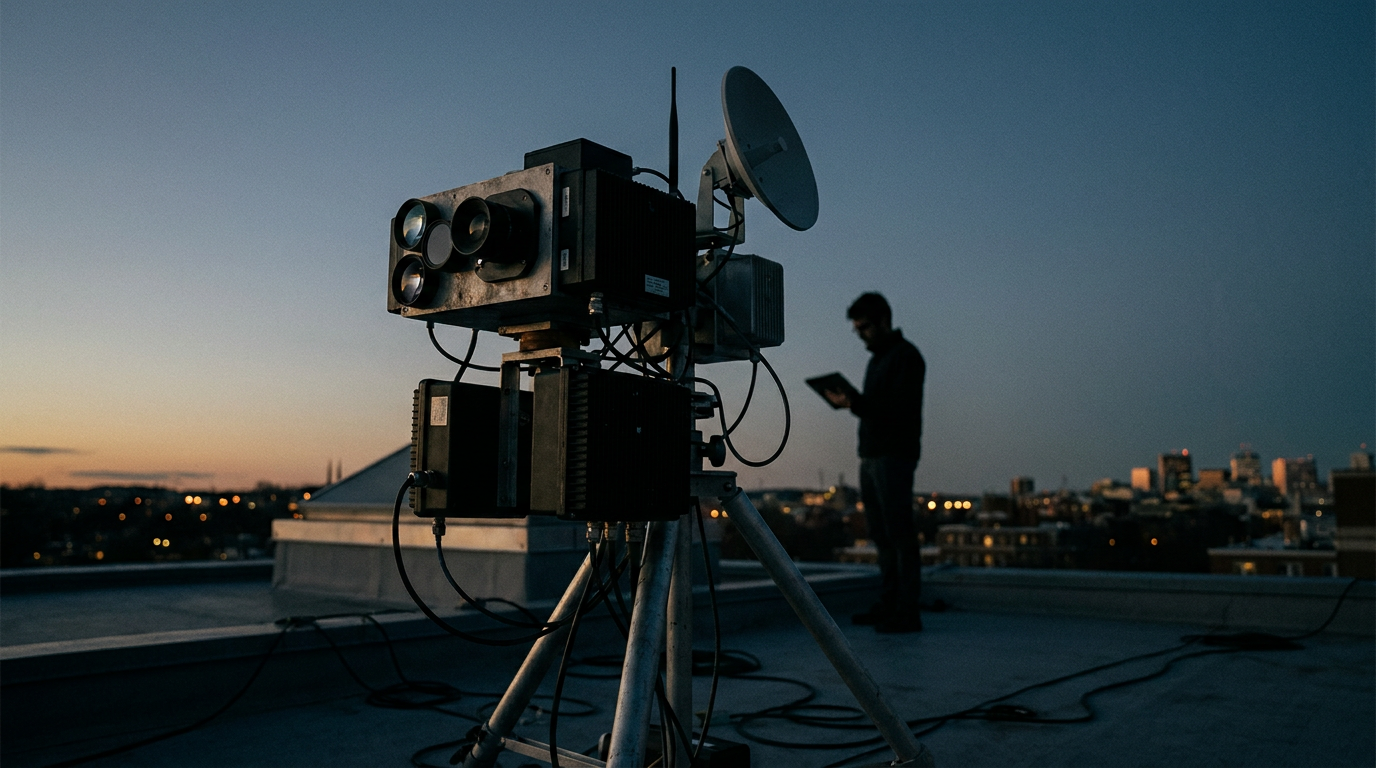
In the summer of 2023, a small observatory running on Harvard University's campus began doing something almost nobody in mainstream astronomy had attempted seriously in decades: it pointed calibrated, multi-spectral sensors at the sky and waited for something to behave unexpectedly. Not waiting with hope, exactly. Waiting with rigor. The Galileo Project, led by astrophysicist Avi Loeb and a growing team of researchers, had constructed what they called an all-sky monitoring system[1] — multiple cameras, a radio receiver, an infrared array, an audio sensor, and a magnetometer — designed to track anything that moved through their field of view and to capture enough spectral and trajectory data to classify it. The system was not built to find aliens. It was built to generate the kind of clean, layered, instrumented records that the UAP conversation had never really had before.
By the time they published their first significant results in the journal Sensors[3], the system had processed something close to 80,000 tracked objects. Birds. Planes. Satellites. Meteors. Lens artifacts. Atmospheric debris. The whole parade of things that cross a sky in any given period, now run through a classification pipeline that checked each return against expected flight profiles, spectral signatures, and known object databases. Most objects sorted cleanly. Most were identified with reasonable confidence. A small number were not. The number the team flagged as genuinely resistant to classification — after stripping out sensor artifacts, after accounting for atmospheric distortion, after running elimination checks — was 144.
One hundred and forty-four objects, out of roughly eighty thousand, that the system's own methodology could not confidently assign to a known category. That is approximately 0.2 percent. Which sounds small until you remember that the whole premise of the inquiry is that even one genuinely unclassifiable object, properly documented, would be scientifically meaningful. And that 144 unresolved cases from a single observatory in a single period of operation is not a dismissible residue. It is a data problem, and the project's researchers are careful to say so. They are not claiming 144 anomalies. They are claiming 144 cases where the current instrumentation and pipeline are not sufficient to close the classification.
This distinction — between an anomaly and a data gap — is the real finding. It is also, depending on your priors, either deeply frustrating or exactly the kind of honest accounting that has been missing from this field for seventy years.
What the System Was Actually Measuring
The Galileo Project's observatory setup is worth understanding in some detail, because the strength and the limitations of the 144-case figure both flow from its design. The system is not a telescope in the traditional sense. It is a sensor suite oriented toward event detection rather than deep-sky imaging. The all-sky cameras capture wide-field video continuously. The infrared channel runs in parallel. The radio receiver monitors for electromagnetic signals in the relevant bands. The magnetometer flags unusual field disturbances. The audio sensor — rarely discussed in coverage of the project — is sensitive to infrasound[2], the low-frequency acoustic range associated with certain atmospheric events and some aerial objects. What this means, practically, is that any object transiting the sensor field ideally generates a multi-channel record: shape, trajectory, velocity, thermal signature, any associated radio emission or magnetic fluctuation, any acoustic component. A bird looks like a bird across all channels. A plane looks like a plane. A satellite has a characteristic angular velocity and orbital geometry. The classification pipeline attempts to match multi-channel returns against a library of known profiles.
Where the pipeline struggles is at its resolution limits and in cases of partial data. Clouds interrupt optical channels but not necessarily infrared. Radio interference can corrupt one band without affecting others. Fast-moving objects can produce short event windows — a fraction of a second — where not all sensors complete a full capture. An object that clips the edge of the sensor field, at night, in marginal atmospheric conditions, with only three of five channels producing clean data, may resist classification not because it is extraordinary but because the record is incomplete. The researchers are explicit about this in the published analysis. The 144 residual cases are, by their own account, heterogeneous. Some may be atmospheric phenomena the pipeline has not been trained to recognize. Some may be instrument artifacts that the artifact-rejection filters did not catch. Some may be ordinary objects presenting at unusual angles or in unusual combinations of conditions. The point is that the project cannot yet tell which of these explanations apply, because the data supporting each case is not sufficient to definitively close it.
“The 144 cases are not 144 mysteries. They are 144 invitations for better instrumentation.”
Why Residuals Matter Even When They Are Mundane
There is a version of this story that dismisses 0.2 percent as noise and moves on. That version misses the point. In any detection system designed to flag genuine anomalies, the residual — the unclassified fraction — is actually where the methodology's quality gets tested. If every unclassified case is eventually traced to a sensor artifact or an edge-case atmospheric effect, that itself is useful: it tells you the pipeline is working, that it is not over-classifying, that it is not forcing ambiguous returns into known categories just to clean up the numbers. If, on the other hand, residual cases cluster around specific conditions, specific times of day, specific atmospheric states, specific sensor channel combinations, that clustering becomes a signal worth pursuing. The Galileo team is now specifically analyzing whether the 144 cases share structural features — whether they are disproportionately nocturnal, whether they tend to appear under particular atmospheric conditions, whether certain sensor channels consistently fail for them. Clustering would not prove anything exotic. But it would narrow the problem, and narrowing the problem is progress.
This is also why the project's methodological transparency is genuinely valuable regardless of what the residuals ultimately turn out to be. The historical problem with UAP data is not that unexplained things do not exist. It is that the records supporting most unexplained cases are catastrophically thin. A pilot's verbal account, reconstructed hours after the event. A radar return with no corroborating sensor. A video clip with no metadata, no scale reference, no spectral information. Officials reviewing UAP reports have consistently noted that a significant portion of cases remain unresolved primarily because the data needed to resolve them was never collected in the first place. The Galileo Project is attempting to close that gap prospectively — not by claiming better cases after the fact, but by building the infrastructure that would make a genuine anomaly documentable if one appeared.
The Loeb Question, and Why It Is Separate
Avi Loeb is a polarizing figure in this conversation, and that polarity is worth addressing directly rather than quietly navigating around. His 2021 book[4] arguing that the interstellar object 'Oumuamua might have been an artifact of extraterrestrial technology drew sharp criticism from the astronomical community — not primarily for being wrong, but for what many colleagues described as a methodological looseness, a willingness to advance an extraordinary hypothesis without the evidence density that such a claim requires. That criticism is fair. The 'Oumuamua data is genuinely strange, but the jump from 'strange and unresolved' to 'probably technological in origin' is a leap the evidence does not support, and Loeb has at times framed that leap with a confidence that the observation record cannot hold. This matters when evaluating the Galileo Project because the project operates in Loeb's institutional orbit, and it is reasonable to ask whether the same inferential looseness shapes its methodology.
The honest answer, based on the Sensors publication, is that the project's analytical approach is more careful than its principal investigator's public-facing rhetoric sometimes suggests. The paper does not claim the 144 residuals are evidence of non-human technology. It claims they are unclassified, identifies the instrumental reasons they may have resisted classification, and proposes specific upgrades to the detection infrastructure to improve the pipeline's resolution. That is conservative, appropriate science. Loeb's willingness to speculate in interviews about what those cases might contain is a different matter — one that generates press coverage and, not coincidentally, funding interest, but which should not be allowed to color the underlying methodology one way or the other. The data deserves to be evaluated on its own terms.
“Unexplained does not license extraordinary claims. It licenses better instruments.”
The Sensor Problem Is the Science Problem
The Galileo Project team has been specific about what improvements the 144-case residual reveals to be necessary. Current optical resolution at the observatory limits shape discrimination for fast-moving objects. A compact object moving at several hundred kilometers per hour at low altitude may produce only a few pixels per frame at the camera's operational field of view — enough to flag a transit, not enough to characterize morphology. The infrared channel has similar constraints under certain atmospheric humidity conditions, where thermal contrast is reduced. The radio receiver's current bandwidth and sensitivity are sufficient for broad-spectrum monitoring but not for fine characterization of electromagnetic signatures in the UHF range. The proposed next-generation version of the observatory, which the team refers to as Galileo 2.0 in project documentation, is designed around narrowing these gaps — higher-resolution optics, improved IR sensitivity, a more capable radio array, and a second observatory site to enable triangulation, which would provide real three-dimensional trajectory data rather than the angular projections the current single-site setup produces.
Triangulation is not a minor upgrade. Without it, the apparent velocity and trajectory of any detected object remain projections — what the object looks like it is doing from a single vantage point, not what it is actually doing in three-dimensional space. A slow object at high altitude can produce the same apparent angular velocity as a fast object at low altitude, and distinguishing between them requires parallax — two sensor points separated by enough distance to detect the angular difference. This is the same principle that makes stereo vision work, scaled up to observatory geometry. Many of the 144 residual cases may be unresolved precisely because the system currently lacks the triangulation capability to determine whether an anomalous velocity profile is real or an artifact of unknown range. Adding a second site would not guarantee classification of every remaining case, but it would close a significant portion of the uncertainty that currently prevents it.
What This Survey Actually Changed
The significance of the Galileo Project's first-phase results is not that they detected something extraordinary. They may have, in the loose sense that 144 cases resist current classification, but 'resists current classification' is not a conclusion anyone should be building a worldview on. The significance is that a credentialed scientific team, using instrumented, calibrated, multi-spectral hardware, produced a documented record of sky transits at a scale that previous UAP research had never come close to achieving, and then reported the ambiguous results honestly rather than forcing them into a predetermined narrative. That is not a small thing. The UAP field, if it can be called that, has been epistemically poisoned for decades by two opposed tendencies: overclaiming on the believer side, which inflates ambiguous data into alien certainty, and underclaiming on the skeptic side, which dismisses residuals as noise without actually working through the evidence. The Galileo Project, at its methodological best, does neither.
There is also a secondary contribution that rarely gets discussed. By running eighty thousand objects through a classification pipeline and achieving roughly 99.8 percent resolution with current methods, the project has begun to characterize the normal sky at a level of instrumental detail that did not previously exist in published form. What the background population of tracked objects looks like — their velocity distributions, their infrared signatures, their radio profiles — is now documented. That baseline matters enormously. Any future claim of a genuine anomaly needs to be measured against a known background population. Without a baseline, 'anomalous' is just a synonym for 'unusual to me.' With one, it becomes a statement about deviation from a measured distribution. That is the difference between impression and evidence.
“Any future claim of a genuine anomaly needs to be measured against a known background. Without a baseline, 'anomalous' is just a synonym for 'unusual to me.'”
The Residual as a Research Program
The 144 cases sit in a peculiar epistemic position. They are too ambiguous to support any conclusion about what they represent, and too structured — the result of careful filtering, not raw sighting reports — to dismiss as pure noise. The Galileo team is treating them as a research program rather than a result, which is the correct response. Some of those cases will likely be resolved by improved instrumentation. Some may be resolved by better atmospheric modeling that allows the pipeline to recognize rare but natural phenomena it currently misreads. Some may persist even through upgraded systems, which would make them genuinely harder to explain and would justify closer attention. The point is that the process itself — rigorous detection, honest documentation of residuals, systematic improvement of the pipeline — is how scientific inquiry into unusual sky phenomena should work. It is, remarkably, how it has almost never worked before in this particular corner of inquiry.
If the Galileo Project's next phase produces a refined set of residuals that still cannot be classified after triangulation, improved resolution, and better atmospheric correction, that will be genuinely interesting — not because it will confirm any particular explanation, but because the quality of the mystery will have improved. A well-documented anomaly, with multi-spectral data, known atmospheric conditions, triangulated trajectory, and a clean baseline population for comparison, is a different category of phenomenon than a blurry video and a pilot's recollection. One invites serious investigation. The other invites argument. The project is, slowly and unglamorously, trying to move from the second category to the first. Whether there is anything genuinely surprising waiting in that residual fraction, nobody yet knows. But the machinery to find out is, finally, being built.
References
- all-sky monitoring system (projects.iq.harvard.edu)
Describes the Galileo Project's all-sky monitoring system design with multiple integrated sensors for tracking and classifying sky objects. - Multi-Band Acoustic Monitoring of Aerial Signatures (arxiv.org)
Documents the acoustic monitoring system's use of infrasound detection to characterize aerial phenomena as part of the multi-channel sensor suite. - Commissioning an All-Sky Infrared Camera Array for Detection of Airborne Objects (mdpi.com)
Published the Galileo Project's first major results analyzing approximately 80,000 tracked objects and identifying 144 unclassified cases. - Extraterrestrial: The First Sign of Intelligent Life Beyond Earth (en.wikipedia.org)
Loeb's 2021 book proposing 'Oumuamua as possible extraterrestrial technology, criticized by the astronomical community for methodological looseness.
About Rowan Ellery
Rowan Ellery writes about anomalies, unexplained sightings, strange signals, and the uneasy border between observation, misinterpretation, and genuine mystery. Their work focuses on keeping curiosity alive without letting evidence dissolve into folklore.
More like this
The Pentagon Built a UAP Sensor. It Found Mostly Balloons. That's Not the Whole Story.
The Pentagon's new UAP sensor system quietly entered field testing — and what it's already revealing is less about what's up there than about how badly we've been trying to look.
The Pentagon's New UAP Files Have a Sensor Problem No One Is Talking About
The May 2025 PURSUE disclosure is historic — but the cases that stayed unexplained share a quiet technical flaw that changes what 'unresolved' actually means.
The Pentagon Released 162 UAP Files. The Unresolved Ones Are the Interesting Part.
The May 2025 file release is historic, but the official language used to explain every unresolved case quietly reveals something more useful than any alien hypothesis.