Baseline Population
The reference group or standard dataset used to compare against in research, establishing what's normal or expected before analyzing new observations.
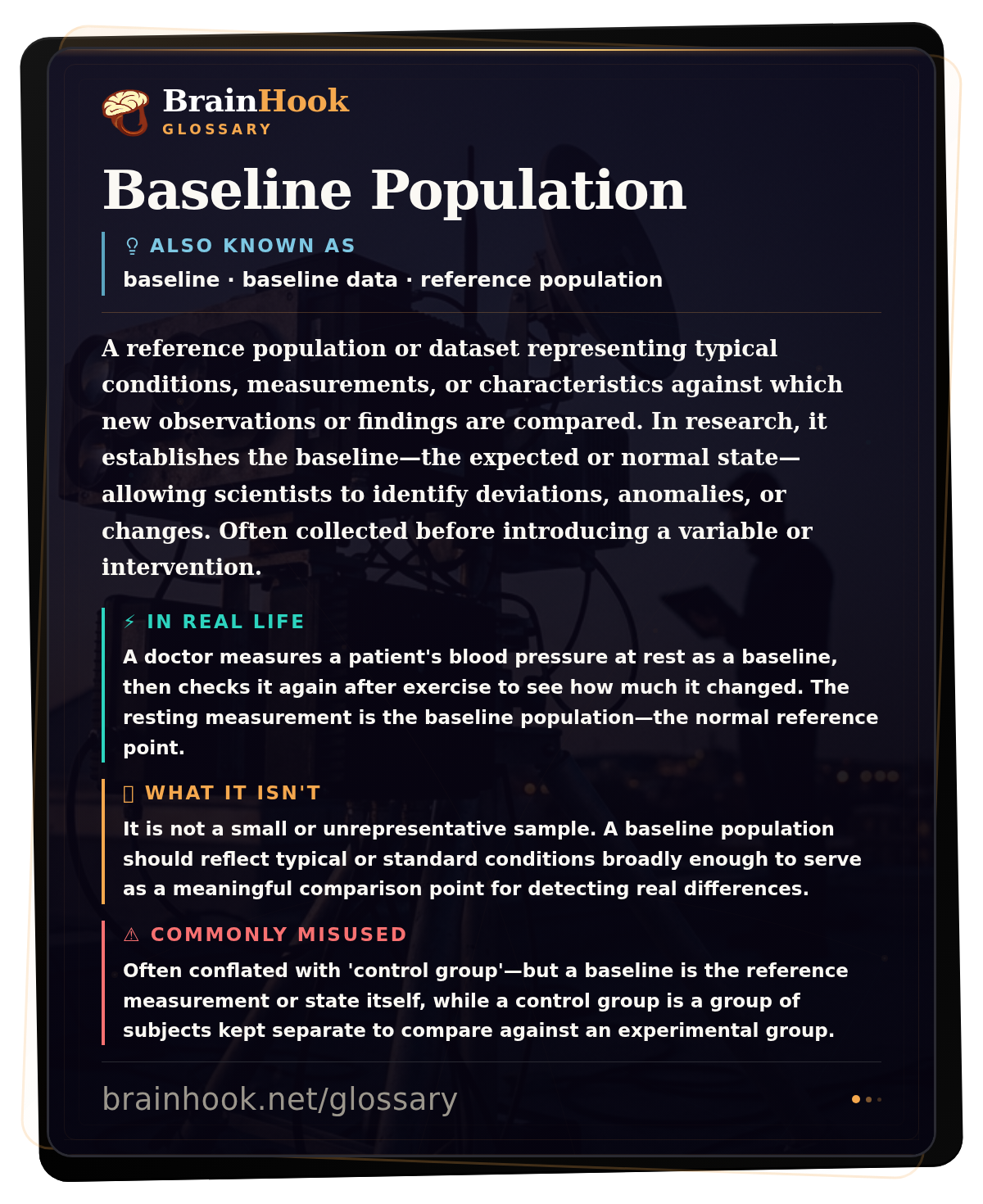
A reference population or dataset representing typical conditions, measurements, or characteristics against which new observations or findings are compared. In research, it establishes the baseline—the expected or normal state—allowing scientists to identify deviations, anomalies, or changes. Often collected before introducing a variable or intervention.
What this means in real life
A doctor measures a patient's blood pressure at rest as a baseline, then checks it again after exercise to see how much it changed. The resting measurement is the baseline population—the normal reference point.
What it isn’t
It is not a small or unrepresentative sample. A baseline population should reflect typical or standard conditions broadly enough to serve as a meaningful comparison point for detecting real differences.
Commonly misused online
Often conflated with 'control group'—but a baseline is the reference measurement or state itself, while a control group is a group of subjects kept separate to compare against an experimental group.