The Object From Interstellar Space Got Scanned for Signals. Here's What Was Actually Found.
Breakthrough Listen and the SETI Institute both pointed instruments at 3I/ATLAS — and the null result tells us something specific, limited, and genuinely worth understanding.
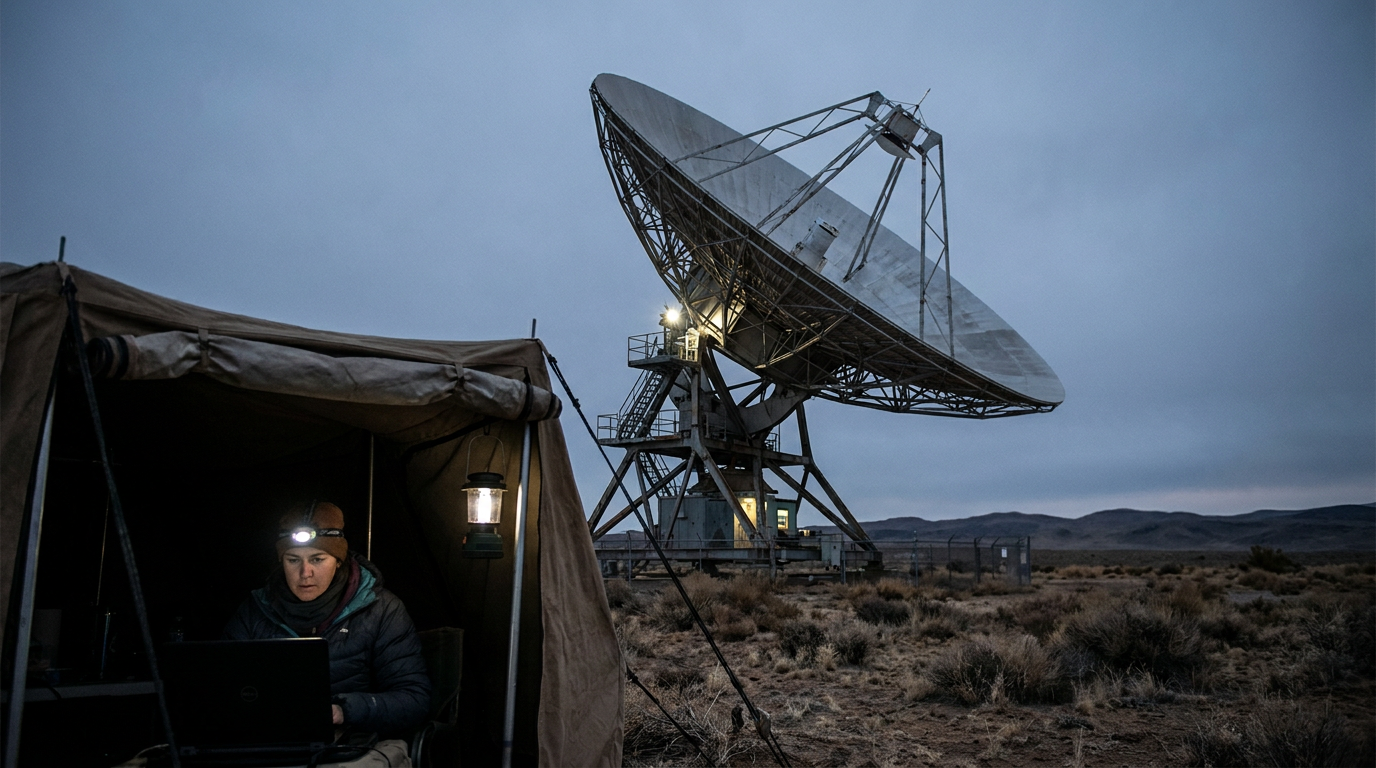
On the morning that astronomers confirmed 3I/ATLAS was not from here — not gravitationally bound to our sun, not a long-period comet from the Oort Cloud, not a fragment of anything local — the familiar machinery of speculation started turning almost immediately. The object had a hyperbolic trajectory too steep to be explained by solar gravity alone. Its velocity entering the inner solar system was inconsistent with a native origin. It was, by the cleanest available definition, interstellar: a traveler from somewhere else, moving through our neighborhood with complete indifference to our curiosity about it.
3I/ATLAS is the third such object ever detected. The first, 'Oumuamua, arrived in 2017 and still hasn't fully released its grip on the scientific imagination — its odd shape, anomalous acceleration, and non-gravitational trajectory generated serious papers, genuine disagreement, and a great deal of noise that was considerably less serious. The second, Borisov, arrived in 2019 and turned out to be cometary and relatively unremarkable, which was itself a kind of data point: sometimes an interstellar object is just a rock with ice on it. 3I/ATLAS arrived into a community that had spent years arguing about what to do the next time this happened, and this time they were somewhat more ready.
Within days of the trajectory confirmation, researchers at Breakthrough Listen — the privately funded SETI initiative operating out of UC Berkeley — had coordinated telescope time. The SETI Institute followed with its own effort. Both teams pointed radio and optical instruments at 3I/ATLAS, logged the data, and eventually reported what they found. The headline version of that finding was fast, clean, and easy to distribute: no signal detected[1]. No technosignature. No anomalous radio emission. Nothing to suggest the object was transmitting anything at all.
That headline is accurate as far as it goes. The problem is how far it actually goes, which is considerably less far than either excited believers or satisfied skeptics tend to assume. What the scans found — and failed to find — deserves a closer reading than it usually gets.
What 'No Signal Detected' Actually Means
Radio SETI observations work by pointing a large dish at a target and listening for electromagnetic emission in frequency ranges that either occur naturally or might plausibly be used for communication or propulsion. Breakthrough Listen's primary instrument for this kind of work is the 100-meter Green Bank Telescope in West Virginia[3], one of the largest fully steerable radio telescopes on Earth, capable of detecting extraordinarily faint signals across a wide frequency range. When researchers report no detection, they are reporting that no signal above a specific threshold was found within a specific band during a specific observing window.
Each of those qualifiers matters. The threshold is set by the instrument's sensitivity combined with observing time — a fainter signal would require a longer look or a bigger dish. The frequency band represents a choice: SETI researchers typically prioritize ranges that seem physically meaningful, such as the hydrogen line at 1420 MHz, the hydroxyl line, or the so-called "water hole" between them, but the full radio spectrum is vast and cannot all be monitored simultaneously. The observing window is constrained by telescope scheduling, object visibility, and the velocity of the object relative to Earth, which affects what Doppler-shifted frequencies need to be searched. A null result does not mean the object is silent. It means the object did not emit, at detectable intensity, in the frequencies checked, during the time the telescope was pointed at it.
“A null result does not mean the object is silent. It means the object did not emit, at detectable intensity, in the frequencies checked, during the time the telescope was pointed at it.”
To be concrete: if 3I/ATLAS were somehow an artificial object transmitting at power levels comparable to what we routinely emit — terrestrial television broadcasts, airport radar, a cell tower — it would have been undetectable at interstellar distances, let alone at the relatively short range of its solar flyby. The null result places an upper bound on isotropic radio emission at certain frequencies, not a ruling on whether the object is inert. These are meaningfully different claims.
The Object Itself: What the Optical Data Does and Doesn't Show
Setting aside the radio search, what do direct observations of 3I/ATLAS reveal? The photometric and spectroscopic data gathered as the object brightened on approach indicate cometary activity — outgassing, a developing coma, the characteristic brightness variations consistent with volatile material sublimating as it gets closer to the sun. This behavior is not, on its face, exotic. Borisov showed similar activity. Comets outgas. The presence of a coma and tail does not confirm a natural origin any more than its absence would confirm an artificial one, but it does mean the object is behaving in ways that have a well-understood physical baseline.
Size estimates remain rough. Interstellar objects are observed at distance, often under less than ideal conditions, and the presence of outgassing material around the nucleus makes direct measurement of the solid body difficult. Current estimates put 3I/ATLAS somewhere in a range that is consistent with a modest comet nucleus — probably not kilometers across, but the uncertainty bars are wide. Its color and spectral characteristics are under active analysis, and that data will tell researchers something about composition: the ratio of carbon compounds to silicates, the presence or absence of certain ices. This kind of characterization is slow work and it matters more than the radio scan for understanding what the object actually is.
The trajectory remains the strangest thing about it. The excess velocity — the speed above what solar gravity alone can account for — places its origin outside the solar system with high statistical confidence. But excess velocity is a description, not an explanation. A cometary body ejected from another star system by gravitational interaction with a giant planet, a binary companion, or a stellar flyby would arrive here on exactly this kind of trajectory. The mechanism is prosaic. The event is extraordinary only in the sense that it is rare, not in the sense that it is unexplained.
Why the 'Oumuamua Shadow Still Falls Here
'Oumuamua is difficult to shake because its anomalies accumulated rather than resolving. Its light curve suggested an extreme elongated or flat shape unlike any natural object in the catalog. It showed non-gravitational acceleration without a detectable outgassing signature, which is the mechanism that usually explains cometary deviation from pure gravitational trajectories. Several serious researchers, including some at Harvard, published papers suggesting that radiation pressure on a thin, flat object — perhaps a natural hydrogen iceberg, perhaps something manufactured — could account for the motion. None of these papers reached a consensus. The object was gone before follow-up instruments could be arranged.
“'Oumuamua is difficult to shake because its anomalies accumulated rather than resolving — and the field hasn't stopped arguing about it since.”
3I/ATLAS arrived into that unresolved context. The instinct to scan it for signals was not irrational — if there were any chance of artificial origin, the calculus of effort required to point a telescope versus the potential information value of a positive detection is straightforwardly in favor of looking. Breakthrough Listen has made this argument explicitly as part of its operational philosophy: the cost of checking is low relative to what a genuine detection would mean. That logic holds even when — especially when — the prior probability of detection is extremely small. You do not skip the search because you expect to find nothing.
But 3I/ATLAS is already behaviorally different from 'Oumuamua in at least one meaningful way: it shows clear cometary activity. 'Oumuamua showed none, which is part of why the non-gravitational acceleration was so difficult to explain. An object that outgasses has a natural acceleration candidate. That does not close the case entirely — scientists will want to check whether the observed outgassing rate actually accounts for the measured trajectory deviation — but it substantially tightens the probability space around conventional explanations. The mystery, if there is one, is already smaller.
The Technosignature Search and Its Honest Limits
Technosignature research is a legitimate and increasingly serious branch of astrobiology. The search for signs of technology — radio emission, laser pulses, atmospheric chemical anomalies, megastructure transits — has a coherent scientific framework, and several observatories now dedicate a portion of their time to it. The challenge is that the search space is enormous and the detection criteria require choices that necessarily exclude possibilities. Searching for radio signals in the GHz range is reasonable but assumes that a transmitting civilization uses, or would use, frequencies that are also meaningful to us. Searching for narrowband emission assumes intentional transmission. Searching for broadband emission assumes powerful propulsion or industrial leakage. Each assumption is defensible but not guaranteed.
When Breakthrough Listen reports no narrowband signal between, say, 1 and 12 GHz above a certain flux density threshold, it is making a specific and bounded claim. That claim is real and useful: it rules out a particular kind of strong, directed, or isotropically broadcast emission in that band during the observation window. It does not rule out a probe that is powered down, transmitting directionally away from us, using frequencies outside the searched range, operating on a duty cycle that happened to be off during the observation window, or not transmitting at all because it does not need to. These are not exotic loopholes. They are simply the ordinary limits of detection.
The SETI Institute's observations add complementary constraints. Combined with Breakthrough Listen's data, researchers can characterize the electromagnetic environment around 3I/ATLAS with reasonable fidelity across a useful portion of the spectrum. The aggregate finding is not 'this object is definitely natural.' The aggregate finding is: 'this object did not produce detectable signals of the types we looked for, and its cometary behavior is consistent with natural origin.' That is a more honest sentence, and it is worth using.
What a Flyby Like This Is Actually Good For
The practical value of 3I/ATLAS — regardless of its origin, which almost certainly is natural — is compositional. A body that formed around another star and has spent most of its existence in the cold between stellar systems carries chemical information that no solar system object can provide. The isotope ratios in its outgassing, the structure of its dust, the relative abundance of carbon to oxygen to nitrogen compounds: all of this is a message, just not the kind that involves intent. It is the kind that involves physics. Reading it tells us something about the range of conditions under which planetary systems form, and whether the building blocks that made Earth's chemistry available are common across the galaxy.
There is a mission concept worth mentioning here. A fast spacecraft dispatched on an intercept trajectory — ideally with something like a solar sail augmented by a laser array for acceleration — could potentially catch 3I/ATLAS before it exits the inner solar system. The physics are brutal: the object is moving fast and the window is short, and no existing launch vehicle gets there without the kind of technology that remains developmental rather than operational. But the conversation is happening. ESA's Comet Interceptor mission[2], designed for exactly this kind of target-of-opportunity scenario, was not in position for 3I/ATLAS, but it represents the kind of standing readiness that the next interstellar visitor might actually benefit from.
“The compositional data from 3I/ATLAS is a message — just not the kind that involves intent. It is the kind that involves physics.”
The Correct Relationship to Not Knowing
The null result from the radio searches will be cited in two incompatible ways going forward. Some will use it to declare the question settled: no signal, not a probe, nothing to see here. Others will cite the detection limits as evidence that the search was inadequate and therefore the question remains open in a way that still gestures toward something exotic. Both readings miss the point. The value of the observation is not in what it confirms or rules out about interstellar probes — a prior probability that was always extremely small — but in what it demonstrates about how the field should operate when a genuinely rare object appears. You look. You document the limits of your instruments. You publish what you found and what you didn't find and what those findings can actually support. You do not let the silence mean more than it does, and you do not let it mean less.
3I/ATLAS will be gone from easy observational range before the full analysis is complete. The cometary activity data, the compositional spectra, the precise trajectory reconstruction: these will take months to work through, and some of the most interesting findings may not appear until the object is already deep into the outer solar system, beyond reach. That is the uncomfortable rhythm of interstellar visitors. They do not wait. Whatever 3I/ATLAS is — and the odds heavily favor a comet nucleus, flung out of some other system by gravitational mechanics we will probably never trace — it is a sample delivery from a part of the universe that sent us no warning and will accept no reply. The scans for signals were the right thing to do. The silence was the expected outcome. What remains is the slower, harder work of actually reading what the object brought with it.
References
- Breakthrough Listen observations of interstellar object 3I/ATLAS (seti.berkeley.edu)
Reports Breakthrough Listen's null result from radio observations of 3I/ATLAS across multiple facilities worldwide. - Comet Interceptor (esa.int)
- Telescopes (greenbankobservatory.org)
Describes the 100-meter Green Bank Telescope as Breakthrough Listen's primary instrument for radio SETI observations.
About Rowan Ellery
Rowan Ellery writes about anomalies, unexplained sightings, strange signals, and the uneasy border between observation, misinterpretation, and genuine mystery. Their work focuses on keeping curiosity alive without letting evidence dissolve into folklore.
More like this
An Interstellar Comet Crossed Our Solar System. We Had 12 Spacecraft Ready.
Comet 3I/ATLAS is only the third object ever confirmed to have crossed into our solar system from another star — and unlike the first two, we had an entire fleet waiting for it.
3I/ATLAS Came From Another Star. Its Chemistry Doesn't Match Anything We Know.
The third confirmed interstellar object has a carbon-dioxide-to-water ratio unlike any comet in our solar system — and the leading explanation is that it's been drifting alone for longer than Earth has existed.
3I/ATLAS Left Our Solar System. Its Water Stayed Strange.
A new ALMA study found that 3I/ATLAS carries water with a deuterium ratio far outside anything measured in our solar system — and what that number actually means is stranger than the spacecraft headlines ever were.