The Pentagon Built a UAP Sensor. It Found Mostly Balloons. That's Not the Whole Story.
The Pentagon's new UAP sensor system quietly entered field testing — and what it's already revealing is less about what's up there than about how badly we've been trying to look.
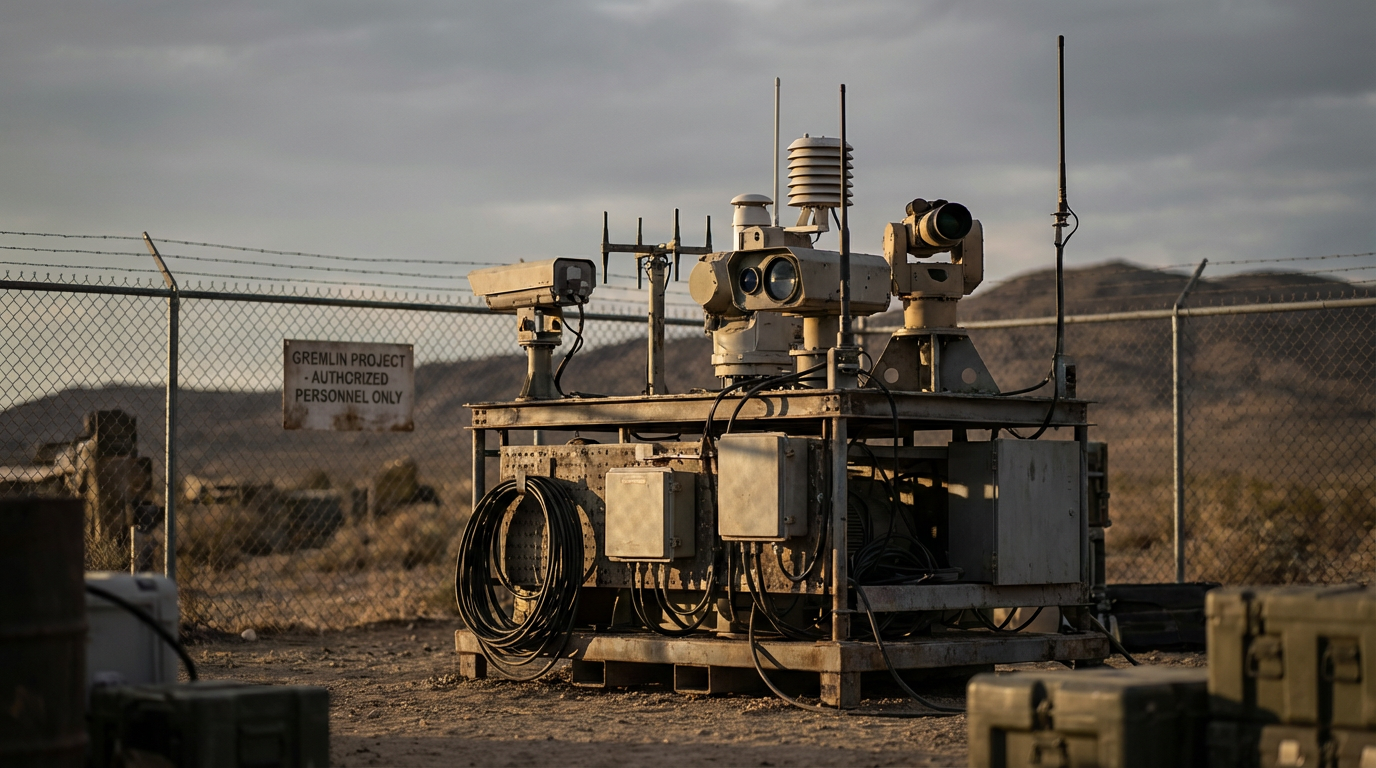
Somewhere on a fenced patch of American soil, a sensor array called GREMLIN has been watching the sky. The name is an acronym — Geodesic Remote Environmental Monitoring for Low-signature Integrated Networks, or something close to that, depending on which version of the program description you're reading — and the system was built specifically to do what decades of UAP research have conspicuously failed to do: collect calibrated, multi-domain instrument data from an unidentified aerial phenomenon at the actual moment it appears. Not reconstructed afterward from cockpit footage and witness memory. Not pulled off a degraded radar tape. In real time, with multiple sensors running simultaneously, producing overlapping data streams that can be cross-checked against each other.
The All-domain Anomaly Resolution Office[1] — AARO, the Pentagon's official UAP investigative body — has been quietly filing progress reports that include references to GREMLIN's prototype deployment at an undisclosed national security installation[4]. The reports are careful, bureaucratically measured documents, not the kind of thing that generates headlines. But read through the technical sections and a clear picture emerges: AARO's scientists are not primarily struggling with what UAPs might be. They are struggling with the far more fundamental problem of not having the right instruments in the right place when something unexplained shows up. The bottleneck in UAP research is not political will or institutional courage. It is the chronic, structural absence of good data.
And what has GREMLIN detected so far, in its early field deployment? Mostly balloons. Weather balloons, small commercial balloons, research platforms drifting through restricted airspace at altitudes that confuse radar systems not designed to track slow, low-radar-cross-section objects at those particular elevations. A few birds. Some drone incursions. Objects that, once the multi-sensor data was actually assembled and analyzed, resolved into mundane identities[2] that individual sensors or single-domain tracking systems would have left ambiguous. That result sounds deflating. It is not. It is exactly the kind of result that tells you the instrument is working — and that tells you, by extension, how many previously logged UAP reports may have been balloons and birds all along, labeled unresolved not because they were extraordinary but because the observational apparatus was inadequate.
This is the uncomfortable center of the current UAP conversation, the part that neither enthusiasts nor dismissers seem to want to sit with: the answer to 'what are UAPs?' cannot be separated from the answer to 'how well are we actually looking?' And the honest answer to the second question, even now, is: not well enough, and GREMLIN is the first serious attempt to change that.
What GREMLIN Actually Is
AARO's sensor program represents a specific engineering philosophy, one that treats UAP investigation as an instrumentation problem before it treats it as a classification problem. The system is designed around multi-domain collection — meaning it is intended to gather data simultaneously across radar, optical, infrared, radio frequency, and potentially other detection channels. The logic is straightforward: a genuine anomaly should appear consistently across multiple sensor modalities, while a misidentification or sensor artifact will typically show up in one channel and not others, or will show inconsistent signatures across channels. A balloon that looks strange on radar will look like a balloon in optical and infrared. An instrument ghost — a false positive created by electromagnetic interference or beam scattering — will probably not produce a corroborating infrared signature. Multi-domain collection is the standard tool for separating real detections from noise, and it is the tool that has been almost entirely absent from UAP investigation since the subject became a legitimate research priority.
The prototype deployment at a national security site is significant for a reason that goes beyond GREMLIN's own capabilities. Restricted military and intelligence installations are where a disproportionate number of credible UAP reports originate. Pilots, security personnel, and sensor operators at these sites have documented objects behaving in ways that existing tracking systems could not cleanly resolve — low-altitude objects with odd velocity profiles, objects that did not respond to transponder interrogation, objects that appeared on one radar and not another. The decision to put GREMLIN at such a site means that if something anomalous does appear, the chances of capturing multi-domain data during the actual event go from nearly zero to at least plausible. That shift in probability is, in context, enormous.
“The bottleneck in UAP research is not political will or institutional courage. It is the chronic, structural absence of good data collected at the moment of a sighting.”
The Data-Gap Problem, Reconstructed
To understand why GREMLIN matters, it helps to understand the specific shape of the data problem it is trying to solve. The vast majority of UAP reports in the historical record — including those that generated the most serious attention from military and intelligence analysts — were observed by instruments that were not designed to observe UAPs. Fighter jet radar systems are optimized for tracking fast-moving, high-radar-cross-section targets at certain altitudes and engagement distances. Infrared tracking cameras on aircraft are optimized for identifying heat signatures consistent with jet engines or missile plumes. Cockpit video captures what the pilot is looking at, not necessarily what the instrumentation is measuring, and neither the video nor the instruments were calibrated for the detection of slow, small, low-observable objects at close range in the infrared. The result is a cascade of observational ambiguity: something appears, the available instruments flag it in ways they were not designed to flag things, and the recording of that flagging becomes the evidence. What you get is not a clean detection of an anomaly. You get a record of an instrument behaving unexpectedly, which is a very different thing.
AARO's own reports acknowledge this directly. The office has described cases where the same event, reviewed across all available data sources, produced contradictory signatures — present on one radar, absent on another covering the same airspace, appearing differently in infrared than in optical, uncorrelated with any known flight plan or weather balloon launch but also uncorrelated with any sensor behavior that would clearly indicate a tracked object. These cases do not resolve neatly. They remain in the genuinely unresolved category, not because there is an official reluctance to explain them, but because the data available is not sufficient to support a confident explanation in any direction. The frustrating corollary is that this data insufficiency is not a new problem. It has been the structural condition of UAP research since the first formal investigation programs in the mid-twentieth century, and no previous administration or military directive has addressed it with instrumentation purpose-built for the task.
Why Balloons Are Actually the Interesting Finding
The fact that GREMLIN's early detections resolved primarily into balloons deserves more attention than it is likely to receive. In the current media environment, 'sensor finds balloons' reads as a non-story, evidence of either official stonewalling or the mundane reality of low-altitude airspace. But the finding carries real weight when you read it against the background of historical UAP cases. A substantial number of unresolved reports from the mid-twentieth century through the 1990s involved slow-moving, high-altitude or mid-altitude objects without obvious propulsion, sometimes with radar returns inconsistent with their apparent size, sometimes tracked visually by multiple observers over extended periods before disappearing. Several of these cases were formally investigated and left open. The instrumentation available to those investigations was far cruder than what GREMLIN deploys. The question of how many of those historical unresolves were, in fact, balloon-class objects that simply could not be confirmed with single-domain observation is not a trivial one. It reframes a significant portion of the UAP archive.
“A sensor that correctly identifies balloons is not failing — it is establishing the baseline that makes genuine anomalies detectable.”
There is also a forward-looking dimension. The low-altitude balloon and small-drone category is rapidly becoming more crowded. Commercial stratospheric platforms, scientific research balloons, and increasingly capable small uncrewed systems are proliferating in airspace that military tracking infrastructure was not designed to monitor closely. The 2023 shootdown of several objects over North American airspace[3] — including at least one balloon from an overseas program and several objects that were never publicly identified — demonstrated that the military's existing tracking architecture has real gaps in the slow, small, low-observable regime. GREMLIN, if scaled beyond its prototype phase, has operational relevance that extends well beyond UAP research in the narrow sense. It is, effectively, airspace monitoring infrastructure for a threat environment that existing systems were not built to handle.
The Genuinely Unresolved Cases
None of the above explains away the cases that AARO has not been able to resolve — and to AARO's credit, the office has not pretended otherwise. A subset of reports in the current database involve object behavior that does not map cleanly onto balloon physics, drone capability, atmospheric optics, or sensor malfunction. Some involve velocity and maneuverability signatures that remain difficult to account for even when sensor artifacts are ruled out. Some involve multiple independent sensor systems producing corroborating data that points to a real physical object without identifying what that object is. These cases are a small fraction of the total caseload — AARO has consistently reported that the majority of incoming reports, once investigated, resolve into identified categories — but they are not zero, and the office has been explicit that some cases remain open because the evidence genuinely does not support a conclusion.
What GREMLIN represents for these cases is not resolution. It represents the possibility of better data the next time something in that category appears. The assumption built into the sensor program is that some fraction of what shows up in restricted airspace is genuinely novel — not extraterrestrial, necessarily, but unknown in origin or capability, whether that means an adversarial program, an emergent atmospheric phenomenon, or something in a category that has not been adequately characterized. For any of those possibilities, the investigative response is identical: you need more sensors, better calibrated, collecting more data types, and you need them running before the event, not assembled afterward in an attempt to reconstruct what happened from degraded recordings.
The Credibility Problem the Instruments Cannot Fix
There is a dimension of this problem that GREMLIN cannot address, and it is worth being clear about that. The instrumentation gap has a mirror image in the social and institutional gap — the fact that for decades, the stigma attached to UAP reporting meant that credible witnesses did not report, that reports which were made were not formally investigated, and that the observational record is therefore not just incomplete but systematically biased toward the cases that were unusual enough or witnessed by enough people that they could not be quietly set aside. Military pilots who reported anomalous sightings were sometimes informally discouraged from filing official reports. Sensor operators who flagged unusual returns were sometimes advised that the returns were instrument artifacts without a formal investigation being conducted. The result is an evidentiary record that has unknown holes in unknown places — a population of events that never entered the database at all.
AARO has taken steps to address the reporting side, establishing formal channels for military and government personnel to submit UAP reports without career consequence, and more recently extending limited reporting mechanisms to commercial aviation and other sectors. Whether those channels produce genuinely complete reporting is a separate question. Institutional culture changes slowly, and the stigma that accumulated over fifty years of official dismissiveness does not dissolve because a new office has been created. But the instrumentation and the reporting culture have to be addressed together, because a better sensor that nobody activates because nobody wants to be the person who flagged the UFO is not actually a better sensor.
“A sensor that nobody activates because nobody wants to be the person who flagged the UFO is not actually a better sensor.”
What a Sensor Can and Cannot Prove
It is worth being precise about what multi-domain detection can actually establish, because enthusiasm for the instrumentation approach can shade into a kind of techno-magical thinking — the idea that sufficiently good sensors will finally answer the question everyone is actually asking. They will not, or at least not directly. A sensor array can tell you that a physical object was present, that it had a certain radar cross-section, a certain infrared signature, a certain velocity and trajectory. It can rule out a large class of misidentifications. It can tell you whether the object matches any known aircraft, balloon type, or atmospheric phenomenon in the relevant databases. What it cannot do, by itself, is tell you where the object came from, who made it, or why it was there. Attribution is a separate problem from detection, and detection is the problem that GREMLIN was built to begin solving.
The other thing sensors cannot fix is the public conversation, which has consistently oscillated between two positions — 'UAPs are alien spacecraft and the government knows it' and 'UAPs are swamp gas and we should stop wasting money on this' — neither of which reflects the actual state of the evidence. The evidence says that most UAP reports resolve into identified categories when investigated properly, that a small fraction do not, that the fraction that does not includes some cases with genuinely strange characteristics that have not been explained, and that the explanation for most of the unresolved cases is almost certainly not extraterrestrial in origin, while remaining unknown. That is a precise and informative state of knowledge. It is also, for many people, deeply unsatisfying, which is why the conversation keeps gravitating toward the two poles that feel more conclusive even though neither is supported.
GREMLIN will not end that conversation. What it might do, over time and with sufficient deployment, is shift the quality of evidence on which the conversation rests — move it from a database of ambiguous recordings and after-the-fact reconstructions toward a body of contemporaneous, multi-domain, calibrated instrument data that can actually bear analytical weight. If that happens, some of the currently unresolved cases will resolve into known categories, and that will be genuinely useful knowledge. Some will remain unresolved in ways that cannot be attributed to instrument limitation, and that will be useful knowledge of a different kind — the kind that earns genuine scientific attention rather than the kind that earns congressional hearings and cable news segments. The sky is not giving up its ambiguities easily. At least now someone is watching it with the right tools.
References
- DOD AARO Consolidated Annual Report On UAP Nov2024 (dni.gov)
Establishes AARO as the Pentagon's official UAP investigative body and source of progress reports on GREMLIN deployment. - FY24 CONSOLIDATED ANNUAL REPORT ON UAP 508 (media.defense.gov)
Provides the Pentagon's official report showing GREMLIN's early detections resolved into balloons, birds, and other mundane objects through multi-sensor analysis. - UFOs? Airborne objects? What we know about 4 recent shootdowns (npr.org)
Provides context on the 2023 shootdown of high-altitude objects over North American airspace, illustrating the operational backdrop for UAP detection efforts. - ‘The truly anomalous’: New AARO chief unveils Pentagon’s annual UAP caseload analysis, new efforts (defensescoop.com)
Documents AARO's new director announcing GREMLIN prototype deployment and enhanced collection capabilities to improve UAP data gathering.
About Rowan Ellery
Rowan Ellery writes about anomalies, unexplained sightings, strange signals, and the uneasy border between observation, misinterpretation, and genuine mystery. Their work focuses on keeping curiosity alive without letting evidence dissolve into folklore.
More like this

The Government Said UAPs Aren't a Threat. It Also Can't Explain 3% of Them.
AARO's 2025 report resolves the vast majority of UAP sightings with ordinary explanations — but the cases that survive that process expose a structural gap in how the U.S. tracks anything moving through its airspace.

The Pentagon Released 162 UAP Files. The Unresolved Ones Are the Interesting Part.
The May 2025 file release is historic, but the official language used to explain every unresolved case quietly reveals something more useful than any alien hypothesis.

The Declassified UAP Files Are Real. They're Also a Classification Problem.
The National Archives' 2025 UAP release is the most transparent disclosure in decades — and it exposes a problem that has nothing to do with aliens.