What Environmental DNA Found (and Didn't) in Loch Ness
Environmental DNA sampling can find a single organism's genetic trace in millions of liters of water — which makes what it didn't find in Loch Ness the more interesting result.
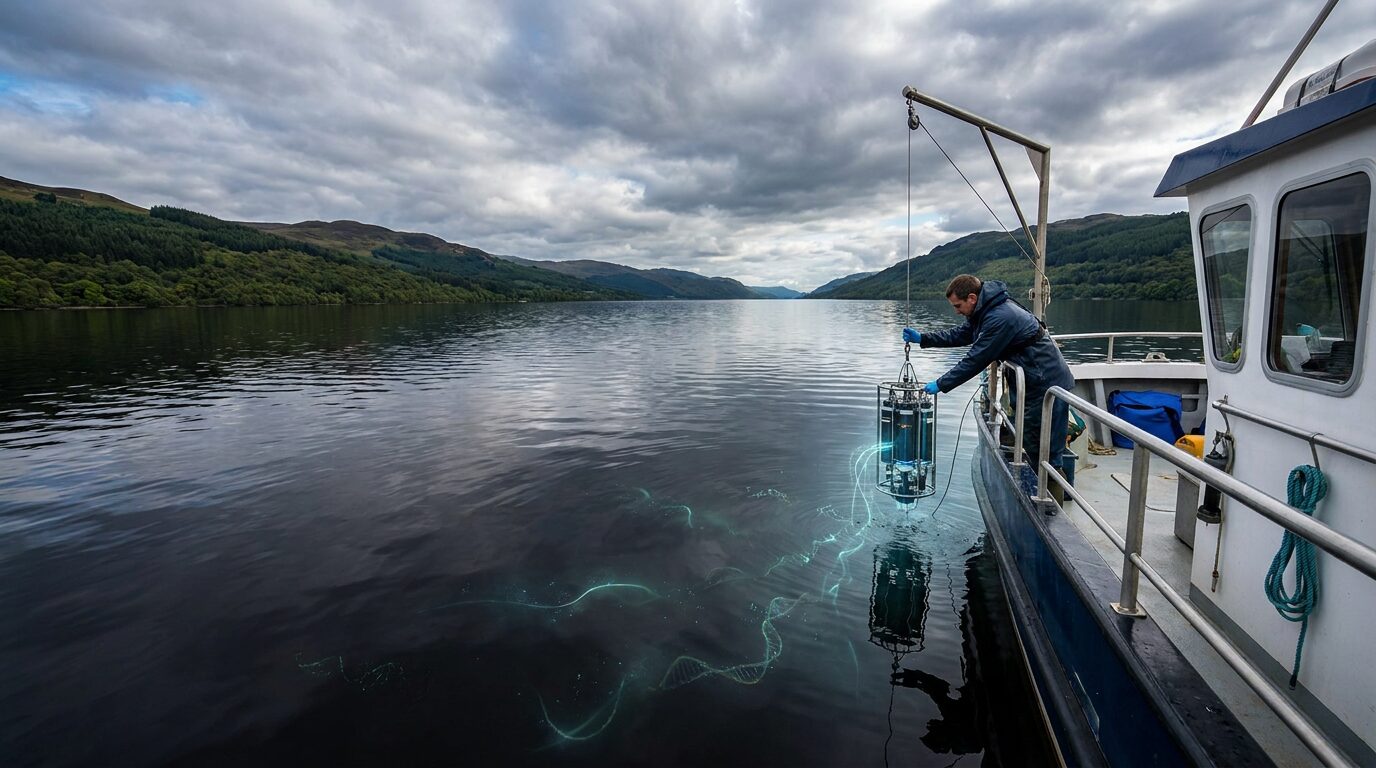
Picture a very dark lake in the Scottish Highlands: 23 miles long, nearly 800 feet deep, cold enough to suppress decomposition and cold enough, some locals will tell you, to hide almost anything. For nearly a century, Loch Ness has been the world's most famous ecological mystery — not because the evidence was ever particularly good, but because the absence of proof felt like a different thing from proof of absence. The water was too deep, too peaty, too opaque. You couldn't rule anything out.
Then scientists stopped trying to see through the water and started reading what the water had touched. Environmental DNA — eDNA — is a sampling technique built on the fact that every living organism sheds biological material continuously: cells from skin, scales, mucus, feces, blood, shed tissue. That material carries DNA. That DNA dissolves and disperses into the surrounding water, soil, or air, where it lingers for days to weeks before degrading. A sensitive enough test can pull a species' genetic signature out of a sample of water even if the animal itself is nowhere nearby, even if only a handful of individuals exist in the entire system. Researchers have used eDNA to detect rare freshwater fish in rivers, to census whale populations from seawater, to track invasive species before they become established. The method does not require you to see the animal. It requires only that the animal was there.
The Loch Ness eDNA survey, led by Neil Gemmell's team from the University of Otago, collected water samples from across the loch at multiple depths, ran them through metabarcoding — a technique that amplifies and sequences all the DNA fragments present in a sample and matches them against a reference database of known species — and catalogued hundreds of species living in the loch. Bacteria, fungi, eels, birds, deer whose DNA had washed in from shore. No plesiosaur. No giant unknown reptile. No cryptid. What they found instead was something arguably more interesting than a monster: an almost complete ecological map of a body of water, assembled not from nets or sonar but from molecular residue. The absence of Nessie is the press release. The eDNA methodology is the actual story.
A Tool Sensitive Enough to Rule Things Out
The reason eDNA changes the epistemology of a search like this is that it transforms a negative result from a shrug into a statement. Before, you couldn't find the Loch Ness Monster because the loch is enormous, dark, and cold — and a large aquatic animal is very good at not surfacing on cue. The failure to photograph it or catch it on sonar was genuinely ambiguous. A large enough lake with a large enough animal could, in principle, evade casual observation indefinitely. But an animal cannot evade its own shed DNA. A plesiosaur-sized organism — or any organism large enough to be mistaken for one — living and metabolizing in a closed lake system would be shedding DNA constantly, into every cubic meter of water it moved through. The technique's sensitivity makes the negative result load-bearing. It does not prove nothing unusual has ever been in the loch, but it makes a large, persistent, living population essentially genetically invisible. That is a different kind of claim.
“An animal cannot evade its own shed DNA. A plesiosaur-sized organism living in a closed lake would be shedding genetic material into every cubic meter of water it passed through.”
What the survey did find, in notable quantities, was European eel DNA. Anguilla anguilla — the common eel — turns up across the loch in enough genetic material to suggest a population of large individuals. Gemmell's team was careful not to overclaim: eDNA sampling tells you a species is present, but it cannot reliably tell you the size of the individuals contributing the signal. Still, the eel hypothesis has a quiet elegance. Eels are long-lived, can reach impressive sizes under the right conditions, and are famously difficult to observe directly. A large eel breaking the surface in low light and peaty water would look, to a startled onlooker, like a hump. A very large one writhing near the surface would look like several humps.
The Ecology of Misidentification
This is where the Gross Science angle sharpens into something genuinely interesting, because eDNA is not just a monster-hunting tool. It is a tool for understanding what an ecosystem actually contains — which means it can also illuminate the gap between what an ecosystem contains and what people have reported seeing in it. That gap is the ecology of misidentification. Loch Ness is not unusual for having one. Ecosystems regularly contain species that are rarely, badly, or never directly observed — and those gaps fill predictably with projections, misidentifications of mundane organisms, and occasionally deliberate hoaxes that seed subsequent genuine misperceptions.
The eels are interesting here because eels are, in their own right, genuinely strange animals — animals whose actual biology is dramatic enough to earn the attention. The European eel's life cycle remains one of the more haunting unsolved problems in vertebrate biology: they spawn somewhere in the Sargasso Sea, larvae drift thousands of miles on ocean currents, juveniles colonize freshwater rivers and lakes across Europe and North Africa, they live there for years or decades, and then, compelled by some still poorly understood hormonal trigger, they migrate back to the sea to spawn and die, in water no researcher has ever directly observed them reaching. For a long time, no one had ever found a sexually mature European eel. The eel is strange enough on its own merits that its role as a plausible cryptid-substrate feels almost fitting.
The broader principle extends well beyond Loch Ness. Rare species that scientists genuinely did not expect to exist in a given environment keep turning up in eDNA surveys — not because they were hiding from humans, but because the density of direct observation has always been far lower than assumed. Consider the bumblebee catfish: scientists observed a massive aggregation of Rhyacoglanis paranensis[3] climbing waterfalls in Brazil in November 2024 — a species considered rare, about whose biology almost nothing was known. This was not a new species. It had simply never been observed doing this, partly because no one had been watching the right place at the right time, and partly because its rarity made casual encounters unlikely. eDNA surveys in the same watershed would have confirmed the species was present long before anyone filmed it ascending a waterfall.
What the Negative Space Contains
The Loch Ness eDNA survey is a useful case study in what it means to finally have a tool sensitive enough to interrogate negative space — the space where absence of evidence has historically been treated as almost-evidence of presence. Cryptozoology has always relied on the intuition that a sufficiently large, sufficiently remote ecosystem could conceal a sufficiently large animal from all but the most determined or lucky observer. eDNA dismantles that intuition not by brute-force exhaustive searching but by sampling the molecular record the animal would necessarily leave behind. The same logic that makes eDNA useful for tracking invasive species at very low population densities — as the National Institute of Justice has noted in the forensic DNA context[1], biological material persists and can be detected from trace quantities[1] — also makes it useful for establishing, with some confidence, that a large organism is absent.
There is a parallel here to the way forensic DNA transformed cold-case investigation — and it is worth noting because the epistemological shift is the same. Before sensitive DNA techniques, the absence of a suspect from a crime scene was ambiguous: maybe they were careful, maybe the evidence degraded, maybe the search was incomplete. After, a clean genetic sweep of a scene that should have produced biological material from a suspect starts to become evidence in itself. The tools made absence speak. The development of DNA phenotyping services[4] and forensic genetic genealogy databases[2] have pushed this further, to the point where a DNA trace can now generate a physical description, trace distant relatives, and reconstruct an identity from residue that was never meant to be found. The logic in Loch Ness is simpler but structurally identical: the loch contains its own molecular record, and that record is now legible. As BrainHook has covered, opting out of DNA databases no longer keeps you out of DNA databases — and in a sense, no organism opts out of eDNA surveillance either. Life sheds evidence constantly. The question is always whether anyone is sensitive enough to read it.
“Life sheds evidence constantly. The question is always whether anyone is sensitive enough to read it.”
What Loch Ness left behind, in the end, was not a monster — it was an ecosystem. Hundreds of species documented in molecular detail, including eels large enough to plausibly explain decades of ambiguous surface sightings, alongside the bacterial communities, the fungal signatures, the genetic residue of deer and birds that had touched the water from shore. The loch was not empty. It was full of things that had been there all along, doing what living things do, shedding DNA into cold dark water, waiting for someone to finally think to look.
References
- Using DNA to Solve Cold Cases: Special Report (ojp.gov)
Establishes that biological material persists and can be detected from trace quantities in forensic contexts, supporting the article's parallel between forensic DNA and eDNA's ability to make absence meaningful. - GEDmatch (en.wikipedia.org)
Describes forensic genetic genealogy databases allowing law enforcement DNA comparison, illustrating the broader shift in how DNA traces can now reconstruct identity and relationships from residue. - 5 unexpected animal behaviors we learned about in 2025 (news.mongabay.com)
Provides example of bumblebee catfish species confirmed present via eDNA before direct behavioral observation, illustrating how eDNA reveals organisms missed by casual observation. - Parabon Snapshot™ Gives Crime Solvers a New Way to Use DNA (parabon-nanolabs.com)
Documents DNA phenotyping technology that generates physical descriptions from DNA traces, exemplifying how DNA tools transform the epistemology of absence into actionable evidence.
About Phoebe Lark
Phoebe Lark writes about the biology and chemistry your body and home would rather you didn't examine too closely — odors, fluids, microbes, parasites, infestations, and the quietly industrious rot happening on and around you right now. She follows disgust down to the mechanism underneath, where the gross thing almost always turns out to be a system doing exactly what it evolved to do.
More like this

DNA Genealogy Solved a 39-Year-Old Sex Crime—Two Days Too Late
Forensic genealogy just closed a 39-year-old kidnapping and sexual assault—but the man charged died before investigators could reach his door.

The DNA Face on the Wanted Poster Might Not Look Like Anyone
DNA phenotyping can predict hair color and ancestry with real precision — but the face shape pinned to a tip line is educated guesswork, and once a rendering goes public, it starts doing work the science never authorized.
The Government Called Unidentified Remains a 'Silent Disaster.' Now DNA Is Naming the Dead.
America's unidentified dead have been piling up in morgues for decades — and the forensic genealogy companies working to name them are doing it with science that would have seemed impossible fifteen years ago.