The Deepest Ecosystem on Earth Runs on Methane, Not Sunlight. We Had No Idea It Was There.
A Chinese Academy of Sciences expedition into the hadal zone just found the deepest ecosystem ever recorded — and it doesn't care that the sun exists.
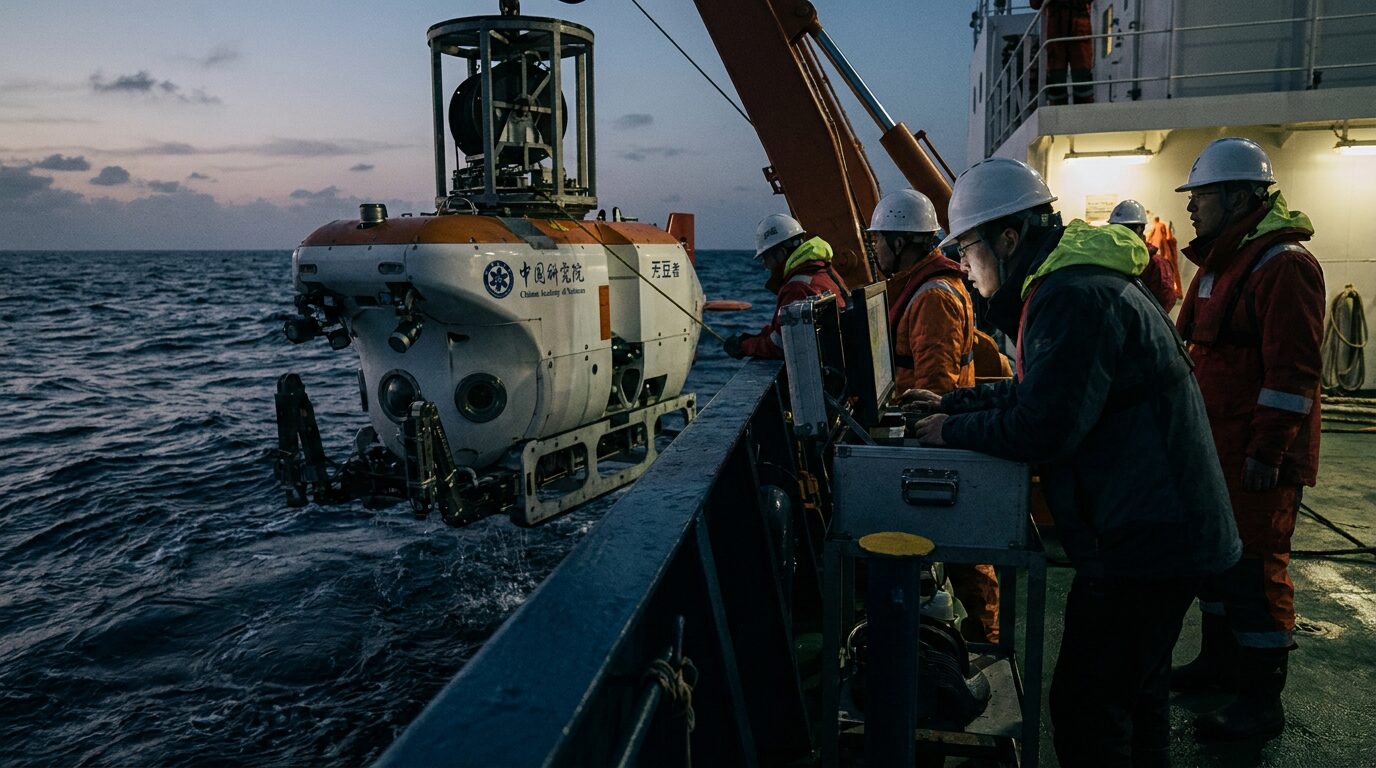
The hadal zone is one of the least hospitable addresses on the planet. The name comes from Hades, which gives you a sense of how the scientists who named it felt about it. These are the ocean's deepest trenches, mostly formed where one tectonic plate slides beneath another, and they occupy a narrow slice of the seafloor between roughly 20,000 and 36,000 feet below the surface. They are cold, pitch-black, and crushed under pressures that would collapse a submarine hull like a paper cup. For a long time, the working assumption was that very little of consequence lived there — that life at such depths subsisted mainly on what drifted down from above: dead organisms, fecal particles, bits of biological debris from the sunlit ocean hundreds of meters up. The deep trenches were seen as recipients, not producers. A gutter at the bottom of the food chain.
That picture is now being actively dismantled. A research expedition led by scientists from the Chinese Academy of Sciences recently probed the hadal trenches of the western Pacific[1] — including the Mariana, which holds the deepest point on Earth's surface — and returned with evidence of something that doesn't fit the old model at all. Stretching across more than 1,500 miles of trench seafloor, they documented a chemosynthetic ecosystem, the deepest ever found, where microbial communities are generating organic matter entirely from chemical energy: specifically from methane seeping up through the seafloor. Not one calorie of sunlight drives this system. It is, in a meaningful sense, a biosphere that does not know the sun exists.
This matters for reasons that extend well beyond deep-sea biology. The discovery forces a revision to the concept of the "energy floor" of life — the lowest limit at which biological systems can sustain themselves. The assumption had been that deep chemosynthetic ecosystems, while real and documented in shallower settings like hydrothermal vents and cold seeps on the continental shelf, would thin out and eventually disappear as depths became extreme, as pressures mounted, and as the methane and chemical gradients that sustain such communities became harder to maintain. The hadal trenches were supposed to be too far, too deep, too extreme. They were not.
What the expedition found instead was a community of microbial life — and in some areas, the larger organisms that build their ecology on top of it — spread across a corridor of trench seafloor that is staggering in scale. Fifteen hundred miles is approximately the distance from New York to Denver. This is not a pocket of weird chemistry at the bottom of a single trench. It is a coherent biological province, operating on its own energy budget, structured around methane oxidation, and completely decoupled from the photosynthetic machinery that runs almost everything else on Earth.
What Chemosynthesis Actually Is, and Why It's Harder Down There
Chemosynthesis is the process by which certain microorganisms build organic compounds using energy derived from chemical reactions rather than from light. The most familiar version of this happens at hydrothermal vents, where superheated water carries hydrogen sulfide upward from volcanic rock, and sulfur-oxidizing bacteria use that chemistry as their energy source. Around these vents, entire ecosystems have assembled — tube worms, clams, shrimp, crabs — all of them ultimately dependent on microbial chemosynthesis rather than photosynthesis. These vent communities were discovered in 1977 and remain one of the most significant revisions to biology's sense of where life can exist and what it needs. But hydrothermal vents are not especially deep by ocean standards, and they are geologically active in ways that supply a steady stream of reactants. Hadal trenches are different terrain.
At hadal depths, the relevant chemistry is methane seepage rather than hydrothermal activity. Methane seeps occur where geological pressure forces biogenic or thermogenic methane up through sediments and into the water column. The microorganisms that exploit this are called anaerobic methanotrophs — a consortium of archaea and bacteria that perform anaerobic oxidation of methane, often coupled to sulfate reduction. The process is metabolically slow and thermodynamically constrained: these organisms live close to the minimum energy threshold at which life can sustain itself. At ambient pressure and temperature, this is already demanding biochemistry. At hadal pressures, where the water column above exerts more than 1,000 atmospheres of force, the metabolic challenge becomes considerably more severe. Enzymes are deformed by pressure. Membrane fluidity changes. The entire molecular toolkit of life has to be adapted to an environment that should, by most expectations, shut it down.
“At hadal pressures, the metabolic challenge isn't just extreme — it's close to the theoretical minimum energy threshold at which life can sustain itself at all.”
Research into anaerobic oxidation of methane in extreme environments has been building for decades, but the assumption was always that the deepest trenches would prove too hostile for even these hardy consortia. What the Chinese Academy of Sciences expedition suggests is that hadal trenches are not just inhabited by chemosynthetic microbes — they host geologically structured methane seepage systems, complete with the carbonate crusts, sulfide mineral precipitation, and sediment chemistry signatures that characterize fully functioning cold seep ecosystems at shallower depths. The machinery is the same. The address is just far more extreme.
Reading the Seafloor Backward from Chemistry
Documenting an ecosystem at 30,000 feet requires more than lowering a camera. The expedition used a combination of deep-sea landers, sediment cores, water sampling, and remotely operated vehicles capable of operating at full hadal depth — a significant engineering constraint, since most deep-sea sampling technology is rated for depths far shallower than the hadal zone. The evidence they accumulated was layered: microbial community analysis from sediment cores, isotopic signatures in the carbon chemistry of the sediments, and direct observation of the biological and mineral structures that cold seep ecosystems characteristically produce.
Carbon isotope ratios are one of the key forensic tools here. Methane-derived carbon has a distinctive isotopic signature — strongly depleted in carbon-13 — and that signature propagates through the organisms that consume it and through the carbonate minerals that precipitate as a byproduct of methanotrophic activity. When you find that signal in sediment cores at the bottom of a hadal trench, spread across a spatial range of over a thousand miles, you are not looking at contamination or a localized anomaly. You are looking at a structured, geographically extensive system that has been running long enough to leave a mineralogical record. The seafloor, like rock strata on land, preserves chemistry as evidence. The expedition was, in effect, reading a crime scene: organic matter produced in the dark, from methane, at the bottom of the world.
“Carbon-13 depletion in sediment cores doesn't lie — it is the chemical fingerprint of methane-eating life, and it was everywhere they looked.”
The spatial continuity is particularly striking. Cold seep ecosystems at continental margins and in shallower trenches tend to be patchy — tied to specific geological features where methane flux is high enough to sustain community structure. The idea that a chemosynthetic system could maintain coherent biological activity across 1,500 miles of hadal terrain implies that methane seepage along subduction zone trenches is far more pervasive than previously appreciated. Subduction zones, where one plate dives beneath another, compress and heat organic-rich sediments in ways that generate methane at depth. The western Pacific is ringed with some of the most active subduction zones on the planet. The tectonic architecture of the western Pacific has been churning for hundreds of millions of years, and it appears to be feeding the deepest biosphere on Earth from below.
The Energy Floor of Life, Revised
The philosophical weight of this discovery sits in what it does to our sense of life's minimum requirements. For most of Earth's history, and across most of Earth's surface, photosynthesis has been the foundation. Sunlight drives the reduction of carbon dioxide into organic matter, and almost everything eats something that ultimately traces back to that transaction. Even in the deep ocean, the conventional model depended on photosynthetic production near the surface — marine snow, the slow rain of organic particles that sustains deep-water communities. The discovery that a fully independent, methane-fueled biosphere can operate at hadal depths removes photosynthesis from the picture entirely, not as an exception, but as a regional energy economy spanning thousands of miles.
Studies of subsurface microbial life and deep biosphere limits have long suggested that the total biomass of microorganisms living beneath Earth's surface — in rock, in sediment, in aquifers — may rival or exceed the biomass of all life on the surface. These communities also survive largely on chemical energy, drawing on hydrogen produced by water-rock interactions, on methane, on the slow oxidation of iron and sulfur. The hadal chemosynthetic ecosystem connects that deep biosphere picture to the ocean floor in a new way: it is neither a surface system nor a purely subsurface system, but a zone where chemical energy from deep geological sources breaks the surface of the sediment and supports complex biological structure in the water column above.
There is an astrobiological implication here that researchers in that field will not ignore. The argument for life on ocean worlds like Europa or Enceladus has always rested partly on the analogy with hydrothermal vent systems — the idea that water in contact with rock, driven by tidal heating rather than sunlight, could sustain chemosynthetic life. The hadal finding strengthens that analogy considerably. It demonstrates that chemosynthetic ecosystems can function not just at isolated volcanic hot spots, but across geologically structured regions of a seafloor, sustained by the slow mechanics of tectonics and methane seepage rather than spectacular hydrothermal plumes. An ocean world does not need convenient volcanic vents scattered across its seafloor. It may only need a subducting plate, or the pressure of a rocky mantle squeezing methane upward, and life can find a way to run the numbers.
What Lives Down There, and How
The microbial consortia doing the core metabolic work are not, individually, dramatic organisms. Anaerobic methanotrophic archaea — ANME clades, in the shorthand — are single-celled, slow-growing, and metabolically parsimonious to a degree that is almost difficult to conceptualize. Some deep-seep organisms are estimated to divide only once every few months, or even more slowly. They are not racing to consume their substrate; they are barely ticking over, extracting just enough energy from methane oxidation to maintain themselves and, eventually, reproduce. Paired with sulfate-reducing bacteria, they operate as a consortium — the archaea oxidize the methane, the bacteria use the electrons to reduce sulfate to sulfide, and together they close a chemical loop that neither could manage alone.
Above this microbial base, where methane flux is high enough to support more than just biofilms in the sediment, larger organisms can establish themselves. Cold seep communities at shallower depths host mussels with chemosynthetic symbionts in their gills, polychaete worms, gastropods, crustaceans — an entire trophic architecture stacked on the microbial foundation. At hadal depths, the biological inventory thins, and the organisms that persist there are adapted to pressure in ways that remain poorly understood at the molecular level. But they are present. Research into hadal fauna at the deepest Pacific trenches has repeatedly turned up surprising biological richness — amphipods in enormous abundance, snailfish at record depths, microbial mats that suggest sustained chemical productivity. The new expedition adds the critical piece: a coherent energy source, operating at scale, that explains how that life is sustained.
The Ocean's Deepest Archive
There is something worth sitting with in the sheer remoteness of this discovery. Ocean heat content has been rising for years, reshaping surface ecosystems from coral reefs to open-ocean food webs, while 30,000 feet below, a different ocean entirely was running on chemistry that predates the sunlit one. The hadal zone is so physically separated from the surface — by pressure, temperature, and the simple absence of light — that whatever is happening there records a different planetary story. It is not insulated from Earth's changes entirely: shifts in ocean chemistry, changes in organic matter flux, alterations in deep-water circulation can all eventually reach the trenches. But the energy base of the hadal chemosynthetic ecosystem is geological, not atmospheric. It is fed from below, by the slow squeeze of tectonics, by methane migrating upward through sediment. That engine has been running for a very long time, and it will not stop because the surface ocean is warmer.
“The energy base of the hadal ecosystem is geological, not atmospheric — fed from below by tectonics, indifferent to everything happening at the surface.”
The discovery also carries a quiet methodological lesson about the limits of sampling. The hadal zone covers only about 0.2 percent of the ocean floor by area, and accessing it remains technically demanding and expensive. The instruments required to sample sediment and water at full hadal depth without contaminating or depressurizing the sample are not widespread. What this expedition accomplished represents years of engineering as much as years of biology. And what it found — a 1,500-mile chemosynthetic corridor that was simply not known to exist — is a reminder that the ocean's deep interior remains one of the genuinely undersampled regions of this planet. We have better maps of the Moon's surface than of Earth's ocean floor. The gap between what we have sampled and what is down there to find is not a small one.
The deepest ecosystem on Earth runs on methane, operates in total darkness, endures pressures that would destroy any human-made vessel not specifically engineered for the task, and stretches across a distance that would take a car two days of uninterrupted driving to cover. It was not discovered until now. It has almost certainly been running, in some form, for millions of years. The universe of life on this planet is not fully inventoried, and the places where the inventory is most incomplete are often the places where the most unexpected things turn out to be living.
References
- Flourishing chemosynthetic life at the greatest depths of hadal trenches (nature.com)
Provides the primary research findings on the Chinese Academy of Sciences expedition discovering chemosynthetic ecosystems across 1,500 miles of hadal trench seafloor.
About Mira Solen
Mira Solen writes about deep time, cosmic history, extinct stars, ancient impacts, and the long memory stored in rock, dust, and light. Her work specializes in making the oldest stories in the universe feel vivid, physical, and strangely near.
More like this

No Star Required: How Rogue Planets Could Hold Liquid Water in the Dark
Planets flung into interstellar space were assumed to be dead on arrival — but geothermal heat and hydrogen-rich atmospheres may keep some of them warm enough for liquid water, billions of miles from any sun.
The Oceans Have Lost 500 Dead Zones' Worth of Silence
Ocean dead zones have grown tenfold since the 1950s, and the deoxygenation driving them is quietly rewiring marine life from the seafloor up — long before fish populations crash.
Two Continent-Sized Blobs Have Been Sitting at Earth's Core for Four Billion Years
Buried at the base of Earth's mantle, two continent-sized masses of anomalous rock have resisted four billion years of planetary churning — and a new study argues they are fossilized relics of Earth's primordial interior that may have quietly shaped the conditions for life.