The Cosmic Microwave Background Has a Cold Spot That Shouldn't Be There
Embedded in the afterglow of the Big Bang is a region so anomalously cold that every standard explanation has failed — and the ones that might actually work would each require rewriting something fundamental about the universe.
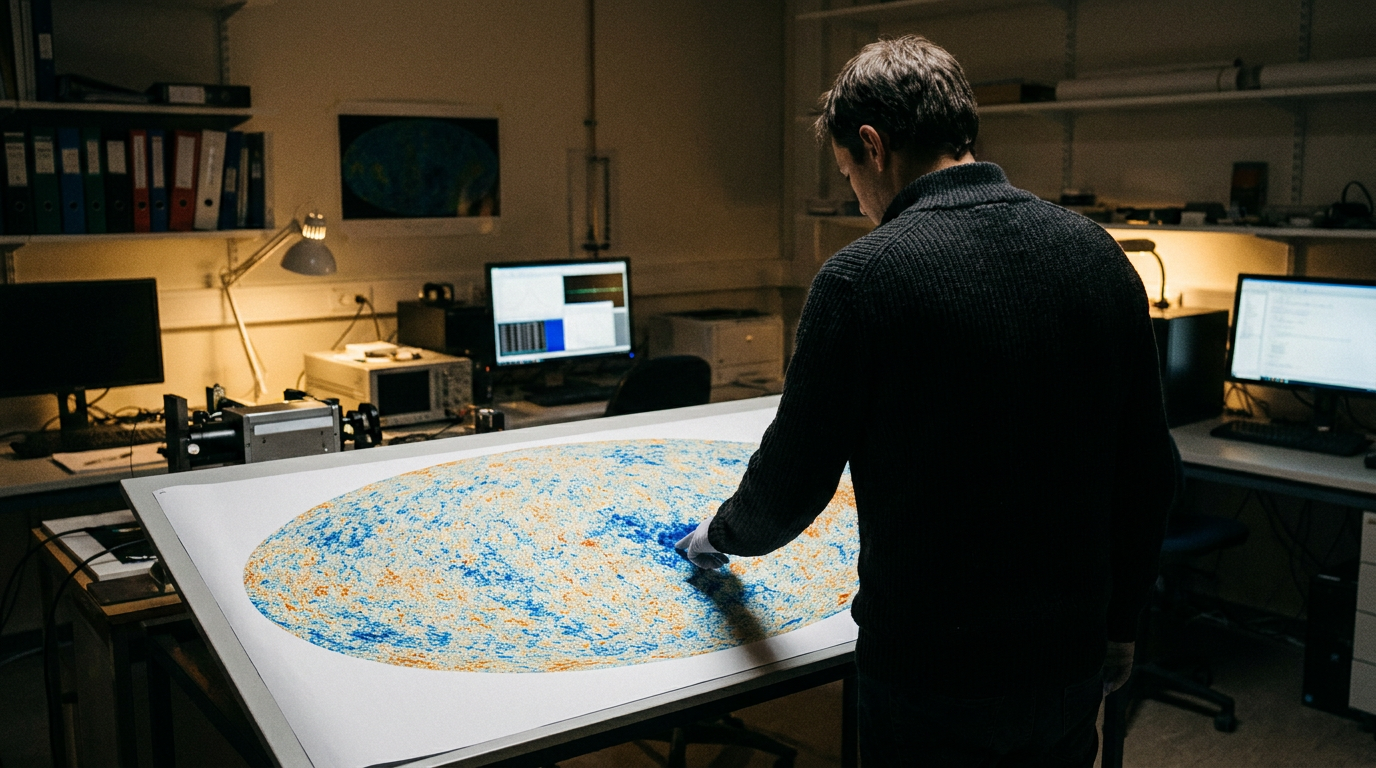
There is a map of the oldest light in the universe, and it has a bruise. The map is of the cosmic microwave background — the CMB — that faint, pervasive glow of radiation left over from roughly 380,000 years after the Big Bang, when the universe had cooled just enough for hydrogen atoms to form and light to travel freely for the first time. That light has been moving through expanding space ever since. It reaches us now as microwave radiation, nearly uniform in every direction, a relic of conditions that no longer exist anywhere in the observable universe. It is, in the most literal sense possible, the oldest light we can detect.
The map is not perfectly smooth. It was never expected to be. Tiny fluctuations in temperature — variations of about one part in a hundred thousand — are distributed across the CMB sky, and those fluctuations are important. They are the seeds of everything: the faint density ripples in the early universe that eventually grew, under gravity, into the galaxies and clusters and filaments that define cosmic structure today. The fluctuations follow a statistical pattern that the standard cosmological model — the Lambda-CDM model, built on dark matter and dark energy — predicts with extraordinary precision. Decades of satellite observations, from COBE through WMAP to the Planck mission, have confirmed that the predictions and the measurements match almost everywhere.
Almost. In the southern hemisphere of the CMB sky, in a region of the actual sky centered near the constellation Eridanus, there is a patch roughly fourteen degrees across — corresponding to a physical scale of perhaps a billion light-years at the surface of last scattering — that is significantly colder than everything around it. Not slightly. Not within the range of expected statistical variation. Colder by enough that, under the standard model, a feature like this occurring by chance has been estimated at roughly one in a hundred thousand. It was first identified in the WMAP data in 2004. The Planck satellite confirmed it a decade later. It has been sitting in the data ever since, neither explained away nor explained.
This is the Cold Spot. And it has resisted every straightforward cosmological interpretation for more than twenty years.
Reading Temperature as a Record
To understand why the Cold Spot is strange, you first need to understand what temperature means in the CMB. The map is not a photograph of an object. It is a record of conditions — specifically, a record of how matter and energy were distributed when the universe became transparent. Hotter regions correspond to areas that were slightly denser, slightly more compressed, releasing slightly more energy as the photons that eventually became CMB radiation fought their way out of gravitational wells. Cooler regions correspond to areas that were slightly less dense, where photons lost a little less energy escaping. The pattern is random, but it is a constrained randomness: the statistical distribution of hot and cold patches follows precise predictions about the physics of the early universe, including the scale at which fluctuations should cluster, how hot and cold patches should be correlated, and how extreme any given feature should be.
The Cold Spot fails those constraints. It is too cold, and it covers too much area, and the profile of how it gets colder toward its center does not match what standard inflationary cosmology predicts for a primordial fluctuation. Statisticians working on the CMB have argued about exactly how anomalous it is — some analyses reduce the significance somewhat depending on how you define the test and correct for the fact that you are looking for unusual things in a large dataset. But the Cold Spot has survived rigorous scrutiny. The Planck collaboration acknowledged it[1] as a genuine feature requiring explanation. The question is not really whether it is real. The question is what made it.
“The Cold Spot has survived rigorous scrutiny for two decades — not as a statistical ghost, but as something physically stamped into the oldest light we can observe.”
The Supervoid: An Attractive Failure
The most widely discussed candidate explanation is a supervoid: an enormous, nearly empty region of space lying between us and the CMB, along the line of sight toward the Cold Spot. The mechanism is real physics. As CMB photons travel through space, they pass through regions of varying density. When a photon enters a gravitational well — a cluster, a filament — it gains a little energy climbing in, and loses a little climbing out. In a universe where dark energy is accelerating expansion, these gains and losses do not cancel perfectly: the well is shallower by the time the photon exits, because the large-scale structure has shifted slightly during transit. The result is a subtle imprint on CMB temperature known as the Integrated Sachs-Wolfe effect. A void works the same way in reverse: a photon passing through a large underdense region gets a slight energy deficit, arriving slightly cooler than it should.
In 2015, a large-scale structure survey identified a candidate supervoid in the direction of the Cold Spot[3] — a region roughly 1.8 billion light-years across, centered about three billion light-years from Earth, with a galaxy density significantly below the cosmic average. The correlation was striking. The problem is the arithmetic. The Integrated Sachs-Wolfe effect, even for a void that large, is estimated to account for perhaps twenty to thirty percent of the observed temperature deficit in the Cold Spot. The remaining cooling cannot be explained this way without invoking a void so extreme in its emptiness that it would itself be statistically improbable under the standard model. You would be trading one anomaly for another, slightly smaller one.
The supervoid hypothesis is not wrong, exactly. There probably is a large underdense region there, and it probably contributes something to the Cold Spot's signature. But it does not close the case. It is a partial answer that leaves the most extreme part of the anomaly unaccounted for — which means something else, or something additional, still needs to be in play.
Primordial Fingerprints and Inflation's Limits
A second class of explanations looks earlier — not at what the photons passed through on their way to us, but at conditions in the infant universe itself. Standard inflationary cosmology holds that a brief, violent period of exponential expansion in the universe's first fractions of a second smoothed out any large-scale irregularities, stretching quantum fluctuations into the seeds of structure while erasing anything more extreme. The resulting CMB fluctuations should be Gaussian in their statistical distribution: no single feature should be dramatically more extreme than the background noise in any consistent way. The Cold Spot, in its profile and its scale, strains that prediction.
Some theorists have explored whether non-standard inflationary models — inflation that was not perfectly smooth, or that involved multiple scalar fields, or that incorporated topological defects like cosmic strings or textures[4] — could produce a feature like the Cold Spot. A cosmic texture, in particular, is an intriguing candidate. Textures are hypothetical knots in the fabric of certain quantum fields, predicted by some extensions of the standard model of particle physics, that could have formed during phase transitions in the early universe and left large-scale imprints on the CMB as they unwound. The predicted signature of a texture — a circular cold region with a specific temperature profile — matches the Cold Spot somewhat better than a simple primordial fluctuation does. The obstacle is that textures require physics beyond the standard model, and no independent evidence for them has emerged. They solve the geometry of the anomaly without anchoring it to anything confirmed.
“Every explanation that fits the Cold Spot's shape requires physics that has not been confirmed anywhere else — which is not a reason to dismiss them, but it is a reason to hold them carefully.”
The Multiverse in the Data
The most dramatic candidate explanation arrives from the edges of theoretical cosmology: the possibility that the Cold Spot is a bruise left by a collision between our universe and another bubble universe during a period of eternal inflation. In inflationary models that allow for eternal inflation — where inflation never truly stops globally, but continues in some regions indefinitely while ending in others, producing isolated pocket universes — our observable universe would be one bubble among an enormous, perhaps infinite, ensemble. If two such bubbles were ever close enough to interact gravitationally or through their field structures during the chaotic early period of cosmic expansion, the collision could have left an imprint on our CMB: a roughly circular region with an anomalous temperature profile, possibly colder or hotter than its surroundings, with a characteristic edge.
The Cold Spot matches some of these predicted features. It is roughly circular. It has a temperature profile that some analyses suggest is consistent with a collision signature. Researchers have laid out specific additional predictions that could in principle distinguish a bubble collision from other explanations — including polarization patterns in the CMB around the feature, and correlations with large-scale structure along the same line of sight. So far, the data are not conclusive in either direction. The Planck polarization data have not confirmed the specific pattern that bubble collision models predict, but neither have they definitively ruled it out. The signal, if it exists, is near the limits of what current instruments can resolve.
The multiverse explanation is the kind of idea that makes physicists nervous in a specific way: it is unfalsifiable in the broad sense — we cannot visit other universes — but it makes testable, specific predictions about what we should see in our CMB if it is true. That is a more defensible position than pure speculation. It is also a position that, if confirmed, would be among the most consequential findings in the history of science. The Cold Spot would not be an anomaly in that case. It would be a scar from contact with another universe.
What the Anomaly Preserves
There is a temptation, when a cosmological anomaly resists explanation for long enough, to quietly reclassify it as a known unknown and move on. The CMB has other anomalies — the alignment of large-scale temperature patterns known as the axis of evil, the hemispherical power asymmetry, the low quadrupole — and none of them have been satisfactorily resolved. Some researchers argue that the standard model is simply imperfect at large scales, that the statistical machinery used to evaluate the CMB is itself subtly flawed, and that features like the Cold Spot reflect the limitations of our tools rather than holes in our physics. It is a reasonable position. It is also, in its own way, a deferral.
The Cold Spot is more than an embarrassment for a model. It is the kind of anomaly that sometimes marks the edge of where a framework actually works — the point where the map starts to differ from the territory in ways that have consequences. The Lambda-CDM model is spectacularly successful across an enormous range of scales and observations. That success is real, and it should not be discarded lightly. But its success everywhere else does not guarantee that the Cold Spot is an artifact. The CMB is the deepest archaeological layer we can access: a record of conditions that no longer exist, preserved in radiation that has been traveling for nearly fourteen billion years. When a feature appears in that record that the best models cannot account for, the appropriate response is not to average it away. It is to read it more carefully.
“The CMB is the deepest archaeological layer we can access — and the Cold Spot is a feature in that record that the best models still cannot account for.”
What Comes Next in the Sky
Future CMB experiments — including the Simons Observatory in Chile[2], the planned CMB-S4 ground-based array, and the proposed LiteBIRD satellite — will measure CMB polarization with significantly greater precision than Planck achieved. Polarization is the key. The photons of the CMB carry a faint directional signature that encodes information about what they passed through and what scattered them. Different explanations for the Cold Spot — supervoid, texture, bubble collision, statistical fluke — predict different polarization patterns in and around the anomalous region. If a distinctive polarization signal is detected around the Cold Spot at the precision these instruments can achieve, it will sharply constrain or eliminate some of the candidate explanations. If no signal is found, that too is information, narrowing the field in a different direction.
Galaxy surveys will also continue to map the large-scale structure in the direction of the Cold Spot with increasing depth and resolution, refining the picture of whether the candidate supervoid is large enough and empty enough to account for even part of the temperature deficit. The Euclid satellite, now operating, is building a three-dimensional map of the cosmos across billions of light-years. Some of that map covers the relevant region of sky. If the void is there in the detail that the Integrated Sachs-Wolfe mechanism requires, the data will show it. If the void falls short of what is needed — and current indications suggest it does — the fraction of the Cold Spot that remains unexplained will be measured with greater precision than before.
What the Cold Spot will not do is go away. It is in the light. It has been there since before any structure in the observable universe finished forming. Whatever made it — a vast emptiness in the foreground, a knot in a primordial field, a collision with something that is not our universe, or something not yet seriously proposed — it left a record in radiation that is nearly fourteen billion years old, and that record is still arriving, one photon at a time, from every direction in the sky. The universe does not erase its own history. It just stores it in forms that take a long time to read.
References
- Planck finds no new evidence for cosmic anomalies (esa.int)
Confirms Planck satellite's detection of the Cold Spot as a genuine anomalous feature requiring explanation. - The Simons Observatory: Overview of data acquisition, control, monitoring, and computer infrastructure (arxiv.org)
- Detection of a supervoid aligned with the cold spot of the cosmic microwave background (academic.oup.com)
Identifies the supervoid candidate in the Cold Spot's direction, roughly 1.8 billion light-years across and three billion light-years from Earth. - The CMB cold spot: texture, cluster or void? (academic.oup.com)
Provides theoretical framework for cosmic strings and textures as potential primordial sources of the Cold Spot anomaly.
About Mira Solen
Mira Solen writes about deep time, cosmic history, extinct stars, ancient impacts, and the long memory stored in rock, dust, and light. Her work specializes in making the oldest stories in the universe feel vivid, physical, and strangely near.
More like this
Dark Energy Is Not a Constant. Three Years of Data Say So.
The DESI survey's third year of data has made the case for a changing dark energy disturbingly strong — which means the force expanding the universe may not be what physicists have spent thirty years assuming.

This Star Is Older Than the Universe — And the Math Might Be Right
HD 140283 has been clocking in at 14-plus billion years old, which is a problem, because the universe is only 13.8 billion — and resolving that contradiction is quietly rewriting how we measure cosmic time.
Dark Energy Just Survived Its Biggest Challenge yet. That Should Worry Us More.
A landmark rebuttal restored the standard model of cosmic acceleration — but the galaxy survey quietly doing more damage than the debunked study ever could is still running.