Dark Energy Is Not a Constant. Three Years of Data Say So.
The DESI survey's third year of data has made the case for a changing dark energy disturbingly strong — which means the force expanding the universe may not be what physicists have spent thirty years assuming.
The universe has been expanding since the moment of its formation, but for roughly the first eight billion years of that expansion, gravity was winning. Matter pulled against the outward rush. The rate of expansion was slowing. Then, around five billion years ago, something changed. The expansion stopped decelerating and began to speed up — not because new matter appeared or some external force reached in, but because the universe seems to contain a kind of energy embedded in space itself, a pressure distributed everywhere and in every direction, pushing the geometry of spacetime outward faster than gravity can compensate. Astronomers gave it a name before they understood it: dark energy. They still don't understand it.
For most of the past quarter century, the working assumption was that dark energy is simply a cosmological constant — a fixed property of the vacuum, the same everywhere and at all times, denoted by the Greek letter lambda in the equations physicists use to describe the universe's evolution. The model that incorporated it, called Lambda-CDM, became the standard framework of modern cosmology. It was not perfect, but it was rigorous, it was predictive, and it fit the available data well enough that questioning lambda felt, to many researchers, like arguing with the periodic table. That era may now be ending.
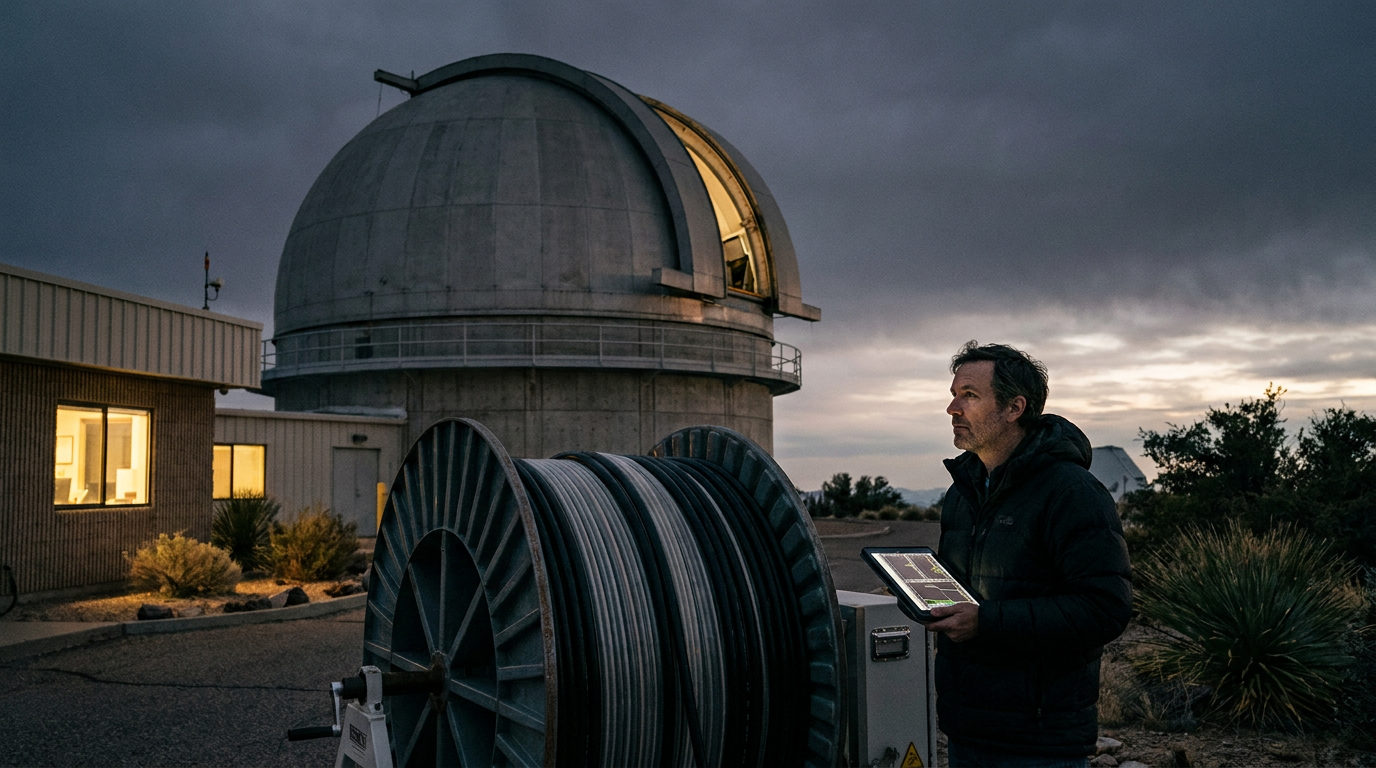
The Dark Energy Spectroscopic Instrument, DESI, sits inside the Mayall Telescope at Kitt Peak National Observatory in Arizona. It is not a dramatic instrument in the way that a space telescope tends to capture public attention. There are no iconic images, no nebulae rendered in false color. DESI does something quieter and, for cosmology, more powerful: it measures the spectrum of light arriving from distant galaxies and quasars with enough precision to determine how far away each object is and how fast the intervening space has expanded since that light began its journey. In its first year of operation, DESI mapped 6 million galaxies. By year three, that number had grown to more than 14 million, making this the largest three-dimensional map of the observable universe ever constructed[1].
What the instrument found, across three years of increasingly precise data, is a quiet anomaly that has not gone away. If dark energy were a true cosmological constant, certain signatures in the distribution of galaxies — particularly the scale of what are called baryon acoustic oscillations, the fossilized imprint of pressure waves from the early universe — should remain statistically consistent across cosmic time. They do not. The signal emerging from DESI's data suggests that dark energy may be changing. Not randomly, not violently, but measurably, systematically, and in a direction that current theory did not predict.
How You Weigh the Universe Without a Scale
To understand why DESI's results matter, it helps to understand baryon acoustic oscillations, or BAOs, which are the instrument's primary measuring tool. In the first 380,000 years after the Big Bang, the universe was a hot plasma of matter and radiation packed tightly enough that pressure waves moved through it the way sound waves move through air. When the universe cooled enough for atoms to form, those waves froze in place, leaving a characteristic pattern in the distribution of matter — a slight preference for galaxies to cluster at a specific separation, roughly 500 million light-years in today's expanded universe. Because this scale was set early and is well understood from the physics of that plasma, it functions as a standard ruler. By measuring how that ruler appears at different epochs of cosmic history — how large it looks in maps of galaxies near and far — astronomers can trace the expansion history of the universe with high precision. It is one of the most elegant measurement strategies in all of physics: using a relic of the early universe's sound field to weigh the behavior of spacetime billions of years later.
DESI uses 5,000 robotic fiber positioners to capture spectra from thousands of galaxies simultaneously during each observation window. Each spectrum encodes a redshift — the stretching of light toward longer wavelengths that occurs when a source is receding, which in an expanding universe correlates directly to distance. Layer those redshifts into a three-dimensional volume, map where galaxies cluster and how, and the BAO scale emerges from the statistics like a watermark pressed into paper. Do this across different redshift bins — different snapshots in cosmic time — and you can watch how the expansion rate changed from epoch to epoch. Year one of DESI data showed a mild tension with lambda-CDM. Year two sharpened it. Year three, covering the full 14-million-object catalog, has moved the signal to a level of statistical significance that cosmologists are no longer comfortable calling noise.
“A signal that sharpens with more data is not an artifact. It is evidence accumulating toward a shape.”
What 'Dynamical' Means and Why It Changes Everything
The alternative to a cosmological constant is what physicists call dynamical dark energy — a form of energy whose density, and therefore whose influence on the expansion rate, changes over time. The most studied class of dynamical dark energy models involves a hypothetical field called quintessence, loosely analogous to the inflaton field theorized to have driven the rapid expansion of the very early universe. Unlike lambda, a field has a value that can evolve. It can roll slowly down an energy potential landscape, growing stronger or weaker as the universe ages. Other models posit something called phantom dark energy, in which the energy density actually increases over time, which would drive an accelerating acceleration ultimately ending in what theorists call the Big Rip — a future in which the expansion becomes so extreme that it tears apart first galaxy clusters, then galaxies, then star systems, then eventually atoms. The DESI data does not yet point cleanly at any single model, but it does point away from the simplest one.
The standard way to parameterize dark energy's behavior uses two numbers. The first, called w₀, describes the equation-of-state parameter of dark energy today — the ratio of its pressure to its energy density. For a cosmological constant, w₀ is exactly negative one. The second number, wₐ, describes how that parameter has changed over cosmic time. For a true cosmological constant, wₐ is exactly zero. DESI's year-three analysis, when combined with complementary datasets from the Planck satellite's cosmic microwave background measurements and supernova distance catalogs, yields values of w₀ and wₐ that are inconsistent with the lambda-CDM prediction at a confidence level approaching four sigma[1] — meaning if the cosmological constant were the correct model, the probability of seeing data this discrepant by chance is roughly one in 15,000. That is not a discovery threshold by particle physics standards, which typically requires five sigma. But in a field as observationally constrained as cosmology, it is the kind of number that ends complacency.
“For a true cosmological constant, wₐ is exactly zero. DESI's data does not give zero.”
The Hubble Tension in the Background
DESI's dark energy anomaly does not exist in isolation. It is arriving alongside another unresolved problem that has been worsening for a decade: the Hubble tension. The Hubble constant, H₀, describes the current rate at which the universe is expanding — expressed in kilometers per second per megaparsec, it tells you how fast a galaxy recedes for every additional 3.26 million light-years of distance from us. When calculated from the cosmic microwave background using lambda-CDM, the value sits around 67 to 68 kilometers per second per megaparsec. When measured using local distance indicators — Cepheid variable stars, Type Ia supernovae, and now several independent cross-checks — the number comes out closer to 73, sometimes higher. The two values have not converged despite years of improving data on both ends. They appear to be genuinely different, which means either the measurements contain a systematic error that no one has yet identified, or the model connecting the early and late universe is missing something real.
A dynamical dark energy field, one that changes strength over cosmic history, could in principle create exactly that kind of tension — producing a universe that behaved one way at early epochs and another way more recently, such that the same model cannot smoothly bridge both windows without adjusting its parameters. This is speculative. Cosmologists are careful to note that the Hubble tension and the DESI anomaly may have separate causes or may reflect entirely different measurement challenges yet to be resolved. But it is also notable that two independent, increasingly robust lines of evidence are pointing toward the same uncomfortable place: that the standard model of cosmology, the framework that physicists have trusted to describe the largest scales of reality, may be incomplete in ways that no amount of additional lambda-CDM fitting will resolve.
What Cannot Be Ruled Out Yet
Science conducted at the frontier of measurement is always shadowed by the possibility of systematic error. DESI's team has been transparent about this. Survey instruments accumulate not only signal but also subtle biases — in how fibers are assigned to targets, in how spectra are reduced and calibrated, in how overlapping datasets are combined. The year-three results have been scrutinized with blinded analysis techniques, in which key parameters are hidden from researchers until the analysis pipeline is locked down, specifically to prevent unconscious tuning. The signal has survived that scrutiny. But surviving an internal audit is not the same as surviving five more years of independent cross-checks, and the team is explicit that the current data alone are not sufficient to overturn lambda-CDM. What they are sufficient to do is make the question unavoidable.
Other large-scale structure surveys are now in operation or approaching full capacity. The Euclid telescope, launched by the European Space Agency in 2023[2] and now returning data, will map galaxies out to a redshift of two, covering a different but overlapping slice of cosmic history. The Vera C. Rubin Observatory in Chile, expected to begin its Legacy Survey of Space and Time in the mid-2020s, will produce a photometric galaxy catalog of staggering breadth. The Nancy Grace Roman Space Telescope, when it launches, will add high-resolution near-infrared spectroscopy from orbit. Each of these instruments will measure BAOs, weak gravitational lensing, and galaxy clustering in ways that are partly independent of DESI's approach. If the dynamical dark energy signal is real, these surveys should see it too, and the combined dataset will push statistical confidence well past the five-sigma threshold within this decade. If the signal evaporates under that additional scrutiny, it will mean something equally important: that DESI's pipeline harbored a systematic effect subtle enough to fool four years of analysis, which would itself demand explanation.
“If the signal is real, the next decade of surveys will confirm it. If it evaporates, that will also require an explanation.”
What Lives on the Other Side of the Constant
The cosmological constant has a troubled history that makes the current moment feel less like a crisis and more like a resumption of an old argument. When Einstein first introduced lambda into his field equations in 1917, he used it to counterbalance gravity and produce a static universe — then retracted it when Hubble's observations revealed that the universe was expanding. When evidence for accelerating expansion arrived in 1998 from supernova surveys, lambda was rehabilitated and installed at the center of modern cosmology. Physicists were uncomfortable with it from the beginning, because quantum field theory predicts that the vacuum should contain enormous energy density — estimates run to 120 orders of magnitude larger than the observed value of dark energy, one of the most notorious mismatches in all of theoretical physics, sometimes called the vacuum catastrophe[3]. Lambda as a cosmological constant offers no mechanism to explain why it takes the precise value it does. It simply does, and models are built around that fact.
A dynamical dark energy field does not solve the vacuum catastrophe. But it does open a different kind of door. If dark energy has structure — if it changes over time according to some physical law — then in principle it can be studied, characterized, and eventually explained by mechanisms that theorists can construct and test. A constant can only be measured. A field can be understood. The distinction matters enormously for physics: a measured constant is the end of an inquiry, while a field with dynamics is the beginning of one. This is why DESI's results, even hedged with appropriate uncertainty, have drawn the attention they have. Not because they prove anything final, but because they suggest the universe may have given us a thread to pull.
The light captured by DESI's fibers left those 14 million galaxies billions of years ago, some of it before Earth existed, some before the solar system had begun to condense from the disk of gas and dust surrounding a young star. That light carried in it the record of how the universe was expanding at the moment of its departure — the exact rate, encoded in its wavelength, stretched precisely by the amount the intervening space has grown since. Enough of those wavelengths, laid together into a statistical structure, are now telling us that the expansion did not follow the simplest possible law. Whether that is a cosmological field, a modification of gravity, something not yet imagined, or a stubborn systematic error in the data, we don't yet know. But the signal is sharpening. The universe is saying something, and for the first time in twenty-five years, the answer may not be lambda.
References
- DESI DR2 Results II: Measurements of Baryon Acoustic Oscillations and Cosmological Constraints (arxiv.org)
Provides DESI's three-year data showing 14 million galaxies mapped and baryon acoustic oscillation measurements yielding four-sigma tension with lambda-CDM. - Euclid (esa.int)
Confirms Euclid space telescope launched by European Space Agency in July 2023 to map dark Universe structure. - Cosmological constant problem (en.wikipedia.org)
Defines the cosmological constant problem and vacuum catastrophe as the disagreement between observed and theoretical vacuum energy density.
About Brenna Vance
Brenna Vance writes about the cosmos — stars that predate the universe's own chemistry, spacecraft flying close enough to the sun to catch it misbehaving, the physics of what the universe is still getting wrong. Her work focuses on the moments when an observation breaks a model, and what that break actually means.
More like this
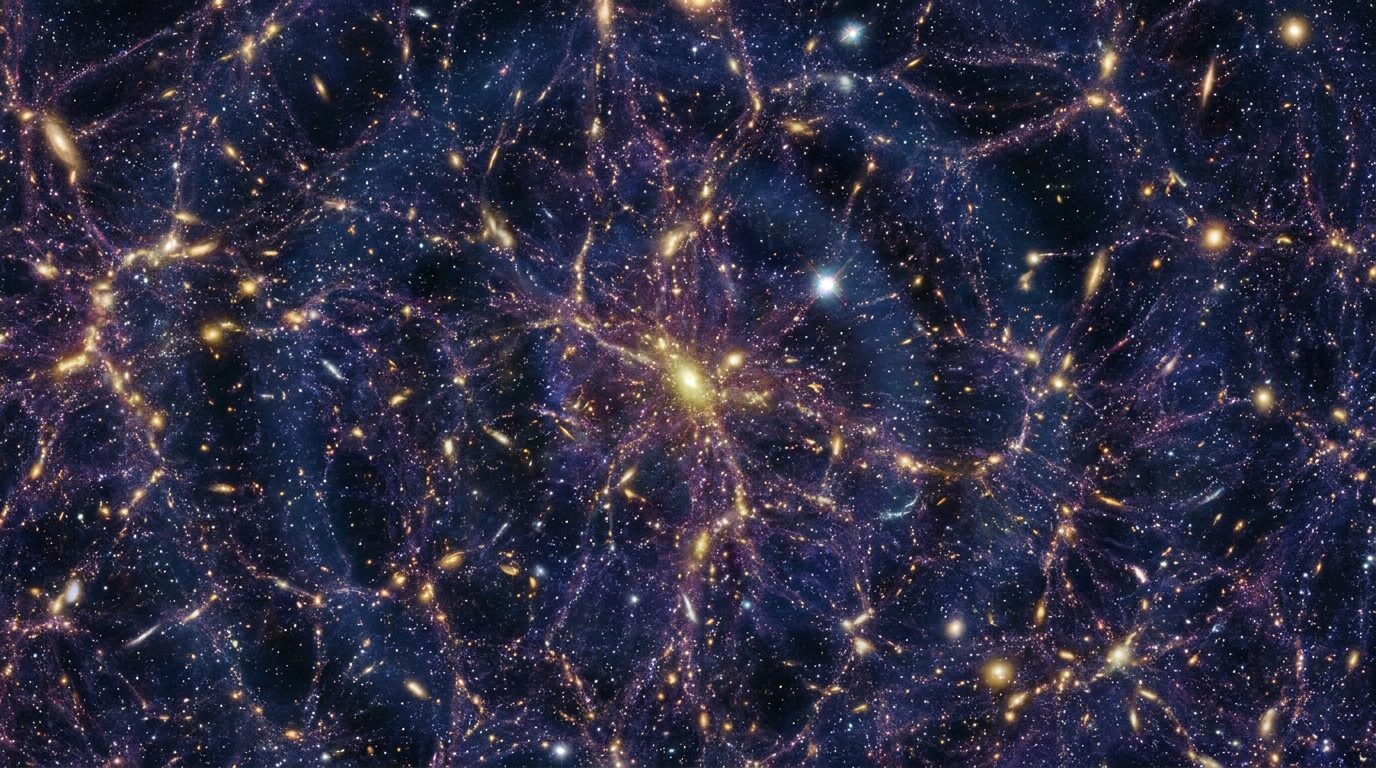
Why the Universe's Expansion Rate Refuses to Match Its Oldest Light
DESI's second data release measured the universe's expansion with unprecedented precision — and the answer doesn't quite match what the oldest light in existence tells us.
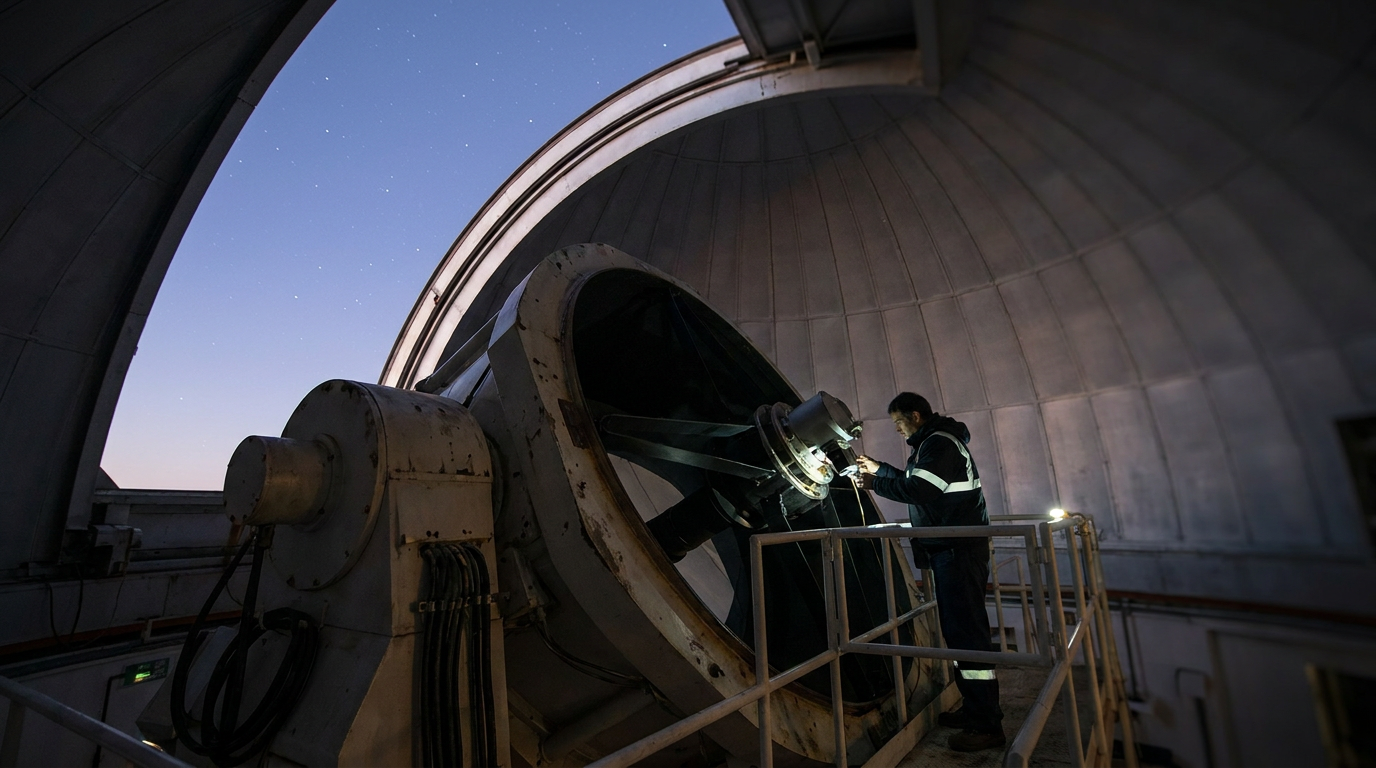
Dark Energy Just Survived Its Biggest Challenge yet. That Should Worry Us More.
A landmark rebuttal restored the standard model of cosmic acceleration — but the galaxy survey quietly doing more damage than the debunked study ever could is still running.

This Star Is Older Than the Universe — And the Math Might Be Right
HD 140283 has been clocking in at 14-plus billion years old, which is a problem, because the universe is only 13.8 billion — and resolving that contradiction is quietly rewriting how we measure cosmic time.