The Spiral Galaxy That Wasn't Supposed to Exist Yet
A 2025 study found a structurally complete spiral galaxy in the early universe, and the unsettling part isn't what it looks like — it's what it implies about everything we thought we knew about cosmic timing.
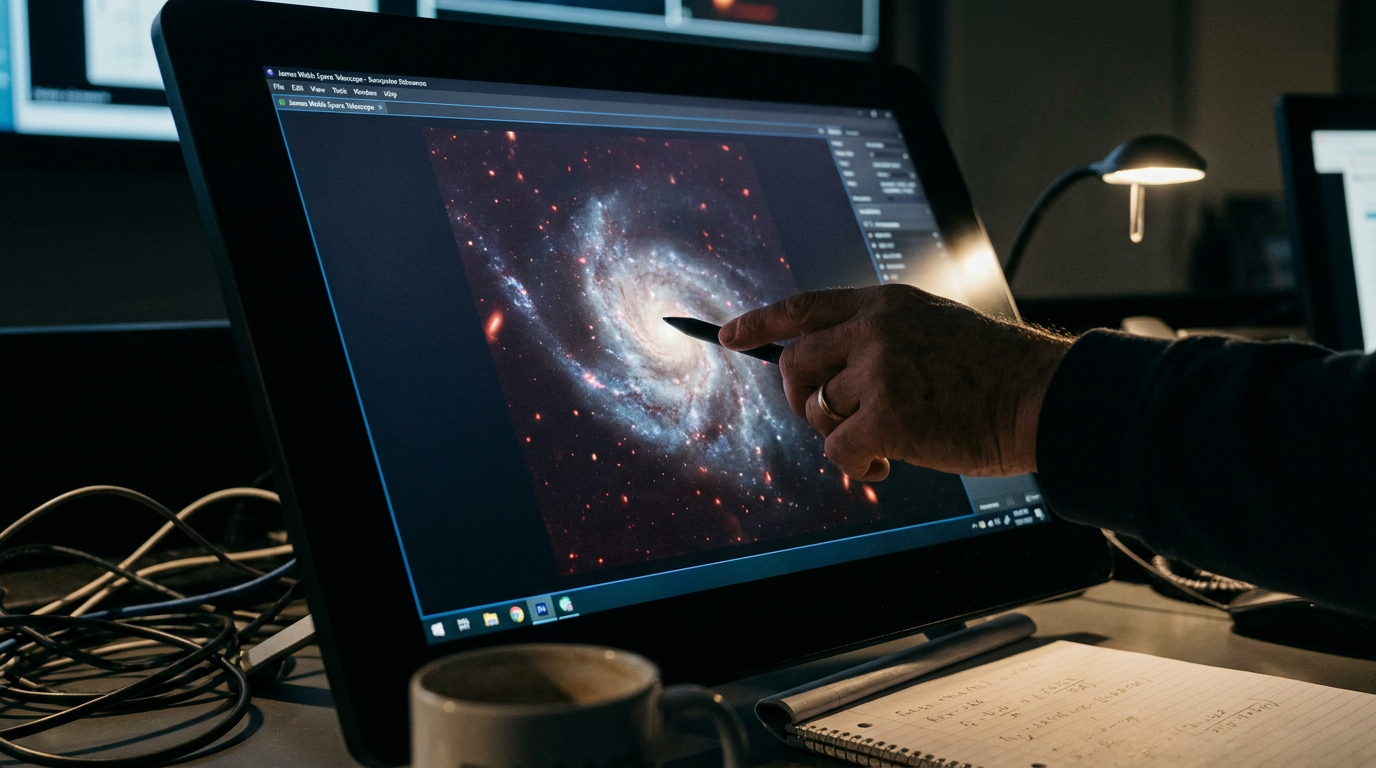
The James Webb Space Telescope was not supposed to find this. Not this cleanly, not this early. When astronomers pointed it toward a patch of deep sky and pulled back the image data, what emerged was a spiral galaxy — organized, structured, its arms already coherent — existing just 1.5 billion years after the Big Bang. That number is worth sitting with. The universe is roughly 13.8 billion years old. This galaxy was already a finished-looking object when the cosmos was barely ten percent of its current age.
The research, led by a team at the Tata Institute of Fundamental Research and published in 2025 in Astronomy & Astrophysics[1], describes the galaxy in terms that would sound unremarkable if you were talking about something in the nearby universe: a disk, a bulge, spiral structure, stellar populations that suggest organized formation history. Applied to a galaxy from the epoch astronomers call cosmic dawn, each of those words becomes quietly alarming. Structure like this was not supposed to exist at that redshift. The current standard framework for galaxy evolution — the one that has guided cosmological modeling for decades — says it takes significantly longer to assemble something that coherent.
To call this galaxy a Milky Way twin undersells the strangeness slightly. Our galaxy spent billions of years accreting gas, merging with smaller systems, settling its disk, developing the architecture we observe today. The galaxy JWST has now resolved in the early universe looks like it skipped most of that slow accumulation phase. Or perhaps it never needed to go through it. Both possibilities are interesting. Neither one fits cleanly into what we expect.
This is not the first JWST finding to put pressure on the standard model of galaxy formation, and it will not be the last. But the Tata Institute result is notable for its specificity. This is not a massive, irregular, star-forming blob that gets loosely described as a proto-galaxy. The imaging and spectroscopic data support a genuinely structured spiral morphology — the kind that, in most simulations, requires far more time and far calmer conditions to produce than the early universe could plausibly have provided.
What the Standard Model Actually Predicts
The ΛCDM model — Lambda Cold Dark Matter — is the framework that most working cosmologists use to describe how structure in the universe grew after the Big Bang. In this picture, dark matter halos formed first, gravity pulled ordinary baryonic matter into them, and galaxies assembled hierarchically: small clumps merged into larger ones over long timescales. Disk galaxies, especially spiral ones, are considered late bloomers in this framework. They require a settling period. Turbulent early conditions — violent gas accretion, frequent mergers, intense radiation from rapid star formation — tend to disrupt delicate disk structures before they can stabilize. The canonical expectation is that well-organized spiral galaxies become prevalent only after several billion years of cosmic history have passed.
This is not a fringe model. It is backed by decades of observation, simulation, and independent lines of evidence. The cosmic microwave background, the large-scale structure of the universe, the distribution of galaxy clusters — all of it sits reasonably comfortably within ΛCDM's predictions. Which is exactly why an exception does not slide quietly past. When an observation contradicts a framework this established, the response should not be to immediately throw out the framework. It should be to ask, with genuine precision, which part of the prediction chain actually failed.
“The galaxy looks like something that took billions of years to build — and it apparently did that in a fraction of the time.”
The Problem Is the Clock
At a redshift corresponding to 1.5 billion years post-Big Bang, the universe was a genuinely different place. It was hotter, denser, and the intergalactic medium was still in the process of reionization — being ionized by the first generations of ultraviolet-emitting stars and quasars. Gas dynamics were chaotic. Merger rates were high. The conditions that theorists typically invoke to allow disk formation — gradual gas cooling, reduced merger frequency, diminishing turbulence — were not yet well established. To form a coherent spiral structure under those conditions, something would have had to either work very fast or work very differently.
One avenue that theorists have been exploring is whether early dark matter halos could, under certain conditions, create more hospitable environments for disk formation than the standard picture allows. If a halo is unusually massive and unusually quiescent — neither merging aggressively nor accreting chaotically — it might shelter a developing disk from the disruptions that normally delay structural maturity. Some recent high-resolution simulations have produced early disk galaxies in exactly this way: rare but not impossible outcomes that the model technically permits even if it does not predict them as common. The question the Tata Institute finding sharpens is whether these early spirals are a manageable statistical outlier or whether they represent a systematic gap in the model's assumptions.
There is also the question of what we mean by structured. JWST's infrared sensitivity has been transformative in this domain, because it allows us to peer through the dust that obscures these galaxies at other wavelengths and see morphological detail that Hubble simply could not resolve. But resolution has its own interpretation problem. When you detect what appears to be a spiral arm at extreme redshift, you are working from a combination of direct imaging and inferred structure. The signal-to-noise on individual morphological features is real but not unlimited. The Tata Institute team's analysis is careful about this — they present the structural classification with appropriate uncertainty — but it is worth noting that the confidence interval on the morphology matters for how seriously the finding strains the model.
What JWST Changed About What We Can See
Part of the story here is instrumental. JWST was engineered specifically to observe the early universe in the infrared[3] — to catch light that has been redshifted out of the optical range by the expansion of space over billions of years. Its mirror is large enough, and its detectors sensitive enough, to resolve structure in galaxies that previous observatories could only detect as faint smudges. The telescope has been returning science data for a few years now, and its accumulated findings in the area of early galaxy morphology have been consistently surprising — not in a single dramatic announcement, but in a steady drip of results that each, individually, produce a slight but measurable tension with the timeline ΛCDM predicts.
The galaxy described in the 2025 paper is among the cleanest examples yet. Previous JWST observations flagged other candidates for early disk or spiral structure, but the specificity of this result — the detail of the structural analysis, the spectroscopic confirmation of redshift — gives it particular weight. It is harder to explain away as an artifact or a morphological ambiguity when the data is this resolved. That does not mean the interpretation is final. It means the challenge to the standard timeline is sharply posed enough to require a substantive response from theorists rather than a methodological quibble.
“JWST did not just give us better images — it gave us evidence that the early universe was doing things we hadn't given it enough credit for.”
The Honest Range of Explanations
The range of serious explanations for this finding runs from incremental to genuinely revisionary. At the conservative end: the galaxy is a statistical outlier, a rare instance of unusually favorable conditions for early disk formation that ΛCDM technically accommodates. The universe is vast. JWST, for all its precision, is still sampling a tiny volume of early cosmic history. Rare events happen. If this is one of them, the standard model survives largely intact, with perhaps some tuning of the parameters governing how efficiently disks can form in massive halos.
A step further out: the finding is not alone. Taken together with other JWST results showing unexpectedly massive and structured galaxies in the early universe, there may be a systematic pattern rather than an anecdotal one. If early spirals are less rare than the standard model predicts, that suggests something about the model's assumptions about early gas dynamics, dark matter behavior, or star formation efficiency is wrong — not catastrophically, but meaningfully enough to require revision. Theorists working on warm dark matter models, or modified assumptions about baryonic feedback during early galaxy formation, have been arguing for some of these revisions for years. JWST is now giving them observational ammunition.
At the most revisionary end, though still within the bounds of serious scientific discussion: some researchers are asking whether the timeline implied by ΛCDM for structure formation needs deeper reconsideration. This is not the same as saying the Big Bang didn't happen or that the universe is a different age. It is asking whether the sequence of events — when structure forms, how quickly it matures, what conditions enable or suppress morphological complexity — has been correctly modeled. ΛCDM has been revised before. It will be revised again. The question is whether the needed revision is a trim or something more structural.
Why This Particular Mystery Is Worth Tracking
“Every galaxy has a formation story; the one this galaxy seems to be telling doesn't match the chapter it's supposed to be in.”
It is tempting to frame early galaxy discoveries as a crisis for cosmology, because that framing is exciting and because individual results can be made to look dramatic in isolation. The more accurate framing is that JWST is doing exactly what it was built to do: testing model predictions against real observation in a regime that was previously inaccessible. Some of those tests are coming back with unexpected results. That is not a failure of the model — it is science working as it should, accumulating evidence until the data forces precision. The Tata Institute finding does not overturn the Big Bang. It does not require exotic physics to explain, at least not yet. What it does is sharpen the question of whether our model of how galaxies mature has been calibrated on too limited a sample of cosmic history.
Our Milky Way took the long route — billions of years of merger, accretion, and settling before it became the organized spiral we inhabit. The galaxy in this JWST image apparently had no patience for that. It sits there at cosmic dawn, fully structured, spinning its arms in the early dark of a young universe, and it does not especially care what our models say it should look like. The job now is to figure out what it knows that we don't.
References
- A grand-design spiral galaxy 1.5 billion years after the Big Bang with JWST (aanda.org)
Reports the 2025 discovery of a structurally complete spiral galaxy at 1.5 billion years post-Big Bang, the article's central finding. - Accelerated Structure Formation: The Early Emergence of Massive Galaxies and Clusters of Galaxies (iopscience.iop.org)
Describes the hierarchical galaxy assembly model that predicts disk galaxies form only after billions of years, establishing the standard expectation the discovery challenges. - Telescope Overview - NASA Science (science.nasa.gov)
Explains JWST's infrared design and large mirror capability that enabled detection of distant galaxy structure invisible to previous telescopes.
About Rowan Ellery
Rowan Ellery writes about anomalies, unexplained sightings, strange signals, and the uneasy border between observation, misinterpretation, and genuine mystery. Their work focuses on keeping curiosity alive without letting evidence dissolve into folklore.
More like this
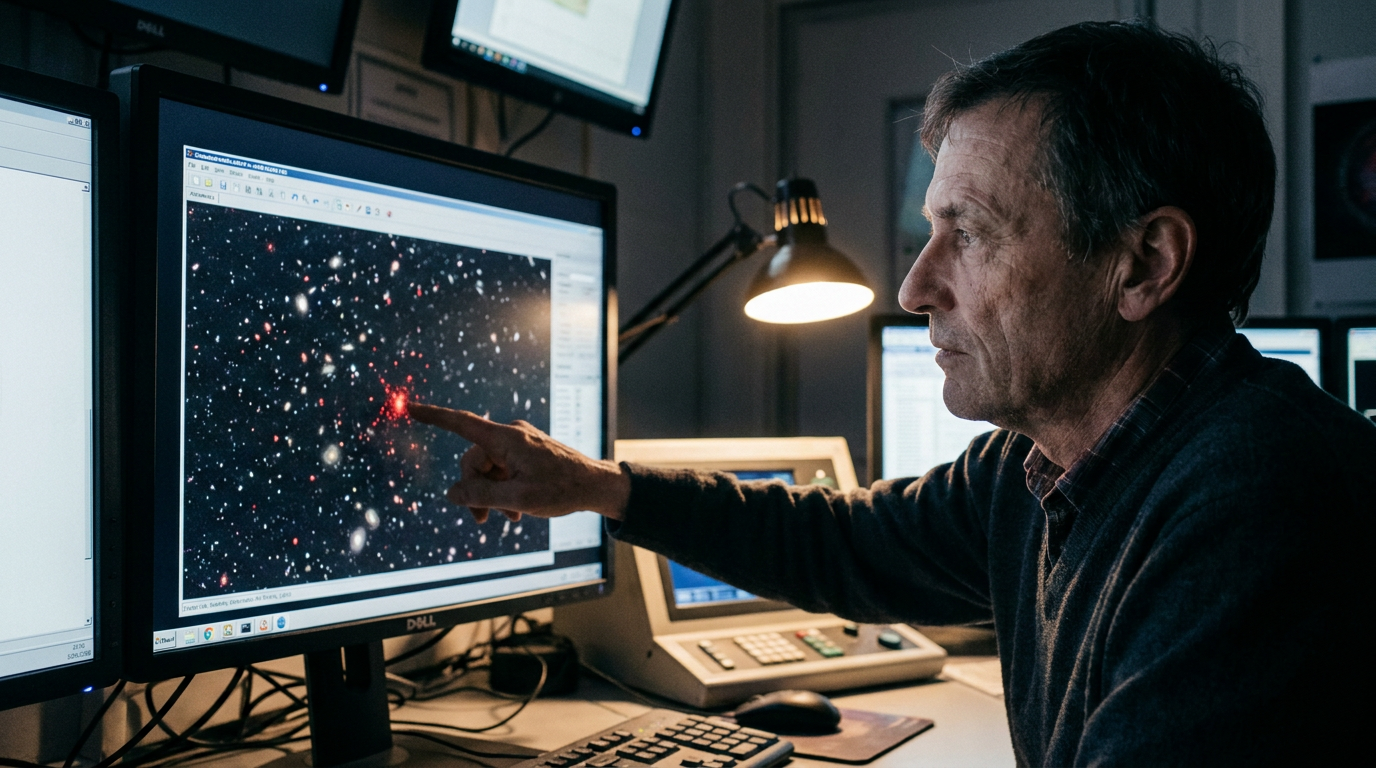
JWST Found Objects so Red and so Strange That Astronomers Invented a New Category for Them
JWST's deep-field images are filling up with tiny, furiously red objects that fit no existing category — and the strangest one may be something the universe was never supposed to make.
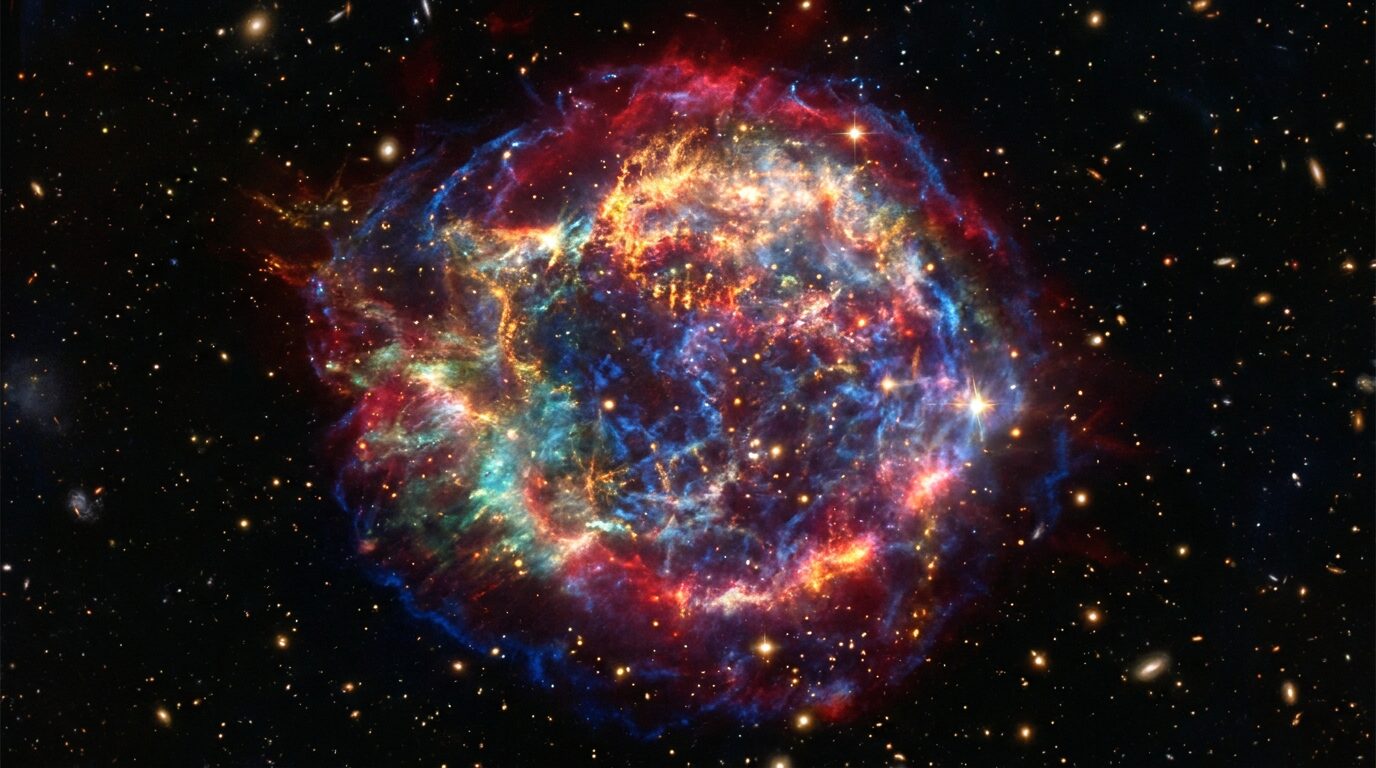
The Universe's Oldest Supernova Just Rewrote What Stars Could Do at Cosmic Dawn
JWST confirmed a supernova from when the universe was just 730 million years old — and its unsettling resemblance to modern explosions is forcing astronomers to rethink what the earliest stars were even supposed to be.

This Star Is Older Than the Universe — And the Math Might Be Right
HD 140283 has been clocking in at 14-plus billion years old, which is a problem, because the universe is only 13.8 billion — and resolving that contradiction is quietly rewriting how we measure cosmic time.