Dark Energy Just Survived Its Biggest Challenge yet. That Should Worry Us More.
A landmark rebuttal restored the standard model of cosmic acceleration — but the galaxy survey quietly doing more damage than the debunked study ever could is still running.
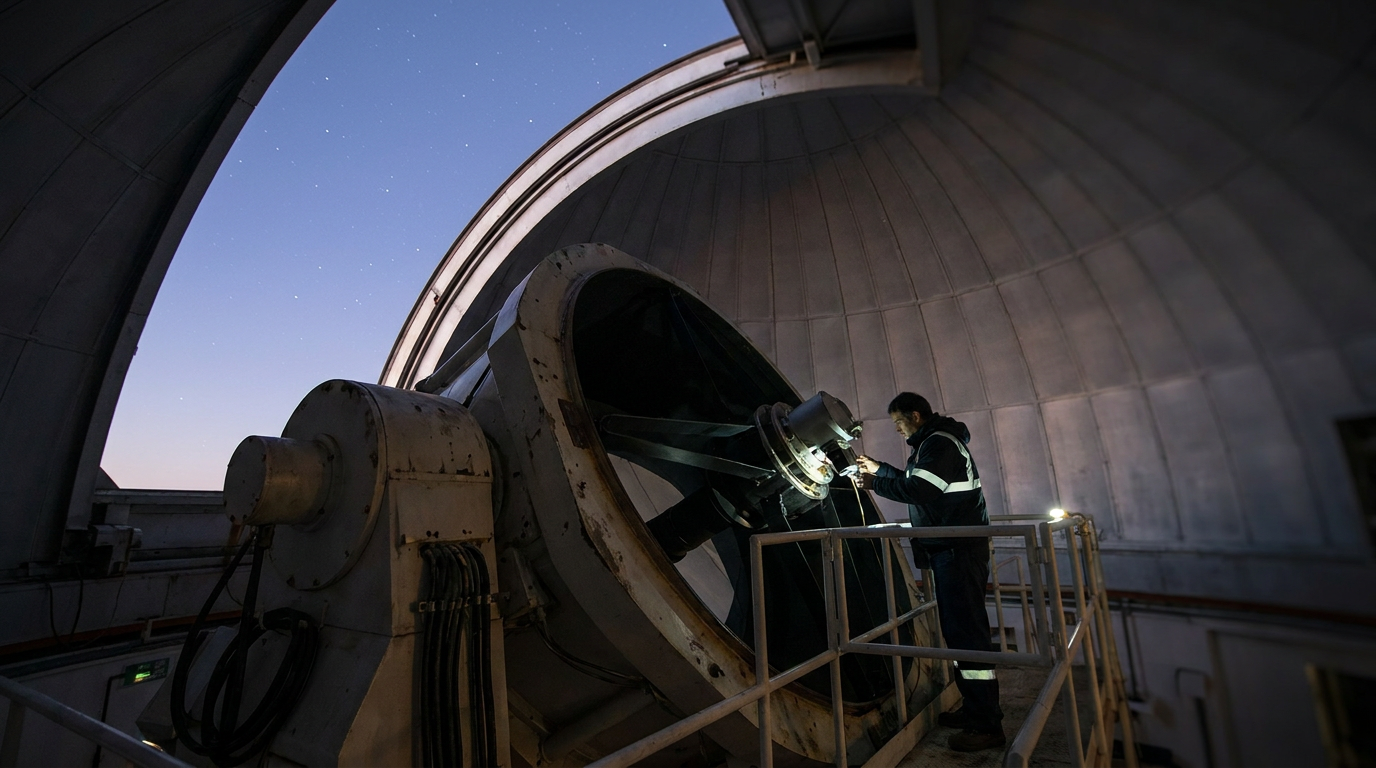
For roughly a decade, the cosmological constant has functioned as cosmology's most successful embarrassment. It fits the data. It predicts the expansion rate of the universe with uncomfortable precision. It sits inside the standard model — ΛCDM, shorthand for a cosmos filled with cold dark matter and governed by a fixed, unchanging energy density in empty space — and it refuses to break. The only genuine problem with the cosmological constant is that no one can explain why it has the value it does, and the best theoretical attempts to calculate it from first principles are off by somewhere between fifty and one hundred and twenty orders of magnitude, depending on how you count. That gap is not a rounding error. It is the largest known discrepancy between theory and observation in the history of physics.
So when a 2025 paper appeared claiming that cosmic acceleration itself might be slowing — that the universe is not expanding at a steady clip but rather decelerating relative to what the standard model predicts — the field took it seriously. The paper was careful. It used real supernova data. It moved through peer review. And for a stretch of months, it kept company with a genuine open question: was the cosmological constant finally cracking? Then, in June 2026, a rebuttal appeared in Monthly Notices of the Royal Astronomical Society[4], co-authored by Adam Riess and Brian Schmidt — two of the three scientists who shared the 2011 Nobel Prize in Physics for discovering cosmic acceleration in the first place — and the answer came back as a firm, documented no. The original analysis had carried a subtle but consequential systematic error in how it handled supernova light-curve standardization. When the correction was applied, the acceleration held. Dark energy survived.
The story the press ran with was a rescue narrative: Nobel laureates defend their discovery, the cosmological constant stands, science works as designed. That story is accurate. It is also incomplete in a way that matters. Because while Riess and Schmidt were demonstrating that one particular challenge to dark energy was methodologically flawed, a separate instrument — one with an entirely different detection strategy, built on an entirely different dataset — was assembling the most detailed three-dimensional map of the large-scale structure of the universe ever constructed, and finding something that the cosmological constant does not cleanly explain. The Dark Energy Spectroscopic Instrument, mounted on the Nicholas U. Mayall Telescope at Kitt Peak National Observatory in Arizona, has now catalogued the redshifts of more than fifteen million galaxies[3]. What it found does not break the standard model. It just makes the cosmological constant look like it might be too simple.
This is the distinction worth sitting with. Dark energy was challenged by a flawed study and survived. Dark energy is also being challenged by a careful, ongoing, high-precision survey and has not, quite, survived that one yet. Those are different claims made with different instruments against different data, and conflating them — celebrating the defeat of the first as though it answers the second — would be a significant mistake. The universe spent thirteen-point-eight billion years arranging itself into a structure we are only now becoming precise enough to read. What DESI is reading is still being interpreted. But the signal is there.
What the Cosmological Constant Actually Claims
Lambda — the Greek letter Einstein originally inserted into his field equations in 1917 to hold the universe static, then famously abandoned, then watched get resurrected by supernova observations in 1998 — represents, in the current framework, the energy density of the vacuum itself. Empty space, on this account, is not empty. It carries a fixed energy, uniform in all directions, constant across all of cosmic time, and that energy exerts a pressure that drives space apart faster than gravity can pull it together. This is dark energy in its simplest possible form: a single number, unchanging, woven into the geometry of spacetime. It has no preferred direction. It does not cluster. It does not evolve. Whatever it is, it is the same in every cubic centimeter of the universe at every moment in history.
That simplicity is both its power and its problem. A single-parameter explanation that fits decades of supernova photometry, baryon acoustic oscillation measurements, and the angular power spectrum of the cosmic microwave background is the kind of model physicists dream about. But when you ask what, physically, produces that vacuum energy, the answers range from unconvincing to absurd. Quantum field theory predicts that the vacuum should be seething with zero-point fluctuations — virtual particles constantly appearing and vanishing — and the energy those fluctuations contribute should be enormous. The discrepancy between the predicted vacuum energy and the observed cosmological constant is so large that it constitutes, by some measures, the worst prediction in theoretical physics. The constant fits the observations. The observations make no theoretical sense.
“The cosmological constant fits the data with uncomfortable precision. It just cannot be explained by any physics we currently understand.”
This is why the field has long maintained a quiet hope that dark energy might turn out to be something richer — a dynamic field, perhaps, that evolves over time, changing its equation of state as the universe ages. In the standard model, dark energy's equation-of-state parameter, denoted w, equals negative one exactly. That is the cosmological constant's signature: pressure equal to negative energy density, constant everywhere, constant always. If w is not exactly negative one, or if it changes with redshift, then dark energy is not a cosmological constant. It is something else. Something that has a history. Something we might, eventually, understand.
How DESI Measures Time in Galaxy Clusters
The Dark Energy Spectroscopic Instrument does not photograph galaxies the way an imaging telescope does. It measures their spectra — the fingerprints of light that reveal, through redshift, how fast each galaxy is receding from us, and therefore how far away it sits in both space and time. DESI accomplishes this with five thousand robotic fiber-positioner units[2], each capable of repositioning in roughly ten seconds, working together to take simultaneous spectra of five thousand objects at once. Over the course of a night at Kitt Peak, this becomes tens of thousands of redshifts. Over the course of a multi-year survey, it becomes the largest spectroscopic dataset in the history of observational cosmology.
The primary tool DESI uses to probe dark energy is the baryon acoustic oscillation, or BAO — a characteristic clustering scale imprinted in the distribution of matter when the early universe transitioned from a plasma of charged particles to a transparent gas of neutral atoms, roughly three hundred and eighty thousand years after the Big Bang. At that moment, a pressure wave that had been propagating outward through the hot plasma froze in place, leaving a slight overdensity of matter at a fixed physical scale. That scale — roughly five hundred million light-years in today's expanded universe — acts as a standard ruler. By measuring how that ruler's apparent size changes across different epochs of cosmic history, astronomers can trace how the expansion rate of the universe has changed over time. BAO measurements are, in this sense, a direct probe of the geometry of the universe across billions of years.
DESI's fifteen-million-galaxy map allows BAO measurements at a range of redshifts — meaning a range of cosmic epochs — with a precision that earlier surveys could not approach. And when those measurements are combined and analyzed, they suggest that dark energy's equation-of-state parameter may not be fixed at negative one. The data are consistent with a scenario in which w has been changing — possibly weakening over time, or shifting in a way that does not match what a static vacuum energy would produce. The statistical significance of this signal, drawn from DESI's first major data release[1], hovered around the two-to-three sigma level — not a discovery in the formal sense, but not noise either. It is a persistent lean in the data that independent analyses have not dissolved.
Why the Rebuttal and the Survey Are Not the Same Story
“Defeating a flawed supernova analysis does not answer what fifteen million galaxy redshifts are quietly suggesting about the future of the standard model.”
The Riess-Schmidt rebuttal addressed a supernova-based claim about whether cosmic acceleration is decelerating — whether the universe is expanding more slowly than expected. That is a question about the magnitude and stability of dark energy's effect over recent cosmic time, examined through Type Ia supernovae used as standardizable candles. The methodology in question involved how the brightness of those supernovae is corrected for the properties of the galaxies hosting them, and the rebuttal showed that the correction applied in the original paper systematically skewed the results. Correct for it properly, and the deceleration signal vanishes. The expansion proceeds as the standard model describes.
DESI's challenge is structurally different. It does not rely on supernova standardization. It uses a geometric measurement — the BAO scale — derived from the spatial distribution of millions of galaxies across a wide range of cosmic epochs. The two methods have different systematic error profiles, different calibration dependencies, and different theoretical sensitivities. When they agree, as they mostly do at the level of confirming accelerated expansion, that agreement is meaningful. When DESI's measurements hint at something the supernova data do not cleanly resolve, the discrepancy cannot be attributed to the same calibration problems that sank the earlier paper. It is a different kind of signal from a different kind of instrument, and it deserves to be read separately.
This matters for how the public and the scientific community frame the current state of dark energy research. Cosmology has had enough high-profile claims that did not survive systematic scrutiny — the BICEP2 gravitational wave signal, later revealed to be dust; various earlier hints of w deviations that faded with better data — that a reflexive skepticism toward any departure from ΛCDM is understandable. But DESI's data are not a single anomalous observation. They are a cumulative measurement drawn from the largest spectroscopic survey ever conducted, designed from the start to probe precisely this question, and they have not gone away as the dataset has grown. That does not make them correct. It does make them serious.
What a Changing Dark Energy Would Mean
If DESI's signal strengthens — if future data releases push the w-evolution hint above five sigma and it survives independent confirmation from the Euclid space telescope, which began releasing cosmological data in 2024, or from the Vera C. Rubin Observatory's Legacy Survey of Space and Time once its full dataset matures — the consequences for theoretical physics would be profound in a specific, uncomfortable way. Not because dark energy would be disproven. But because a cosmological constant is the simplest possible form of dark energy, and the moment you allow w to vary with time, you need a physical mechanism that produces that variation. You need a field. You need dynamics. You need new physics.
The leading class of alternatives to the cosmological constant involves scalar fields — often called quintessence — that pervade space and have an energy density that changes as the universe expands. Unlike the cosmological constant, quintessence would have had different values at different epochs of cosmic history. It might explain why the vacuum energy we observe today is so mysteriously small: not because the cosmological constant has that exact value for some fundamental reason, but because a dynamic field naturally diluted to that value over billions of years. This is not a solved theory. Quintessence models carry their own fine-tuning problems, their own observational predictions that need to be tested, and their own theoretical instabilities. But a dynamic dark energy would at least give physicists something to sink their teeth into — a field with behavior, a history, and potentially a future that differs from what the cosmological constant predicts.
A cosmological constant implies a specific fate for the universe: indefinite expansion, gradual cooling, the slow dispersal of all matter into an increasingly cold and empty void — what cosmologists call the heat death scenario. A dynamic dark energy field could evolve differently. If its equation of state crosses below negative one — a theoretical scenario sometimes called phantom dark energy — the expansion rate could accelerate without bound, eventually tearing apart galaxies, then solar systems, then planets, then atoms themselves, in a scenario known as the Big Rip. If dark energy weakens over time, expansion might slow, and the ultimate fate of the universe becomes less certain. These are not near-term concerns. They play out on timescales of tens of billions of years. But they depend entirely on what dark energy actually is, and that question is not yet settled.
The Tension That Stays on the Table
“The standard model of cosmology has never been more precisely confirmed and never been more quietly under pressure at the same time.”
DESI is not the only pressure the standard model is absorbing. The Hubble tension — a persistent, statistically significant disagreement between the expansion rate of the universe measured locally using Cepheid variable stars and supernovae, and the expansion rate inferred from the early universe through the cosmic microwave background — has refused to resolve for years. Various instrumental and methodological explanations have been proposed and tested; none has cleanly eliminated the discrepancy. Some theorists have suggested that a dark energy that was not constant in the early universe — an early dark energy, active during the epoch of recombination — might help relieve the Hubble tension. DESI's data, depending on how they are interpreted, may offer weak support for this class of models, though the connection is not yet direct or confirmed.
What this accumulation of tensions suggests is not that cosmology is broken, but that ΛCDM — which has served as the remarkably successful standard framework for understanding the structure and evolution of the universe for more than two decades — may be approaching the edge of its range of validity. Successful models in science do not typically fail all at once. They accumulate small discrepancies at the margins, persist through several rounds of would-be refutation, and eventually give way not to a single fatal blow but to a gradually more compelling alternative. The cosmological constant has survived the debunked supernova reanalysis. It has survived dozens of earlier challenges. It may yet survive DESI. But the map of fifteen million galaxies is still being read, Euclid is still accumulating data, Rubin is coming online, and the tensions are not shrinking. The standard model of cosmology has never been more precisely confirmed and never been more quietly under pressure at the same time, and learning to hold both of those things true simultaneously is, at this moment, the honest position.
What persists after the Riess-Schmidt rebuttal is not reassurance. It is a more precisely drawn question. Dark energy did not survive 2026 unscathed — it survived one particular challenge while a more patient, more carefully constructed challenge continued accumulating data points in the background. The cosmological constant may still be right. It may be right for the worst possible reason: that we have not yet built the instruments capable of seeing exactly how it is wrong. DESI's full dataset is still incoming. The next data release will carry more galaxies, narrower error bars, and a clearer answer about whether that w-evolution signal was a statistical fluctuation or the first clean edge of something new. Until then, the most accurate thing to say about the fate of the cosmological constant is that the trial is ongoing, the key witnesses have not yet finished testifying, and the verdict, when it arrives, will not be simple.
References
- DESI DR2 Results II: Measurements of Baryon Acoustic Oscillations and Cosmological Constraints (arxiv.org)
Provides DESI's first major data release showing BAO measurements suggesting dark energy's equation-of-state parameter may not be fixed at negative one. - DESI DR2 Results: March 19 Guide (desi.lbl.gov)
Describes DESI's technical capability of five thousand robotic fiber-positioner units that enable simultaneous spectral measurements. - New DESI Results Strengthen Hints That Dark Energy May Evolve (newscenter.lbl.gov)
Reports DESI has catalogued redshifts of more than fifteen million galaxies in its large-scale universe map. - Still accelerating: type Ia supernova cosmology is robust to host galaxy age evolution (doi.org)
Provides the June 2026 rebuttal by Riess and Schmidt demonstrating the flawed supernova analysis contained a systematic error in light-curve standardization.
About Brenna Vance
Brenna Vance writes about the cosmos — stars that predate the universe's own chemistry, spacecraft flying close enough to the sun to catch it misbehaving, the physics of what the universe is still getting wrong. Her work focuses on the moments when an observation breaks a model, and what that break actually means.
More like this
Dark Energy Is Not a Constant. Three Years of Data Say So.
The DESI survey's third year of data has made the case for a changing dark energy disturbingly strong — which means the force expanding the universe may not be what physicists have spent thirty years assuming.
Why the Universe's Expansion Rate Refuses to Match Its Oldest Light
DESI's second data release measured the universe's expansion with unprecedented precision — and the answer doesn't quite match what the oldest light in existence tells us.

This Star Is Older Than the Universe — And the Math Might Be Right
HD 140283 has been clocking in at 14-plus billion years old, which is a problem, because the universe is only 13.8 billion — and resolving that contradiction is quietly rewriting how we measure cosmic time.