Ghosts of the First Stars: What Ancient, Metal-Poor Suns Are Telling Us About the Universe's Earliest Chemistry
A small population of stars in the Milky Way's outer halo carries chemical signatures from before the universe knew how to make iron — and what spectrometers are finding in them is forcing a rethink of how fast the early cosmos grew complex.
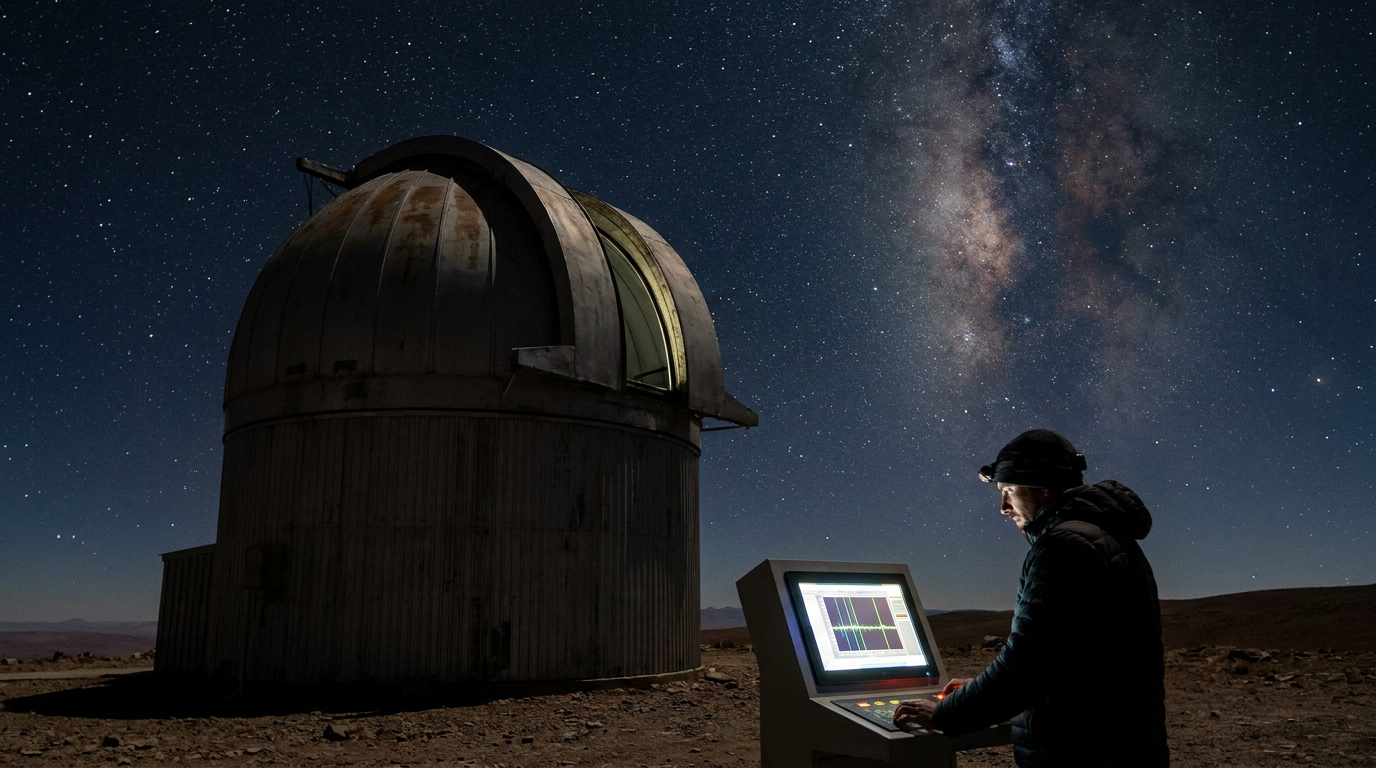
There is a star roughly 36,000 light-years from Earth, orbiting in the sparse outer halo of the Milky Way, that contains almost no iron. Not a trace amount — almost none. The iron abundance in its atmosphere is measured at roughly one hundred-thousandth of what our own sun carries. In the parlance of stellar spectroscopy, that puts it at a metallicity of about negative five on the logarithmic scale astronomers use, written as [Fe/H] ≈ −5. That notation is compact enough to look like a typo, but what it describes is a sun that formed when the universe had barely figured out how to make anything heavier than hydrogen, helium, and a dusting of lithium.
Stars like this belong to a category called ultra-metal-poor stars, and there are only a handful of confirmed examples — fewer than a dozen with metallicities below [Fe/H] = −4.5, depending on the survey and the measurement technique. They are old. Almost certainly among the oldest stars still burning in the observable universe, with ages estimated between 13 and 13.5 billion years, which places their formation within the first few hundred million years after the Big Bang. They did not form from the wreckage of earlier stars the way our sun did. They formed from the raw, nearly unprocessed material of the early universe itself, shaped by whatever came before them — by Population III stars, the purely theoretical first generation of stars that no telescope has yet directly observed.
What makes these ancient survivors scientifically electric is not their age alone. It is their chemistry. When high-resolution spectrometers are trained on their light, the absorption lines encoded in that light function as a kind of chemical autobiography. Each element leaves a distinct fingerprint at precise wavelengths. Reading those fingerprints tells astronomers not just what this star contains, but what the interstellar gas cloud it formed from contained — which means these stars are, in effect, atmospheric samples of the universe from an era no direct observation can reach. And what those samples are showing is not a clean, orderly picture of early chemical evolution. It is something considerably stranger.
The standard picture of cosmic chemical evolution — called stellar nucleosynthesis — holds that the universe began almost purely hydrogen and helium, that the first massive stars burned fast and exploded as supernovae, seeding the gas around them with heavier elements, and that each subsequent generation of stars formed from progressively more enriched material. It is an elegant progression, and it is broadly correct. But the chemical patterns inside the most metal-poor stars are revealing enrichment pathways, elemental ratios, and abundance anomalies that the standard framework either did not predict or cannot easily explain. The universe's first chemistry was messier, faster in some ways and stranger in others, than the models suggested.
Reading a Star Like a Document
The instrument that makes this possible is the spectrograph, and the technique is absorption spectroscopy. When starlight passes through a star's outer atmosphere on its way to a telescope, atoms in that atmosphere absorb specific wavelengths of light corresponding to their electron transition energies. A spectrograph splits the incoming light into its component wavelengths and maps the resulting dark absorption lines. Because every element has a unique spectral signature — a fingerprint that does not change regardless of where in the universe the atom is — astronomers can read the chemical composition of a stellar atmosphere from thousands of light-years away with remarkable precision. Facilities like the Magellan Telescopes in Chile, the Very Large Telescope at Paranal, the Subaru Telescope on Maunakea, and the Keck Observatory have all contributed high-resolution spectra of the most metal-poor stars known. The resolution required to distinguish and measure weak, low-abundance absorption lines is demanding enough that observations typically require long integration times on large-aperture mirrors under excellent seeing conditions.
Finding these stars in the first place requires surveying enormous volumes of sky. Programs like the Hamburg/ESO Survey, the HK survey, and more recently the SkyMapper Southern Sky Survey[4] and the Pristine Survey[3] have scanned hundreds of thousands of stars looking for candidates with weak or absent calcium absorption lines — calcium being an element that scales roughly with iron abundance. Once a low-metallicity candidate is flagged, follow-up high-resolution spectroscopy confirms and precisely characterizes its chemistry. It is slow, expensive work. The rarity of genuine ultra-metal-poor stars means that for every few hundred promising candidates, only a handful survive to detailed characterization. The ones that do have earned considerable attention.
“These stars are atmospheric samples of the universe from an era no direct observation can reach.”
Carbon, Oxygen, and the Problem of the Missing Iron
If ultra-metal-poor stars simply had low abundances of everything, the picture would be cleaner. What actually shows up in the spectra is more complicated. A significant fraction of the most metal-poor stars are also dramatically enhanced in carbon — sometimes by factors of hundreds or thousands relative to iron. These are called carbon-enhanced metal-poor stars, or CEMP stars, and they split into subcategories based on whether they also show elevated levels of elements associated with the slow neutron capture process (the s-process) or the rapid neutron capture process (the r-process), or neither. The CEMP-no subclass — enhanced in carbon but without the neutron-capture enhancement — is thought to be the oldest, most primitive subgroup, potentially preserving the chemical output of individual Population III supernova events.
Why would the first supernovae produce so much carbon relative to iron? One proposed mechanism involves what are called faint supernovae — massive stars that exploded with insufficient energy to fully expel their iron-rich inner cores. In this scenario, the explosion occurs, but much of the heavier material falls back onto the remnant rather than dispersing into the surrounding medium. What escapes and eventually seeds the next generation of forming stars is disproportionately the lighter products of nucleosynthesis: carbon, nitrogen, oxygen. The iron stays behind. This fallback scenario can explain some of what is observed, but it requires fine-tuning of explosion energies and progenitor masses that is difficult to constrain, because the Population III stars that produced this enrichment are, by definition, no longer observable.
Other CEMP-no stars may record the output of rapidly rotating massive stars — sometimes called spinstars — in which rotationally driven mixing carried processed material from the stellar interior to the surface and into the surrounding envelope before the star exploded. Rotation can also drive the production of primary nitrogen through a pathway that does not require pre-existing metals, which leaves a distinct isotopic and abundance pattern in the gas that later forms low-mass stars. Whether a given ultra-metal-poor star's chemistry traces back to faint supernovae, spinstars, or some combination is often genuinely ambiguous. The models make different predictions, but the observational data are precise enough to distinguish between them only in the best cases. This is where the science is actively contested, not because the observations are unreliable, but because the theoretical landscape has grown complex enough that multiple scenarios can reproduce similar abundance patterns through different physical routes.
What the R-Process Stars Are Complicating
Carbon is not the only unexpected abundance pattern showing up in ancient stars. In 2018, observations of the metal-poor dwarf galaxy Reticulum II[2] revealed that a disproportionate fraction of its stars were heavily enhanced in r-process elements — elements like europium, barium, and gold that are forged when neutron-rich environments allow atomic nuclei to capture neutrons faster than they can decay. The r-process has long been associated with extreme astrophysical events, and the detection of gravitational waves and an associated kilonova — the optical counterpart of a neutron star merger — by LIGO and the electromagnetic follow-up community in 2017 provided strong observational evidence that neutron star mergers are at least one major r-process site[1]. But Reticulum II's abundance pattern posed a timing problem: for its ancient, metal-poor stars to carry such strong r-process enrichment, the event that produced it had to have occurred very early, and the enrichment had to have been confined to a small enough gas reservoir that it concentrated rather than dispersed. A single neutron star merger in a small, gravitationally bound protogalactic system could theoretically accomplish that. But neutron star systems require time after their formation to merge — typically estimated at hundreds of millions to billions of years — and fitting that delay into the earliest cosmic epochs requires either unusually rapid inspiral timescales or other r-process contributors.
“The universe's first chemistry was messier, faster in some ways and stranger in others, than the models suggested.”
Collapsars — the collapse of rapidly rotating massive stars directly into black holes, accompanied by energetic jets — have been proposed as an r-process site that could operate on shorter timescales, potentially explaining early r-process enrichment without requiring neutron star mergers. The debate between these two channels, and the possibility that both contribute at different epochs or environments, is one of the most active problems in nuclear astrophysics. The ancient, metal-poor stars of the Milky Way halo and its satellite galaxies serve as the observational archive for this debate — each spectrum an imperfect but irreplaceable record of a single enrichment event from the universe's earliest chapters.
The Stars We Cannot Find, and What Their Absence Means
One of the more quietly unsettling aspects of this field is the apparent scarcity of stars below a certain metallicity floor. Theoretical models of early star formation predict that the very first generation of stars — Population III — would have been massive, hot, short-lived, and formed from gas that was almost purely primordial hydrogen and helium. They should have exploded as supernovae and enriched the surrounding medium. The next generation, Population II, would have formed from that slightly enriched gas, and somewhere in that population we should expect to find survivors with metallicities as low as [Fe/H] = −6, −7, or even lower. But despite extensive surveys, the distribution of observed metallicities cuts off sharply around [Fe/H] = −5. No confirmed star has yet been found at lower abundance, though a few candidates are under investigation. Either these stars are genuinely rare because the first enrichment events raised the floor more quickly than expected, or they formed and preferentially evolved off the main sequence before we could find them, or they are present but have been systematically missed because their spectra are so unusual that survey filters do not flag them as candidates.
The metallicity floor — if it is real — would carry significant implications. It might suggest that a single supernova, or a small number of Population III explosions, was enough to rapidly and efficiently enrich at least the local cosmic environment above a minimum threshold. It might also reflect a physical threshold below which the gas could not cool efficiently enough to fragment into low-mass, long-lived stars; stars below a certain metallicity are thought to have difficulty radiating away heat through the same channels that more metal-rich gas uses, which should bias early star formation toward high masses, producing stars that burned out billions of years ago. The low-mass survivors we observe today, the stars with [Fe/H] around −5 and below, may represent a narrow window in time and enrichment where the gas was just barely complex enough to form them.
What the Next Instruments Will Unlock
The current picture is assembled from hundreds of individual stellar spectra, each requiring hours on large telescopes, accumulated over several decades of dedicated survey work. The next generation of instruments is expected to expand this sample dramatically. The 4MOST survey on ESO's VISTA telescope will conduct wide-field multi-object spectroscopy capable of observing thousands of stars simultaneously, targeting low-metallicity candidates across the Milky Way halo and its satellite system. The Maunakea Spectroscopic Explorer, still in development, is designed specifically for survey-scale, high-resolution spectroscopy of faint objects. The Giant Magellan Telescope and the Extremely Large Telescope, both under construction in Chile, will offer apertures large enough to obtain high-resolution spectra of metal-poor stars in more distant halo environments and in external dwarf galaxies that currently require prohibitively long integration times.
The James Webb Space Telescope is contributing from a different angle. While JWST does not do stellar spectroscopy of nearby halo stars in the same mode, it is characterizing the stellar populations of the earliest detectable galaxies at extreme redshift and placing constraints on the star formation rates, mass functions, and enrichment timescales of the first cosmic structures. Comparing what JWST finds in early galaxies with what high-resolution spectrographs find in the local relics of those early galaxies — the ancient, metal-poor stars in the halo — creates a form of cross-check between direct observation at high redshift and chemical archaeology in the local universe. Neither approach alone gives a complete picture. Together, they are triangulating on conditions that no single instrument could reconstruct.
“Each spectrum is an imperfect but irreplaceable record of a single enrichment event from the universe's earliest chapters.”
What Disorder at the Beginning Implies
The emerging picture from stellar archaeology is not one of elegant, uniform progression from simple to complex. It is one of extreme variance. Different pockets of early universe gas were enriched at different rates, by different types of stellar explosions, producing wildly different chemical signatures that are still legible in the stars that formed from them. Some regions appear to have been enriched by a single supernova — carrying the output of one explosion and nothing else. Others show the blended signatures of multiple events. Some record r-process enrichment that demands explanations involving extreme environments and possibly very short merger timescales. The early universe was not a uniform nursery producing stars on a schedule; it was a chaotic, highly stochastic environment where the outcome of a single stellar death could leave a chemically distinct imprint on every star that formed in its wake for billions of years afterward.
This stochasticity at small scales is now thought to be a fundamental feature of early chemical evolution, not a complication to be averaged out. Models that treat early enrichment as a smooth, statistical process systematically fail to reproduce the scatter observed in the abundances of ultra-metal-poor stars. The scatter is the signal. It encodes the discreteness of early enrichment events, the heterogeneity of the interstellar medium before it was well-mixed, and the outsized influence that individual massive stars had on their immediate environment when the universe was young enough that such influence could not be diluted by scale. In a galaxy the size of the modern Milky Way, one supernova is a negligible perturbation. In a protogalactic gas cloud a few million solar masses in size, one supernova is almost everything.
The stars that survive from that era are not anomalies to be explained away. They are the archive. They formed in conditions that no longer exist anywhere in the observable universe, from gas that no longer exists in its original form, enriched by stars that no longer exist and that we have never directly seen. What we can see, with instruments precise enough to read absorption lines at parts-per-billion precision across tens of thousands of light-years, is the chemical residue those first stars left behind — encoded in the atmospheres of survivors that have been orbiting the Milky Way, quietly and unhurried, for longer than the Earth's sun has existed. The universe was already doing complicated chemistry before most of it was ready. These stars are what that looks like.
References
- GW170817 Press Release (ligo.caltech.edu)
Confirms the 2017 detection of gravitational waves and kilonova from neutron star merger GW170817, establishing mergers as an r-process site. - R-process enrichment from a single event in an ancient dwarf galaxy (doi.org)
Provides observational evidence that Reticulum II's ancient stars show disproportionate r-process element enrichment from a single event. - The Pristine Survey IV: Approaching the Galactic metallicity floor with the discovery of an ultra metal-poor star (arxiv.org)
Documents the Pristine Survey's discovery of ultra metal-poor stars as windows into the earliest Galactic stages. - The SkyMapper DR1.1 Search for Extremely Metal-Poor Stars (arxiv.org)
Describes the SkyMapper survey's photometric selection procedures and spectroscopic follow-up for identifying extremely metal-poor star candidates.
About Brenna Vance
Brenna Vance writes about the cosmos — stars that predate the universe's own chemistry, spacecraft flying close enough to the sun to catch it misbehaving, the physics of what the universe is still getting wrong. Her work focuses on the moments when an observation breaks a model, and what that break actually means.
More like this
The Universe's Oldest Supernova Just Rewrote What Stars Could Do at Cosmic Dawn
JWST confirmed a supernova from when the universe was just 730 million years old — and its unsettling resemblance to modern explosions is forcing astronomers to rethink what the earliest stars were even supposed to be.
The Universe's First Stars Were 10,000 Times the Size of the Sun. We Just Found the Ash.
A nitrogen fingerprint in an ancient galaxy suggests the universe's first stars were so massive that no modern physics textbook accounted for them — and their collapse seeded everything that came after.

This Star Is Older Than the Universe — And the Math Might Be Right
HD 140283 has been clocking in at 14-plus billion years old, which is a problem, because the universe is only 13.8 billion — and resolving that contradiction is quietly rewriting how we measure cosmic time.