Proxy Records
Physical evidence preserved in rocks, sediments, or fossils that scientists use to infer past climate conditions when direct measurements don't exist.
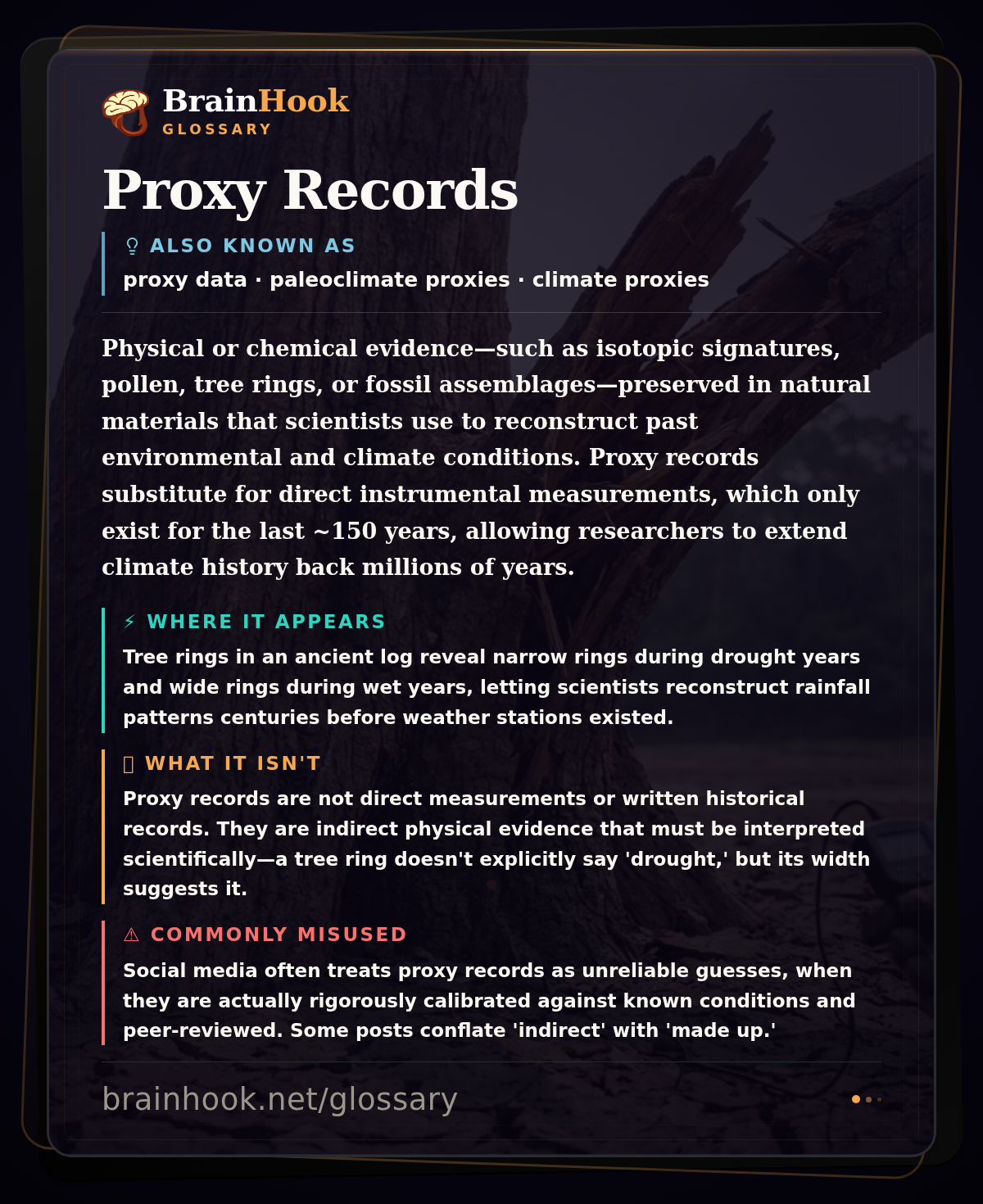
Physical or chemical evidence—such as isotopic signatures, pollen, tree rings, or fossil assemblages—preserved in natural materials that scientists use to reconstruct past environmental and climate conditions. Proxy records substitute for direct instrumental measurements, which only exist for the last ~150 years, allowing researchers to extend climate history back millions of years.
What this means in real life
Tree rings in an ancient log reveal narrow rings during drought years and wide rings during wet years, letting scientists reconstruct rainfall patterns centuries before weather stations existed.
What it isn’t
Proxy records are not direct measurements or written historical records. They are indirect physical evidence that must be interpreted scientifically—a tree ring doesn't explicitly say 'drought,' but its width suggests it.
Commonly misused online
Social media often treats proxy records as unreliable guesses, when they are actually rigorously calibrated against known conditions and peer-reviewed. Some posts conflate 'indirect' with 'made up.'
Based on 1 reference source, including reference sources. Last verified July 16, 2026.