The FRB That Fired 11,553 Times Has a Math Problem. The Standard Model Can't Solve It.
A hyper-active fast radio burst has already burned through most of what a magnetar can store — and the source was still going when astronomers stopped watching.
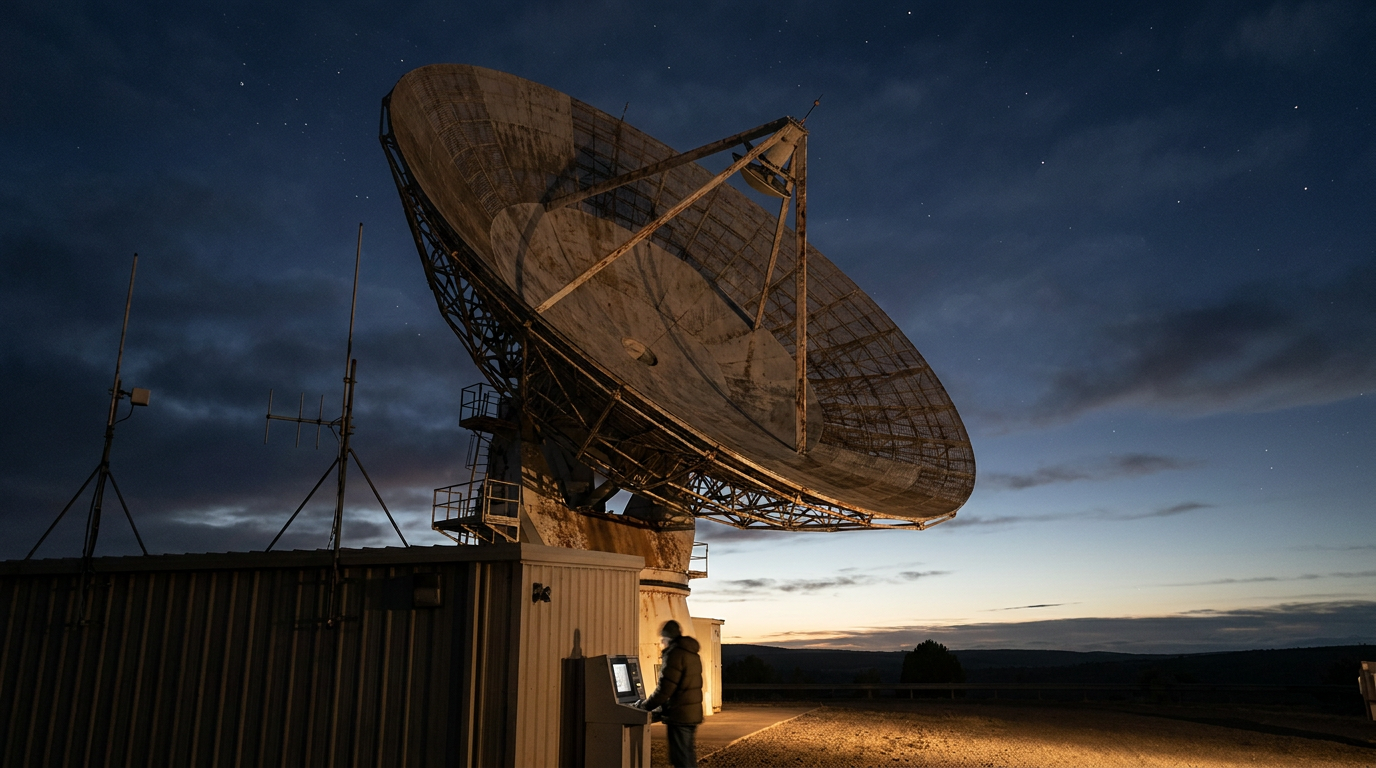
Sometime in January 2024, a radio telescope flagged a signal from roughly a billion light-years out. This was not unusual by itself — fast radio bursts have been detected for nearly two decades, and the catalog of known sources has grown long enough that a new one rarely stops a room. What stopped the room, eventually, was the repetition. FRB 20240114A did not fire once and go quiet. It fired again. And again. Over several months of coordinated observation, it produced 11,553 detected bursts — a number so large that it displaced the previous record holder and forced a genuine accounting of what, exactly, this object could possibly be running on.
The accounting has now been attempted, in a new paper circulating on arXiv[4], and the numbers are uncomfortable. When researchers totaled the radiated energy across all detected bursts from FRB 20240114A, they found that the source had already expended more than 86 percent of the entire magnetic energy budget that a typical magnetar is expected to contain. That figure assumes standard magnetar parameters — a neutron star with an extraordinarily strong magnetic field, roughly ten to the fifteen power Gauss, slowly converting stored magnetic energy into electromagnetic output. At 86 percent spent, the object is not running low on power. It has nearly run dry. And it was still firing when the monitoring campaign ended.
The magnetar hypothesis has served as the dominant framework for repeating fast radio bursts for years, supported by a real-world data point that strengthened the case considerably: in 2020, a magnetar inside our own galaxy, SGR 1935+2154[1], produced a burst energetic enough to be classified as a fast radio burst if it had originated outside the Milky Way. That was a significant anchoring event. It showed that magnetars could do this. The problem FRB 20240114A now presents is not whether magnetars can produce fast radio bursts. It is whether a single magnetar can produce this many, this energetically, without burning itself out on a timescale that makes no physical sense — or whether the energy accounting demands something the standard magnetar model cannot cleanly supply.
That distinction matters. There is a difference between a model being stressed and a model being broken, and the honest answer right now is that FRB 20240114A is doing the former while threatening the latter. The data does not mandate a new theory. But it narrows the corridor that the existing theory must fit through, and the corridor is getting tight enough that some researchers are starting to ask whether the door was ever the right size.
What a Magnetar Is, and Why Its Energy Budget Has a Ceiling
A magnetar is a specific type of neutron star — already an object of extraordinary density, roughly the mass of the Sun compressed into a sphere about twenty kilometers across — with a magnetic field orders of magnitude stronger than an ordinary pulsar. The energy reservoir of a magnetar is not nuclear, not rotational in the way a pulsar relies on spin-down, but magnetic. That stored magnetic energy, sometimes called the magnetic free energy, is finite. It is set at birth by the conditions of the collapse that created the neutron star. A magnetar cannot generate more magnetic energy from the inside out; it can only release what it has, gradually, through field-decay processes, crustal cracking, and the bursts and flares that rearrange or reconnect its internal magnetic structure. When that energy is gone, the magnetar is still there, but it is no longer particularly magnetar-like. It becomes a quieter object. The show ends.
The standard energy budget for a magnetar — derived from observations of known Galactic magnetars and from models of neutron star formation — sits around ten to the forty-six ergs of magnetic energy, give or take roughly an order of magnitude depending on exact field strength and configuration. This is an enormous number by any human standard. It is not an infinite number. And when researchers integrate the energy radiated by FRB 20240114A across 11,553 detected bursts, assuming a standard radio emission efficiency, the implied total begins to bite into that budget in ways that are difficult to explain away with comfortable margins.
“The magnetar model does not forbid this level of activity — it just cannot obviously afford it.”
Two variables soften this somewhat, but neither softens it enough to dissolve the problem. First, radio emission efficiency: if the actual fraction of magnetic energy converted into detectable radio waves is very low, the total energy expenditure could be much higher than what is radiated in the radio band alone, meaning the 86 percent figure might be a lower bound on what the source has actually spent. That makes the problem harder, not easier. Second, detection completeness: the 11,553 bursts are detected bursts, not all bursts. A monitoring campaign has sensitivity limits, and an unknown fraction of activity was almost certainly missed. But again, this argument cuts against the magnetar model — more total bursts would mean more total energy output, pushing the depletion fraction toward or beyond 100 percent of the standard budget.
What 'Hyper-Active' Actually Means at This Scale
Before FRB 20240114A, the most prolific repeating fast radio burst in the catalog was FRB 20201124A, which produced hundreds of bursts[2] over active windows and was itself considered extraordinary enough to generate significant theoretical attention. FRB 20201124A showed clustering behavior, apparent quasi-periodic activity windows, and burst statistics that strained simple random-emission models. Researchers used words like "hyperactive" for that source. FRB 20240114A has since absorbed that descriptor and made it seem conservative. The gap between 11,553 detections and anything previously catalogued is not marginal. It is a different regime of behavior, and different regimes sometimes require different physics.
The burst rate matters beyond its dramatic quality. The rate, combined with the energy per burst and the total duration of observed activity, feeds directly into the efficiency constraints on the source. A magnetar that fires occasionally, spending down its reservoir slowly over thousands of years, fits comfortably within the model. A magnetar that fires 11,553 times in months, at the energies observed, implies either that the object is extraordinarily young — and therefore still near the peak of its magnetic field strength — or that the engine operates with an efficiency that standard models do not easily accommodate, or that the object is not, strictly speaking, a standard magnetar at all.
The Efficiency Problem Nobody Wants to Solve First
Efficiency, in this context, means the fraction of the source's total energy output that emerges as detectable radio emission rather than heat, X-rays, particle wind, gravitational energy, or other forms of radiation that monitoring campaigns are not capturing. If radio efficiency is high — meaning the source converts a large fraction of its available magnetic energy directly into radio waves — then the magnetar budget stretches further, because less energy is being wasted on invisible outputs. If radio efficiency is low, more energy is being spent for every burst detected, and the budget depletes faster. The problem is that researchers do not have clean observational handles on radio efficiency for extragalactic FRBs. Galactic magnetar bursts can sometimes be simultaneously observed across X-ray, optical, and radio bands, giving efficiency estimates. Extragalactic sources like FRB 20240114A are simply too far away for that kind of multi-wavelength accounting to be complete.
“Efficiency is where the model gets to hide — and for FRB 20240114A, the hiding room is running out.”
Some theoretical frameworks around fast radio burst emission invoke coherent curvature radiation[3], where charged particles streaming along magnetic field lines emit radio waves in a highly ordered fashion that can be extraordinarily efficient at converting kinetic or magnetic energy into radio photons. If coherent emission is efficient enough — and some models push efficiency toward a few percent, which is relatively high for astrophysical processes — then a magnetar with a modestly elevated magnetic field could potentially sustain this level of activity without obviously exhausting itself. But "potentially" is doing considerable structural work in that sentence. The parameters required to make the numbers close are not ruled out, but they are not standard. You have to request special conditions from the model, which is a sign you are asking the model to do something it was not primarily designed to do.
Alternatives That Are Not (Yet) Wild Speculation
The most conservative extension of the magnetar framework involves a magnetar that is simply younger, stronger, and more magnetically energetic than the typical examples used to set the standard budget. Magnetar field strengths span a range, and an object at the high end of that range — a field strength perhaps two or three times the assumed value — would carry an energy budget that scales with the square of the field strength, meaning the available reservoir could be four to nine times larger. If FRB 20240114A's source has a field of ten to the fifteen-point-five Gauss rather than ten to the fifteen, the energy crisis becomes much more manageable. This is not exotic. It is asking for an object at the high end of an already-observed distribution rather than a new class of object.
A second class of alternative involves the source being powered not solely by magnetic free energy but by rotational energy as well — a rapidly spinning magnetar in which spin-down luminosity contributes to the burst engine. The SGR 1935+2154 observations showed that Galactic magnetar activity can be triggered by rotational dynamics and crustal processes, not just pure field decay. If FRB 20240114A's engine is being driven partly by spin-down, the total available energy is higher, and the depletion fraction drops. The observational signature of this would ideally be a drift in burst timing or periodicity consistent with spin-down, but timing analysis of extragalactic sources at this distance is technically challenging. The data to confirm or exclude this contribution cleanly does not yet exist.
A third possibility, more speculative but not disqualified by current evidence, is that the FRB source sits in an unusually dense or structured local environment — a magnetar closely orbiting a companion object, or embedded in a region of elevated electron density and strong ambient magnetic field — that modifies or amplifies the emission mechanism. FRB 20201124A showed hints of environmental interaction in its scintillation properties and in apparent temporal drift of burst sub-structure. If the local environment feeds the burst engine in some way, through accretion, magnetic reconnection across a binary gap, or interaction with a surrounding nebula, then the energy reservoir is not limited to what the magnetar brought with it at birth. But this is where the models begin to require more input assumptions than the observations currently constrain, and the conversation shifts from energy accounting into genuine theoretical uncertainty.
What the Paper Is Actually Claiming, and What It Isn't
It is worth being precise about what the arXiv analysis does and does not conclude. The paper does not declare the magnetar model falsified. It performs an energy audit and shows that the audit produces a residual — a gap between observed energy output and the comfortable range of what standard magnetar parameters allow — that warrants attention. The 86 percent figure is derived under stated assumptions about emission efficiency, field strength, and burst completeness, and the paper is transparent about where those assumptions introduce uncertainty. What the analysis argues is that the assumptions you have to adopt to make the energy balance work are increasingly constrained, and that future monitoring of this source will tighten those constraints further, possibly to the point where some current models cannot bend to accommodate them.
“An energy budget at 86 percent spent is not a crisis — unless the source is still firing, and it is.”
This is a reasonable and responsible scientific argument. It does not require dramatic reframing to be interesting. The interesting part is already there in the physics: an object that was still producing bursts when the monitoring window closed, with an energy depletion fraction that high, is either going to quiet down very soon — offering a measurable prediction — or it is going to keep firing in ways that demand a revised accounting. Both outcomes are scientifically useful. If it has since gone quiet, that is consistent with a nearly exhausted magnetar burning through its last reserves. If it has not gone quiet, the standard magnetar model gets narrower with each additional burst detected.
Why the Number Keeps Mattering After You Stop Counting
Fast radio bursts began as a single anomaly — the Lorimer Burst of 2007, a dispersed radio transient in archival survey data with no clear origin and no immediate repetition. For years, the catalog grew slowly and the source population remained unclear. The discovery of repeating sources changed the field structurally, because repetition allows you to study a source across time, to build burst statistics, to probe the emission mechanism with more than one data point. FRB 20240114A has now given the field its most complete burst dataset by a wide margin. That is a resource regardless of what it proves or fails to prove about magnetar models specifically.
The energy problem this source presents is not the kind of problem that goes away when the next telescope comes online and adds more sensitivity. More sensitivity means more detected bursts at lower fluences, which means the energy total climbs further, which means the depletion fraction either rises or forces a recalibration of what efficiency the source must be running at. There is no obvious direction in which better data makes this easier. The field has a source that has, in less than a year of monitored activity, done something that most theoretical frameworks were not built to accommodate comfortably — and it was still going. That is not proof that anything exotic is happening inside that emitting region a billion light-years out. But it is a reason to hold the question open and not let the familiar machinery of the magnetar model absorb the anomaly before the anomaly has been properly measured.
References
- A fast radio burst associated with a Galactic magnetar (nature.com)
Demonstrates that magnetars can produce fast radio bursts, anchoring the magnetar hypothesis as the dominant framework for repeating FRBs. - FAST observations of an extremely active episode of FRB 20201124A: II. Energy Distribution (arxiv.org)
Establishes FRB 20201124A as the previous record holder with hundreds of bursts, providing the baseline for comparing FRB 20240114A's unprecedented activity. - Magnetospheric curvature radiation by bunches as emission mechanism for repeating fast radio bursts (arxiv.org)
Describes coherent curvature radiation as a theoretical framework that could potentially achieve high radio efficiency for fast radio burst emission. - The magnetar model's energy crisis for a prolific repeating fast radio burst source (arxiv.org)
Provides the core analysis showing FRB 20240114A expended 86 percent of a standard magnetar's magnetic energy budget across 11,553 detected bursts.
About Rowan Ellery
Rowan Ellery writes about anomalies, unexplained sightings, strange signals, and the uneasy border between observation, misinterpretation, and genuine mystery. Their work focuses on keeping curiosity alive without letting evidence dissolve into folklore.
More like this
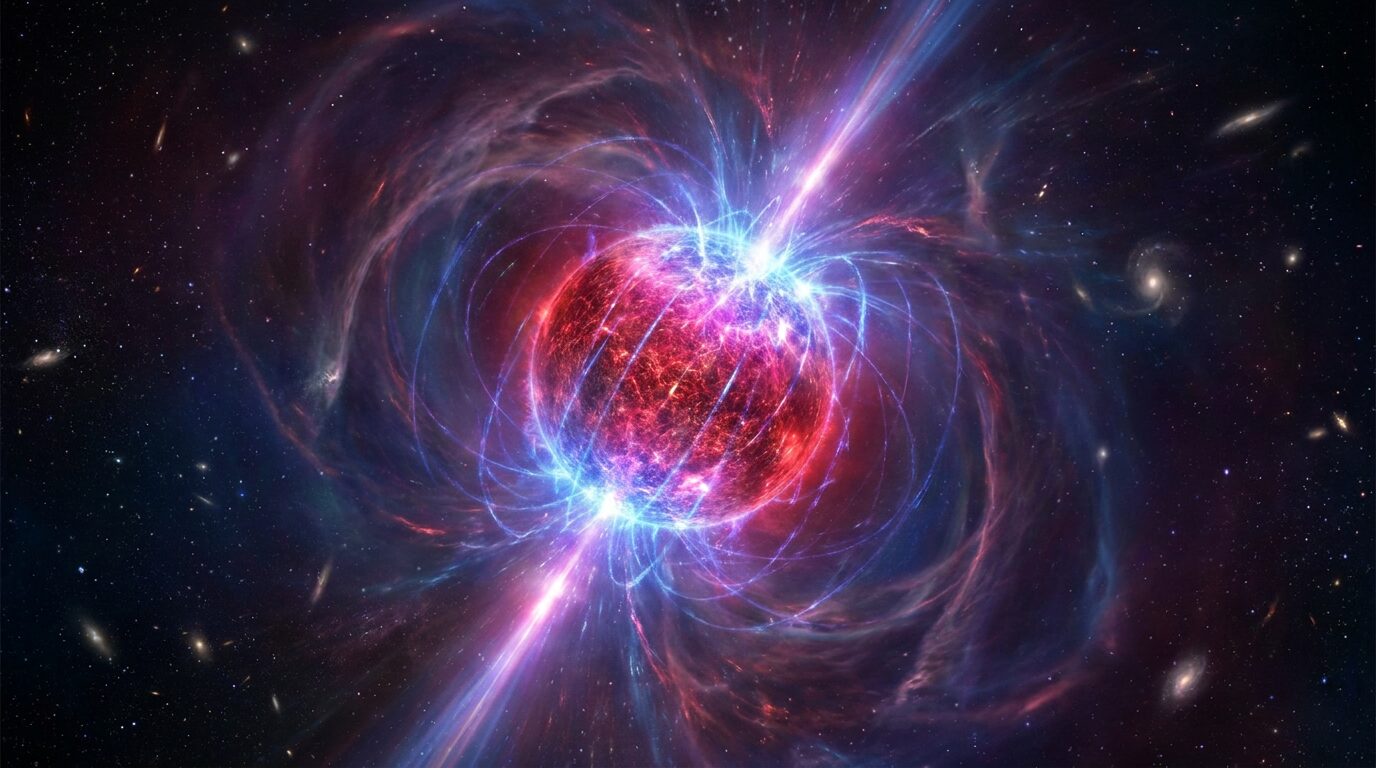
A Cosmic Radio Gun Fires 11,000 Times—And It Shouldn't Exist
A prolific fast radio burst source has released so much energy that it's straining the physics of the object thought to power it.
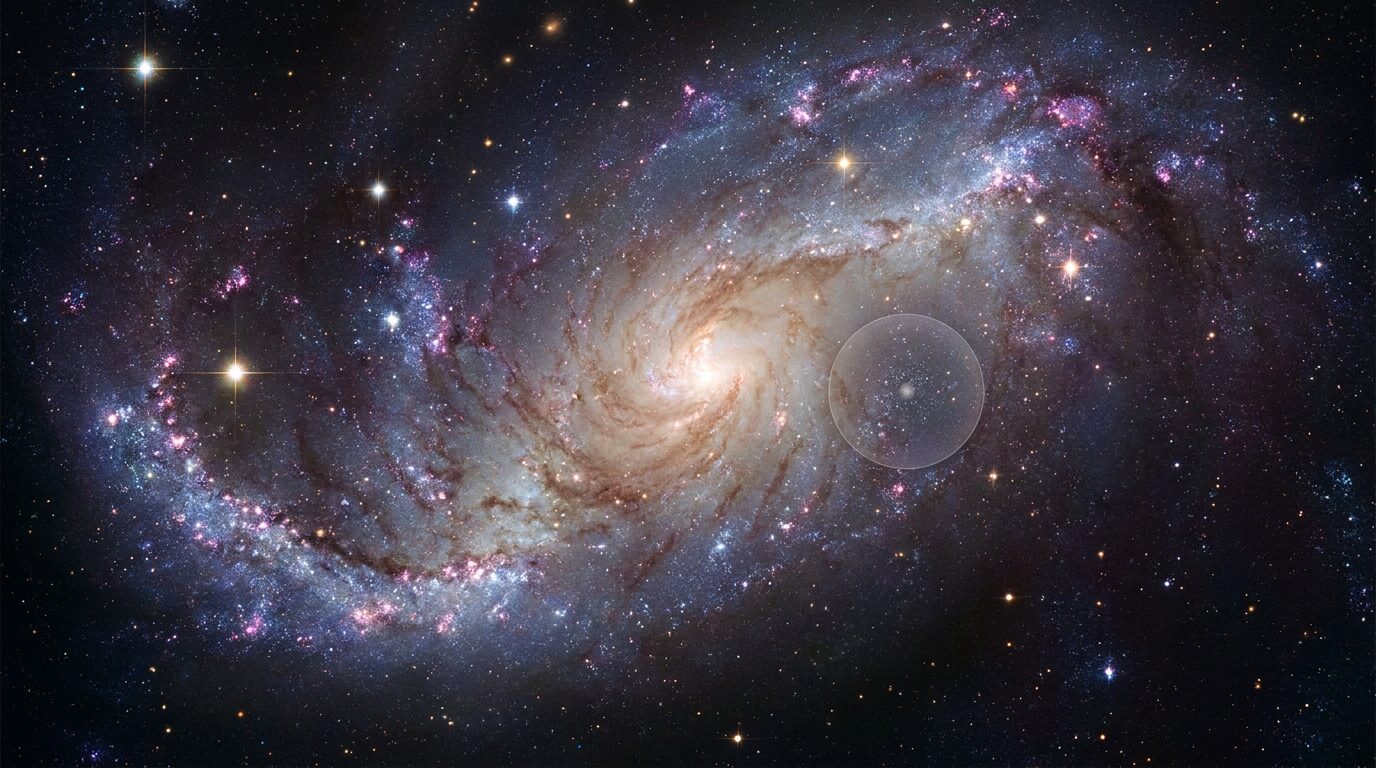
The Brightest Radio Flash Ever Detected Has a Silence Problem
For the first time, astronomers pinpointed a record-breaking fast radio burst to a region smaller than most star clusters — and what they found there quietly threatens the theory meant to explain all of them.

The FRB That Fired Once, Left a Partner Behind, and Broke the Rulebook
A fast radio burst caught inside a binary star system just overturned the leading explanation for what produces them — and the real problem is that the burst only fired once.