Why Rats Recoil From Sick Companions Before Showing Any Symptoms
Rodent research is revealing that disgust isn't a feeling so much as an ancient pathogen-detection engine running on smell.
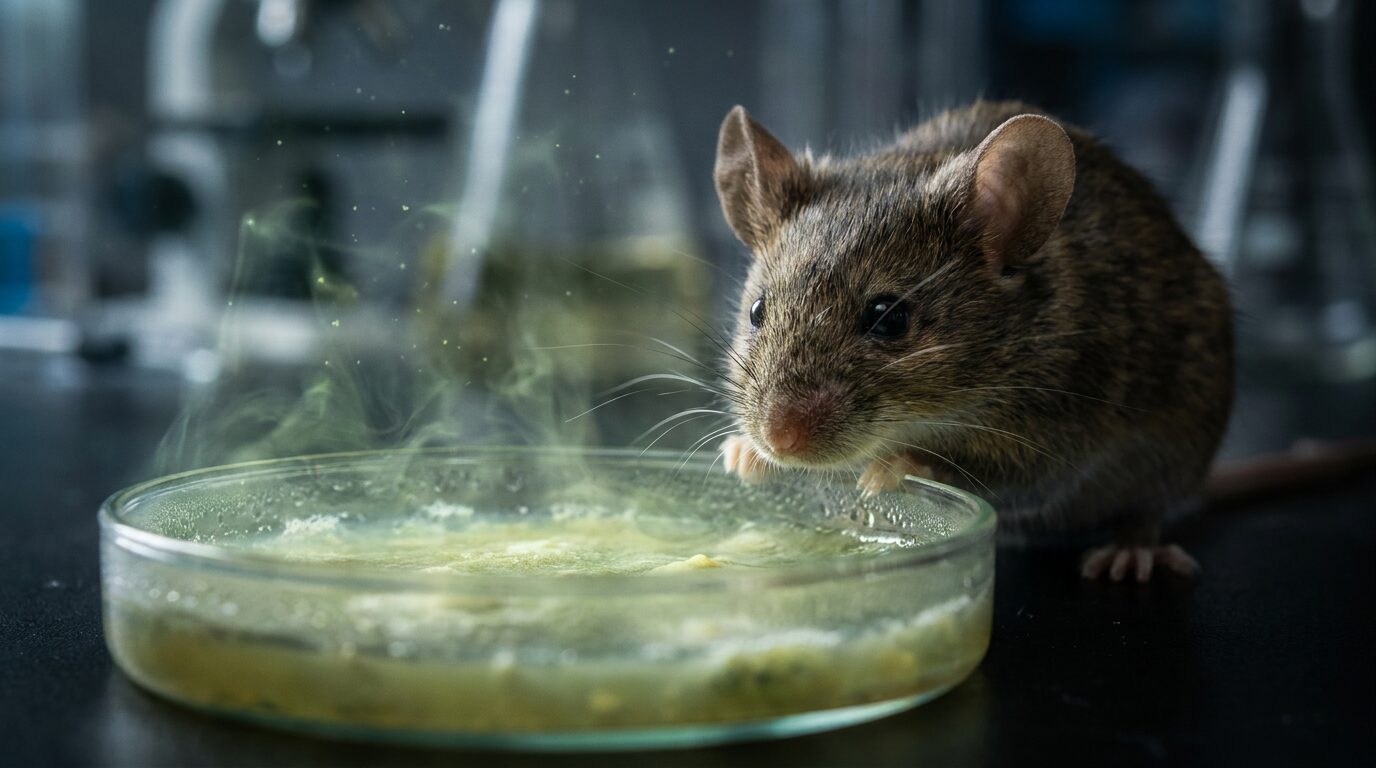
There is a smell to sickness. Not the antiseptic tang of a hospital corridor, but the biological signature of an animal — or a person — whose body is under active siege from a parasite or pathogen. Most of us register it as revulsion first and information second, if we register the information at all. But the revulsion, it turns out, is the information. What your brain is doing when it recoils is not drama. It is computation.
Researchers studying rodent behavior have been building a detailed picture of what that computation looks like at the level of behavior, neuroscience, and chemistry — and the picture is less like a simple alarm bell and more like a sophisticated, flexible assessment system. According to a review published in Current Opinion in Behavioral Sciences[1], pathogen disgust is an evolutionarily conserved affective system: old, widespread, adaptive, and far more nuanced than a knee-jerk recoil. It has valence (it feels bad, on purpose), scalability (the response adjusts to the size of the threat), flexibility (context shapes it), and persistence (it does not simply reset when the threat is removed). That is not a reflex. That is something much closer to an emotion.
What the Nose Is Actually Doing
In rodents, pathogen disgust is primarily odor-mediated[1]. This is not surprising once you consider the sensory world mice and rats actually inhabit — one built more on scent than sight, where the chemical signatures drifting off a conspecific carry dense packets of health and status information. A mouse nose is doing something a human nose does only crudely: it is reading the molecular exhaust of another animal's immune activity, and deciding, very quickly, what to do about it.
The evidence for this reaches well beyond rodents. From nematodes to fish to humans, odors and chemosensory cues associated with parasites, infection, inflammation, and reduced fitness are detected and recognized by members of the same species. The chemical signals vary by organism and environment, but the underlying behavior — sniff, assess, avoid — turns up across the evolutionary tree with remarkable consistency. Disgust as a biological warning system[1] appears to be far older than the animals that experience it most vividly.
This connects to something worth sitting with: your own nose is doing a version of this right now, in every room you enter, around every person you meet. The odors you find instinctively repulsive — stale sweat, something that has begun to ferment, the particular closeness of a crowd of sick people — are not arbitrary cultural accidents. They are a sensory vocabulary the immune system has been whispering to the outside world for millions of years, and your olfactory system evolved to listen.
The Social Cost of Staying Away
“Social information provides information about pathogen threat while at the same time enhancing the likelihood of the acquisition of parasites.”
Here is where the research becomes genuinely interesting, and where the system reveals its sophistication. Social contact is not just how parasites spread — it is also how information about parasites spreads. A mouse that gets close enough to another mouse to assess its infection status is also a mouse that has gotten close enough to pick something up. This is not a design flaw. It is the fundamental trade-off baked into the system, and evolution has had to navigate it without a clean solution.
As the review notes, "deciding who to approach and who to avoid is integral to avoiding exposure to pathogens." That sentence sounds simple until you consider what it implies: pathogen disgust is not just reactive, it is also prospective. The animal is not merely fleeing something revolting. It is making a continuous, context-sensitive assessment of risk against reward — the reward in this case being the social information that only proximity can deliver.
The research on group size adds another layer. Isolated mice — those without companions — display greater avoidance responses to infection threat than mice living in social groups. This suggests the system is genuinely sensitive to social context, modulating the intensity of disgust-driven avoidance based on what else is at stake. A mouse alone has less to lose socially by avoiding an infected conspecific. A mouse embedded in a group has relationships, alliances, and information networks that make blanket avoidance costly. The disgust response, in other words, weighs the social ledger before it renders a verdict.
An Emotion, Not a Switch
This is the part that tends to surprise people: calling what rodents experience an affective state — something functionally analogous to an emotion — is not anthropomorphism run amok. It is a mechanistic claim supported by the behavior. A simple reflex-like response would be fixed, binary, and indifferent to context. What pathogen disgust actually looks like in rodents is none of those things. It scales with the intensity of the cue. It responds to social context. It persists after the trigger is removed. It involves neuromodulatory systems — the same classes of brain chemistry that regulate mood, motivation, and threat response in mammals more broadly.
The distinction matters because it changes the kind of question you are allowed to ask. If pathogen disgust is a reflex, you ask about the stimulus and the output. If it is an affective state, you can ask about the animal's internal experience of the threat, about how social and emotional context shapes the response, about what happens in the brain when the animal is deciding whether the smell of a sick neighbor is worth ignoring for the sake of staying close. Those are harder questions, with more interesting answers.
And the parallel to human disgust is not incidental. Decomposition, infection, and contamination all have distinctive chemical signatures, and human disgust responses cluster around exactly those signatures — bodily fluids, rot, parasites, sickness. The emotion we experience as visceral and moral and uniquely cultural is, underneath, running on very old hardware. The same trade-off a mouse weighs when it considers approaching an infected cagemate — social proximity versus infection risk — is one humans navigate constantly, in waiting rooms and crowded subway cars and the careful social distance we give someone who has spent the meeting coughing into their sleeve.
“Pathogen disgust is an adaptive affective/emotional state that functions to both detect cues associated with parasitic infection and facilitate reactive and proactive responses that reduce the risk of infection.”
What rodent research is giving us, slowly and carefully, is a mechanistic account of the thing human disgust evolved from — the ancient smell-based threat-detection system that predates language, predates culture, and predates any conscious awareness that infection is something to fear. Your nose already knew. It has known, in one form or another, for a very long time.
References
- Pathogens, odors, and disgust in rodents (pmc.ncbi.nlm.nih.gov)
Establishes pathogen disgust as an evolutionarily conserved affective system with valence, scalability, flexibility, and persistence—the core framework for the article's argument that disgust is computation, not reflex.
About Phoebe Lark
Phoebe Lark writes about the biology and chemistry your body and home would rather you didn't examine too closely — odors, fluids, microbes, parasites, infestations, and the quietly industrious rot happening on and around you right now. She follows disgust down to the mechanism underneath, where the gross thing almost always turns out to be a system doing exactly what it evolved to do.
More like this
Cat Bunting Does Four Things at Once — And Affection Is Only One of Them
When a cat presses its cheek into you, something more structurally interesting than affection is happening — and researchers are only beginning to pull it apart.

Your Phone Is the Escape Route. That's Exactly the Problem.
A 90-day study tracking real phone behavior found that using your screen to escape bad feelings doesn't quiet the anxiety or the depression — it quietly locks them together.

Loneliness Doesn't Make You Want People Less. It Makes You Afraid of Them.
Research is revealing that long-term loneliness doesn't just hurt — it quietly rewires how the nervous system reads other people, turning the cure into something that feels like danger.