Cat Bunting Does Four Things at Once — And Affection Is Only One of Them
When a cat presses its cheek into you, something more structurally interesting than affection is happening — and researchers are only beginning to pull it apart.
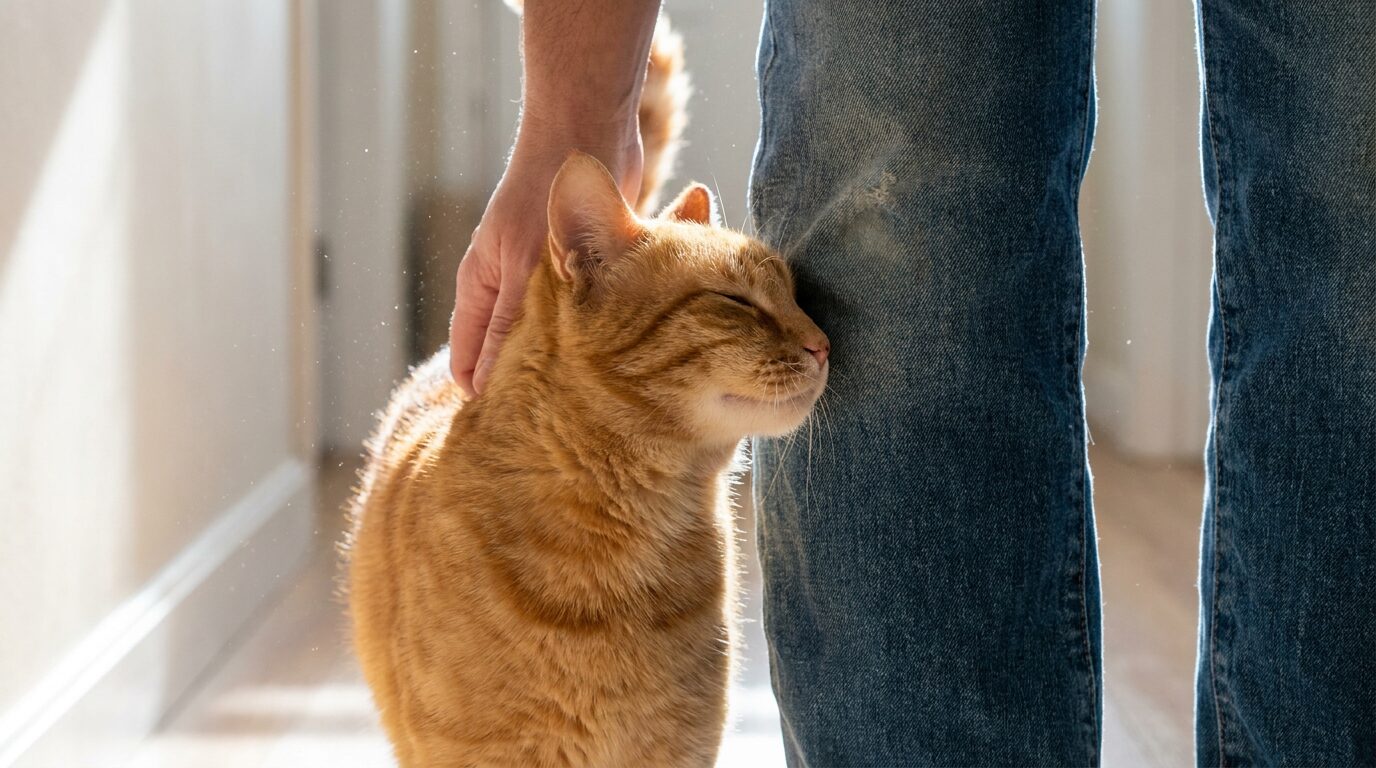
It usually happens the moment you walk in the door. Before your coat is off, the cat has materialized at ankle level, pressing its face along your calf and winding its tail around your leg. It's easy to receive this as simple fondness — the feline equivalent of a hug — and leave it there. But that reading misses most of what is actually going on, which turns out to be one of the more interesting things any domestic animal does to a human: a form of contact that is simultaneously affectionate, territorial, investigative, and social, all at once, with no clean line between them.
The behavior has a name researchers use: allorubbing. When it involves the head and face specifically, it's called bunting. It works because the cheeks and forehead contain scent glands[1] that deposit pheromones when pressed against a surface — including, in this case, your leg. Cats have nine different scent glands in their body: the pinna, temples, cheeks, the corners of the mouth, under the jaw, between the toes, near the anus, along the tail, and at the tail's base. What you register as a soft nuzzle is, in the cat's sensory world, a meaningful chemical deposit. The question researchers keep bumping into is: what exactly is being communicated, to whom, and why?
You're Being Added to the Group Scent
The best way to understand what allorubbing does is to look at how it functions between cats. Like many cat behaviors, allorubbing probably serves multiple functions: the intense face-to-face and face-to-body contact facilitates the exchange of scent, and there are likely tactile components significant to the cats as well — cats often purr during allorubbing. The behavior also helps cats within a colony develop a "colony odor" that is maintained through these exchanges. The shared smell becomes a kind of social passport. A significant benefit is that since the odor transfers from cat to cat throughout a group, not all cats need to groom each other, or even meet regularly, in order to share enough elements of the group odor to recognize one another when they meet.
When your cat rubs on you, it is extending this same system across species. When your cat rubs around your legs to greet you, they are doing the same as they would in greeting another cat by mutual rubbing of the face and body — and as they can't easily reach your face, for convenience, they'll use your legs. Afterward, your cat will take themselves off to groom and check out your scent. That last detail is easy to miss but worth sitting with: the cat isn't only depositing. It's also reading. The rub is a two-way transaction.
This becomes especially visible when you return home after time away. If you return after a long day or a trip, your cat may rub more intensely than usual. This is scent gathering and re-marking in action — you smell like the outside world, other animals, food, and unfamiliar environments, and your cat is updating your scent profile so you once again fit into their territory. Which means, technically, that you are also being corrected.
“The rub isn't only affection deposited onto you. It's a status update — yours and the cat's at the same time.”
The Dominance Wrinkle Nobody Talks About
There's a layer to this that disrupts the simple warmth of the interpretation, and it's one that tends to get quietly dropped from popular explainers. Head-bumping and cheek rubbing may be displays of social dominance, as they are often exhibited by a dominant cat toward a subordinate. In feline colonies, a more dominant cat with a higher social rank will be the one to initiate head bunting[4] — it's the job of the dominant, confident cat to spread the family scent and groom the other cats. So when your cat butts its head against you, the gesture carries an edge of social claiming that "I love you" doesn't fully capture. You are being marked. You are also, in some sense, being managed.
None of this makes the behavior less real as affection. But it does complicate the idea that it's purely affectionate. Like many cat behaviors, allorubbing probably serves multiple functions — and those functions don't resolve into a single clean motive the way humans prefer. The territorial and the tender aren't opposites here; they appear to be woven into the same gesture.
What a 2025 Study Found When Cats Met Scent in a Tube
A 2025 study published in PLOS ONE[2] by researchers at Tokyo University of Agriculture offered a useful complication to the tidier story. They presented thirty housecats with three tubes: one holding their owner's scent, one holding a stranger's, one blank. The cats spent an average of 4.8 seconds sniffing the stranger's odor — about twice as long as they spent on their owner's scent (2.4 seconds) and even more compared to the blank swab (1.9 seconds). Familiarity, in other words, reduced investigation. The owner's scent was already known and filed away.
Then came the rubbing. After their olfactory investigations, many of the cats rubbed their faces against the tubes — behavior that may seem like affection but serves a more utilitarian purpose in feline society: scent-marking. Rubbing behavior increased with higher scores in "closeness" with the owner toward tubes containing the owner's scent — suggesting that when cats rub on their person, something relationship-specific is happening, not just generic territorial tagging. The researchers were careful: their results suggest that rubbing the owners could be a way of showing affection — but since the owner presented the odor conditions in the study, it was not possible to discern whether the cats directed their rubbing at the odors or at the owners, and future research should consider what motivation actually stimulates rubbing behavior toward odors. Honest science, in other words, lands somewhere more interesting than either "pure love" or "pure territory."
What Your Cat Is Actually Sensing About You
It's also worth noting that cats appear to be reading something about your state when they rub. One study found that within bouts of interaction, cats engaged in more allorubbing toward a human in a depressive mood, approached humans feeling "numb" less often, and approached humans who felt agitated or extroverted more frequently — indicating cats can detect human emotional state and mood and, to some extent, alter their behavior in response, though more research must be conducted in this area. This is preliminary, and the mechanism isn't clear. But it fits with the broader picture of the cat as an animal that navigates its social world through a constant stream of chemical and behavioral signals — and has apparently been tracking yours.
The comparison to human attachment isn't entirely metaphorical. Researchers have found that cats' capacity for attachment to humans often mirrors the attachment styles observed in human infants and their caregivers[3]. That framework — developed for understanding early human bonds — has legs across species lines, partly because the underlying dynamics of proximity-seeking, safe-base behavior, and social regulation are older than any species. When your cat presses its face into your shin, it is doing something rooted in the same ancient architecture that makes humans seek contact with the people they trust. The delivery system is different. The function rhymes.
“When your cat presses its face into your shin, it is doing something rooted in the same ancient architecture that makes humans seek contact with the people they trust.”
So Is It Petting You Back?
Sort of — and that's actually the more interesting answer than yes or no. The gesture shares structural features with what humans do when they touch someone they're bonded to: it involves physical contact, it regulates closeness, it reasserts membership in a shared group, and it carries real information about emotional state. What it isn't is a mirror image of human petting. The cat isn't offering comfort the way a person might stroke another person's hair. It's doing something more instinctively economic: maintaining the shared-scent infrastructure that keeps its social world coherent, and you happen to be part of that world.
Bunting in domesticated and wild cat species has a range of uses including mother-young association bonds, greeting and welcoming of kin, diffusing potential aggression in social environments, and distributing scent on areas to cultivate familiarity. That's a lot of work for one small gesture. And it says something quietly significant about what your cat has decided you are: not furniture, not an obstacle, not a feeding station alone — but a member of something, worth the chemical maintenance it takes to keep you in the group. You're being enrolled, repeatedly, in something that matters to them. Most relationships could do with that level of consistent tending.
References
- “How Do They Even Know They Love?” The Image of Polyamory in Polish Expert Discourse (pmc.ncbi.nlm.nih.gov)
- Behavioral responses of domestic cats to human odor (journals.plos.org)
Provides 2025 experimental data showing cats spend twice as long investigating strangers' scent as owners', and rub more on owner-scented tubes with higher closeness scores. - Perceptions of primary and secondary relationships in polyamory (journals.plos.org)
Provides the research framework on attachment styles in human infants and caregivers that the article applies to cat-human bonding patterns. - Cat Head Bunting: What It Means And How To Respond (vet-organics.com)
Supports the article's claim that dominant cats initiate head bunting toward subordinates in feline colonies.
About Elena Rivera
Elena Rivera writes about the hidden architecture of relationships — how attachment shapes conflict, why friendships quietly collapse without anyone deciding to let them, and the structural forces that make intimacy harder to maintain than most people expect. Her work focuses on what research reveals about the things people feel but rarely have language for in their closest relationships.
More like this

Ethical Unicorn Hunting Is Possible — But Almost Nobody Does It Right
Wanting a shared partner isn't the ethical failure. Building a triad where one person's exit requires two people's permission is.

The Opening Agreement You Made Isn't the One You're Actually Living By
Most couples negotiate their open relationship once, then renegotiate it through behavior — and the gap between those two versions is where real harm quietly accumulates.

The Hierarchy in Your Poly Relationship Is Hurting a Person You Chose to Love
Studies on hierarchical polyamory keep finding the same thing: secondary partners report lower attachment security and lower satisfaction — and calling the arrangement ethical doesn't change the math.