What 15 Terabytes Per Night Can Reveal About the Universe's Deepest Secrets
The Legacy Survey of Space and Time officially began in June 2026 — and the sheer scale of what it's designed to catch raises questions that go well beyond counting stars.
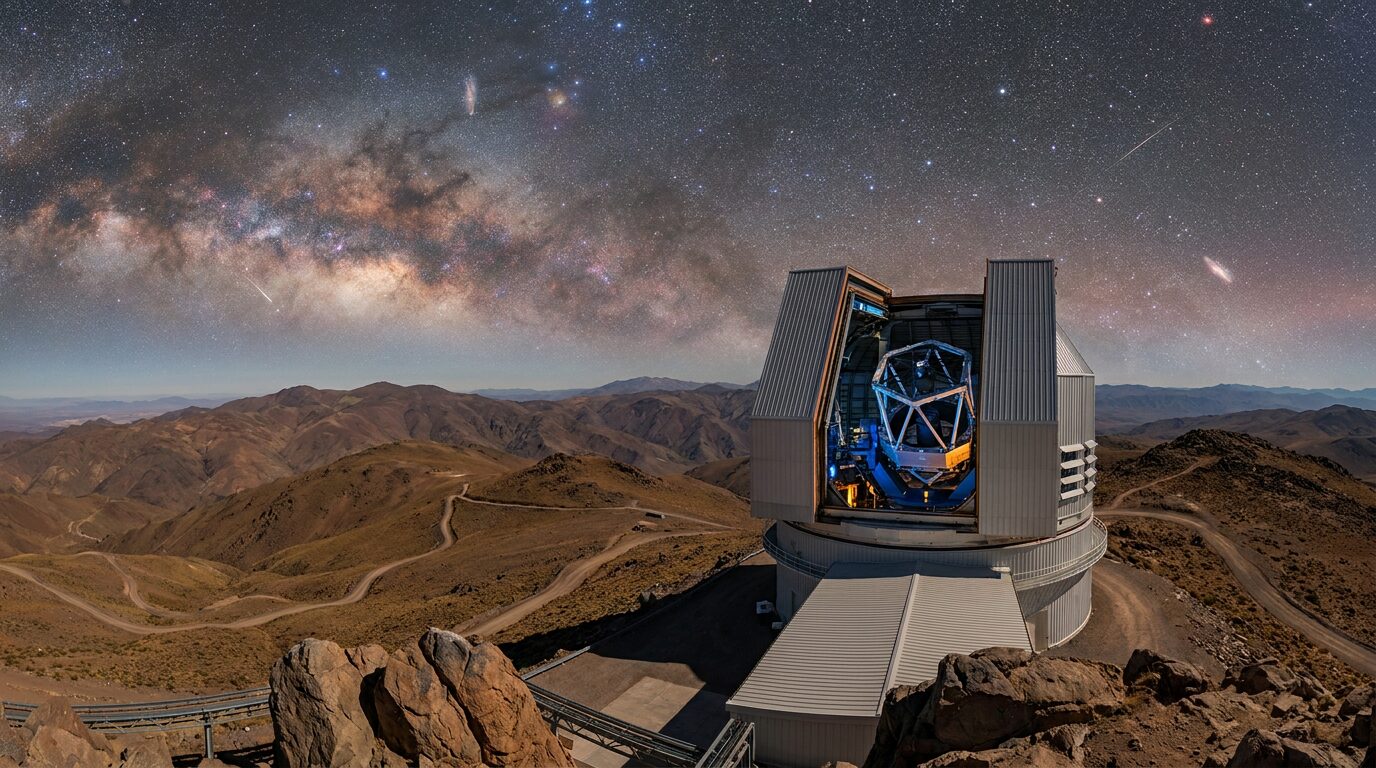
On June 30, 2026, a telescope in the Chilean Andes began one of the most methodical observation campaigns in the history of astronomy[1]. It did not announce this with a single dramatic image. It began producing data — roughly 15 terabytes per night — and it will continue doing so every clear night for the next decade. This is the Legacy Survey of Space and Time[1], known by its initials, LSST, and the instrument running it is the NSF-DOE Vera C. Rubin Observatory, sitting on the El Peñon peak of Cerro Pachón in northern Chile.
What makes LSST unusual is not just its size or its sensitivity. It is the ambition of the question it is built around: what changes in the sky, when, and by how much? Most observatories are pointed at known targets. Rubin is designed to watch an 18,000-square-degree sweep of the southern sky repeatedly, systematically, over ten years — producing more than 5.2 million exposures in total. The result will not be a photograph. It will be something closer to a long exposure film of the universe, and the things that move, flash, fade, or appear between frames are exactly what the survey is designed to catch.
The Camera at the Center of It
The instrument making this possible is a 3,200-megapixel digital camera assembled at SLAC National Accelerator Laboratory[2]. To put that number in perspective: a standard high-resolution digital camera captures around 20 to 50 megapixels. LSST's camera captures roughly 160 times more detail per frame. Each 15-second exposure reaches down to a magnitude of 24.5 in the r-band — deep enough to detect objects far fainter than anything visible to the naked eye, and sensitive to redshifts of up to z=3, meaning light emitted when the universe was less than a quarter of its current age.
“The result will not be a photograph. It will be something closer to a long exposure film of the universe, and the things that move, flash, fade, or appear between frames are exactly what the survey is designed to catch.”
That reach into the early universe is not incidental. It is the mechanism. The further back you look, the more leverage you have on the large-scale structure of the cosmos — and that structure is shaped, invisibly, by two of the most stubborn unsolved problems in physics: dark matter and dark energy. As we've covered at BrainHook, dark energy may not be a simple constant, and the evidence for that has been building. LSST is, among other things, a purpose-built instrument for pressing that question harder.
What the Survey Is Actually Hunting
The LSST science case, as outlined by the Kavli Institute for Particle Astrophysics and Cosmology at Stanford, spans several distinct domains. Dark energy and dark matter sit at the top. The survey will also target questions about the formation of the Milky Way and the properties of small solar system objects — a category that includes near-Earth asteroids, comets, and the population of bodies in the outer solar system whose orbits have barely been charted.
The time-domain component is what separates Rubin from most previous deep-sky surveys. By imaging the same regions of sky repeatedly over a decade, the survey will build a record of transient events: supernovae flickering into brightness and fading, variable stars pulsing on their cycles, asteroids tracking across the field of view, and rarer events that don't yet have clean classifications. The survey is, by design, structured to surface anomalies — things that don't behave the way the surrounding data expects them to.
That is a meaningful distinction. A survey that only images the sky once, or that targets known objects, cannot catch what it didn't know to look for. LSST is designed around the opposite assumption: that the sky contains objects and events whose existence we have not yet confirmed, and that the only way to find them is to watch continuously, at depth, over time. This is the same logic that eventually resolved debates over pulsars, fast radio bursts, and the orbital perturbations that led to the prediction of new planets. The prolific repeating fast radio burst debate, for example, remains open partly because the instruments doing the watching were not designed with this kind of systematic cadence.
Data at That Scale Is Its Own Problem
Fifteen terabytes per night is not a number that resolves cleanly into insight without infrastructure. The raw data volume from LSST over ten years will constitute what the survey's planners describe as an uncompressed database of the southern sky across time — a record with no straightforward human-scale analog. Processing that data, identifying anomalies within it, and separating genuine detections from sensor artifacts, atmospheric distortion, and cosmic ray hits on the detector requires automated pipelines running at a scale that would have been implausible a generation ago.
This is where the survey intersects with a broader shift in how astronomy is done. The science of the time domain is increasingly a science of alerts — automated systems flagging events in near-real time so that follow-up telescopes can be pointed before the event fades. A supernova peaks and declines in days or weeks. A near-Earth object's trajectory window for observation may be shorter. The LSST pipeline is designed to issue alerts within 60 seconds of detecting a significant change[3] in a known or newly discovered object. Researchers around the world — not just those affiliated with the survey — will have access to those alerts, making Rubin less a proprietary instrument than a shared early-warning system for changes in the visible universe.
“Rubin is less a proprietary instrument than a shared early-warning system for changes in the visible universe.”
What a Decade of Watching Might Resolve
The honest answer is that we don't fully know, which is precisely the point. LSST is not built to confirm what we already believe. It is built to accumulate enough data that the things we've been inferring — the distribution of dark matter through gravitational lensing signatures, the equation of state of dark energy through supernova distances, the population census of the outer solar system — can be constrained with precision that current surveys cannot reach. Recent dark energy data has survived serious scrutiny, but the error bars remain uncomfortably wide. A decade of Rubin data, at the depths and cadence LSST can achieve, should narrow those bars significantly.
But the history of systematic sky surveys is also a history of discovering things nobody planned for. The original photographic sky surveys of the mid-20th century — some of which are only now being mined for anomalies — were not designed to find quasars or gamma-ray burst afterglows. They were designed to map known stellar populations. What they actually produced was a baseline against which subsequent surprises could be measured. LSST is operating on the same principle, but at a depth and cadence those earlier surveys could not approach. Whatever the southern sky is doing between now and 2036, Rubin will have a record of it — and so will the research community that has access to its alert stream. What gets found in that record is, for now, genuinely open.
References
- NSF-DOE Vera C. Rubin Observatory's Legacy Survey of Space and Time (kipac.stanford.edu)
Confirms LSST's official start date of June 30, 2026, location in northern Chile, and primary science goals including dark energy, dark matter, and solar system objects. - SLAC completes construction of the largest digital camera ever built for astronomy (www6.slac.stanford.edu)
Establishes that SLAC completed construction of the 3,200-megapixel LSST Camera designed to study dark matter and dark energy. - Action! NSF–DOE Vera C. Rubin Observatory Begins Capturing the Greatest Cosmic Movie Ever Made (rubinobservatory.org)
Confirms LSST's alert system issues notifications within 60 seconds of detecting significant changes in observed objects.
About Rowan Ellery
Rowan Ellery writes about anomalies, unexplained sightings, strange signals, and the uneasy border between observation, misinterpretation, and genuine mystery. Their work focuses on keeping curiosity alive without letting evidence dissolve into folklore.
More like this
AI Is Now Finding Gravitational Lenses Astronomers Missed for Decades
Machine learning systems are pulling gravitational lenses out of archival survey images that human eyes passed over for years — and what they're finding is quietly rewriting the dark matter distribution maps cosmologists thought they'd already built.
An Interstellar Comet Crossed Our Solar System. We Had 12 Spacecraft Ready.
Comet 3I/ATLAS is only the third object ever confirmed to have crossed into our solar system from another star — and unlike the first two, we had an entire fleet waiting for it.
A Star in Andromeda Just Vanished Without Exploding. Scientists Caught It Happening.
For the first time, astronomers assembled a complete before-and-after record of a star collapsing directly into a black hole — and the mechanism behind the silence turns out to be stranger than a supernova.