AI Is Now Finding Gravitational Lenses Astronomers Missed for Decades
Machine learning systems are pulling gravitational lenses out of archival survey images that human eyes passed over for years — and what they're finding is quietly rewriting the dark matter distribution maps cosmologists thought they'd already built.
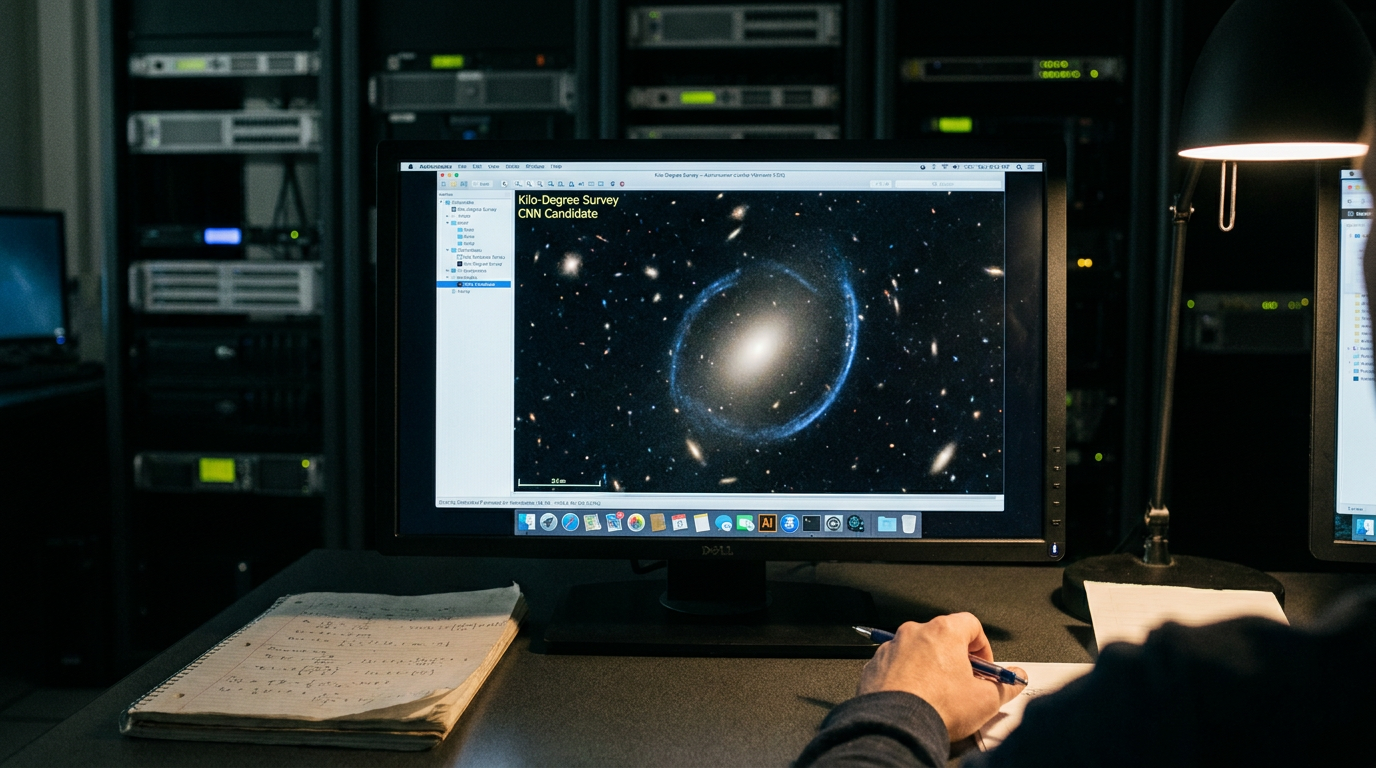
Somewhere in the archival imaging data from the Kilo-Degree Survey, a faint blue arc curves around a foreground galaxy with enough precision to qualify as one of the most useful natural instruments in observational astronomy. It had been sitting there, unrecognized, for years. Human reviewers had passed over it. It did not flag any automated alert. The image was catalogued, moved on from, and effectively lost inside a database containing millions of similar frames. Then a convolutional neural network, trained on simulated and confirmed lensing examples, was run across the archive. It paused on that image. It paused on hundreds of others like it.
Gravitational lensing is one of the most powerful tools cosmologists have, and it works entirely because of geometry. When light from a distant galaxy passes close to a massive foreground object — another galaxy, a cluster, a dense knot of dark matter — the gravitational field bends the light path. Depending on alignment and mass, this bending produces arcs, rings, and multiple distorted images of the background source, all smeared and warped in ways that encode direct information about what is doing the bending. The stronger the lens, the more dramatic the distortion. But most lenses are not strong. Most are subtle: a slight elongation here, a faint arc at the edge of a detection threshold there, a brightness excess that barely clears the noise floor. These are called weak or intermediate lenses, and for decades they have slipped through human visual inspection at a rate that, in retrospect, should have alarmed the field more than it did.
The scale of what has been missed is only now becoming clear. In the past few years, machine learning pipelines — most of them variants of convolutional neural networks initially developed for image classification tasks outside astronomy — have been systematically retrained on lensing morphologies and turned loose on survey data from instruments including the Dark Energy Survey, the Hyper Suprime-Cam Subaru Strategic Program, and the Kilo-Degree Survey[3]. The candidate lists coming back are not modest additions to the known inventory. They are multiples of it. Where astronomers had painstakingly confirmed a few hundred strong gravitational lenses over several decades of searching, machine learning systems are now flagging thousands of candidates per survey dataset, with confirmation rates on human follow-up running high enough to qualify as a genuine transformation in the available sample.
The immediate scientific payoff is concrete: more lenses mean more sight lines through the large-scale structure of the universe, more independent measurements of mass along each line, and a dramatically expanded dataset for mapping where dark matter actually clusters relative to visible matter. But the discovery that raises harder questions is not about dark matter specifically. It is about the archives themselves. If machine learning is finding this many lenses in data that was already collected, already processed, and already reviewed, then the question becomes unavoidable: what else is in there?
How a Lens Reveals What Cannot Be Seen Directly
To understand why this matters for dark matter specifically, it helps to understand what a gravitational lens actually measures. The angular deflection of light around a mass depends on the total gravitational potential along the line of sight — not just the luminous matter you can image directly, but everything. Stars, gas, dust, and crucially, the dark matter halo that surrounds most galaxies and galaxy clusters like an invisible envelope vastly more massive than the stars it hosts. When you measure the geometry of a gravitational arc — its radius of curvature, its brightness distribution, how many images appear and where — you are effectively weighing everything between you and the background source, visible or not. This is why lensing became one of the most important probes of dark matter structure: it does not ask the dark matter to emit light. It asks the dark matter to bend it, which it does regardless.
The standard cosmological model predicts specific statistical relationships between how dark matter clumps, on what scales, and in what density profiles. Simulations — most influentially the family of models running under names like IllustrisTNG[4] and EAGLE — generate universes from these assumptions and make predictions that observers then go test. Gravitational lensing sits near the top of the list of tests that can actually constrain the small-scale structure of dark matter halos, a regime where the predictions differ meaningfully between competing models. The classic tension in this space involves how many low-mass subhalos — the clumpy dark matter satellites that simulations predict should surround large galaxies — actually exist. Because most of these predicted subhalos contain too little luminous matter to be visible as galaxies, you cannot count them directly. But they do lens background light, producing detectable perturbations in otherwise smooth arcs. The more gravitational lenses you have, the more substructure signal you can accumulate.
“The lens does not ask dark matter to emit light. It asks it to bend light — which it does regardless of whether we can otherwise see it.”
What the Neural Network Actually Learned to See
Training a neural network to find gravitational lenses is not straightforward, and the history of the attempts reveals a recurring methodological challenge. The first efforts used real confirmed lenses as positive examples and random non-lens galaxy images as negatives. This worked, but the networks trained this way tended to over-fit to the specific morphologies of previously known lenses, which were themselves biased toward the most spectacular, unambiguous cases — lenses discovered precisely because they were obvious to human reviewers. The networks became adept at finding things that already looked like what people had already found, which is not quite the same as finding everything there is to find.
The shift that changed the results was training primarily on simulated lenses — synthetic arcs and rings generated by ray-tracing background galaxies through modeled mass distributions, then injected into real survey imaging to include authentic noise, seeing conditions, and detector artifacts. The Hyper Suprime-Cam pipeline work and similar efforts using Dark Energy Survey coadded images generated training sets containing hundreds of thousands of simulated lens examples spanning the full range of expected morphologies, including faint, partial, and asymmetric configurations that no human had ever catalogued as a confirmed lens because none had yet been confirmed. The networks trained on this synthetic diversity became sensitive to lensing signatures at lower surface brightness and smaller angular scale than any previous search. They were not finding what people had already tagged. They were generalizing to a broader morphological space, which is exactly what the archives contained.
The outputs still require human follow-up and, for the best candidates, spectroscopic confirmation — verification that the background source and the foreground lens are at different redshifts, which is the definitive proof that the geometry is real rather than a chance projection of two similarly colored galaxies. Follow-up programs using instruments like the Very Large Telescope's MUSE spectrograph and Keck's DEIMOS have been running systematically through machine-identified candidates, and the confirmation rates have been high enough to sustain confidence in the method. The networks produce false positives, including compact galaxy groups and edge-on spiral galaxies with prominent dust lanes that can mimic arc morphologies. But at a manageable false-positive rate, the effective discovery yield per unit of telescope time is dramatically higher than classical visual inspection ever achieved.
“The networks were not finding what people had already tagged. They were generalizing to a broader morphological space — which is exactly what the archives contained.”
What the New Sample Changes About Dark Matter Maps
With lens samples now running into the thousands of confirmed or high-confidence candidates, the statistical analyses that were previously limited by sample size are becoming genuinely powerful. The distribution of Einstein radii — the angular scale of the arc or ring produced by a given lens — encodes information about the mass distribution in the lensing population. A large, uniform sample allows researchers to stack lens signals, measure weak lensing shear statistically across many systems simultaneously, and constrain the average dark matter halo profiles for galaxies at different masses, redshifts, and environments with much tighter error bars than previous analyses permitted. The picture emerging is broadly consistent with the standard Lambda-CDM framework but is starting to sharpen the boundaries of what that framework has to accommodate. In particular, the small-scale distribution of mass around lens galaxies — the granularity of dark matter halos — is getting testable at scales that were previously inaccessible without much larger samples.
There is also a cosmological application that is independent of dark matter structure entirely. A subset of gravitational lenses — those where the background source is time-variable, typically a quasar — can be used to measure the Hubble constant, the current expansion rate of the universe. When a quasar varies in brightness and the lens produces multiple images, the light reaching each image has traveled a slightly different path length through space. This produces a measurable time delay between images, and the time delay, combined with a model of the lens mass distribution, yields an independent estimate of how fast the universe is expanding. Programs like H0LiCOW and its successor TDCOSMO[2] have been using exactly this technique, and the answers they are getting are part of the ongoing Hubble tension — the stubborn disagreement between expansion rate measurements made at low redshift and those inferred from the cosmic microwave background data collected by the Planck satellite. More lenses, including newly recovered archival systems with variable sources, mean more independent time-delay measurements and more leverage on what is either a systematic error somewhere or a genuine crack in the standard cosmological model.
The Inventory Problem: What Else Is Waiting in the Archives
The question the gravitational lens story forces onto the table is one the astronomical community is only beginning to sit with seriously. The archives of major survey programs represent an enormous and largely undigested scientific resource. The Legacy Survey of Space and Time, which the Vera C. Rubin Observatory[1] will generate over its ten-year operational program, is expected to produce roughly 15 terabytes of imaging data per night, eventually building a dataset orders of magnitude larger than anything that currently exists. Human review at that scale is not a viable strategy for any category of transient or morphological detection. Machine learning is not an optional supplement to traditional methods at this data volume. It is the only mechanism capable of operating at the required throughput.
But the Rubin example is the future. The gravitational lens results are a demonstration that the archives already collected — from the Sloan Digital Sky Survey, from the Canada-France-Hawaii Telescope Legacy Survey, from the various Dark Energy Survey data releases — contain scientifically significant objects that have never been systematically searched for with modern methods. Gravitational lenses are one category. Tidal disruption events, where a star is torn apart by the gravity of a supermassive black hole, are another: the light curves are distinctive but can be faint and slow-evolving enough to be misclassified or overlooked in older analysis pipelines. Stellar streams — the gravitationally shredded remnants of dwarf galaxies and globular clusters being cannibalized by the Milky Way — are a third, and they have already proven to be more numerous than the pre-machine-learning inventory suggested. Each of these categories represents a phenomenon where detection efficiency was limited not by what telescopes could collect, but by what analysis methods could recognize in the collected data.
“Detection efficiency was limited not by what telescopes could collect, but by what analysis methods could recognize in the collected data.”
The Uncertainty That Comes With Scale
None of this means the machine learning results are automatically reliable or that the flood of new candidates represents clean science without caveats. The simulated training data used to build these networks encodes assumptions about lens and source populations — assumptions about galaxy morphology, source redshift distributions, and mass profile shapes that may not perfectly reflect the real universe. A network trained on simulated data will be most sensitive to lenses that look like the simulations it learned from, and may still under-perform on configurations the simulations did not adequately represent. The networks also cannot tell you about their own blind spots. When a human expert reviews an image and passes over something, there is at least a chain of reasoning you can interrogate. When a network misses something, the failure mode is opaque in ways that require systematic testing to characterize. Researchers working in this space are acutely aware of these limitations and are investing significant effort in building validation frameworks: testing networks on held-out datasets with known ground truth, running different network architectures against the same data to map disagreements, and building hybrid pipelines that combine machine scores with traditional morphological measurements.
The appropriate frame is not that the algorithms have solved gravitational lens detection. It is that they have expanded the practical boundary of what is detectable in a given dataset, at a given investment of telescope time, with a given tolerance for false positives — and that this expansion is large enough to materially change the scientific questions that can be asked. The dark matter maps being built from these enlarged lens catalogs are more detailed, more statistically robust, and more capable of distinguishing between competing theoretical predictions than anything the field had access to five years ago. That is not a small shift. The data was always there. The sensitivity to what it contained was not.
References
- NSF-DOE Vera C. Rubin Observatory's Legacy Survey of Space and Time (kipac.stanford.edu)
Describes the Vera C. Rubin Observatory's upcoming decade-long survey that will generate new imaging data for discovering gravitational lenses and constraining dark matter. - TDCOSMO IV: Hierarchical time-delay cosmography -- joint inference of the Hubble constant and galaxy density profiles (arxiv.org)
- Finding strong gravitational lenses in the Kilo Degree Survey with Convolutional Neural Networks (academic.oup.com)
Identifies the Kilo-Degree Survey as one of the archival imaging datasets where machine learning systems discovered previously missed gravitational lenses. - IllustrisTNG - Project Description (tng-project.org)
Provides the cosmological simulation framework (IllustrisTNG) that generates predictions about dark matter structure that gravitational lensing observations test.
About Elias Voss
Elias Voss writes about astronomy, space missions, telescope discoveries, and cosmic anomalies - and why it matters to us here on Earth. When the universe's physics reaches down and touches life on our planet, he follows it there too. He specializes in translating dense data into vivid, precise stories without sacrificing accuracy.
More like this
What 15 Terabytes Per Night Can Reveal About the Universe's Deepest Secrets
The Legacy Survey of Space and Time officially began in June 2026 — and the sheer scale of what it's designed to catch raises questions that go well beyond counting stars.
Dark Energy Is Not a Constant. Three Years of Data Say So.
The DESI survey's third year of data has made the case for a changing dark energy disturbingly strong — which means the force expanding the universe may not be what physicists have spent thirty years assuming.
JWST Found Objects so Red and so Strange That Astronomers Invented a New Category for Them
JWST's deep-field images are filling up with tiny, furiously red objects that fit no existing category — and the strangest one may be something the universe was never supposed to make.