A Cosmic Radio Gun Fires 11,000 Times—And It Shouldn't Exist
A prolific fast radio burst source has released so much energy that it's straining the physics of the object thought to power it.
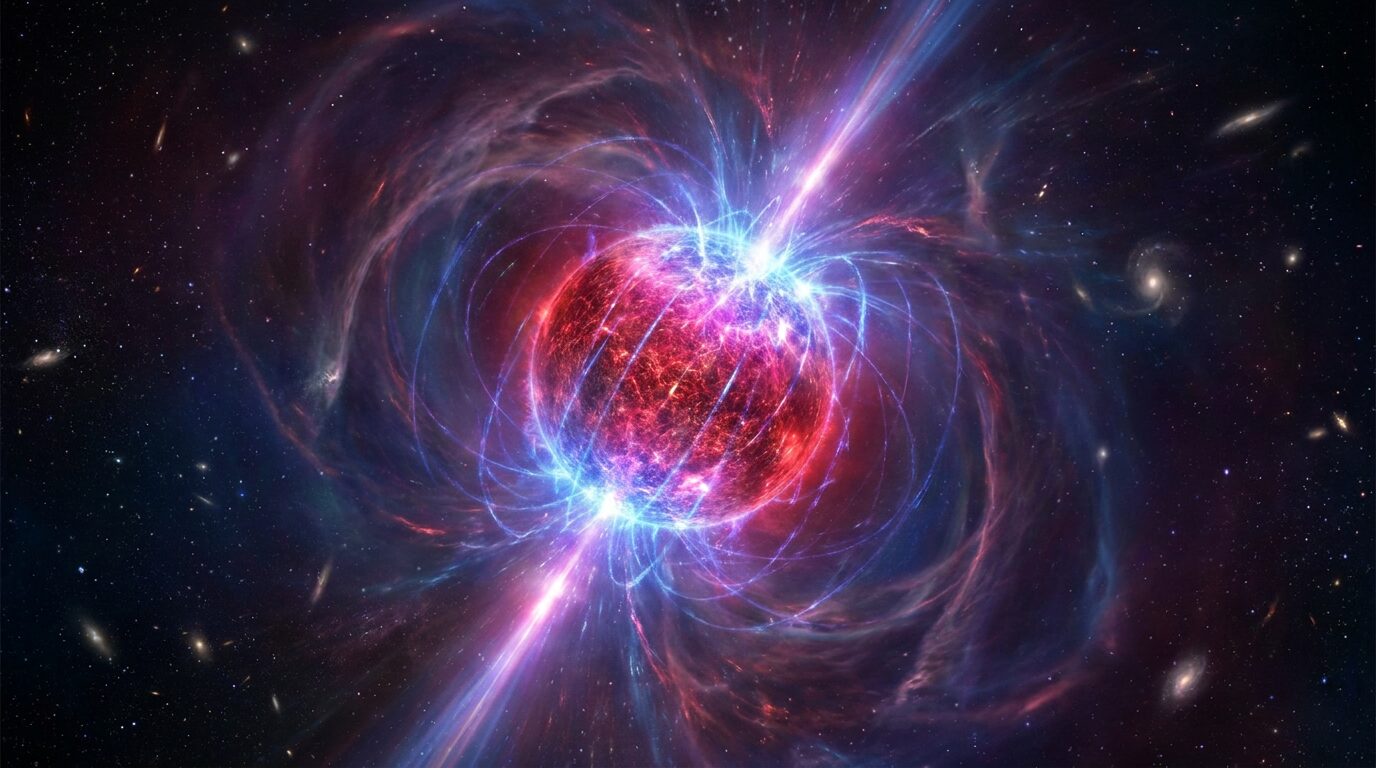
A fast radio burst repeats. That alone is strange enough. In the span of a few milliseconds, it releases more energy than the Sun emits in three days — then it fires again, and again, and again. The FRB that fired 11,553 times was already hard enough to explain. Now, a new analysis of one particularly prolific repeating source has pushed the accounting problem to a point where the favored explanation — a magnetar, the most intensely magnetized type of neutron star known — may not have enough energy in reserve to have produced everything already observed.
The numbers in a preprint posted to arXiv in July 2025[2] by Zhang et al. are striking in a very specific way. The estimated total isotropic burst energy released by this source has crossed a threshold: it now exceeds 86 percent of the dipolar magnetic energy of a typical magnetar. That is not a theoretical projection. It is a cumulative ledger, built from the observed bursts. And the source, as the authors note plainly, "remained active at the end of this observation campaign." It was still spending.
What a Magnetar Is, and Why It Was Always the First Candidate
Magnetars are neutron stars with magnetic fields so intense they warp the structure of space around them. A typical neutron star already packs more mass than the Sun into a sphere roughly the width of a city. A magnetar does that and then generates a magnetic field trillions of times stronger than anything achievable in a terrestrial laboratory. The energy stored in that magnetic configuration is enormous by any human standard, but it is finite — and it is physically bounded by a well-understood relationship between the star's magnetic dipole moment and its total field energy. That bound is what the new analysis has bumped against.
The connection between magnetars and fast radio bursts has been the leading theoretical framework since the first repeating FRBs were identified. The logic is straightforward: magnetars have the energy budget, the extreme field geometry, and the established tendency to produce violent, transient radiation across a range of wavelengths. Coherent curvature radiation[1] — the proposed mechanism by which charged particle bunches moving along field lines in a magnetar's magnetosphere could generate the observed radio frequencies — has been discussed as the underlying emission process since FRBs were first discovered. Theoretically, the model is elegant. Observationally, it has faced a growing series of stress tests, and the latest may be its most serious.
The Ledger Problem
“The estimated total isotropic burst energy of this source exceeds 86% of the dipolar magnetic energy of a typical magnetar.”
The 86 percent figure comes with an important qualifier: it assumes isotropic emission. That is, it assumes the burst energy is being radiated equally in all directions, which is the conservative default when you lack detailed geometric information about the source. If the bursts are actually beamed — focused into a narrower cone, like a lighthouse rather than a bare bulb — the true energy expenditure would be lower, potentially much lower. That escape hatch is real, and the authors acknowledge it.
But the hatch has a cost. The more tightly beamed the emission is assumed to be, the more the apparent brightness of each burst has to be reinterpreted, and the more precise the geometric alignment between the source and Earth has to be. Beaming solves the energy budget by demanding a particular geometry. That geometry is not currently constrained by observation. It is an assumption adopted out of necessity, not a measured quantity.
The comparison to other known repeaters is equally striking. According to the Zhang et al. preprint[2], the total released energy from this source "exceeds that of other known repeaters by about one and a half orders of magnitude." An order of magnitude is a factor of ten. One and a half orders is roughly thirty times. This is not a source that is slightly more energetic than its peers. It is categorically more prolific, and that gap itself requires explanation.
What the Magnetic Moment Lower Limit Actually Tells You
The analysis also produces what the authors describe as the most stringent lower limit yet derived for the magnetar's magnetic moment: 4.7 × 10^32 G cm³. A magnetic moment is a measure of the strength of a magnetic source — how hard the field pushes, integrated over the volume it occupies. Setting a lower limit from observations means that whatever object is powering this source must possess at least that much magnetic field energy to have produced the bursts already counted. If a typical magnetar sits comfortably above that floor, the model survives in principle. If the floor is close to — or above — what a typical magnetar can provide, the model is in genuine trouble.
The 86 percent figure suggests the floor is close. The authors are careful about this: they do not conclude that the standard magnetar model is falsified. They conclude that one of two things must be true. Either the source's magnetar engine has "exceptionally high emission efficiency" — meaning it converts a far greater fraction of its stored magnetic energy into observable radio output than standard models predict — or the central engine is "a more powerful compact object" than a typical magnetar. That second possibility is left open but not developed. The preprint does not specify what a more powerful compact object might be. It simply names the gap.
The Source Is Still Active. That Matters.
“The source remained active at the end of this observation campaign.”
One sentence in the paper carries more weight than its brevity suggests. The source was still firing when the observation campaign ended. This is not a closed-case energy audit. It is an ongoing measurement of a system that has not stopped. Every additional burst that arrives after the campaign closes adds to a cumulative total that already strains the standard model. The energy ledger is still open, and it is accruing.
That ongoing activity also complicates any explanation that requires the source to be running down. A magnetar that has already spent 86 percent of its dipolar magnetic energy should be noticeably weakening — the field that powers the bursts should be depleting, and the burst rate or intensity should reflect that. Whether this source shows signs of depletion is a question the preprint raises but the observation window cannot fully answer. The campaign ended before the source did.
Where the Model Goes From Here
Fast radio bursts have been accumulating anomalies for years. The radio burst lasted a millisecond. The argument about it has lasted years. The magnetar model has survived each challenge in modified form — adjustments to field geometry, emission mechanisms, beaming assumptions, or progenitor populations have repeatedly allowed it to accommodate new data without collapsing. That resilience is scientifically legitimate. A model that can be tuned to fit new observations is still useful, provided the tuning remains physically plausible and the number of free parameters does not grow unconstrained.
The energy crisis documented in this preprint is a different kind of challenge. It is not about the shape of a burst's spectrum or the polarization angle of its emission. It is about conservation of energy. You cannot radiate more than you store, and the more prolific a repeating source becomes, the harder it is to fit its cumulative output inside the energy reservoir of any single known object. The magnetar model does not need to be wrong in its basic physics to face a budget problem. It may simply be pointing at a subset of objects — unusually powerful magnetars, or something not yet classified — rather than describing the whole population.
That is not a defeat for the model. It is a refinement it did not ask for. The universe produced a source prolific enough to stress-test the accounting, and the accounting came back with a red flag. What fills that gap — higher efficiency, stronger fields, a different class of engine entirely — is now an open question with specific numbers attached to it. That is exactly the kind of constraint that makes a mystery productive rather than merely strange.
References
- On the radiation mechanism of repeating fast radio bursts (academic.oup.com)
Describes coherent curvature radiation as the proposed mechanism by which magnetars generate the observed fast radio burst radio frequencies. - The magnetar model's energy crisis for a prolific repeating fast radio burst source (arxiv.org)
Provides the July 2025 analysis showing this FRB source has released 86% of a typical magnetar's total magnetic energy, straining the standard model.
About Rowan Ellery
Rowan Ellery writes about anomalies, unexplained sightings, strange signals, and the uneasy border between observation, misinterpretation, and genuine mystery. Their work focuses on keeping curiosity alive without letting evidence dissolve into folklore.
More like this
The FRB That Fired 11,553 Times Has a Math Problem. The Standard Model Can't Solve It.
A hyper-active fast radio burst has already burned through most of what a magnetar can store — and the source was still going when astronomers stopped watching.

The FRB That Fired Once, Left a Partner Behind, and Broke the Rulebook
A fast radio burst caught inside a binary star system just overturned the leading explanation for what produces them — and the real problem is that the burst only fired once.
The Radio Burst Lasted a Millisecond. The Argument About It Has Lasted Years.
Fast radio bursts arrive from across the universe in under a millisecond — brilliant, violent, and until recently, assumed to be unrepeatable. A handful of them have since proved that assumption wrong, and the physics debate that followed is far from over.