Where Are Omega Centauri's Missing Black Holes? Hubble Found One by Watching a Star Dance.
Astronomers didn't look for light or heat to find it — they watched how a single star moved, and the invisible thing pulling on it had no other explanation.
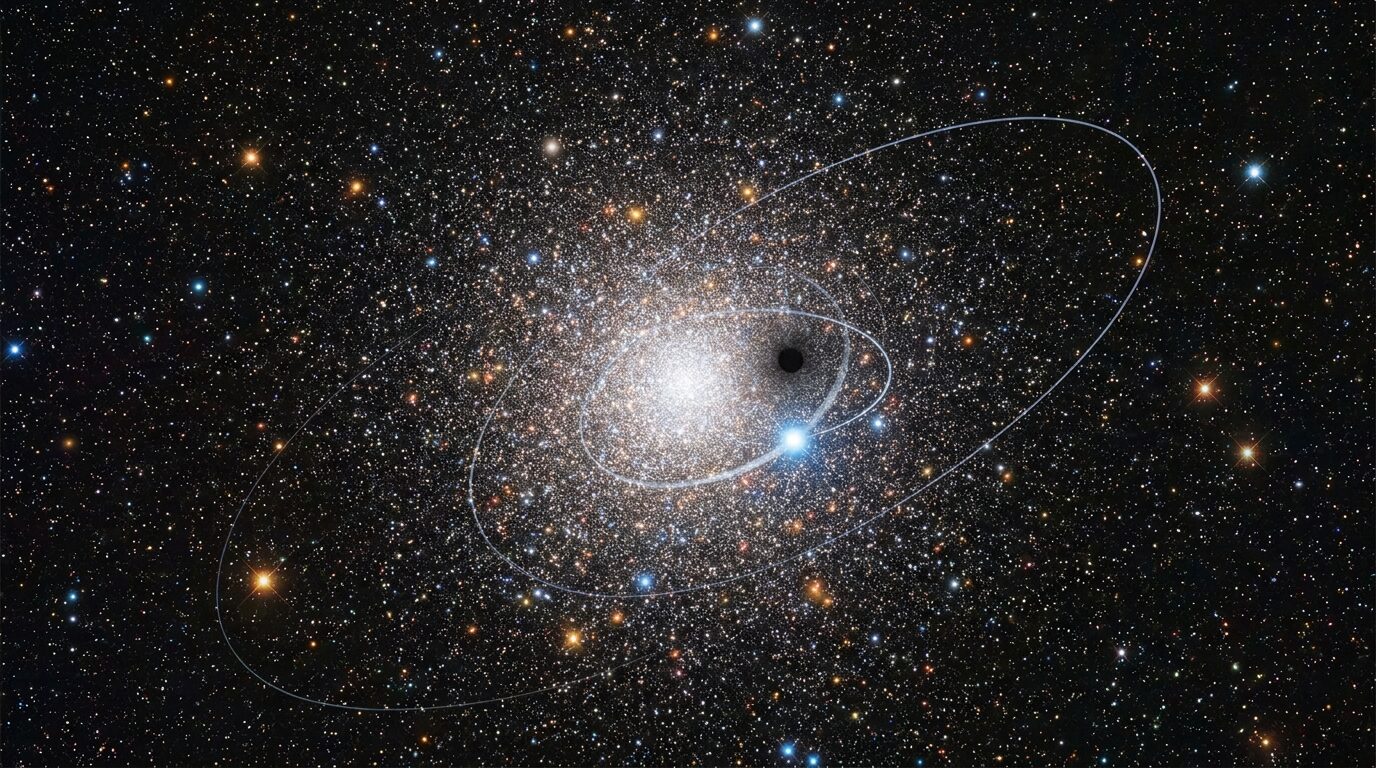
Omega Centauri is the largest globular cluster in the Milky Way's extended family — a gravitationally bound city of roughly ten million stars, ancient enough to predate most of the galaxy's structure around it. Look at it through a modest backyard telescope from the Southern Hemisphere and you see a smudged, luminous sphere, almost too dense to resolve into individual points. At about 17,000 light-years away, it appears nearly as wide as the full moon on the sky. And by the logic of stellar evolution, it should be riddled with black holes: when massive stars exhaust their fuel and explode, they leave collapsed remnants behind, and Omega Centauri has had billions of years to manufacture them. Yet for decades, observations of the cluster kept coming up empty. The black holes that physics predicted should be there were simply not showing up.
Now, for the first time, one has. According to NASA[1], a team of astronomers using archival data from the Hubble Space Telescope and supporting observations from the James Webb Space Telescope has identified a stellar-mass black hole inside Omega Centauri — not by catching X-rays from infalling gas, not by detecting a radio pulse, but by watching how a single star moves. The object has been designated oMEGACat BH-2, and the visible star it holds in orbit traces a path so wide that one complete circuit takes 94 years — the longest-period black hole binary system ever recorded.
What you can do
- Follow Hubble and Webb mission updates directly on NASA's science pages to track discoveries like this one as they're published.
- Look up Omega Centauri's sky position — it's visible to the naked eye from the Southern Hemisphere and a striking binocular target.
- When you read about a 'missing' population in astronomy, ask what detection method was actually used — absence of evidence is often a method problem, not a physics problem.
The Absence That Shouldn't Have Been There
The puzzle of Omega Centauri's missing black holes is not just an observational gap — it reflects something genuinely uncertain about how black holes behave in dense stellar environments. A globular cluster is not a loosely scattered field of stars. It is a packed, gravitationally churning system where stars pass close to one another far more often than they do in the open galaxy. When a massive star collapses into a black hole at the end of its life, the resulting remnant can receive a powerful natal kick — a recoil from the asymmetric blast of the supernova — that flings it out of the cluster entirely. Some models predict that most of the black holes born in a globular cluster are promptly ejected this way. But Omega Centauri, with its exceptional mass and depth of gravitational potential, should be able to hold onto at least some fraction of what it makes. The discrepancy between prediction and observation has been sitting uncomfortably in the literature for years.
Previous searches focused on the signatures that black holes are easiest to produce: X-ray glow from accreting material, radio emission, or Doppler shifts in spectral lines that reveal stars moving toward and away from an unseen partner along the line of sight. These are powerful methods when conditions are right. But they depend on the black hole actively consuming nearby matter, or on the orbital geometry being favorable for radial velocity detection. A black hole sitting quietly, with a companion on a wide and slow orbit, can evade all of them.
Measuring Motion Across Two Decades
“A black hole sitting quietly, with a companion on a wide and slow orbit, can evade every conventional detection method. Astrometry found it anyway.”
The approach the team used — astrometry — is conceptually simple and technically brutal. Rather than measuring what a star radiates or how its light is stretched, astrometry measures where the star actually is, precisely and repeatedly, over a long baseline of time. If a star is orbiting an invisible massive object, it will not move in a straight line across the sky. It will curve, or wobble, or trace a slow arc around a center of mass that contains something we cannot see. To detect that deviation from a straight path in a cluster as crowded and distant as Omega Centauri, you need extraordinarily sharp images taken years apart, and you need to track stellar positions down to a fraction of a pixel across those observations. That is exactly what Hubble, with more than two decades of archival imaging of Omega Centauri, made possible — and what Webb's more recent data helped sharpen further.
The result was a star whose motion through the cluster could not be explained by the gravitational influence of any visible object. Whatever was pulling on it had to be compact enough to be invisible, and massive enough to hold a star in a 94-year orbit. The geometry of that orbit and the inferred mass of the unseen companion point to a stellar-mass black hole — the kind left behind by an ordinary, if massive, stellar death. Not the intermediate-mass black hole that some researchers have long suspected lurks at Omega Centauri's core, but a garden-variety stellar remnant that the cluster has been quietly harboring all along. The work also revisited and refined an earlier study by a separate group that had suggested the existence of such a binary, bringing the detection to firmer ground with the expanded dataset.
A Binary That Formed by Accident
One of the more striking details of this system is that the star and the black hole almost certainly did not form together. In the crowded environment of a globular cluster, gravitational encounters between stars and stellar remnants are common over billions of years. A star can be captured by a black hole not through any common birth, but through a dynamical interaction — a close pass, a three-body exchange, a slow gravitational negotiation — that eventually settles the two objects into a bound pair. The team's analysis suggests that oMEGACat BH-2 and its stellar companion are most likely a dynamically formed binary, assembled from objects that were strangers to each other for most of the cluster's history. That origin matters for what this discovery implies about the broader population: if black holes in Omega Centauri can acquire stellar companions through dynamics, then the total number still lurking in the cluster, most of them invisible and unaccompanied, could be significant.
The 94-year orbital period is itself a record. Binary systems containing black holes are typically found in much tighter configurations, where a black hole is actively stripping material from a close companion star and the resulting accretion produces the X-ray and radio signatures that previous surveys were looking for. A companion in a wide, gentle orbit produces none of that. It just moves — slowly, patiently, on a timescale that spans human generations — and the only way to notice is to watch the sky carefully enough, long enough. Hubble has been doing exactly that for Omega Centauri for over twenty years, which is why this detection was finally possible now. This is, in a real sense, the patience of a telescope paying off.
What One Black Hole Implies About Thousands More
Finding one is not the same as mapping the population, and the team is careful not to overstate what this single detection resolves. What it does do is confirm that stellar-mass black holes exist in Omega Centauri, that at least some of them are detectable through astrometry, and that the cluster has not simply ejected every remnant it ever produced. That baseline confirmation has direct implications for theoretical models of black hole retention and cluster dynamics — models that have been constrained almost entirely by non-detections until now. The discovery of oMEGACat BH-2 gives those models something real to anchor to. This is similar to how star clusters near the Sun are being re-examined as better data forces revision of what we thought we understood about stellar populations in gravitationally bound systems.
It also opens a methodological door. If astrometry — using the long baseline of Hubble's archive, sharpened by Webb's resolution — can find a black hole on a 94-year orbit in a cluster 17,000 light-years away, the same approach should be applicable to other globular clusters. Omega Centauri may have been first simply because it is the most massive, the best-studied, and the subject of the most accumulated imaging time. But the technique does not belong to it alone. The missing black hole populations in other clusters may not be missing so much as waiting for someone to measure the right thing. Astrometry, it turns out, is patient enough for the job.
Astronomy has a long history of absences that turned out to be detection problems rather than physical realities. The planets of other stars were invisible until we learned to watch for the wobble in a host star's radial velocity, then the dimming of its light during a transit. Gravitational waves went undetected for a century not because the universe wasn't producing them but because no instrument was sensitive enough to notice. Omega Centauri's black holes were never really gone. They were simply waiting, in wide orbits and quiet gravity, for a telescope with enough data and enough time to catch the slow arc of a companion star and ask what must be pulling it.
References
- NASA’s Hubble Discovers First of Star Cluster’s Missing Black Holes - NASA Science (science.nasa.gov)
Confirms the discovery of the first stellar-mass black hole in Omega Centauri using Hubble and Webb data, and its publication in The Astrophysical Journal Letters.
About Brenna Vance
Brenna Vance writes about the cosmos — stars that predate the universe's own chemistry, spacecraft flying close enough to the sun to catch it misbehaving, the physics of what the universe is still getting wrong. Her work focuses on the moments when an observation breaks a model, and what that break actually means.
More like this
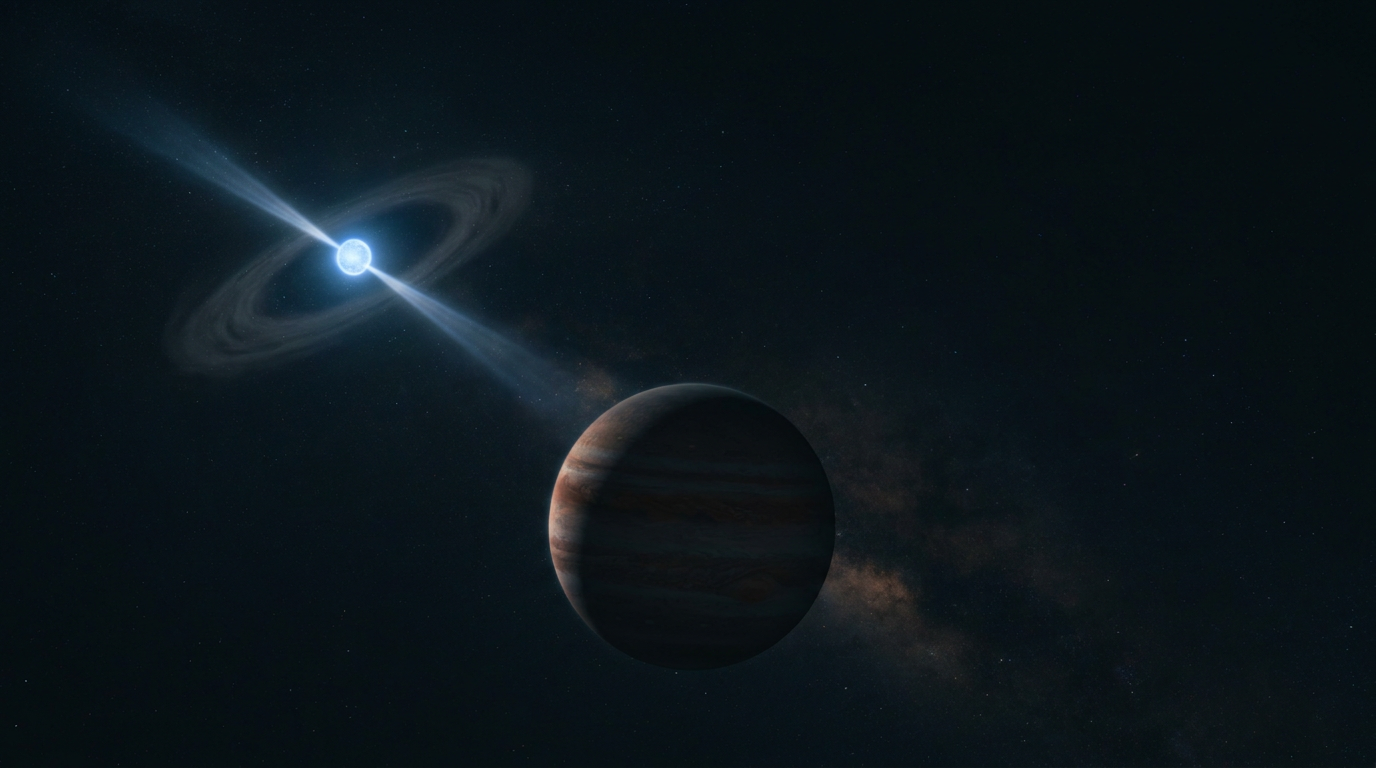
JWST Found a Planet That Shouldn't Exist — Orbiting a Dead Star, Raining Diamonds
A Jupiter-mass planet orbiting a millisecond pulsar carries a helium-and-carbon atmosphere that no known formation pathway can produce — and the physics of what falls from its sky is stranger still.
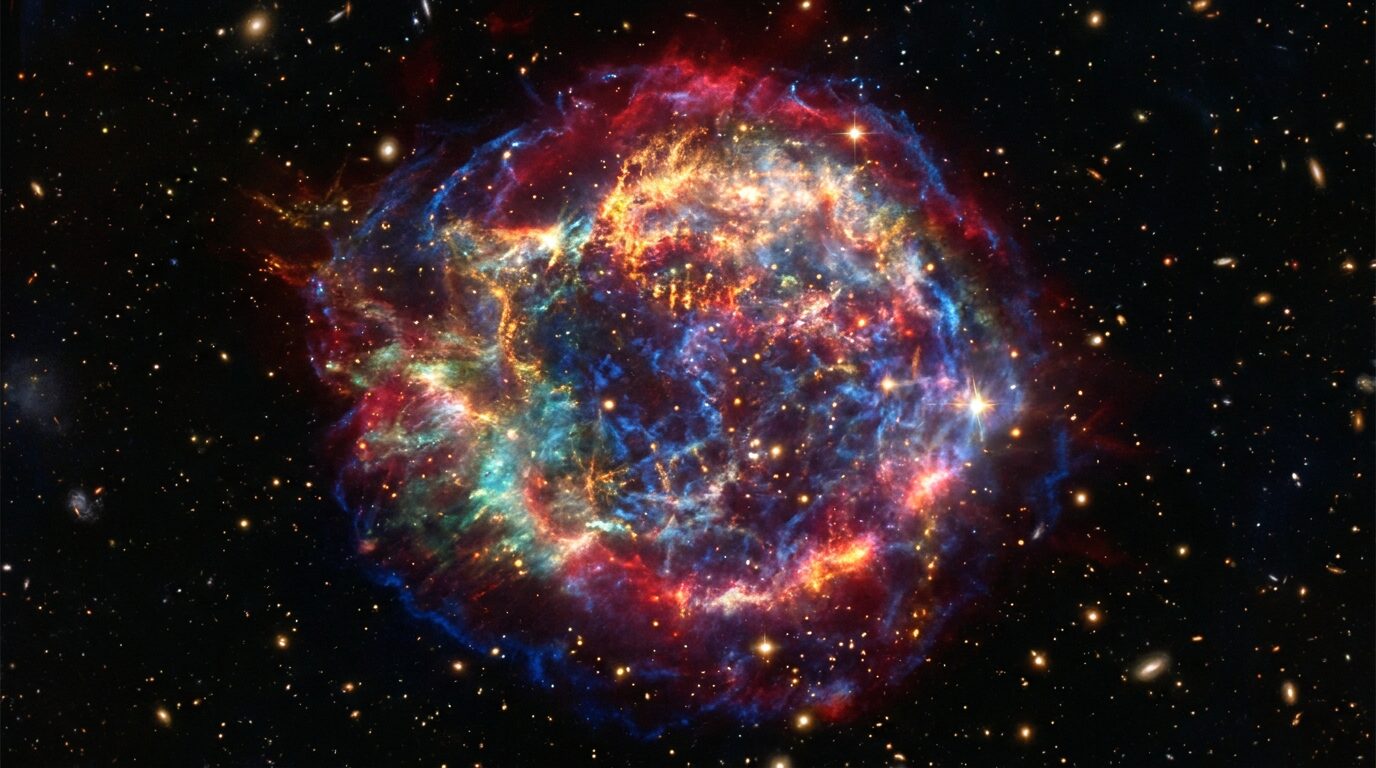
The Universe's Oldest Supernova Just Rewrote What Stars Could Do at Cosmic Dawn
JWST confirmed a supernova from when the universe was just 730 million years old — and its unsettling resemblance to modern explosions is forcing astronomers to rethink what the earliest stars were even supposed to be.
The Gamma-Ray Burst That Fired for 7 Hours Doesn't Fit Any Known Physics
GRB 250702B lasted nearly twice as long as any gamma-ray burst ever recorded, and the two leading explanations for it are mutually incompatible — which means at least one of them has to be wrong.