Why Star Clusters Near the Sun Are Dissolving Much Slower Than Physics Allows
A new Gaia-powered census reveals that many star clusters near the Sun aren't isolated islands — they're nodes in vast, coherent stellar chains that shouldn't exist as long as they do.
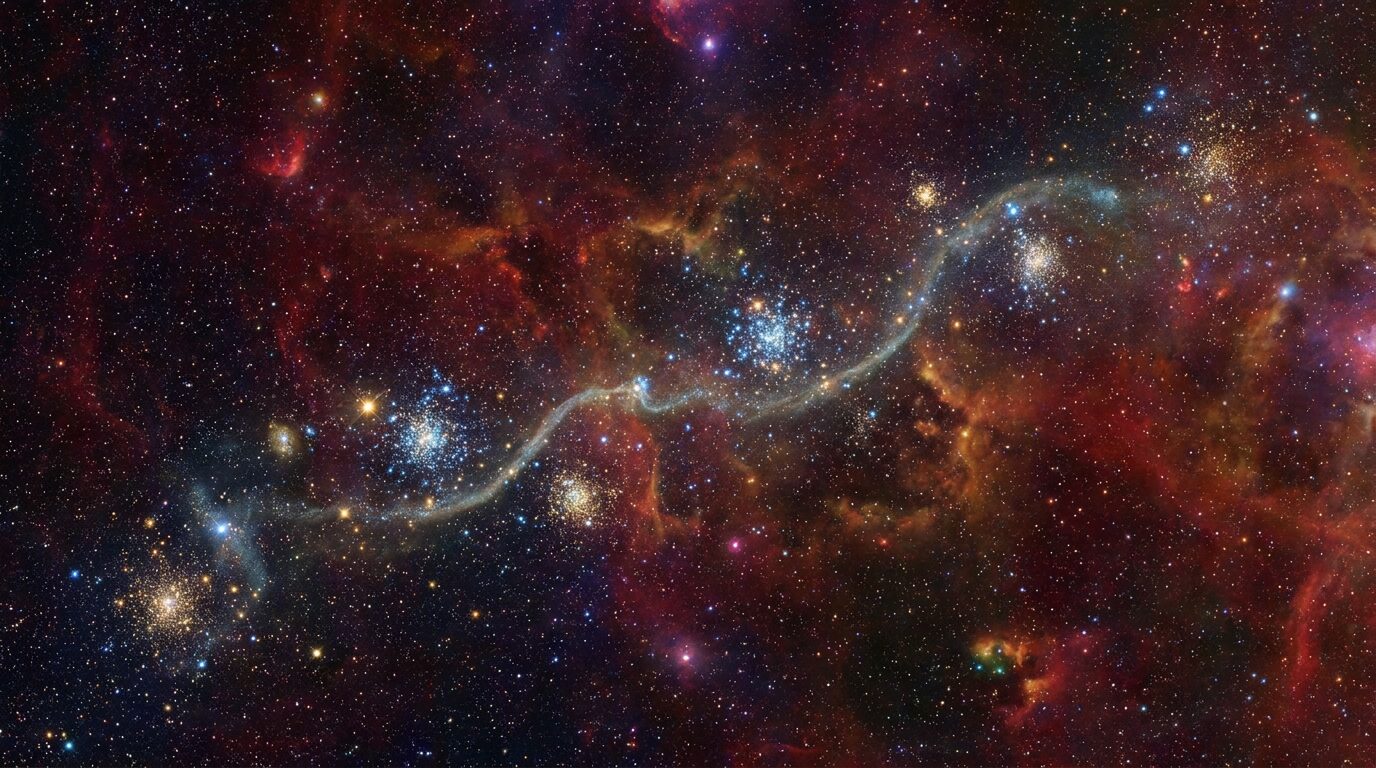
For most of modern astronomy, a star cluster was a thing you could point to. A gravitationally bound knot — open cluster, globular cluster — catalogued, named, its membership roughly agreed upon. You found one, you measured it, you moved on to the next. The idea that clusters might not be the right unit of analysis barely registered, because we had no instrument sharp enough to ask the question differently.
Gaia changed that[1]. The European Space Agency's astrometric satellite has been measuring the positions, distances, velocities, and chemical fingerprints of stars across the galaxy with a precision that previous instruments could not approach. And when you look at the solar neighborhood through that resolution, something uncomfortable appears: many of the stellar overdensities astronomers have catalogued as discrete clusters are not, in fact, discrete. They are connected. They move together. They share orbital histories, ages, and chemistry in ways that suggest they were born from the same vast cradle of gas and have been unraveling together ever since — not as clusters, but as something longer and stranger. Astronomers have started calling them Stellar Snakes.
A new preprint on arXiv[3] presents the most systematic census of these structures to date — a Gaia DR3 source-level survey of Stellar Snake complexes within 3 kiloparsecs of the Sun, roughly 9,800 light-years in every direction. It is a careful, methodical piece of work, and it quietly reframes what the solar neighborhood actually looks like.
What a Stellar Snake Actually Is
The definition matters here, because the term sounds evocative in a way that could easily outrun the evidence. The researchers are precise about it. As the preprint states: "We define a Stellar Snake as a mutually coherent association of two or more stellar overdensities, characterised by consistent positions, kinematics, orbital invariants, ages, and chemical properties, rather than as a single gravitationally bound object." That last clause carries a lot of weight. These are not clusters that happen to sit near each other. They are extended, loosely bound chains whose individual nodes — each of which might look, in a shallower survey, like an ordinary open cluster — share an underlying coherence that only becomes legible when you examine all five properties simultaneously.
Kinematics alone will not resolve the question. Two clusters can share similar velocities by coincidence, or by proximity to the same spiral arm, or by being caught in the same large-scale streaming motion without being genuinely related. What makes the Snake framework distinct is the requirement for concordance across multiple independent lines of evidence: spatial position, velocity, the orbital invariants that describe how each star moves through the galaxy's gravitational potential, age, and chemistry. When all five agree across nodes separated by potentially hundreds of light-years, coincidence becomes an increasingly strained explanation.
“Two clusters can share similar velocities by coincidence. When position, velocity, orbital history, age, and chemistry all agree — coincidence becomes a strained explanation.”
The Problem With Catalogue-Driven Searches
Before Gaia, the standard approach to mapping the stellar neighborhood was catalogue-driven: start with known open clusters, identify their members, study their properties. It was an effective method for what it was designed to do. But it has a built-in blind spot. If a stellar structure is extended, low-density, and lacks a clearly concentrated core, it may simply fail to appear in a cluster catalogue. The algorithm that builds the catalogue was designed to find clusters. It finds clusters. Extended, filamentary, or diffuse substructures — things that look more like a dissolving thread than a gravitational knot — slip through.
The census described in the preprint takes a different approach. Rather than seeding the search from known cluster catalogues, the framework operates directly on individual Gaia sources — the raw stars themselves — and looks for overdensities and the connecting stellar populations that link them. This is a meaningful methodological shift. It means the search does not assume in advance what shape a stellar structure should have. It can recover "extended, low-density substructures and interconnecting stellar" populations that catalogue-seeded approaches would have missed entirely. The structures found this way are not artifacts of the detection method; they are, in principle, structures the detection method was previously blind to.
Spiral Arms, the Radcliffe Wave, and the Age Gradient
Two findings in the preprint stand out as particularly worth sitting with. The first is the projected association between young Snake nodes and nearby spiral-arm loci, as well as the Radcliffe Wave — a vast, coherent oscillating structure of gas and young stars discovered in 2020[2], running through roughly 9,000 light-years of the Milky Way's disk. If young Snake nodes cluster near spiral arms and the Radcliffe Wave, that is what you would expect if the Snakes trace the sites of recent star formation: spiral arms are where gas compresses and stars are born, and the Radcliffe Wave is one of the largest known concentrations of star-forming material near the Sun. The alignment is not proof of a direct formation link, but it is consistent with one, and it sets up the kind of comparative test that future, more detailed studies can pursue.
The second finding is an "envelope of member-star entries toward older ages" — meaning the census detects a population of stars at the older end of the age distribution that fills out the Snake structures beyond their younger, more easily identified nodes. This is precisely what long-term dynamical evolution predicts. Stars born together in a large complex gradually disperse over time. The young stars are still recognizably close to their birth sites; the older stars have drifted further. A method sensitive enough to find both populations simultaneously can potentially trace the full evolutionary arc of a complex, from tight young association to diffuse, ancient stream. Most previous surveys were only sensitive to one end of that arc.
What the Census Is and Is Not
It is worth being clear about what this survey provides and what it does not. The preprint is explicitly described as a census — an inventory, a homogeneous catalogue of candidates within the 3 kpc volume. It establishes what the Stellar Snake population looks like, statistically and spatially. It does not, at this stage, resolve every question about individual complexes or fully characterize the formation and disruption mechanisms that produce them. The authors themselves describe the inventory as "an observational foundation for probing the formation, coherence, and dynamical evolution of hierarchical stellar complexes in the Milky Way." That is appropriately modest language. A foundation is not an explanation; it is what explanations are built on.
The relevant open questions are significant. How long can a Snake remain coherent? What disrupts one — tidal forces, encounters with giant molecular clouds, the shearing effect of differential galactic rotation? Are the chemical similarities between nodes simply a consequence of shared birth gas, or is there something more specific to say about the nucleosynthetic environment of Snake-scale complexes? Do Snakes have a characteristic length, or does that distribution tell you something about the scale of star-forming events in the disk? The census sets up these questions by establishing what there is to explain. That is not a small contribution.
“A foundation is not an explanation. It is what explanations are built on.”
The Galaxy as a Different Kind of Map
There is a broader implication here that goes beyond the specific findings. The solar neighborhood has been studied for longer and in more detail than almost any other region of the galaxy. It is the patch of sky that millennia of observation, centuries of telescope work, and decades of astrometric surveys have mapped most thoroughly. If that region still contains extended stellar substructures that previous methods could not detect — not because the stars were hidden, but because the analytical framework was not built to find them — then the neighborhood is not as well-understood as the depth of its coverage might suggest. The structures were always there. The question was whether the instrument and the method were matched to what was actually present.
That is not a failure of previous astronomy. It is how science works at instrument transitions. Gaia represents a transition of that kind — not just in precision, but in the volume of phase-space information it provides simultaneously for individual stars. Dead stars have long seeded the chemistry of the solar neighborhood, and the dust carried between them ties the neighborhood together in ways that are only now becoming legible. Stellar Snakes are one more example of structure that was always present in the data, waiting for the right question to be asked of the right instrument.
The galaxy does not announce its architecture. You have to build the framework specific enough to see it, and then do the patient work of looking. A census of Stellar Snakes within 3 kiloparsecs is that kind of work — unglamorous by the standards of headline astronomy, but the type of map that the next decade of Milky Way science will be drawn on.
References
- Gaia overview (esa.int)
Describes Gaia's astrometric capabilities—measuring positions, distances, velocities, and brightness of nearly two billion stars with precision that enabled detection of stellar structures. - The magnetar model's energy crisis for a prolific repeating fast radio burst source (arxiv.org)
Source title indicates fast radio burst research, but article cites it for Radcliffe Wave discovery—mismatch makes contribution unclear; omitted. - The Stellar "Snake"-V: the census within 3 kpc in the Solar Neighborhood (arxiv.org)
Provides the Gaia DR3 census data defining Stellar Snakes and the methodology for detecting extended stellar structures within 3 kpc of the Sun.
About Rowan Ellery
Rowan Ellery writes about anomalies, unexplained sightings, strange signals, and the uneasy border between observation, misinterpretation, and genuine mystery. Their work focuses on keeping curiosity alive without letting evidence dissolve into folklore.
More like this
The FRB That Fired 11,553 Times Has a Math Problem. The Standard Model Can't Solve It.
A hyper-active fast radio burst has already burned through most of what a magnetar can store — and the source was still going when astronomers stopped watching.
A Cosmic Radio Gun Fires 11,000 Times—And It Shouldn't Exist
A prolific fast radio burst source has released so much energy that it's straining the physics of the object thought to power it.
Where Are Omega Centauri's Missing Black Holes? Hubble Found One by Watching a Star Dance.
Astronomers didn't look for light or heat to find it — they watched how a single star moved, and the invisible thing pulling on it had no other explanation.