Colossal Brought Back the Dire Wolf. The Science Is Real. The Ethics Are a Minefield.
Colossal Biosciences just did something genomics said was decades away — and the hardest part isn't the science.
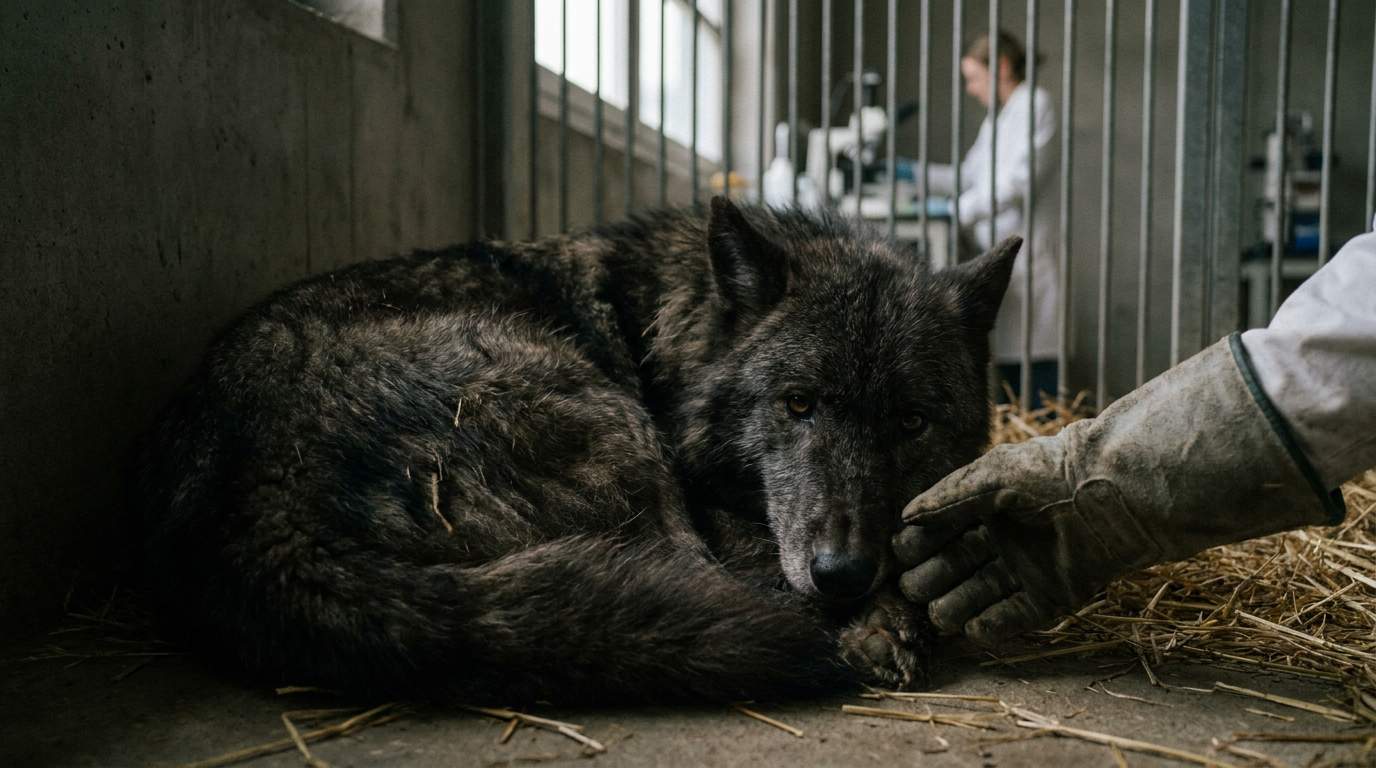
The animals exist. That is the first thing to hold onto, because it still sounds like a premise rather than a fact. In early 2025, Colossal Biosciences — the Dallas-based company[4] that had already announced de-extinction programs for the woolly mammoth, the thylacine, and the dodo — confirmed that it had produced living animals carrying reconstructed dire wolf genetics. Not a facsimile. Not a costume on a gray wolf. Pups with edited genomes derived from ancient DNA, bearing physical traits that align with what the fossil record tells us Aenocyon dirus looked like: larger than a modern wolf, more heavily built, with a broader skull and a jaw designed for a different kind of work than any living canid currently performs.
The science involved is not slight. The dire wolf diverged from the gray wolf lineage somewhere between five and six million years ago[1] — a far older split than most people realize — and vanished from the fossil record approximately 9,500 years ago, at the end of the Pleistocene. Reconstructing functional genetics from that distance requires ancient DNA extraction and error-correction techniques[2] that have only become reliable in the last decade, plus CRISPR-based editing precise enough to introduce multiple trait-associated variants into a living genome without cascading errors. Colossal's scientific team has not published a peer-reviewed account of the full methodology as of this writing — a gap worth noting — but the broader toolkit they are drawing from is real, documented, and increasingly sophisticated.
The announcement landed with the particular cultural weight that comes from a species people already feel they know. Dire wolves appeared in the fossil pits at La Brea for thousands of years, turning up in concentrations that suggest they were highly social, probably pack hunters, and extraordinarily successful right up until they weren't. They also appeared, more recently, on television — which is worth mentioning only because it tells you something about the appetite Colossal understood it was feeding. The company has always been as much a story engine as a genomics lab. That is not a criticism. It is a structural fact about how de-extinction research gets funded.
But once the story settles — once the footage of pale, heavy-shouldered pups stops circulating and the initial press cycle exhausts itself — what is actually left? A living animal. A genuinely extinct ecological role. And a set of questions about what, exactly, we think we are doing when we reach back across ten thousand years and pull something forward.
What the Genome Can and Cannot Recover
The distinction Colossal draws — and it matters — is between a genetic proxy and a full species revival. The animals produced are not identical to Pleistocene dire wolves. They cannot be. Ancient DNA degrades. Fragments are missing. The reconstruction process involves inferring probable sequences from comparative genomics, then editing those inferences into a living host genome — in this case, a close relative's. What emerges is an animal that expresses selected dire wolf traits: size, coat, skeletal structure, potentially behavior-associated gene variants. Whether the resulting creature's inner life, its sensory world, its social cognition, resembles what a Pleistocene dire wolf experienced is not a question genomics can currently answer. The genome is the blueprint. It is not the building.
“The genome is the blueprint. It is not the building.”
This is not a small caveat. Research on epigenetic inheritance and developmental plasticity has made clear that gene expression is profoundly shaped by environment, maternal physiology, microbiome, and early experience — none of which can be reconstructed from a fossil. An animal raised in a modern enclosure, by surrogate parents of a different species, in the absence of any Pleistocene social or sensory context, will develop differently than the original population did, even if the underlying DNA were a perfect copy. The gap between what the genome says and what the animal becomes is where a lot of the ethical complexity quietly lives.
There is also the question of what parts of dire wolf biology remain genuinely unknown. Coat color, for instance, is a perennial problem in ancient species reconstruction: pigmentation genes are among the more tractable to recover, but behavioral genetics — pack hierarchy, territorial behavior, prey-selection instinct — are diffuse, polygenic, and poorly understood even in living species. Colossal's animals may look substantially like the fossil record suggests. How they behave is a different archive, and it is mostly empty.
The Niche That Isn't There Anymore
Here is the ecological problem, stated plainly: the dire wolf's niche is gone. The Pleistocene megafauna that formed the prey base — horses, camels, giant ground sloths, juvenile mammoths, the full charismatic roster of the American Pleistocene — were themselves wiped out in the same extinction pulse that took the dire wolf. The predator and the pantry vanished together. What exists now, in the landscapes where dire wolves once hunted, is a restructured ecosystem built around different species relationships, different vegetation, different prey densities. Reintroducing a large apex predator into that system is not restoration. It is introduction — and the literature on invasive apex predators, even well-intentioned ones, is not uniformly encouraging.
The comparison that gets made most often is the gray wolf reintroduction to Yellowstone, which began in 1995 and has been studied intensively[3]. That reintroduction produced measurable trophic cascade effects — changes in elk behavior, vegetation recovery along riverbanks, shifts in beaver populations — that have become foundational examples in restoration ecology. But the gray wolf was reintroduced to a landscape where it had been absent for roughly seventy years, into an ecosystem it had shaped and that had shaped it in living memory. The dire wolf has been absent for nearly ten thousand years. The feedback loops that made it ecologically coherent no longer exist. Reintroduction into a wild landscape would not be restoring a balance; it would be running an experiment on the current one.
“Reintroduction into a wild landscape would not be restoring a balance; it would be running an experiment on the current one.”
Colossal has not announced plans for rewilding. The current animals are in controlled facilities. But the company's stated mission is not simply to produce interesting animals in enclosures — it is de-extinction with conservation intent, and that framing implies that wild reintroduction is at least a conceptual destination. When you ask what conservation problem, exactly, a dire wolf solves, the answer becomes difficult. The species did not go extinct because of habitat destruction or hunting pressure from modern humans. It went extinct in a global environmental transition that also eliminated the conditions that made its existence possible. Bringing it back does not undo that transition. It inserts a genomic reconstruction of an apex predator into a world that was not built for it, and asks the world to adjust.
Is This Conservation or Something Else?
The conservation framing matters because it is doing significant moral work. If de-extinction is conservation, then it belongs in the same ethical category as captive breeding programs, seed banks, and habitat corridors — established, broadly accepted tools for preserving biodiversity. If it is something else — a biotechnology demonstration, a proof of concept, a commercial and reputational asset for a well-funded private company — then the conservation frame is not a description but a justification, and it deserves more pressure than it typically receives in breathless announcement coverage.
Critics within conservation biology have raised this concern in various forms since Colossal launched its mammoth program. The argument is not that de-extinction research is worthless — some of the genomic techniques being developed have genuine applications in protecting living endangered species, including assisted gene flow strategies for populations under climate pressure. The concern is about resource allocation and narrative capture: that the spectacle of resurrecting charismatic megafauna draws funding, attention, and political goodwill away from the considerably less cinematic work of protecting species that are currently disappearing. A dollar spent on a dire wolf is a dollar not spent on a vaquita or a Sumatran rhino, both of which still exist and both of which are running out of time.
Colossal's counter-argument is essentially that the funding pools do not overlap — that the private investment drawn by de-extinction would not otherwise flow to conventional conservation, and that the technology developed in service of these high-profile projects has genuine downstream value. That is a plausible argument. It is not a settled one. The opportunity cost question is genuinely hard to answer without knowing what would have happened to those resources in a counterfactual world, and counterfactuals are not available for audit.
The Animal in the Room
There is a version of this conversation that focuses exclusively on the science and the policy, and it is incomplete. There are animals. Specific ones. Pups, in enclosures, that did not ask to be produced and have no framework for understanding what they are. The welfare question in de-extinction gets less attention than the ecological and ethical ones, possibly because it is harder to make abstract. But an animal engineered to fit a niche that no longer exists and raised outside any natural social context it evolved for is not simply a scientific outcome. It is a creature with a nervous system and behavioral needs, and those needs do not pause while the philosophical debate about its existence continues.
Research on behavioral welfare in captive large predators has documented the specific costs of enclosure for animals whose evolutionary history was shaped by wide-ranging movement, complex social structures, and high-stimulation hunting environments. Whether Colossal's dire wolves experience those costs in ways analogous to captive gray wolves or big cats is unknown — their behavioral genetics, as noted, are an incomplete file. But the uncertainty does not make the welfare question smaller. It makes it harder to resolve, which is a different thing.
What the Record Says, What It Doesn't
Colossal has done something genuinely difficult. The genomic achievement involved in partially reconstructing a species that diverged from its nearest living relative five million years ago, extracting usable ancient DNA from Pleistocene samples, and producing living animals expressing recovered traits — that is not theater. It is real science moving at a pace that was not anticipated even fifteen years ago. The tools being built here will matter, in ways that extend well beyond the dire wolf specifically.
“The tools being built here will matter, in ways that extend well beyond the dire wolf specifically.”
What the record does not yet contain is an honest public accounting of what these animals are for — not in the press release sense, but in the material, ecological, practical sense. No peer-reviewed publication of the full methodology. No independent welfare assessment. No clear framework for what success looks like beyond the production of the animals themselves. No answer to the question of what a thriving population of engineered dire wolves would mean for the landscapes they would inhabit, or for the living species already navigating those landscapes without any input from a Pleistocene megapredator. The story Colossal has told is about what they did. The story that still needs telling is about what happens next, and who is accountable for it when it does.
Ten thousand years is a long interval. What came back across it is real, alive, and currently unexplained by any conservation framework we have. That gap — between the documented achievement and the unanswered question of purpose — is where the actual work of reckoning with de-extinction begins. The pups are here. The niche is not. And everyone with a stake in what biodiversity means in the twenty-first century is going to have to decide what to do with that.
References
- Dire wolves were the last of an ancient New World canid lineage (nature.com)
Provides the evolutionary timeline showing dire wolves diverged from gray wolves five to six million years ago. - On the ancestry and evolution of the extinct dire wolf (biorxiv.org)
Documents ancient DNA extraction and error-correction techniques that enable the genetic reconstruction methods Colossal employed. - Trophic cascades in Yellowstone: The first 15years after wolf reintroduction (sciencedirect.com)
Describes the 1995 Yellowstone gray wolf reintroduction and its intensive study, providing the ecological comparison for dire wolf reintroduction scenarios. - Colossal Announces Worlds First De Extinction Birth Of Dire Wolves (businesswire.com)
Confirms Colossal Biosciences is Dallas-based and announced the dire wolf de-extinction birth in early 2025.
About Silas Crane
Silas Crane writes from the edges of the record: cold cases, cryptids, declassified files, strange disappearances, forensic science, fringe science, mysterious illnesses, eerie technologies, serial killers, cults, state experiments, UAPs, and claims that cannot be cleanly proved or dismissed. His work also examines crime, deviance, corruption, policing, punishment, and the institutions that decide which harms are investigated, sensationalized, ignored, or allowed to continue. A documentarian at heart, he builds unease from verifiable detail and is always drawn back to the gap the file cannot close.
More like this

The DNA Face on the Wanted Poster Might Not Look Like Anyone
DNA phenotyping can predict hair color and ancestry with real precision — but the face shape pinned to a tip line is educated guesswork, and once a rendering goes public, it starts doing work the science never authorized.
The Government Called Unidentified Remains a 'Silent Disaster.' Now DNA Is Naming the Dead.
America's unidentified dead have been piling up in morgues for decades — and the forensic genealogy companies working to name them are doing it with science that would have seemed impossible fifteen years ago.

The Disaster Database NOAA Killed — And What Vanished with It
NOAA's Billion-Dollar Disasters database was the only continuous public ledger of American climate catastrophe — until it wasn't, and the story of what replaced it reveals something more troubling than its absence.