A Caterpillar That Wears Its Victims' Bones Was Just Discovered. It Rewrites Insect Predation.
A newly discovered caterpillar doesn't just kill — it collects the remains and wears them as armor, revealing an evolutionary trick that entomologists hadn't imagined possible in this lineage.
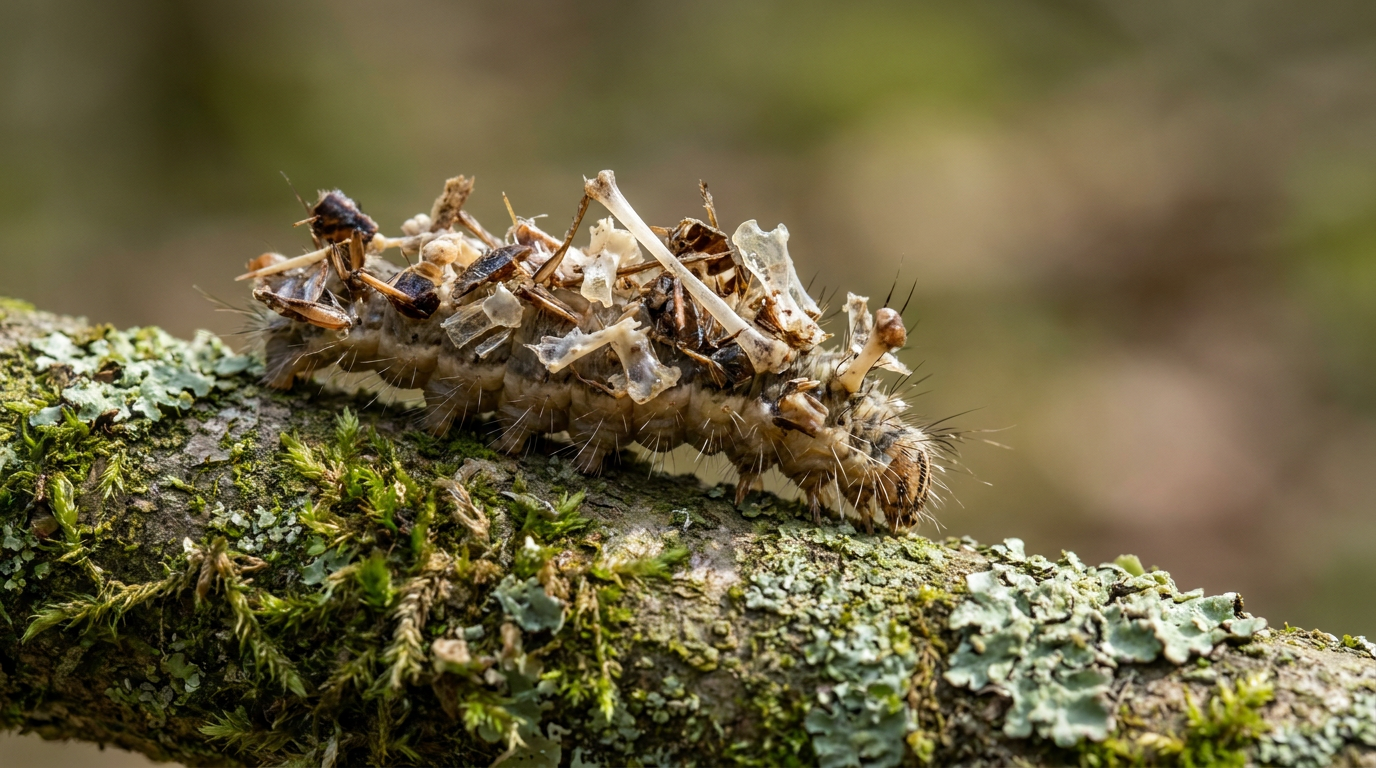
Start with what you know about caterpillars: they eat leaves. They are soft, slow, and emphatically not scary. They inch along stems, chewing through plant tissue with mandibles designed for cellulose and not much else. This is the caterpillar as most of the world has always understood it — a larval phase in a butterfly's or moth's life history, a machine for converting vegetation into wings. That understanding is correct for the overwhelming majority of the roughly 180,000 known species in the order Lepidoptera. It is profoundly incorrect for a small and quietly astonishing minority.
Fewer than 0.1% of lepidopteran species are carnivorous in any meaningful sense. That is not a rounding error — it is a genuine biological rarity, a lineage almost entirely committed to plant matter producing, in scattered pockets, larvae that have crossed into predation. Researchers studying Hawaiian ecosystems first documented some of these meat-eating caterpillars in the genus Eupithecia[2] decades ago, ambush predators that strike at flies with the speed of a mantis. But a newly identified species, documented in 2025, has introduced a behavior so unexpected that it is making entomologists reconsider what they thought they understood about how predatory insects hide themselves.
This caterpillar hunts. And then it wears what is left over. Specifically, it takes skeletal or chitinous parts from the bodies of its insect prey — fragments of exoskeleton, wing components, dry structural remains — and attaches them to its own body, constructing a kind of mobile trophy display that doubles as active camouflage. It is not accidental accumulation, the way debris sometimes clings to sticky surfaces. The behavior is deliberate enough, and consistent enough across individuals, that researchers are treating it as a genuine evolved trait: predation followed by collection followed by disguise, all running as a single behavioral loop.
The instinct is to call it gruesome, and it is a little gruesome. But underneath that reaction, the mechanism is genuinely remarkable — not just as a curiosity, but as evidence that certain evolutionary pressures can push very distantly related organisms toward similar solutions. A caterpillar that wears bones is an extreme example of something biologists call debris-carrying, a behavior documented in other insects but never quite like this. To understand why it matters, you have to understand how rare and strange predatory caterpillars already are, and then how much stranger this particular adaptation makes them.
The Rarest Diet in the Insect World
Lepidoptera evolved as herbivores. The whole order is structured around it: mouthparts shaped for soft plant tissue, digestive chemistry tuned to handle cellulose and plant secondary compounds, larvae built for clinging to foliage in specific microhabitats. The transition to carnivory requires rerouting most of that, and it has happened independently only a handful of times across the order's evolutionary history. Where it has taken hold, the adaptations can be striking. Predatory caterpillars in the genus Eupithecia in Hawaii, studied extensively by entomologists interested in island adaptive radiation, have evolved a strike reflex — they hold their bodies rigid against a stem, mimicking a twig, and snap shut on passing flies with a speed that belies the soft, segmented body doing the catching.
The evolutionary logic behind the shift usually comes down to resource availability. Islands with limited plant diversity but abundant small arthropod prey can tip the cost-benefit analysis toward predation for larvae with the right baseline morphology and behavioral flexibility. Once a population starts supplementing plant diet with occasional prey, selection can amplify that tendency across generations — sharper strike timing, better sensory detection of movement, stronger grip. But the question of how a predatory caterpillar hides itself from its own predators while also ambushing prey is a separate problem, and it turns out to be a harder one than it looks.
“A caterpillar that hunts is already extraordinary. One that decorates itself with the remains of its kills is something biology hadn't quite prepared us to categorize.”
Most caterpillars, herbivorous ones included, rely on crypsis — blending into the plant surfaces they live on. Green coloration on green leaves, bark-colored bodies on bark, spiny textures that echo the spiny stems they occupy. The visual matching is often extraordinary, refined over evolutionary time by predators that could spot a mismatch from a meter away. But a carnivorous caterpillar faces a compounded problem: it needs to be invisible enough not to be eaten itself, while also looking natural enough that the insects it hunts don't flee before it can strike. Those two pressures don't always point toward the same solution. The bone-wearing species appears to have found one answer to both at once.
What Debris-Carrying Actually Does
Debris-carrying as a defensive strategy is well documented in other insect lineages. Lacewing larvae in the family Chrysopidae[3] are a canonical example: they pile the drained husks of their aphid prey onto hooked dorsal bristles, building a camouflage coat that makes them look like a random accumulation of debris on a leaf surface rather than a predator. Research on debris-carrying in lacewing larvae has shown that the disguise works specifically against predators that key on the visual signature of a known prey species — the lacewing disappears inside a costume made of its food. The strategy turns predation into concealment in a single stroke.
Assassin bugs in the genus Acanthaspis take this further, stacking ant carcasses on their backs in dense formations that function as both camouflage and chemical mimicry — ants use pheromone-based recognition, so a pile of dead ant bodies also smells like the colony rather than like a predator. Studies of Acanthaspis ant-stacking behavior[1] found that individuals stripped of their carcass coat were predated by jumping spiders at significantly higher rates, a clean experimental demonstration that the debris actually functions as defense rather than incidental accumulation. What is striking about these cases is that the behavior requires the insect to modify its own body surface in real time, responding to each kill by integrating the remains into a maintained disguise.
The caterpillar described in 2025 is doing something in this tradition, but in a lineage where no one had seen it before. Lepidoptera generally lack the structural hooks or adhesive pads that lacewing larvae use to attach debris. The mechanism by which this caterpillar affixes the skeletal remnants of its prey is part of what makes the discovery scientifically interesting — the attachment appears to involve silk[2], which caterpillars produce for other purposes (spinning cocoons, anchoring to surfaces), repurposed here as a kind of adhesive harness for collecting fragments. If confirmed, that represents a novel functional application of an existing biological system, which is precisely the kind of exaptation — a structure evolved for one purpose being co-opted for another — that evolutionary biologists find significant.
Silk Repurposed as Bone-Glue
“Silk was already one of the more versatile materials in the insect world — using it to stick the dead to the living is a genuinely new chapter.”
Caterpillar silk is not a simple substance. It is produced by modified salivary glands called spinnerets and is composed primarily of fibroin proteins arranged into strong, semi-flexible filaments. In most lepidopteran larvae, it serves a few clear purposes: constructing protective cases, anchoring the larva to a surface while it feeds, and eventually forming the cocoon or pupal case. Some silk is sticky; some is structural; different species tune the protein chemistry for different mechanical properties. The key point is that silk production in caterpillars is already a flexible, general-purpose biological tool. The evolutionary leap to using it for debris attachment is large behaviorally but not necessarily large mechanically — the raw material was already there.
What appears to differentiate this caterpillar's use of silk is the targeting behavior. The larva doesn't just spin silk incidentally and find things sticking to it. Observations suggest it actively applies silk to prey fragments after a kill, fixing them to its dorsal surface in a way that maintains the disguise as it moves. This kind of targeted manipulation — applying a material produced by your own body to an external object for a specific constructed purpose — is uncommon enough in insects that behavioral ecologists tend to sit up when they see it. It places this caterpillar in a very short list of insects that could be loosely described as building a tool onto themselves.
The visual result of this construction is a caterpillar that does not look much like a caterpillar. It looks like a small aggregation of insect debris, the kind of thing a spider might leave behind or wind might accumulate in a corner of bark. For a bird or a larger arthropod hunting by visual search image — a mental template of what a caterpillar looks like — the disguise should create genuine confusion. And for the small insects the caterpillar hunts, the appearance of inert debris is almost certainly less alarming than a predator's profile. The camouflage is doing double work.
Why This Rewrites More Than One Set of Rules
The headline discovery here is the behavior itself, but the deeper implication sits in what it says about evolutionary possibility within Lepidoptera. The order has been studied intensively for centuries — it is one of the most thoroughly catalogued groups of insects on Earth, partly because of its beauty, partly because of its agricultural relevance, and partly because of the sheer accessibility of butterflies and moths to amateur naturalists. The assumption that its larval forms were understood in broad strokes felt relatively safe. Discovering a carnivorous species is surprising. Discovering a carnivorous species that has independently evolved a debris-wearing strategy previously known only from unrelated lineages suggests that the pressures driving this solution are general enough to arise wherever the conditions are right.
That is the concept biologists call convergent evolution: unrelated lineages arriving at the same solution because the same problem shaped both. Research on convergent evolution in predatory insects shows repeatedly that certain adaptive strategies — ambush predation, chemical mimicry, structural camouflage — arise independently across wildly different taxonomic groups when similar ecological pressures apply. The bone-wearing caterpillar adds debris-carrying to that list for Lepidoptera specifically, which means the solution isn't tied to any particular ancestral toolkit. It can arise from whatever materials happen to be available: silk, in this case, where lacewings used hooks and assassin bugs apparently use something closer to stacking friction.
For entomologists, the practical consequence is a renewed warrant to look harder at what caterpillars are actually doing in the field rather than inferring it from taxonomy. The assumption that a lineage is herbivorous because its relatives are herbivorous is not a safe shortcut. Field surveys on unreported lepidopteran carnivory have periodically turned up new meat-eating species in places no one thought to look, precisely because the search image was wrong. If a predatory caterpillar is also wearing the evidence of its predation as a disguise, it may be actively harder to identify in the field as a caterpillar at all — which raises the uncomfortable possibility that there are more of these, undetected, in ecosystems where no one thought to look for a caterpillar-shaped pile of insect bones.
What the Bones Are Actually Hiding
“The camouflage works on two audiences at once — predators above and prey below — which is the kind of efficiency that only evolution stumbles into.”
There is something worth pausing on in the geometry of this strategy. The caterpillar's situation before the adaptation is genuinely difficult: it is a soft, slow-moving larva in a habitat where it both hunts and is hunted, and the two activities create opposing visibility demands. To hunt effectively, it needs to be ignored — not recognized as a predator by the small arthropods it strikes at. To survive, it needs to not look like a caterpillar to birds, spiders, and parasitoid wasps that would otherwise target it. A coat of prey remains addresses both simultaneously. It eliminates the caterpillar silhouette, it creates a visual texture that reads as debris or detritus rather than prey, and it probably contributes some chemical masking too — insect exoskeleton fragments carry their own scent profile, distinct from a living larva.
The chemical dimension is speculative at this stage — researchers have not yet published detailed olfactory analysis of the disguise — but it is a reasonable inference from what is known about insect sensory ecology. Many predators and parasitoids locate caterpillars partly through volatile chemical cues, particularly the compounds plants release when damaged by feeding larvae. A caterpillar that feeds on insects rather than plants would already be generating a different olfactory profile. One that is additionally coated in dry, aged exoskeleton fragments would be generating less of any recognizable larval signal. The disguise may go deeper than the visible.
The most unsettling version of this story is not the behavior itself — remarkable as it is — but the implication that the caterpillar has effectively solved a predator-prey problem by building its solution out of the problem itself. Every kill becomes both nutrition and armor. The prey is consumed and then repurposed as concealment for the next hunt. It is a closed loop of predatory efficiency that the caterpillar does not have to consciously engineer; the behavior, once established in a lineage, runs on instinct, and natural selection handles the rest. The result is an animal that looks like nothing alive, because the living parts are carefully hidden inside a jacket made of the dead. That is not gruesome so much as it is elegant, in the way that evolution is often elegant — not because it is tidy, but because it is ruthlessly, exactly sufficient for what it needs to do.
References
- Bugs with backpacks deter vision‐guided predation by jumping spiders (zslpublications.onlinelibrary.wiley.com)
Provides experimental evidence that Acanthaspis assassin bugs stripped of carcass coats face higher predation rates, demonstrating debris-carrying functions as genuine defense. - Hawaiian caterpillar patrols spiderwebs camouflaged in insect prey’s body parts (science.org)
Documents Hawaiian Eupithecia caterpillars as predatory ambush hunters that strike at flies with mantis-like speed. - Chrysopidae (en.wikipedia.org)
Identifies lacewing larvae as a canonical example of debris-carrying insects that pile prey husks onto dorsal bristles for camouflage.
About Aris Thorne
Aris Thorne is a microbiologist who writes about the hidden mechanics of ordinary life: the microbes running your home, the chemistry unfolding in food and water, the physics built into familiar objects, and the biological systems quietly keeping the human body alive. His work follows science from kitchens, bathrooms, dust, soil, and city air into wounds, immune responses, infections, medicines, cells, and other worlds. He is most interested in the moment something familiar stops looking simple and reveals the living machinery underneath.
More like this
The Insects Are Vanishing Even Where We Didn't Touch Anything
A two-decade study in the Colorado Rockies found insect populations collapsing in pristine wilderness — and the culprit has nothing to do with pesticides, habitat loss, or human footprint.
Nature's Nesting Doll of Infection Goes Three Layers Deep in Borneo
Scientists just found a new fungus in Borneo that doesn't bother hijacking ant brains — it just feeds on the fungus that's already doing it.
The Forest Still Looks Green. That's the Problem.
Research on Southwest US woodlands reveals that trees can lose the hydraulic and carbon reserves that keep them alive long before their canopy shows a single yellow leaf — meaning the forests we think we're watching die may already be past saving.