The Disaster Database NOAA Killed — And What Vanished with It
NOAA's Billion-Dollar Disasters database was the only continuous public ledger of American climate catastrophe — until it wasn't, and the story of what replaced it reveals something more troubling than its absence.
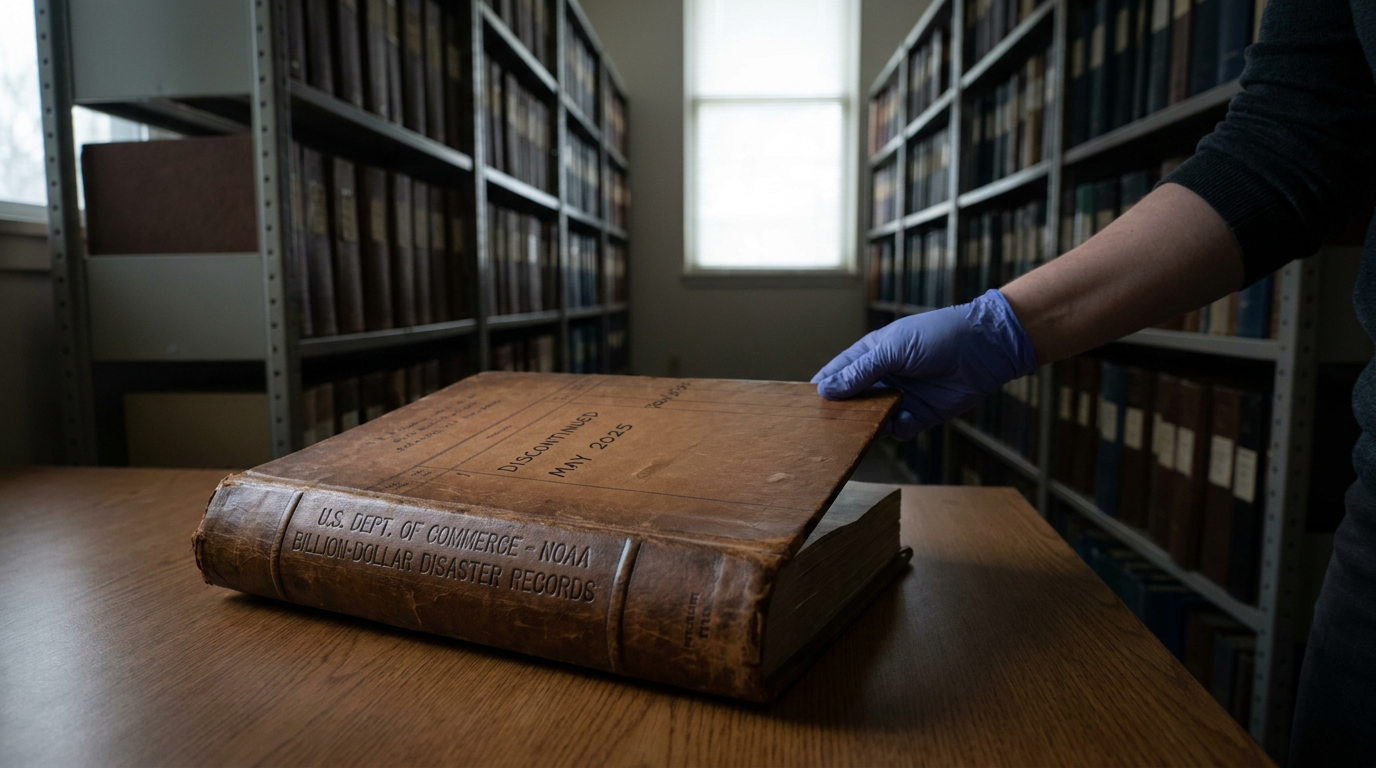
On a Tuesday in May 2025, with no press conference and no formal announcement in the Federal Register, the National Oceanic and Atmospheric Administration removed its Billion-Dollar Weather and Climate Disasters database from active maintenance[2]. The page remained technically visible. The older records sat where they had always sat. But the updates stopped. Forty-five years of continuous, federally maintained catastrophe accounting — tornadoes, floods, droughts, wildfires, winter storms, tropical cyclones, and the slow damage events that don't make television but still hollow out counties — halted at a line item. The ledger closed mid-page.
The database had been running since 1980. It tracked every U.S. weather and climate disaster that crossed a billion dollars in damage, adjusted for inflation, and it did so with a consistent methodology that let researchers, insurers, emergency managers, and municipal planners compare 1988's drought to 2012's drought to last year's drought without having to translate between different counting systems. Consistency is the thing. One methodology, one threshold, one federal keeper, forty-five years of unbroken record. That kind of continuity is almost impossible to rebuild once it is interrupted. The gap it leaves is not a gap in memory. It is a gap in the ability to measure change.
The shutdown arrived inside a broader federal contraction — budget constraints, executive reorganization, the systematic narrowing of what counts as a government function. NOAA, under significant pressure from the Office of Management and Budget, had already absorbed reductions to staffing and programs in the months prior. The database was framed, to the extent it was framed at all, as a redundancy. Other sources exist, officials noted. Private sector analytics have improved. The implication was that the market could cover the gap. That framing deserves to be taken seriously, and then looked at very carefully.
Because the market did step in. Quickly, in some cases. And the story of who now holds the numbers that NOAA used to publish, and under what terms, and for what purposes, is the part that does not resolve neatly.
What the Database Actually Was
The Billion-Dollar Disasters database was not a dramatic document. It was a table. Rows of events, columns of dates, death counts, cost estimates, event types, and geographic footprints. Each entry cross-referenced against insurance claims, FEMA disbursements, agricultural loss reports, Army Corps of Engineers damage assessments, and dozens of other federal sources. The methodology was public, updated periodically, and available to anyone who wanted to audit the counting. Federal researchers used it to model future risk. State emergency management offices used it to justify infrastructure spending. Academic climate scientists used it as a baseline for attribution studies — the branch of climate science that asks, with statistical precision, how much more likely a given event was made by background warming[4]. Insurers used it as a check against their own proprietary loss models. It was not glamorous work. It was the kind of work that holds the more visible work together.
Since 1980, the database had recorded over 380 separate billion-dollar events[3] in the United States. The pace of those events has accelerated visibly. In the 1980s, the U.S. averaged roughly three per year[1]. By the late 2010s, that figure had climbed past eighteen. The costliest five-year period in the database's history was its last five. Whether you attribute that trend primarily to climate change, to population growth in vulnerable coastal and wildland areas, to the rising monetary value of built infrastructure, or to some combination of all three — a legitimate scientific debate with strong evidence on multiple fronts — you need the long baseline to have the argument at all. Remove the baseline, and the argument gets harder to ground. That may or may not be the point. The database did not say.
“Consistency is the thing — one methodology, one threshold, one keeper, forty-five years of unbroken record. That kind of continuity is almost impossible to rebuild once it is interrupted.”
The Methodology Problem Nobody Is Talking About
Several organizations moved to fill the void almost immediately after the shutdown became apparent. The most prominent among them are private catastrophe modeling firms — companies like Verisk's AIR Worldwide, Moody's RMS, and Karen Clark and Company, all of which maintain proprietary disaster loss databases that predate NOAA's shutdown and are, by some measures, more technically sophisticated. These firms use satellite imagery, real-time claims data, probabilistic modeling, and machine learning to estimate disaster losses faster and at finer geographic resolution than NOAA's retrospective accounting ever could. On the surface, the upgrade argument is coherent.
The problem is access. NOAA's database was public infrastructure. You could download the entire dataset, scrutinize the methodology, publish criticisms, replicate the numbers, and argue about the counting rules in a journal. The private models are not built like that. They are commercial products, licensed at rates that academic researchers, small municipalities, and nonprofit advocacy organizations cannot easily afford. The output that gets released publicly is typically a summary figure, a press release number, a top-line loss estimate with the underlying assumptions sealed inside a product that costs money to see. The data still exists. The public's ability to verify it, audit it, or argue with it does not.
There is also the question of what private catastrophe models are optimized to count. Insurance industry loss models are designed to capture insured losses — the portion of a disaster's damage covered by policies. Uninsured losses, which consistently run higher in lower-income communities and rural areas, are structurally undercounted in models built around claims data. NOAA's methodology attempted to capture total economic loss, including uninsured damage, using a broader set of federal sources. The difference is not academic. In some events, uninsured losses represent the majority of economic harm. Shifting from a total-loss framework to an insured-loss framework does not just change the numbers. It changes which damage is made visible and whose communities appear in the record.
“The data still exists. The public's ability to verify it, audit it, or argue with it does not.”
The Non-Profits Scrambling to Hold the Line
On the non-commercial side, several research institutions and climate-focused nonprofits announced efforts to maintain disaster tracking in the gap left by NOAA. The most visible early effort came from researchers affiliated with university climate centers and organizations like the Rocky Mountain Institute and Resources for the Future, who began coordinating on a provisional public tracking framework within weeks of the shutdown. The intent is explicitly to preserve methodological continuity with the NOAA dataset — to use the same inflation adjustment approach, the same billion-dollar threshold, the same broad damage categories — so that the long historical record does not become stranded from any new data collected going forward.
Whether those efforts can sustain themselves is a different question. Federal databases do not run on good intentions and grant cycles. NOAA's operation was underpinned by dedicated staffing, interagency data-sharing agreements, and institutional memory accumulated over decades. A university consortium working on foundation funding, even a well-resourced one, faces inherent fragility. Grants expire. Principal investigators move. Methodologies drift as teams turn over. The NOAA database persisted through administration changes, budget fights, and reorganizations precisely because it was bureaucratically embedded. Rebuilding that kind of durability outside the federal structure is genuinely hard, and the people trying to do it mostly say so directly when asked.
What a Gap in the Record Actually Looks Like
It is worth being precise about what the shutdown does and does not mean in practical terms over the near horizon. In the immediate term, the existing NOAA archive remains accessible — the historical data through early 2025 is still there, still downloadable, still usable as a baseline. The loss is not retroactive. What is lost is the forward thread: the ability to extend that specific baseline forward in time using the same methodology and the same federal sourcing. Every year the gap widens, the historical record becomes more difficult to connect to current events without methodological translation work that introduces its own uncertainties.
Emergency managers feel this concretely. A county in Alabama planning flood mitigation investments might compare its current loss trajectory against what the NOAA record showed for comparable counties over the prior two decades. That comparison has a specific value because the same instrument made all the measurements. If the forward data now comes from a different source, with a different counting methodology and different baseline assumptions, the comparison becomes approximate in ways that compound over time. Risk models built on mixed-methodology baselines produce wider error bars. Wider error bars produce more conservative, more expensive, or more politically contested policy decisions. The scientific fog that results from a data gap is rarely dramatic. It is slow and it is costly.
There is also a signal-detection problem. One of the most important uses of the long disaster record is identifying when a region or a disaster type begins behaving differently — when tornado alley expands eastward, when the Atlantic hurricane season lengthens, when inland flooding events start clustering in a geography that had not historically seen them at that rate. Those detections depend on comparing a long stable baseline against recent counts using consistent definitions. Introduce a methodological break and you have to spend the first several years of any new dataset establishing whether you are seeing a real signal or a counting artifact. That lag is time the science cannot get back.
“The scientific fog that results from a data gap is rarely dramatic. It is slow, and it is costly.”
The Document That Did Not Explain Itself
What is frustrating about the shutdown, and what makes it feel like something worth watching carefully rather than simply mourning and moving on, is the quality of the public record surrounding the decision. There is very little of it. NOAA did not publish an impact assessment before the cut. There was no public comment period, no scientific advisory board recommendation, no formal transition plan released to researchers who depended on the data. The shutdown entered the record the way a lot of consequential decisions enter it: through the absence of a thing that had previously been there, noticed first by the users who went looking for the update and found the page had gone quiet.
That absence of process is its own kind of document. It does not tell you the intent was malicious. It does not tell you the decision-makers understood what they were discontinuing. It does not tell you this was a deliberate move to obscure climate accountability rather than a blunt budget cut applied without enough domain expertise to recognize what was being cut. All of those remain possible. None of them are documented in the way that would let you say which one is true. What is documented is the outcome: a forty-five-year instrument is no longer being operated by the people who built and calibrated it, and the replacements that exist serve different masters, answer to different incentive structures, and are not equally available to the public that paid for the original.
The data will keep existing somewhere. Catastrophe firms will keep modeling losses. Researchers will keep trying to patch together a coherent record. The disasters themselves will certainly keep arriving. What is harder to replace is the specific thing the NOAA database represented: a public instrument, maintained without a profit motive, accountable to external scrutiny, continuous across political administrations, and aimed at the whole picture of harm rather than the insured fraction of it. That instrument is now gone. What stands in its place is a patchwork of private products and underfunded civic efforts, each measuring something real, none measuring quite the same thing, and the gap between them is where the argument about what this country's disasters actually cost us will increasingly have to be held.
References
- 2022 U.S. billion-dollar weather and climate disasters in historical context (climate.gov)
Provides historical data showing U.S. billion-dollar disaster frequency increased from roughly three per year in the 1980s. - Billion Dollar Weather and Climate Disasters (nesdis.noaa.gov)
Official NOAA notice confirming the Billion Dollar Weather and Climate Disasters product retirement effective after calendar year 2024. - Billion-Dollar Weather and Climate Disasters (ncei.noaa.gov)
Source for the article's claim that the NOAA database recorded over 380 separate billion-dollar events since 1980. - Extreme event attribution: the climate versus weather blame game (climate.gov)
Explains extreme event attribution science that researchers use the disaster database to conduct with statistical precision.
About Silas Crane
Silas Crane writes from the edges of the record: cold cases, cryptids, declassified files, strange disappearances, forensic science, fringe science, mysterious illnesses, eerie technologies, serial killers, cults, state experiments, UAPs, and claims that cannot be cleanly proved or dismissed. His work also examines crime, deviance, corruption, policing, punishment, and the institutions that decide which harms are investigated, sensationalized, ignored, or allowed to continue. A documentarian at heart, he builds unease from verifiable detail and is always drawn back to the gap the file cannot close.
More like this
When Forecasters Lose Their Tools: How Budget Cuts Are Colliding with Record Hurricanes
The Trump administration cut hundreds of the people who warn you about killer storms — right as scientists project the hottest, most extreme years in recorded history are almost certainly ahead.
Scientists Measured How Much Extra Heat the Ocean Holds. Then They Had to Find a Comparison Big Enough.
A new study put a number on the ocean's heat surplus that makes annual energy statistics look like pocket change — and the rate is still climbing.

Your Productivity Score Is Real. The Productivity It Measures Isn't.
A new wave of AI scoring tools doesn't just watch workers — it quietly rewrites what counts as good work, and the rewrite favors employers in ways most workers never see coming.